

SUBSCRIBE TO OUR FREE NEWSLETTER
Daily news & progressive opinion—funded by the people, not the corporations—delivered straight to your inbox.
5
#000000
#FFFFFF
To donate by check, phone, or other method, see our More Ways to Give page.
Daily news & progressive opinion—funded by the people, not the corporations—delivered straight to your inbox.
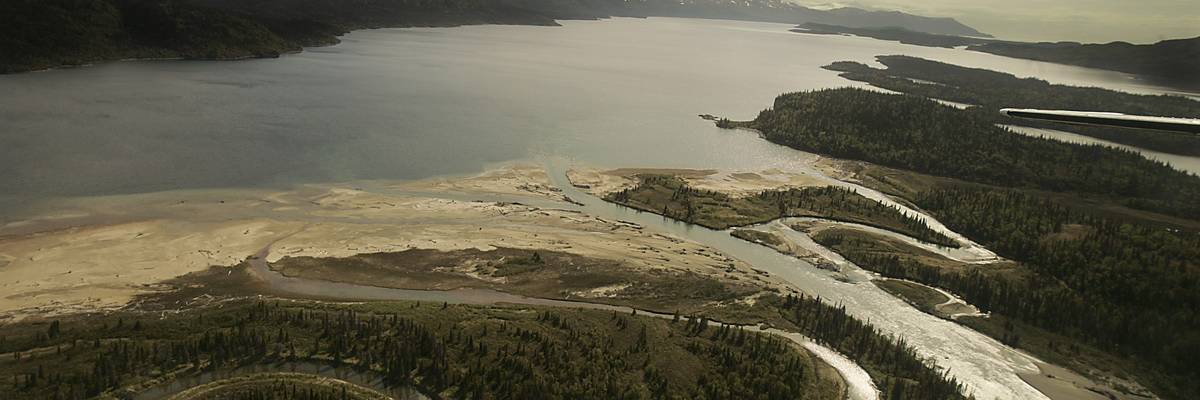
The Pile River flows into the northern end of Lake Iliamna, whose tributaries are the headwaters of the Bristol Bay region, on
One coalition described the Republican attorney general's lawsuit as "little more than a publicity stunt filed on behalf of an unscrupulous mining company."
The state of Alaska on Wednesday bypassed the lower courts and directly asked the U.S. Supreme Court to undo the Environmental Protection Agency's decision earlier this year to prohibit the construction of Pebble Mine, a proposed copper and gold project that conservationists say would be disastrous for Bristol Bay waters, wildlife, and communities.
Alaska Attorney General Treg Taylor's 91-page filing, which argues that the EPA's rare use of its veto authority under the Clean Water Act was unlawful, drew immediate outrage from environmentalists, who accused the state of prioritizing the interests of profit-seeking mine developers.
"As the climate catastrophe wreaks havoc around the world, it's disheartening to see the governor turn his back on the irreplaceable ecosystem of Alaska's Bristol Bay," said Marc Fink, a senior attorney at the Center for Biological Diversity. "A remarkable array of wildlife depends on this watershed, from salmon and grizzly bears to the rare Iliamna Lake seals. Mining has no place here."
The Bristol Bay Defense Fund—a coalition of tribes, commercial and sport fishers, and conservation groups—argued that Alaska's lawsuit is "legally and factually unjustified" and "little more than a publicity stunt filed on behalf of an unscrupulous mining company, Pebble Limited Partnership, that has repeatedly misrepresented its record and misled regulators, its investors, Congress, and the general public."
"The EPA's authority to protect Bristol Bay under the Clean Water Act stands on an extensive and robust scientific and technical record that spans two decades and three presidential administrations," the coalition added. "Alaskans and people across the country overwhelmingly support EPA's action to protect Bristol Bay, and do not support the Pebble Mine. We will continue to defend Bristol Bay against the threat of the Pebble Mine and the state's legal antics as long as necessary to ensure that the region, tribes, salmon, and clean water resources are protected forever."
"The governor and his administration are working against the wishes of most Alaskans, especially Bristol Bay residents."
First proposed in 2001 by Vancouver-based Northern Dynasty Minerals, the project would include an open-pit mine at a depth of roughly 1,500 feet as well as a lengthy gas pipeline and other infrastructure.
After years of review, the EPA issued a final determination in late January restricting mining in a 309-square-mile area of state land surrounding the Pebble deposit, effectively killing the proposed mine.
The agency warned that, if completed, the project would have resulted in "large-scale loss of, and damage to, headwater streams, wetlands, and other aquatic resources that support salmon populations."
"Discharges of dredged or fill material to construct and operate the proposed mine site alone would result in the permanent loss of approximately 8.5 miles (13.7 km) of anadromous fish streams, 91 miles (147 km) of additional streams that support anadromous fish streams, and approximately 2,108 acres (8.5 km2) of wetlands and other waters," the EPA said.
In response to the EPA's decision, which environmentalists celebrated as a hard-fought victory, the state of Alaska is petitioning the Supreme Court with the help of Virginia-based private law firm Consovoy McCarthy, which represented the group behind a recently decided affirmative action case.
The firm also represented a pair of individual plaintiffs who sued the Biden administration over its student debt cancellation plan.
Alaska's case could find a receptive audience in the conservative-dominated U.S. Supreme Court, which weakened the Clean Water Act in a May ruling.
Carole Holley, managing attorney at Earthjustice's Alaska regional office, said Alaska's decision to take its case directly to the Supreme Court is "a highly unusual legal move, and also a highly unpopular one."
"The governor and his administration are working against the wishes of most Alaskans, especially Bristol Bay residents, by continuing to side with the mine developer," said Holley.
Dear Common Dreams reader, It’s been nearly 30 years since I co-founded Common Dreams with my late wife, Lina Newhouser. We had the radical notion that journalism should serve the public good, not corporate profits. It was clear to us from the outset what it would take to build such a project. No paid advertisements. No corporate sponsors. No millionaire publisher telling us what to think or do. Many people said we wouldn't last a year, but we proved those doubters wrong. Together with a tremendous team of journalists and dedicated staff, we built an independent media outlet free from the constraints of profits and corporate control. Our mission has always been simple: To inform. To inspire. To ignite change for the common good. Building Common Dreams was not easy. Our survival was never guaranteed. When you take on the most powerful forces—Wall Street greed, fossil fuel industry destruction, Big Tech lobbyists, and uber-rich oligarchs who have spent billions upon billions rigging the economy and democracy in their favor—the only bulwark you have is supporters who believe in your work. But here’s the urgent message from me today. It's never been this bad out there. And it's never been this hard to keep us going. At the very moment Common Dreams is most needed, the threats we face are intensifying. We need your support now more than ever. We don't accept corporate advertising and never will. We don't have a paywall because we don't think people should be blocked from critical news based on their ability to pay. Everything we do is funded by the donations of readers like you. When everyone does the little they can afford, we are strong. But if that support retreats or dries up, so do we. Will you donate now to make sure Common Dreams not only survives but thrives? —Craig Brown, Co-founder |
The state of Alaska on Wednesday bypassed the lower courts and directly asked the U.S. Supreme Court to undo the Environmental Protection Agency's decision earlier this year to prohibit the construction of Pebble Mine, a proposed copper and gold project that conservationists say would be disastrous for Bristol Bay waters, wildlife, and communities.
Alaska Attorney General Treg Taylor's 91-page filing, which argues that the EPA's rare use of its veto authority under the Clean Water Act was unlawful, drew immediate outrage from environmentalists, who accused the state of prioritizing the interests of profit-seeking mine developers.
"As the climate catastrophe wreaks havoc around the world, it's disheartening to see the governor turn his back on the irreplaceable ecosystem of Alaska's Bristol Bay," said Marc Fink, a senior attorney at the Center for Biological Diversity. "A remarkable array of wildlife depends on this watershed, from salmon and grizzly bears to the rare Iliamna Lake seals. Mining has no place here."
The Bristol Bay Defense Fund—a coalition of tribes, commercial and sport fishers, and conservation groups—argued that Alaska's lawsuit is "legally and factually unjustified" and "little more than a publicity stunt filed on behalf of an unscrupulous mining company, Pebble Limited Partnership, that has repeatedly misrepresented its record and misled regulators, its investors, Congress, and the general public."
"The EPA's authority to protect Bristol Bay under the Clean Water Act stands on an extensive and robust scientific and technical record that spans two decades and three presidential administrations," the coalition added. "Alaskans and people across the country overwhelmingly support EPA's action to protect Bristol Bay, and do not support the Pebble Mine. We will continue to defend Bristol Bay against the threat of the Pebble Mine and the state's legal antics as long as necessary to ensure that the region, tribes, salmon, and clean water resources are protected forever."
"The governor and his administration are working against the wishes of most Alaskans, especially Bristol Bay residents."
First proposed in 2001 by Vancouver-based Northern Dynasty Minerals, the project would include an open-pit mine at a depth of roughly 1,500 feet as well as a lengthy gas pipeline and other infrastructure.
After years of review, the EPA issued a final determination in late January restricting mining in a 309-square-mile area of state land surrounding the Pebble deposit, effectively killing the proposed mine.
The agency warned that, if completed, the project would have resulted in "large-scale loss of, and damage to, headwater streams, wetlands, and other aquatic resources that support salmon populations."
"Discharges of dredged or fill material to construct and operate the proposed mine site alone would result in the permanent loss of approximately 8.5 miles (13.7 km) of anadromous fish streams, 91 miles (147 km) of additional streams that support anadromous fish streams, and approximately 2,108 acres (8.5 km2) of wetlands and other waters," the EPA said.
In response to the EPA's decision, which environmentalists celebrated as a hard-fought victory, the state of Alaska is petitioning the Supreme Court with the help of Virginia-based private law firm Consovoy McCarthy, which represented the group behind a recently decided affirmative action case.
The firm also represented a pair of individual plaintiffs who sued the Biden administration over its student debt cancellation plan.
Alaska's case could find a receptive audience in the conservative-dominated U.S. Supreme Court, which weakened the Clean Water Act in a May ruling.
Carole Holley, managing attorney at Earthjustice's Alaska regional office, said Alaska's decision to take its case directly to the Supreme Court is "a highly unusual legal move, and also a highly unpopular one."
"The governor and his administration are working against the wishes of most Alaskans, especially Bristol Bay residents, by continuing to side with the mine developer," said Holley.
The state of Alaska on Wednesday bypassed the lower courts and directly asked the U.S. Supreme Court to undo the Environmental Protection Agency's decision earlier this year to prohibit the construction of Pebble Mine, a proposed copper and gold project that conservationists say would be disastrous for Bristol Bay waters, wildlife, and communities.
Alaska Attorney General Treg Taylor's 91-page filing, which argues that the EPA's rare use of its veto authority under the Clean Water Act was unlawful, drew immediate outrage from environmentalists, who accused the state of prioritizing the interests of profit-seeking mine developers.
"As the climate catastrophe wreaks havoc around the world, it's disheartening to see the governor turn his back on the irreplaceable ecosystem of Alaska's Bristol Bay," said Marc Fink, a senior attorney at the Center for Biological Diversity. "A remarkable array of wildlife depends on this watershed, from salmon and grizzly bears to the rare Iliamna Lake seals. Mining has no place here."
The Bristol Bay Defense Fund—a coalition of tribes, commercial and sport fishers, and conservation groups—argued that Alaska's lawsuit is "legally and factually unjustified" and "little more than a publicity stunt filed on behalf of an unscrupulous mining company, Pebble Limited Partnership, that has repeatedly misrepresented its record and misled regulators, its investors, Congress, and the general public."
"The EPA's authority to protect Bristol Bay under the Clean Water Act stands on an extensive and robust scientific and technical record that spans two decades and three presidential administrations," the coalition added. "Alaskans and people across the country overwhelmingly support EPA's action to protect Bristol Bay, and do not support the Pebble Mine. We will continue to defend Bristol Bay against the threat of the Pebble Mine and the state's legal antics as long as necessary to ensure that the region, tribes, salmon, and clean water resources are protected forever."
"The governor and his administration are working against the wishes of most Alaskans, especially Bristol Bay residents."
First proposed in 2001 by Vancouver-based Northern Dynasty Minerals, the project would include an open-pit mine at a depth of roughly 1,500 feet as well as a lengthy gas pipeline and other infrastructure.
After years of review, the EPA issued a final determination in late January restricting mining in a 309-square-mile area of state land surrounding the Pebble deposit, effectively killing the proposed mine.
The agency warned that, if completed, the project would have resulted in "large-scale loss of, and damage to, headwater streams, wetlands, and other aquatic resources that support salmon populations."
"Discharges of dredged or fill material to construct and operate the proposed mine site alone would result in the permanent loss of approximately 8.5 miles (13.7 km) of anadromous fish streams, 91 miles (147 km) of additional streams that support anadromous fish streams, and approximately 2,108 acres (8.5 km2) of wetlands and other waters," the EPA said.
In response to the EPA's decision, which environmentalists celebrated as a hard-fought victory, the state of Alaska is petitioning the Supreme Court with the help of Virginia-based private law firm Consovoy McCarthy, which represented the group behind a recently decided affirmative action case.
The firm also represented a pair of individual plaintiffs who sued the Biden administration over its student debt cancellation plan.
Alaska's case could find a receptive audience in the conservative-dominated U.S. Supreme Court, which weakened the Clean Water Act in a May ruling.
Carole Holley, managing attorney at Earthjustice's Alaska regional office, said Alaska's decision to take its case directly to the Supreme Court is "a highly unusual legal move, and also a highly unpopular one."
"The governor and his administration are working against the wishes of most Alaskans, especially Bristol Bay residents, by continuing to side with the mine developer," said Holley.

