SUBSCRIBE TO OUR FREE NEWSLETTER
Daily news & progressive opinion—funded by the people, not the corporations—delivered straight to your inbox.
5
#000000
#FFFFFF
To donate by check, phone, or other method, see our More Ways to Give page.
Daily news & progressive opinion—funded by the people, not the corporations—delivered straight to your inbox.
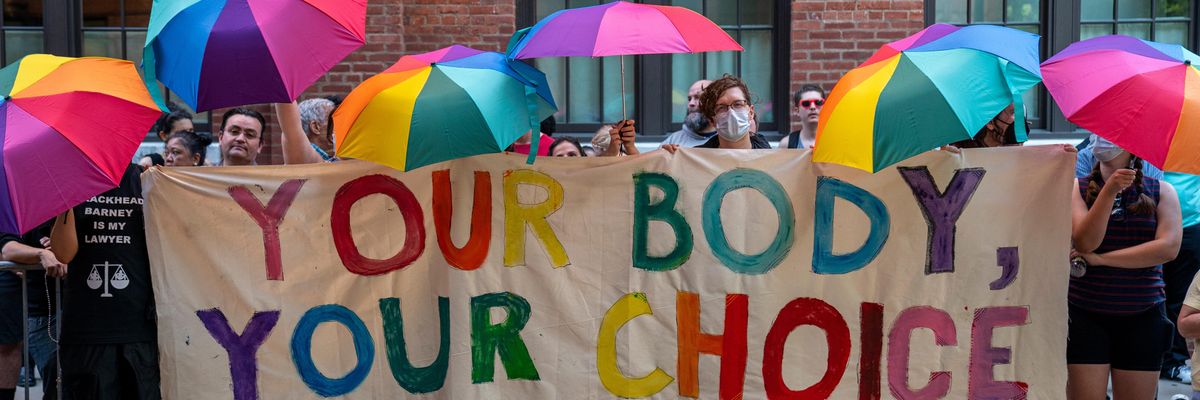
Pro-abortion rights demonstrators gather outside a Planned Parenthood clinic and office on August 6, 2022 in New York City.
"These radical bans have wreaked havoc across the South and Midwest, but today's decision means that the right to make deeply personal healthcare decisions will remain protected in South Carolina," said one advocate.
Reproductive rights supporters in South Carolina and across the country celebrated Thursday once the state Supreme Court permanently struck down a law banning abortion after around six weeks, or before many people even know they are pregnant.
Senate Bill 1 had been blocked in the federal court system—until June, when the U.S. Supreme Court's Dobbs v. Jackson Women's Health Organization decision reversed its Roe v. Wade ruling that had affirmed abortion rights nationwide for a half-century.
As residents of Republican-controlled states fight for abortion access and pregnant people are forced to cross state lines for care, the South Carolina Supreme Court ruled 3-2 Thursday that S.B. 1 violates South Carolinians' rights under the state constitution.
"The court justly rejected this insidious attempt to take away South Carolinians' fundamental rights under the state's constitution," said Nancy Northup, president and CEO of the Center for Reproductive Rights, which represented plaintiffs challenging the anti-choice legislation along with planned Parenthood Federation of America (PPFA) and the law firm Burnette Shutt & McDaniel.
"These radical bans have wreaked havoc across the South and Midwest, but today's decision means that the right to make deeply personal healthcare decisions will remain protected in South Carolina—an immense victory for South Carolinians and the entire region," Northup added. "We know that lawmakers will double down on their relentless efforts to restrict essential healthcare, but we will continue to use every tool at our disposal to restore abortion access across the country once and for all."
As of mid-December, abortion bans were in effect in a dozen states—Alabama, Arkansas, Idaho, Kentucky, Louisiana, Mississippi, Missouri, Oklahoma, South Dakota, Tennessee, Texas, and West Virginia—and abortion care was not available in two more, North Dakota and Wisconsin, according to the pro-choice Guttmacher Institute.
Slate's Mark Joseph Stern noted on Twitter that though the U.S. Supreme Court can't reverse the South Carolina ruling because it's based on state law, Justice Kaye Hearn, who wrote the lead opinion, is set to step down next month and the GOP-controlled Legislature gets to select her replacement, so the fight may not be over.
Still, advocates and providers highlighted that at least for now, the decision means patients—both South Carolina residents and those unable to access care closer to home—can receive legal abortion care until up to 22 weeks of pregnancy.
"The court's decision means that our patients can continue to come to us, their trusted healthcare providers, to access abortion and other essential health services in South Carolina," said Jenny Black, president and CEO, Planned Parenthood South Atlantic. "This is a monumental victory in the movement to protect legal abortion in the South."
PPFA president and CEO Alexis McGill Johnson similarly declared that "today's ruling is a win for freedom."
"We are relieved that this dangerous law has been relegated to the history books and can no longer threaten patients and providers in South Carolina," she said. "Reproductive healthcare, including abortion, is a fundamental right that should never be subject to the whims of power-hungry politicians. Planned Parenthood will keep working day by day and state by state to safeguard that right for all people, and we won't stop until everyone can access the essential healthcare they need and deserve."
While rights campaigners are determined to safeguard and even expand abortion rights across the United States, federal legislation to do so is highly unlikely during the remainder of President Joe Biden's first term, due to not only Senate Republicans and right-wing Sen. Joe Manchin (D-W.Va.) but also the House GOP, which has been unable to even agree upon a speaker since taking narrow control of the chamber earlier this week.
Karine Jean-Pierre, the White House press secretary, tweeted Thursday that "we are encouraged by South Carolina's Supreme Court ruling today on the state's extreme and dangerous abortion ban. Women should be able to make their own decisions about their bodies."
The Biden administration has worked to expand abortion access, including the Food and Drug Administration's "much-welcome step" earlier this week to allow retail pharmacies to dispense abortion pills that patients previously could only access from certified providers and clinics.
Dear Common Dreams reader, It’s been nearly 30 years since I co-founded Common Dreams with my late wife, Lina Newhouser. We had the radical notion that journalism should serve the public good, not corporate profits. It was clear to us from the outset what it would take to build such a project. No paid advertisements. No corporate sponsors. No millionaire publisher telling us what to think or do. Many people said we wouldn't last a year, but we proved those doubters wrong. Together with a tremendous team of journalists and dedicated staff, we built an independent media outlet free from the constraints of profits and corporate control. Our mission has always been simple: To inform. To inspire. To ignite change for the common good. Building Common Dreams was not easy. Our survival was never guaranteed. When you take on the most powerful forces—Wall Street greed, fossil fuel industry destruction, Big Tech lobbyists, and uber-rich oligarchs who have spent billions upon billions rigging the economy and democracy in their favor—the only bulwark you have is supporters who believe in your work. But here’s the urgent message from me today. It's never been this bad out there. And it's never been this hard to keep us going. At the very moment Common Dreams is most needed, the threats we face are intensifying. We need your support now more than ever. We don't accept corporate advertising and never will. We don't have a paywall because we don't think people should be blocked from critical news based on their ability to pay. Everything we do is funded by the donations of readers like you. When everyone does the little they can afford, we are strong. But if that support retreats or dries up, so do we. Will you donate now to make sure Common Dreams not only survives but thrives? —Craig Brown, Co-founder |
Reproductive rights supporters in South Carolina and across the country celebrated Thursday once the state Supreme Court permanently struck down a law banning abortion after around six weeks, or before many people even know they are pregnant.
Senate Bill 1 had been blocked in the federal court system—until June, when the U.S. Supreme Court's Dobbs v. Jackson Women's Health Organization decision reversed its Roe v. Wade ruling that had affirmed abortion rights nationwide for a half-century.
As residents of Republican-controlled states fight for abortion access and pregnant people are forced to cross state lines for care, the South Carolina Supreme Court ruled 3-2 Thursday that S.B. 1 violates South Carolinians' rights under the state constitution.
"The court justly rejected this insidious attempt to take away South Carolinians' fundamental rights under the state's constitution," said Nancy Northup, president and CEO of the Center for Reproductive Rights, which represented plaintiffs challenging the anti-choice legislation along with planned Parenthood Federation of America (PPFA) and the law firm Burnette Shutt & McDaniel.
"These radical bans have wreaked havoc across the South and Midwest, but today's decision means that the right to make deeply personal healthcare decisions will remain protected in South Carolina—an immense victory for South Carolinians and the entire region," Northup added. "We know that lawmakers will double down on their relentless efforts to restrict essential healthcare, but we will continue to use every tool at our disposal to restore abortion access across the country once and for all."
As of mid-December, abortion bans were in effect in a dozen states—Alabama, Arkansas, Idaho, Kentucky, Louisiana, Mississippi, Missouri, Oklahoma, South Dakota, Tennessee, Texas, and West Virginia—and abortion care was not available in two more, North Dakota and Wisconsin, according to the pro-choice Guttmacher Institute.
Slate's Mark Joseph Stern noted on Twitter that though the U.S. Supreme Court can't reverse the South Carolina ruling because it's based on state law, Justice Kaye Hearn, who wrote the lead opinion, is set to step down next month and the GOP-controlled Legislature gets to select her replacement, so the fight may not be over.
Still, advocates and providers highlighted that at least for now, the decision means patients—both South Carolina residents and those unable to access care closer to home—can receive legal abortion care until up to 22 weeks of pregnancy.
"The court's decision means that our patients can continue to come to us, their trusted healthcare providers, to access abortion and other essential health services in South Carolina," said Jenny Black, president and CEO, Planned Parenthood South Atlantic. "This is a monumental victory in the movement to protect legal abortion in the South."
PPFA president and CEO Alexis McGill Johnson similarly declared that "today's ruling is a win for freedom."
"We are relieved that this dangerous law has been relegated to the history books and can no longer threaten patients and providers in South Carolina," she said. "Reproductive healthcare, including abortion, is a fundamental right that should never be subject to the whims of power-hungry politicians. Planned Parenthood will keep working day by day and state by state to safeguard that right for all people, and we won't stop until everyone can access the essential healthcare they need and deserve."
While rights campaigners are determined to safeguard and even expand abortion rights across the United States, federal legislation to do so is highly unlikely during the remainder of President Joe Biden's first term, due to not only Senate Republicans and right-wing Sen. Joe Manchin (D-W.Va.) but also the House GOP, which has been unable to even agree upon a speaker since taking narrow control of the chamber earlier this week.
Karine Jean-Pierre, the White House press secretary, tweeted Thursday that "we are encouraged by South Carolina's Supreme Court ruling today on the state's extreme and dangerous abortion ban. Women should be able to make their own decisions about their bodies."
The Biden administration has worked to expand abortion access, including the Food and Drug Administration's "much-welcome step" earlier this week to allow retail pharmacies to dispense abortion pills that patients previously could only access from certified providers and clinics.
Reproductive rights supporters in South Carolina and across the country celebrated Thursday once the state Supreme Court permanently struck down a law banning abortion after around six weeks, or before many people even know they are pregnant.
Senate Bill 1 had been blocked in the federal court system—until June, when the U.S. Supreme Court's Dobbs v. Jackson Women's Health Organization decision reversed its Roe v. Wade ruling that had affirmed abortion rights nationwide for a half-century.
As residents of Republican-controlled states fight for abortion access and pregnant people are forced to cross state lines for care, the South Carolina Supreme Court ruled 3-2 Thursday that S.B. 1 violates South Carolinians' rights under the state constitution.
"The court justly rejected this insidious attempt to take away South Carolinians' fundamental rights under the state's constitution," said Nancy Northup, president and CEO of the Center for Reproductive Rights, which represented plaintiffs challenging the anti-choice legislation along with planned Parenthood Federation of America (PPFA) and the law firm Burnette Shutt & McDaniel.
"These radical bans have wreaked havoc across the South and Midwest, but today's decision means that the right to make deeply personal healthcare decisions will remain protected in South Carolina—an immense victory for South Carolinians and the entire region," Northup added. "We know that lawmakers will double down on their relentless efforts to restrict essential healthcare, but we will continue to use every tool at our disposal to restore abortion access across the country once and for all."
As of mid-December, abortion bans were in effect in a dozen states—Alabama, Arkansas, Idaho, Kentucky, Louisiana, Mississippi, Missouri, Oklahoma, South Dakota, Tennessee, Texas, and West Virginia—and abortion care was not available in two more, North Dakota and Wisconsin, according to the pro-choice Guttmacher Institute.
Slate's Mark Joseph Stern noted on Twitter that though the U.S. Supreme Court can't reverse the South Carolina ruling because it's based on state law, Justice Kaye Hearn, who wrote the lead opinion, is set to step down next month and the GOP-controlled Legislature gets to select her replacement, so the fight may not be over.
Still, advocates and providers highlighted that at least for now, the decision means patients—both South Carolina residents and those unable to access care closer to home—can receive legal abortion care until up to 22 weeks of pregnancy.
"The court's decision means that our patients can continue to come to us, their trusted healthcare providers, to access abortion and other essential health services in South Carolina," said Jenny Black, president and CEO, Planned Parenthood South Atlantic. "This is a monumental victory in the movement to protect legal abortion in the South."
PPFA president and CEO Alexis McGill Johnson similarly declared that "today's ruling is a win for freedom."
"We are relieved that this dangerous law has been relegated to the history books and can no longer threaten patients and providers in South Carolina," she said. "Reproductive healthcare, including abortion, is a fundamental right that should never be subject to the whims of power-hungry politicians. Planned Parenthood will keep working day by day and state by state to safeguard that right for all people, and we won't stop until everyone can access the essential healthcare they need and deserve."
While rights campaigners are determined to safeguard and even expand abortion rights across the United States, federal legislation to do so is highly unlikely during the remainder of President Joe Biden's first term, due to not only Senate Republicans and right-wing Sen. Joe Manchin (D-W.Va.) but also the House GOP, which has been unable to even agree upon a speaker since taking narrow control of the chamber earlier this week.
Karine Jean-Pierre, the White House press secretary, tweeted Thursday that "we are encouraged by South Carolina's Supreme Court ruling today on the state's extreme and dangerous abortion ban. Women should be able to make their own decisions about their bodies."
The Biden administration has worked to expand abortion access, including the Food and Drug Administration's "much-welcome step" earlier this week to allow retail pharmacies to dispense abortion pills that patients previously could only access from certified providers and clinics.