SUBSCRIBE TO OUR FREE NEWSLETTER
Daily news & progressive opinion—funded by the people, not the corporations—delivered straight to your inbox.
5
#000000
#FFFFFF
To donate by check, phone, or other method, see our More Ways to Give page.
Daily news & progressive opinion—funded by the people, not the corporations—delivered straight to your inbox.
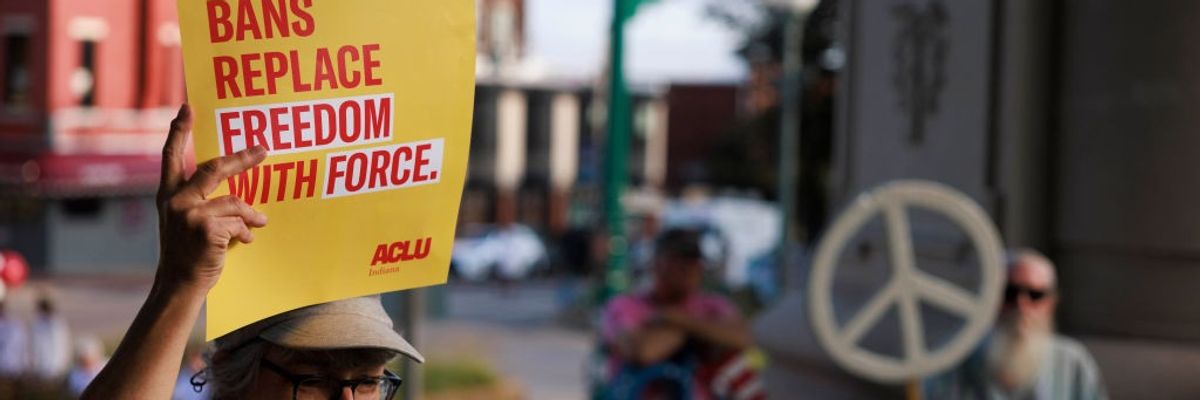
A protester holds a sign outside Monroe County Courthouse in Bloomington, Indiana on September 15, 2022.
The court found that two bans passed in 2022 conflicted with the Oklahoma Constitution's guarantee of a pregnant person's "inherent right" to life.
The Oklahoma state Supreme Court on Wednesday became the latest state-level court to rebuke Republican legislation passed in recent months to bar residents from accessing abortion care, ruling that two laws signed by GOP Gov. Kevin Stitt are unconstitutional.
The court found that S.B. 1603 and H.B. 4327 both conflict with an earlier ruling in March, when five of the nine justices ruled that the Oklahoma Constitution guarantees the "inherent right of a pregnant woman to terminate a pregnancy when necessary to preserve her life."
Earlier this year, the South Carolina Supreme Court ruled that a six-week abortion ban violated the state's constitutional right to privacy. Republicans in the state ignored that finding this month as they passed another six-week ban, only to have a state judge grant abortion providers and three rights groups a temporary restraining order, blocking the law from taking effect.
The ruling by the Oklahoma court on Wednesday was 6-3, with Justice Richard Darby joining the majority due to the precedent set by the March ruling.
S.B. 1603 banned abortion care after the point at which an ultrasound can detect an electronically induced sound from the tissue that will become a fetus' heart—often erroneously referred to as an actual fetal heartbeat by pro-forced pregnancy groups and lawmakers.
H.B. 4327 imposed a near-total ban on abortion care with exceptions for medical emergencies in which a pregnant person's life was at risk and for cases of rape or incest that had been reported to law enforcement.
As Common Dreams reported in April, the life of at least one woman in Oklahoma was put at risk by those so-called "exceptions" when she developed a cancerous molar pregnancy and was told by three different hospitals that she could not obtain an abortion for the condition, which had no chance of ever developing into a fetus.
The woman, Jaci Statton, was eventually advised by one hospital staffer to wait in the facility's parking lot until her heavy bleeding and other symptoms reached the point of "crashing," at which point doctors would be able to treat her without fearing a lawsuit permitted under Oklahoma's laws.
In the state Supreme Court ruling on Wednesday, said Slate journalist Mark Joseph Stern, "the majority found that both the total ban and the 'heartbeat' ban lacked a sufficient exception for medical emergencies."
Oklahoma Attorney General Gentner Drummond responded to the ruling by saying a 1910 abortion ban is still in effect due to the U.S. Supreme Court's overturning of Roe v. Wade last year. The law bans abortion care except when it is necessary to preserve the life of the pregnant person.
"Except for certain circumstances outlined in that statute, abortion is still unlawful in the state of Oklahoma," Drummond said.
The Republican attorney general's claim "tees up another challenge at the Oklahoma Supreme Court," said Stern.
Considering the justices' recent rulings, he said, "it strikes me as... unlikely that this court will allow that law to be enforced."
Dear Common Dreams reader, It’s been nearly 30 years since I co-founded Common Dreams with my late wife, Lina Newhouser. We had the radical notion that journalism should serve the public good, not corporate profits. It was clear to us from the outset what it would take to build such a project. No paid advertisements. No corporate sponsors. No millionaire publisher telling us what to think or do. Many people said we wouldn't last a year, but we proved those doubters wrong. Together with a tremendous team of journalists and dedicated staff, we built an independent media outlet free from the constraints of profits and corporate control. Our mission has always been simple: To inform. To inspire. To ignite change for the common good. Building Common Dreams was not easy. Our survival was never guaranteed. When you take on the most powerful forces—Wall Street greed, fossil fuel industry destruction, Big Tech lobbyists, and uber-rich oligarchs who have spent billions upon billions rigging the economy and democracy in their favor—the only bulwark you have is supporters who believe in your work. But here’s the urgent message from me today. It's never been this bad out there. And it's never been this hard to keep us going. At the very moment Common Dreams is most needed, the threats we face are intensifying. We need your support now more than ever. We don't accept corporate advertising and never will. We don't have a paywall because we don't think people should be blocked from critical news based on their ability to pay. Everything we do is funded by the donations of readers like you. When everyone does the little they can afford, we are strong. But if that support retreats or dries up, so do we. Will you donate now to make sure Common Dreams not only survives but thrives? —Craig Brown, Co-founder |
The Oklahoma state Supreme Court on Wednesday became the latest state-level court to rebuke Republican legislation passed in recent months to bar residents from accessing abortion care, ruling that two laws signed by GOP Gov. Kevin Stitt are unconstitutional.
The court found that S.B. 1603 and H.B. 4327 both conflict with an earlier ruling in March, when five of the nine justices ruled that the Oklahoma Constitution guarantees the "inherent right of a pregnant woman to terminate a pregnancy when necessary to preserve her life."
Earlier this year, the South Carolina Supreme Court ruled that a six-week abortion ban violated the state's constitutional right to privacy. Republicans in the state ignored that finding this month as they passed another six-week ban, only to have a state judge grant abortion providers and three rights groups a temporary restraining order, blocking the law from taking effect.
The ruling by the Oklahoma court on Wednesday was 6-3, with Justice Richard Darby joining the majority due to the precedent set by the March ruling.
S.B. 1603 banned abortion care after the point at which an ultrasound can detect an electronically induced sound from the tissue that will become a fetus' heart—often erroneously referred to as an actual fetal heartbeat by pro-forced pregnancy groups and lawmakers.
H.B. 4327 imposed a near-total ban on abortion care with exceptions for medical emergencies in which a pregnant person's life was at risk and for cases of rape or incest that had been reported to law enforcement.
As Common Dreams reported in April, the life of at least one woman in Oklahoma was put at risk by those so-called "exceptions" when she developed a cancerous molar pregnancy and was told by three different hospitals that she could not obtain an abortion for the condition, which had no chance of ever developing into a fetus.
The woman, Jaci Statton, was eventually advised by one hospital staffer to wait in the facility's parking lot until her heavy bleeding and other symptoms reached the point of "crashing," at which point doctors would be able to treat her without fearing a lawsuit permitted under Oklahoma's laws.
In the state Supreme Court ruling on Wednesday, said Slate journalist Mark Joseph Stern, "the majority found that both the total ban and the 'heartbeat' ban lacked a sufficient exception for medical emergencies."
Oklahoma Attorney General Gentner Drummond responded to the ruling by saying a 1910 abortion ban is still in effect due to the U.S. Supreme Court's overturning of Roe v. Wade last year. The law bans abortion care except when it is necessary to preserve the life of the pregnant person.
"Except for certain circumstances outlined in that statute, abortion is still unlawful in the state of Oklahoma," Drummond said.
The Republican attorney general's claim "tees up another challenge at the Oklahoma Supreme Court," said Stern.
Considering the justices' recent rulings, he said, "it strikes me as... unlikely that this court will allow that law to be enforced."
The Oklahoma state Supreme Court on Wednesday became the latest state-level court to rebuke Republican legislation passed in recent months to bar residents from accessing abortion care, ruling that two laws signed by GOP Gov. Kevin Stitt are unconstitutional.
The court found that S.B. 1603 and H.B. 4327 both conflict with an earlier ruling in March, when five of the nine justices ruled that the Oklahoma Constitution guarantees the "inherent right of a pregnant woman to terminate a pregnancy when necessary to preserve her life."
Earlier this year, the South Carolina Supreme Court ruled that a six-week abortion ban violated the state's constitutional right to privacy. Republicans in the state ignored that finding this month as they passed another six-week ban, only to have a state judge grant abortion providers and three rights groups a temporary restraining order, blocking the law from taking effect.
The ruling by the Oklahoma court on Wednesday was 6-3, with Justice Richard Darby joining the majority due to the precedent set by the March ruling.
S.B. 1603 banned abortion care after the point at which an ultrasound can detect an electronically induced sound from the tissue that will become a fetus' heart—often erroneously referred to as an actual fetal heartbeat by pro-forced pregnancy groups and lawmakers.
H.B. 4327 imposed a near-total ban on abortion care with exceptions for medical emergencies in which a pregnant person's life was at risk and for cases of rape or incest that had been reported to law enforcement.
As Common Dreams reported in April, the life of at least one woman in Oklahoma was put at risk by those so-called "exceptions" when she developed a cancerous molar pregnancy and was told by three different hospitals that she could not obtain an abortion for the condition, which had no chance of ever developing into a fetus.
The woman, Jaci Statton, was eventually advised by one hospital staffer to wait in the facility's parking lot until her heavy bleeding and other symptoms reached the point of "crashing," at which point doctors would be able to treat her without fearing a lawsuit permitted under Oklahoma's laws.
In the state Supreme Court ruling on Wednesday, said Slate journalist Mark Joseph Stern, "the majority found that both the total ban and the 'heartbeat' ban lacked a sufficient exception for medical emergencies."
Oklahoma Attorney General Gentner Drummond responded to the ruling by saying a 1910 abortion ban is still in effect due to the U.S. Supreme Court's overturning of Roe v. Wade last year. The law bans abortion care except when it is necessary to preserve the life of the pregnant person.
"Except for certain circumstances outlined in that statute, abortion is still unlawful in the state of Oklahoma," Drummond said.
The Republican attorney general's claim "tees up another challenge at the Oklahoma Supreme Court," said Stern.
Considering the justices' recent rulings, he said, "it strikes me as... unlikely that this court will allow that law to be enforced."