SUBSCRIBE TO OUR FREE NEWSLETTER
Daily news & progressive opinion—funded by the people, not the corporations—delivered straight to your inbox.
5
#000000
#FFFFFF
To donate by check, phone, or other method, see our More Ways to Give page.
Daily news & progressive opinion—funded by the people, not the corporations—delivered straight to your inbox.
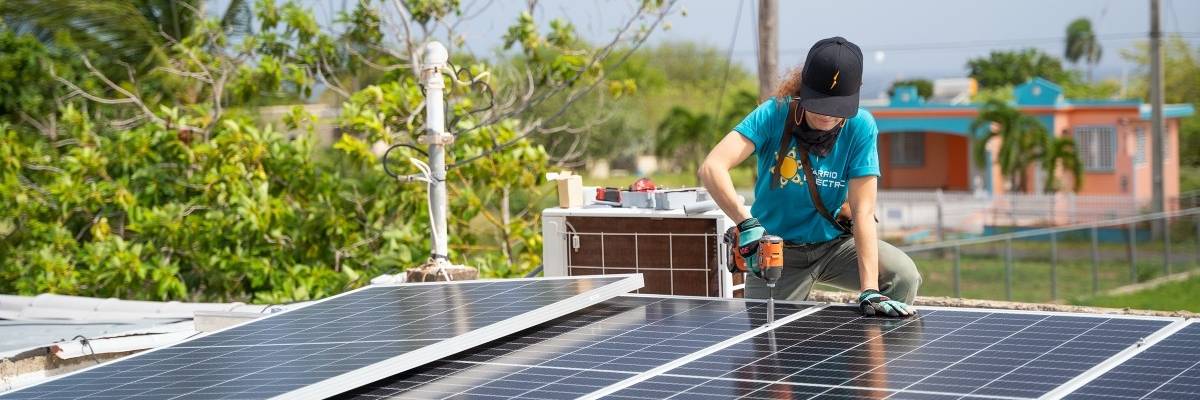
A member of Barrio Eléctrico—a Puerto Rican non-profit advocating affordable solar power for families—installs a photovoltaic panel on a rooftop in this undated photo.
"Net metering has proven essential for families in Puerto Rico and essential for Puerto Rico's progress towards its own renewable goals."
More than 20 members of the U.S. Congressional Democratic Caucus on Friday urged a federal colonial oversight board to safeguard affordable access to rooftop solar power in Puerto Rico by protecting net metering, which the lawmakers called essential to the island's clean energy goals and economic growth.
Net metering "makes household renewable energy sources, like rooftop solar, more affordable for families by ensuring they are reimbursed for the extra energy they produce but do not use," the House Natural Resources Committee Democrats explained in a statement.
"A continued commitment to preserving net metering and a renewed focus on solar energy will benefit the island's economy and people."
However, the Financial Oversight and Management Board (FOMB) for Puerto Rico—the controversial unelected federal body tasked with approving and revising Puerto Rico's obligations under a 2016 bankruptcy law—recently directed Democratic Puerto Rican Gov. Pedro Pierluisi and the territorial Legislature to repeal Act 10, which protects net metering through 2031.
"Any attempt to reduce the economic viability of rooftop solar and batteries by paring back net metering should be rejected at this critical stage of Puerto Rico's energy system transformation," 20 congressional Democrats and Sen. Bernie Sanders (I-Vt.) wrote Friday in a bicameral letter to FOMB members. "Net metering has proven essential for families in Puerto Rico and essential for Puerto Rico's progress towards its own renewable goals."
"Net metering has served the people of Puerto Rico well," the lawmakers argued. "It not only compensates homeowners for their contribution to the grid and their reduced dependence on imported fuels, but it also makes renewable energy production economically viable for millions for whom it would otherwise be out of reach."
The letter continues:
Net metering is an engine for economic recovery. Currently, the renewables sector contributes approximately $1.5 billion to Puerto Rico's economy each year and employs more than 10,000 people. In addition to the direct economic benefits, the tens of thousands of solar and storage installations on the island today provide critical backup power for Puerto Rican families and businesses, helping them avoid economic hardship while supporting uninterrupted economic activity during power outages. Many of these systems provide a literal lifeline to people who depend on the uninterrupted operation of medical equipment.
Weakening or ending net metering in Puerto Rico could be devastating. Rooftop solar has added over 800 MW to an electric system whose demand is about 2,500-3,000 MW. As a result, residential solar technology is responsible for most of the progress the archipelago has made toward its ultimate goal of generating 100% renewable energy by 2050. Puerto Rico's net metering and rooftop solar programs have successfully displaced energy that would otherwise be generated by imported fossil fuel, lowering overall costs for all ratepayers.
"Making rooftop solar and battery storage systems less affordable could hurt the lowest-income people most," the lawmakers contended. "Should net metering be eliminated or weakened, the result would be a growing divide between those stuck with exorbitant energy prices from imported fossil fuels and those who can afford their own dependable solar and battery system. Slowing the adoption of rooftop solar and batteries would mean missed opportunities to leverage the private market to protect those most vulnerable to another hurricane's impacts."
After Hurricane Maria devastated Puerto Rico's energy grid in 2017, many Puerto Ricans turned to renewable energy—especially solar—to keep the lights on. Last year, the U.S. Department of Energy announced up to $440 million in residential solar funding for vulnerable households via the Puerto Rico Energy Resilience Fund.
"Undermining net metering would dramatically slow one of the most active solar and battery markets in the country at the time it is needed most."
Puerto Rico "needs more renewable production, not less," the lawmakers added. "Undermining net metering would dramatically slow one of the most active solar and battery markets in the country at the time it is needed most... We urge you to protect net metering in Puerto Rico. We believe that a continued commitment to preserving net metering and a renewed focus on solar energy will benefit the island's economy and people."
The lawmakers' letter follows a call earlier this week from the Solar and Energy Storage Association of Puerto Rico for U.S. President Joe Biden to replace six FOMB members "who are supportive of Puerto Rico, supportive of solar power, and supportive of dissolving the board as soon as possible."
The FOMB has been decried as an anti-democratic colonial body that dictates the island's budget and operates in secrecy. Last year, the U.S. Supreme Court ruled 8-1 to protect the board from public scrutiny.
Dear Common Dreams reader, It’s been nearly 30 years since I co-founded Common Dreams with my late wife, Lina Newhouser. We had the radical notion that journalism should serve the public good, not corporate profits. It was clear to us from the outset what it would take to build such a project. No paid advertisements. No corporate sponsors. No millionaire publisher telling us what to think or do. Many people said we wouldn't last a year, but we proved those doubters wrong. Together with a tremendous team of journalists and dedicated staff, we built an independent media outlet free from the constraints of profits and corporate control. Our mission has always been simple: To inform. To inspire. To ignite change for the common good. Building Common Dreams was not easy. Our survival was never guaranteed. When you take on the most powerful forces—Wall Street greed, fossil fuel industry destruction, Big Tech lobbyists, and uber-rich oligarchs who have spent billions upon billions rigging the economy and democracy in their favor—the only bulwark you have is supporters who believe in your work. But here’s the urgent message from me today. It's never been this bad out there. And it's never been this hard to keep us going. At the very moment Common Dreams is most needed, the threats we face are intensifying. We need your support now more than ever. We don't accept corporate advertising and never will. We don't have a paywall because we don't think people should be blocked from critical news based on their ability to pay. Everything we do is funded by the donations of readers like you. When everyone does the little they can afford, we are strong. But if that support retreats or dries up, so do we. Will you donate now to make sure Common Dreams not only survives but thrives? —Craig Brown, Co-founder |
More than 20 members of the U.S. Congressional Democratic Caucus on Friday urged a federal colonial oversight board to safeguard affordable access to rooftop solar power in Puerto Rico by protecting net metering, which the lawmakers called essential to the island's clean energy goals and economic growth.
Net metering "makes household renewable energy sources, like rooftop solar, more affordable for families by ensuring they are reimbursed for the extra energy they produce but do not use," the House Natural Resources Committee Democrats explained in a statement.
"A continued commitment to preserving net metering and a renewed focus on solar energy will benefit the island's economy and people."
However, the Financial Oversight and Management Board (FOMB) for Puerto Rico—the controversial unelected federal body tasked with approving and revising Puerto Rico's obligations under a 2016 bankruptcy law—recently directed Democratic Puerto Rican Gov. Pedro Pierluisi and the territorial Legislature to repeal Act 10, which protects net metering through 2031.
"Any attempt to reduce the economic viability of rooftop solar and batteries by paring back net metering should be rejected at this critical stage of Puerto Rico's energy system transformation," 20 congressional Democrats and Sen. Bernie Sanders (I-Vt.) wrote Friday in a bicameral letter to FOMB members. "Net metering has proven essential for families in Puerto Rico and essential for Puerto Rico's progress towards its own renewable goals."
"Net metering has served the people of Puerto Rico well," the lawmakers argued. "It not only compensates homeowners for their contribution to the grid and their reduced dependence on imported fuels, but it also makes renewable energy production economically viable for millions for whom it would otherwise be out of reach."
The letter continues:
Net metering is an engine for economic recovery. Currently, the renewables sector contributes approximately $1.5 billion to Puerto Rico's economy each year and employs more than 10,000 people. In addition to the direct economic benefits, the tens of thousands of solar and storage installations on the island today provide critical backup power for Puerto Rican families and businesses, helping them avoid economic hardship while supporting uninterrupted economic activity during power outages. Many of these systems provide a literal lifeline to people who depend on the uninterrupted operation of medical equipment.
Weakening or ending net metering in Puerto Rico could be devastating. Rooftop solar has added over 800 MW to an electric system whose demand is about 2,500-3,000 MW. As a result, residential solar technology is responsible for most of the progress the archipelago has made toward its ultimate goal of generating 100% renewable energy by 2050. Puerto Rico's net metering and rooftop solar programs have successfully displaced energy that would otherwise be generated by imported fossil fuel, lowering overall costs for all ratepayers.
"Making rooftop solar and battery storage systems less affordable could hurt the lowest-income people most," the lawmakers contended. "Should net metering be eliminated or weakened, the result would be a growing divide between those stuck with exorbitant energy prices from imported fossil fuels and those who can afford their own dependable solar and battery system. Slowing the adoption of rooftop solar and batteries would mean missed opportunities to leverage the private market to protect those most vulnerable to another hurricane's impacts."
After Hurricane Maria devastated Puerto Rico's energy grid in 2017, many Puerto Ricans turned to renewable energy—especially solar—to keep the lights on. Last year, the U.S. Department of Energy announced up to $440 million in residential solar funding for vulnerable households via the Puerto Rico Energy Resilience Fund.
"Undermining net metering would dramatically slow one of the most active solar and battery markets in the country at the time it is needed most."
Puerto Rico "needs more renewable production, not less," the lawmakers added. "Undermining net metering would dramatically slow one of the most active solar and battery markets in the country at the time it is needed most... We urge you to protect net metering in Puerto Rico. We believe that a continued commitment to preserving net metering and a renewed focus on solar energy will benefit the island's economy and people."
The lawmakers' letter follows a call earlier this week from the Solar and Energy Storage Association of Puerto Rico for U.S. President Joe Biden to replace six FOMB members "who are supportive of Puerto Rico, supportive of solar power, and supportive of dissolving the board as soon as possible."
The FOMB has been decried as an anti-democratic colonial body that dictates the island's budget and operates in secrecy. Last year, the U.S. Supreme Court ruled 8-1 to protect the board from public scrutiny.
More than 20 members of the U.S. Congressional Democratic Caucus on Friday urged a federal colonial oversight board to safeguard affordable access to rooftop solar power in Puerto Rico by protecting net metering, which the lawmakers called essential to the island's clean energy goals and economic growth.
Net metering "makes household renewable energy sources, like rooftop solar, more affordable for families by ensuring they are reimbursed for the extra energy they produce but do not use," the House Natural Resources Committee Democrats explained in a statement.
"A continued commitment to preserving net metering and a renewed focus on solar energy will benefit the island's economy and people."
However, the Financial Oversight and Management Board (FOMB) for Puerto Rico—the controversial unelected federal body tasked with approving and revising Puerto Rico's obligations under a 2016 bankruptcy law—recently directed Democratic Puerto Rican Gov. Pedro Pierluisi and the territorial Legislature to repeal Act 10, which protects net metering through 2031.
"Any attempt to reduce the economic viability of rooftop solar and batteries by paring back net metering should be rejected at this critical stage of Puerto Rico's energy system transformation," 20 congressional Democrats and Sen. Bernie Sanders (I-Vt.) wrote Friday in a bicameral letter to FOMB members. "Net metering has proven essential for families in Puerto Rico and essential for Puerto Rico's progress towards its own renewable goals."
"Net metering has served the people of Puerto Rico well," the lawmakers argued. "It not only compensates homeowners for their contribution to the grid and their reduced dependence on imported fuels, but it also makes renewable energy production economically viable for millions for whom it would otherwise be out of reach."
The letter continues:
Net metering is an engine for economic recovery. Currently, the renewables sector contributes approximately $1.5 billion to Puerto Rico's economy each year and employs more than 10,000 people. In addition to the direct economic benefits, the tens of thousands of solar and storage installations on the island today provide critical backup power for Puerto Rican families and businesses, helping them avoid economic hardship while supporting uninterrupted economic activity during power outages. Many of these systems provide a literal lifeline to people who depend on the uninterrupted operation of medical equipment.
Weakening or ending net metering in Puerto Rico could be devastating. Rooftop solar has added over 800 MW to an electric system whose demand is about 2,500-3,000 MW. As a result, residential solar technology is responsible for most of the progress the archipelago has made toward its ultimate goal of generating 100% renewable energy by 2050. Puerto Rico's net metering and rooftop solar programs have successfully displaced energy that would otherwise be generated by imported fossil fuel, lowering overall costs for all ratepayers.
"Making rooftop solar and battery storage systems less affordable could hurt the lowest-income people most," the lawmakers contended. "Should net metering be eliminated or weakened, the result would be a growing divide between those stuck with exorbitant energy prices from imported fossil fuels and those who can afford their own dependable solar and battery system. Slowing the adoption of rooftop solar and batteries would mean missed opportunities to leverage the private market to protect those most vulnerable to another hurricane's impacts."
After Hurricane Maria devastated Puerto Rico's energy grid in 2017, many Puerto Ricans turned to renewable energy—especially solar—to keep the lights on. Last year, the U.S. Department of Energy announced up to $440 million in residential solar funding for vulnerable households via the Puerto Rico Energy Resilience Fund.
"Undermining net metering would dramatically slow one of the most active solar and battery markets in the country at the time it is needed most."
Puerto Rico "needs more renewable production, not less," the lawmakers added. "Undermining net metering would dramatically slow one of the most active solar and battery markets in the country at the time it is needed most... We urge you to protect net metering in Puerto Rico. We believe that a continued commitment to preserving net metering and a renewed focus on solar energy will benefit the island's economy and people."
The lawmakers' letter follows a call earlier this week from the Solar and Energy Storage Association of Puerto Rico for U.S. President Joe Biden to replace six FOMB members "who are supportive of Puerto Rico, supportive of solar power, and supportive of dissolving the board as soon as possible."
The FOMB has been decried as an anti-democratic colonial body that dictates the island's budget and operates in secrecy. Last year, the U.S. Supreme Court ruled 8-1 to protect the board from public scrutiny.