SUBSCRIBE TO OUR FREE NEWSLETTER
Daily news & progressive opinion—funded by the people, not the corporations—delivered straight to your inbox.
5
#000000
#FFFFFF
To donate by check, phone, or other method, see our More Ways to Give page.
Daily news & progressive opinion—funded by the people, not the corporations—delivered straight to your inbox.
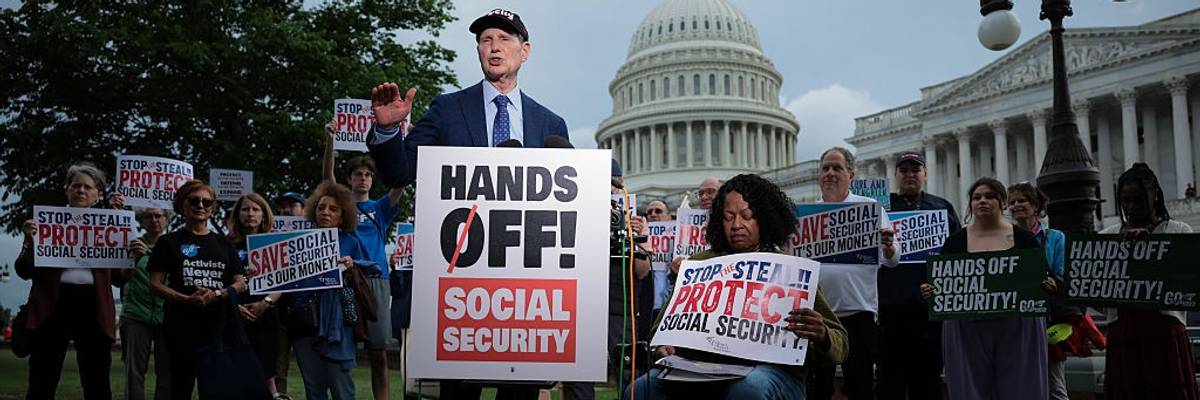
US Sen. Ron Wyden (D-Ore.) speaks during a press conference on Social Security in front of the US Capitol on May 5, 2025 in Washington, DC.
Social Security Administration chief data officer Charles Borges described "fear and anxiety over potential illegal actions resulting in the loss of citizen data" in his resignation letter.
A federal worker who filed a shock whistleblower report alleging that employees of the Department of Government Efficiency had potentially compromised Americans' Social Security data abruptly resigned on Friday.
In a letter obtained by independent journalist Melissa Kabas, Social Security Administration (SSA) chief data officer Charles Borges said that he was "involuntarily" stepping down from his position at the agency due to "serious... mental, physical, and emotional distress" caused in the wake of his whistleblower report.
Borges said that after filing his report with the help of the Government Accountability Project, he was subjected to "exclusion, isolation, internal strife, and a culture of fear" that created a hostile work environment and made "work conditions intolerable."
Borges then recounted that he filed the whistleblower report because he was concerned that Department of Government Efficiency (DOGE) employees had uploaded Americans' Social Security information onto a cloud server that he believed was vulnerable to external hackers.
"As these events unfolded, newly installed leadership in IT and executive offices created a culture of panic and dread, with minimal information sharing, frequent discussions on employee termination, and general organizational dysfunction," Borges claimed. "Executives and employees were afraid to share information or concerns on questionable activities for fear of retribution and termination."
Borges concluded by saying that the total lack of visibility into the actions of DOGE employees who were handling Americans' most sensitive data created a sense of "fear and anxiety over potential illegal actions resulting in the loss of citizen data."
The report, whose existence was made public earlier this week, contends that Borges has evidence of a wide array of wrongdoing by DOGE employees, including "apparent systemic data security violations, uninhibited administrative access to highly sensitive production environments, and potential violations of internal SSA security protocols and federal privacy laws by DOGE personnel."
At the heart of Borges' complaint is an effort by DOGE employees to make "a live copy of the country's Social Security information in a cloud environment" that "apparently lacks any security oversight from SSA or tracking to determine who is accessing or has accessed the copy of this data."
Should hackers gain access to this copy of Social Security data, the report warns, it could result in identity theft on an unprecedented scale and lead to the loss of crucial food and healthcare benefits for millions of Americans. The report states that the government may also have to give every American a new Social Security number "at great cost."
Dear Common Dreams reader, It’s been nearly 30 years since I co-founded Common Dreams with my late wife, Lina Newhouser. We had the radical notion that journalism should serve the public good, not corporate profits. It was clear to us from the outset what it would take to build such a project. No paid advertisements. No corporate sponsors. No millionaire publisher telling us what to think or do. Many people said we wouldn't last a year, but we proved those doubters wrong. Together with a tremendous team of journalists and dedicated staff, we built an independent media outlet free from the constraints of profits and corporate control. Our mission has always been simple: To inform. To inspire. To ignite change for the common good. Building Common Dreams was not easy. Our survival was never guaranteed. When you take on the most powerful forces—Wall Street greed, fossil fuel industry destruction, Big Tech lobbyists, and uber-rich oligarchs who have spent billions upon billions rigging the economy and democracy in their favor—the only bulwark you have is supporters who believe in your work. But here’s the urgent message from me today. It's never been this bad out there. And it's never been this hard to keep us going. At the very moment Common Dreams is most needed, the threats we face are intensifying. We need your support now more than ever. We don't accept corporate advertising and never will. We don't have a paywall because we don't think people should be blocked from critical news based on their ability to pay. Everything we do is funded by the donations of readers like you. When everyone does the little they can afford, we are strong. But if that support retreats or dries up, so do we. Will you donate now to make sure Common Dreams not only survives but thrives? —Craig Brown, Co-founder |
A federal worker who filed a shock whistleblower report alleging that employees of the Department of Government Efficiency had potentially compromised Americans' Social Security data abruptly resigned on Friday.
In a letter obtained by independent journalist Melissa Kabas, Social Security Administration (SSA) chief data officer Charles Borges said that he was "involuntarily" stepping down from his position at the agency due to "serious... mental, physical, and emotional distress" caused in the wake of his whistleblower report.
Borges said that after filing his report with the help of the Government Accountability Project, he was subjected to "exclusion, isolation, internal strife, and a culture of fear" that created a hostile work environment and made "work conditions intolerable."
Borges then recounted that he filed the whistleblower report because he was concerned that Department of Government Efficiency (DOGE) employees had uploaded Americans' Social Security information onto a cloud server that he believed was vulnerable to external hackers.
"As these events unfolded, newly installed leadership in IT and executive offices created a culture of panic and dread, with minimal information sharing, frequent discussions on employee termination, and general organizational dysfunction," Borges claimed. "Executives and employees were afraid to share information or concerns on questionable activities for fear of retribution and termination."
Borges concluded by saying that the total lack of visibility into the actions of DOGE employees who were handling Americans' most sensitive data created a sense of "fear and anxiety over potential illegal actions resulting in the loss of citizen data."
The report, whose existence was made public earlier this week, contends that Borges has evidence of a wide array of wrongdoing by DOGE employees, including "apparent systemic data security violations, uninhibited administrative access to highly sensitive production environments, and potential violations of internal SSA security protocols and federal privacy laws by DOGE personnel."
At the heart of Borges' complaint is an effort by DOGE employees to make "a live copy of the country's Social Security information in a cloud environment" that "apparently lacks any security oversight from SSA or tracking to determine who is accessing or has accessed the copy of this data."
Should hackers gain access to this copy of Social Security data, the report warns, it could result in identity theft on an unprecedented scale and lead to the loss of crucial food and healthcare benefits for millions of Americans. The report states that the government may also have to give every American a new Social Security number "at great cost."
A federal worker who filed a shock whistleblower report alleging that employees of the Department of Government Efficiency had potentially compromised Americans' Social Security data abruptly resigned on Friday.
In a letter obtained by independent journalist Melissa Kabas, Social Security Administration (SSA) chief data officer Charles Borges said that he was "involuntarily" stepping down from his position at the agency due to "serious... mental, physical, and emotional distress" caused in the wake of his whistleblower report.
Borges said that after filing his report with the help of the Government Accountability Project, he was subjected to "exclusion, isolation, internal strife, and a culture of fear" that created a hostile work environment and made "work conditions intolerable."
Borges then recounted that he filed the whistleblower report because he was concerned that Department of Government Efficiency (DOGE) employees had uploaded Americans' Social Security information onto a cloud server that he believed was vulnerable to external hackers.
"As these events unfolded, newly installed leadership in IT and executive offices created a culture of panic and dread, with minimal information sharing, frequent discussions on employee termination, and general organizational dysfunction," Borges claimed. "Executives and employees were afraid to share information or concerns on questionable activities for fear of retribution and termination."
Borges concluded by saying that the total lack of visibility into the actions of DOGE employees who were handling Americans' most sensitive data created a sense of "fear and anxiety over potential illegal actions resulting in the loss of citizen data."
The report, whose existence was made public earlier this week, contends that Borges has evidence of a wide array of wrongdoing by DOGE employees, including "apparent systemic data security violations, uninhibited administrative access to highly sensitive production environments, and potential violations of internal SSA security protocols and federal privacy laws by DOGE personnel."
At the heart of Borges' complaint is an effort by DOGE employees to make "a live copy of the country's Social Security information in a cloud environment" that "apparently lacks any security oversight from SSA or tracking to determine who is accessing or has accessed the copy of this data."
Should hackers gain access to this copy of Social Security data, the report warns, it could result in identity theft on an unprecedented scale and lead to the loss of crucial food and healthcare benefits for millions of Americans. The report states that the government may also have to give every American a new Social Security number "at great cost."