

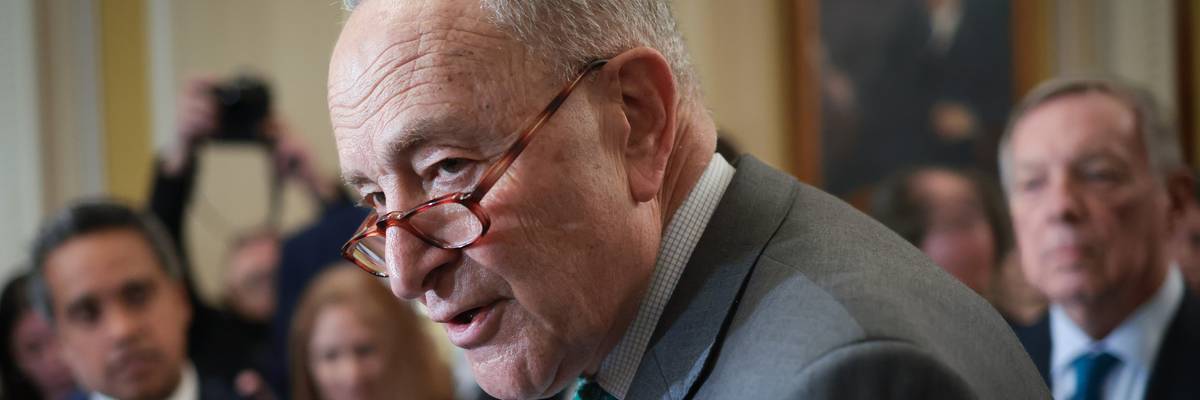
Senate Minority Leader Chuck Schumer (D-N.Y.) speaks during a press conference following a policy luncheon at the U.S. Capitol on March 11, 2025 in Washington, D.C.
'Time to Step Up or Step Down': Our Rev Finds 9 of 10 Progressives Want Schumer Out
"These survey results point to an undeniable crisis of confidence in Chuck Schumer and Democratic leadership," said the head of Our Revolution.
Since Senate Minority Leader Chuck Schumer joined a handful of Democrats in voting for a GOP-backed continuing resolution that cuts nondefense spending by $13 billion and keeps the government open through September, the lawmaker from New York has taken heat from members of his own caucus and liberal groups—and survey data from the group Our Revolution shows that progressive voters are unhappy with him, too.
Our Revolution, the progressive political organizing group launched as a continuation of Sen. Bernie Sanders' (I-Vt.) 2016 presidential campaign, announced Tuesday that it surveyed 9,024 of its members between March 17-18 and found that nearly 90% of respondents believe Schumer should step aside as Senate minority leader and 86% would support a primary challenger against Schumer for his Senate seat, should he refuse to step aside.
The respondents are a subset of Our Revolution's grassroots network, according to the group, and they "include rank-in-file Democratic Party activists and base voters, many of whom supported Bernie Sanders or Elizabeth Warren (D-Mass.) in the 2020 presidential primary."
When given the opportunity to submit open-ended responses, survey respondents expressed things like: "Wildly frustrated and defeated" and "We need an opposition party, the Democrats are anything but!"
"These survey results point to an undeniable crisis of confidence in Chuck Schumer and Democratic leadership at a time of unprecedented executive overreach and corporate takeover of the American federal government," said Joseph Geevarghese, the executive director of Our Revolution.
"It is an utter disgrace that Schumer and other top Democrats cannot muster up the courage to actively resist. It's time to step up or step down," said Geevarghese.
On Thursday, Schumer announced his intention to support the bill, which was a pivot from his position earlier that week when he advocated for an extension in order to negotiated a compromise. The pivot drew sharp backlash, including from House Democrats, who had largely been united in opposing the measure when it cleared that chamber on March 11.
On Friday, the Senate voted 62-38, with 10 members of the Democratic caucus in favor, to advance the funding bill and avoid a government shutdown.
Our Revolution found that 83% of respondents would support primary challengers against those 10 senators.
In addition to steeps cuts to items such as the Department of Housing and Urban Development's community development, rental assistance, and homelessness services programs, the bill also lacks the specific congressional instructions to allocate funds for programs that are generally included in spending bills, according to The New York Times. Sen. Patty Murray (D-Wash.), the party's top appropriator, warned that because of this, the bill turns "turns many of our accounts into slush funds."
There were other signs that this was not a typical shutdown fight.
Everett Kelley, president of the nation's largest federal workers union—the American Federation of Government Employees—wrote in a letter to senators last week that AFGE's position "until this year has been that although continuing resolutions are far from ideal, they are better than an outright government shutdown."
"This year is different," Kelley wrote. "The Trump administration has repeatedly demonstrated over the last seven weeks that it will not spend appropriated funds as the law dictates."
After Schumer's pivot, a number of progressives loudly condemned the move. The grassroots group Indivisible released a statement calling for him to step aside as Senate minority leader and Rep. Alexandria Ocasio-Cortez (D-N.Y.) told reporters that there is a "deep sense of outrage and betrayal" from House Democrats following Schumer's about-face.
The episode also sparked murmurs among some Democrats that Ocasio-Cortez should consider a primary bid against Schumer in 2028.
Schumer has defended his decision to stave off a government shutdown, casting it as the less bad option of the two bad options that Senate Democrats were faced with, according to The New York Times.
We are at a crossroads
This country and this world are at a monumental crossroads. In a few short weeks, US voters will have an opportunity to beat back the forces of fascism and confront the billionaires who are rigging the economy, our media system, and our democracy, making it increasingly impossible for ordinary people to get by. We’re not just talking about the election. We’re talking about what must be done once these fascist elements are vanquished from power. We need a bolder set of solutions than what either major party has so far been willing to offer and a working-class movement ready to fight like hell for it. Trump didn't emerge from nowhere. The conditions that fueled MAGA authoritarianism were created by decades of radical neoliberal economic policies and a corrupt political system dominated by corporate interests. They slashed taxes on the super-rich, promising that the benefits would trickle down. They said giveaways to the corporate titans would make life more affordable for the rest of us. It was all bullshit. And when a bitter, betrayed populace searches for someone to blame, right-wing demagogues have little trouble finding scapegoats. People know when they're being lied to, but you won't hear any of this from the corporate media. Only independent journalism—powered and funded by people who believe in building a better world—can deliver truly trustworthy daily news. Our Fall Campaign is underway, and we need your help. To power our newsroom through the rest of the year, we need to raise $125,000 by midnight on October 31. So if you share our vision, please contribute whatever you can to sustain our work. |
Since Senate Minority Leader Chuck Schumer joined a handful of Democrats in voting for a GOP-backed continuing resolution that cuts nondefense spending by $13 billion and keeps the government open through September, the lawmaker from New York has taken heat from members of his own caucus and liberal groups—and survey data from the group Our Revolution shows that progressive voters are unhappy with him, too.
Our Revolution, the progressive political organizing group launched as a continuation of Sen. Bernie Sanders' (I-Vt.) 2016 presidential campaign, announced Tuesday that it surveyed 9,024 of its members between March 17-18 and found that nearly 90% of respondents believe Schumer should step aside as Senate minority leader and 86% would support a primary challenger against Schumer for his Senate seat, should he refuse to step aside.
The respondents are a subset of Our Revolution's grassroots network, according to the group, and they "include rank-in-file Democratic Party activists and base voters, many of whom supported Bernie Sanders or Elizabeth Warren (D-Mass.) in the 2020 presidential primary."
When given the opportunity to submit open-ended responses, survey respondents expressed things like: "Wildly frustrated and defeated" and "We need an opposition party, the Democrats are anything but!"
"These survey results point to an undeniable crisis of confidence in Chuck Schumer and Democratic leadership at a time of unprecedented executive overreach and corporate takeover of the American federal government," said Joseph Geevarghese, the executive director of Our Revolution.
"It is an utter disgrace that Schumer and other top Democrats cannot muster up the courage to actively resist. It's time to step up or step down," said Geevarghese.
On Thursday, Schumer announced his intention to support the bill, which was a pivot from his position earlier that week when he advocated for an extension in order to negotiated a compromise. The pivot drew sharp backlash, including from House Democrats, who had largely been united in opposing the measure when it cleared that chamber on March 11.
On Friday, the Senate voted 62-38, with 10 members of the Democratic caucus in favor, to advance the funding bill and avoid a government shutdown.
Our Revolution found that 83% of respondents would support primary challengers against those 10 senators.
In addition to steeps cuts to items such as the Department of Housing and Urban Development's community development, rental assistance, and homelessness services programs, the bill also lacks the specific congressional instructions to allocate funds for programs that are generally included in spending bills, according to The New York Times. Sen. Patty Murray (D-Wash.), the party's top appropriator, warned that because of this, the bill turns "turns many of our accounts into slush funds."
There were other signs that this was not a typical shutdown fight.
Everett Kelley, president of the nation's largest federal workers union—the American Federation of Government Employees—wrote in a letter to senators last week that AFGE's position "until this year has been that although continuing resolutions are far from ideal, they are better than an outright government shutdown."
"This year is different," Kelley wrote. "The Trump administration has repeatedly demonstrated over the last seven weeks that it will not spend appropriated funds as the law dictates."
After Schumer's pivot, a number of progressives loudly condemned the move. The grassroots group Indivisible released a statement calling for him to step aside as Senate minority leader and Rep. Alexandria Ocasio-Cortez (D-N.Y.) told reporters that there is a "deep sense of outrage and betrayal" from House Democrats following Schumer's about-face.
The episode also sparked murmurs among some Democrats that Ocasio-Cortez should consider a primary bid against Schumer in 2028.
Schumer has defended his decision to stave off a government shutdown, casting it as the less bad option of the two bad options that Senate Democrats were faced with, according to The New York Times.