SUBSCRIBE TO OUR FREE NEWSLETTER
Daily news & progressive opinion—funded by the people, not the corporations—delivered straight to your inbox.
5
#000000
#FFFFFF
To donate by check, phone, or other method, see our More Ways to Give page.
Daily news & progressive opinion—funded by the people, not the corporations—delivered straight to your inbox.
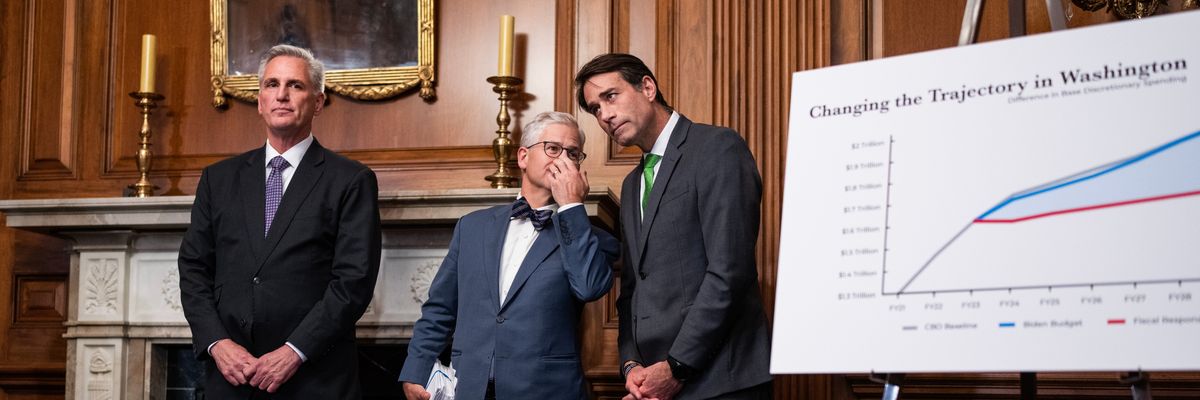
House Kevin McCarthy (R-Calif.) and Reps. Patrick McHenry (R-N.C.) and Garret Graves (R-La.) conduct a news conference on May 31, 2023.
"Democrats are united in stopping Republican attempts to take food out of the mouths of hungry Americans with their attacks on SNAP," wrote Rep. Jim McGovern.
Democrats on the U.S. House Agriculture Committee on Monday slammed the Republican leadership's ongoing attacks on federal nutrition assistance, specifically criticizing members of Speaker Kevin McCarthy's team for floating eligibility restrictions on top of those already imposed by the bipartisan debt ceiling agreement.
"You have seen what happens when leadership gets involved in dictating the details of the farm bill, particularly when the issue involved is SNAP, the safety net for America's working poor and elderly," the Democratic lawmakers wrote in a letter to McCarthy (R-Calif.), referring to the Supplemental Nutrition Assistance Program.
"The continued threat of making additional changes to SNAP eligibility or benefits is not helpful and even undermines [House Agriculture Committee Chair Glenn Thompson (R-Pa.)] as he works with his Democratic and Republican membership to bring a bipartisan farm bill out of the Agriculture Committee," the lawmakers continued. "Our nation's hungry and those who grow their food deserve a bipartisan farm bill to address their needs."
The Democratic lawmakers sent their letter days after Rep. Garret Graves (R-La.), one of McCarthy's top negotiators, told Politico that there is "additional progress or savings that can be maximized" with SNAP, an effective anti-hunger program that Republicans target for cuts every year.
"We kind of got what we could get in the debt ceiling," Graves said, pointing to the new SNAP work requirements for older adults—a change that experts say will put 750,000 people at risk of losing food aid. (Research has repeatedly shown that work requirements are not effective at boosting employment.)
"I think we're gonna continue working, whether it's [appropriations], farm bill, or others to keep building on it," added Graves, who is not a member of the House Agriculture Committee.
The House GOP leadership and rank-and-file Republicans—including members of the far-right Freedom Caucus—are looking to further restrict SNAP benefits at a time of increasing hunger across the U.S. According to recently released U.S. Census Bureau data, food insecurity has risen 35% since July 2021, impacting more than 27 million people.
"Democrats are united in stopping Republican attempts to take food out of the mouths of hungry Americans with their attacks on SNAP—America's most effective anti-hunger program," Rep. Jim McGovern (D-Mass.), a member of the House Agriculture Committee, wrote Monday.
On top of pursuing more changes to SNAP eligibility requirements, House Republicans are seeking $800 million in funding cuts to the Special Supplemental Nutrition Program for Women, Infants, and Children (WIC) in their agriculture appropriations bill for fiscal year 2024.
The Center on Budget and Policy Priorities (CBPP) warned last month that, if enacted, the cuts in the House GOP's agriculture legislation would be disastrous.
"We estimate that 650,000 to 750,000 eligible people—primarily toddlers, preschoolers, and postpartum adults—would be turned away from the Special Supplemental Nutrition Program for Women, Infants, and Children," wrote CBPP's Katie Bergh and Zoë Neuberger. "Another 4.6 million toddlers and preschoolers and pregnant, postpartum, and breastfeeding participants would have their benefits cut significantly."
Dear Common Dreams reader, It’s been nearly 30 years since I co-founded Common Dreams with my late wife, Lina Newhouser. We had the radical notion that journalism should serve the public good, not corporate profits. It was clear to us from the outset what it would take to build such a project. No paid advertisements. No corporate sponsors. No millionaire publisher telling us what to think or do. Many people said we wouldn't last a year, but we proved those doubters wrong. Together with a tremendous team of journalists and dedicated staff, we built an independent media outlet free from the constraints of profits and corporate control. Our mission has always been simple: To inform. To inspire. To ignite change for the common good. Building Common Dreams was not easy. Our survival was never guaranteed. When you take on the most powerful forces—Wall Street greed, fossil fuel industry destruction, Big Tech lobbyists, and uber-rich oligarchs who have spent billions upon billions rigging the economy and democracy in their favor—the only bulwark you have is supporters who believe in your work. But here’s the urgent message from me today. It's never been this bad out there. And it's never been this hard to keep us going. At the very moment Common Dreams is most needed, the threats we face are intensifying. We need your support now more than ever. We don't accept corporate advertising and never will. We don't have a paywall because we don't think people should be blocked from critical news based on their ability to pay. Everything we do is funded by the donations of readers like you. When everyone does the little they can afford, we are strong. But if that support retreats or dries up, so do we. Will you donate now to make sure Common Dreams not only survives but thrives? —Craig Brown, Co-founder |
Democrats on the U.S. House Agriculture Committee on Monday slammed the Republican leadership's ongoing attacks on federal nutrition assistance, specifically criticizing members of Speaker Kevin McCarthy's team for floating eligibility restrictions on top of those already imposed by the bipartisan debt ceiling agreement.
"You have seen what happens when leadership gets involved in dictating the details of the farm bill, particularly when the issue involved is SNAP, the safety net for America's working poor and elderly," the Democratic lawmakers wrote in a letter to McCarthy (R-Calif.), referring to the Supplemental Nutrition Assistance Program.
"The continued threat of making additional changes to SNAP eligibility or benefits is not helpful and even undermines [House Agriculture Committee Chair Glenn Thompson (R-Pa.)] as he works with his Democratic and Republican membership to bring a bipartisan farm bill out of the Agriculture Committee," the lawmakers continued. "Our nation's hungry and those who grow their food deserve a bipartisan farm bill to address their needs."
The Democratic lawmakers sent their letter days after Rep. Garret Graves (R-La.), one of McCarthy's top negotiators, told Politico that there is "additional progress or savings that can be maximized" with SNAP, an effective anti-hunger program that Republicans target for cuts every year.
"We kind of got what we could get in the debt ceiling," Graves said, pointing to the new SNAP work requirements for older adults—a change that experts say will put 750,000 people at risk of losing food aid. (Research has repeatedly shown that work requirements are not effective at boosting employment.)
"I think we're gonna continue working, whether it's [appropriations], farm bill, or others to keep building on it," added Graves, who is not a member of the House Agriculture Committee.
The House GOP leadership and rank-and-file Republicans—including members of the far-right Freedom Caucus—are looking to further restrict SNAP benefits at a time of increasing hunger across the U.S. According to recently released U.S. Census Bureau data, food insecurity has risen 35% since July 2021, impacting more than 27 million people.
"Democrats are united in stopping Republican attempts to take food out of the mouths of hungry Americans with their attacks on SNAP—America's most effective anti-hunger program," Rep. Jim McGovern (D-Mass.), a member of the House Agriculture Committee, wrote Monday.
On top of pursuing more changes to SNAP eligibility requirements, House Republicans are seeking $800 million in funding cuts to the Special Supplemental Nutrition Program for Women, Infants, and Children (WIC) in their agriculture appropriations bill for fiscal year 2024.
The Center on Budget and Policy Priorities (CBPP) warned last month that, if enacted, the cuts in the House GOP's agriculture legislation would be disastrous.
"We estimate that 650,000 to 750,000 eligible people—primarily toddlers, preschoolers, and postpartum adults—would be turned away from the Special Supplemental Nutrition Program for Women, Infants, and Children," wrote CBPP's Katie Bergh and Zoë Neuberger. "Another 4.6 million toddlers and preschoolers and pregnant, postpartum, and breastfeeding participants would have their benefits cut significantly."
Democrats on the U.S. House Agriculture Committee on Monday slammed the Republican leadership's ongoing attacks on federal nutrition assistance, specifically criticizing members of Speaker Kevin McCarthy's team for floating eligibility restrictions on top of those already imposed by the bipartisan debt ceiling agreement.
"You have seen what happens when leadership gets involved in dictating the details of the farm bill, particularly when the issue involved is SNAP, the safety net for America's working poor and elderly," the Democratic lawmakers wrote in a letter to McCarthy (R-Calif.), referring to the Supplemental Nutrition Assistance Program.
"The continued threat of making additional changes to SNAP eligibility or benefits is not helpful and even undermines [House Agriculture Committee Chair Glenn Thompson (R-Pa.)] as he works with his Democratic and Republican membership to bring a bipartisan farm bill out of the Agriculture Committee," the lawmakers continued. "Our nation's hungry and those who grow their food deserve a bipartisan farm bill to address their needs."
The Democratic lawmakers sent their letter days after Rep. Garret Graves (R-La.), one of McCarthy's top negotiators, told Politico that there is "additional progress or savings that can be maximized" with SNAP, an effective anti-hunger program that Republicans target for cuts every year.
"We kind of got what we could get in the debt ceiling," Graves said, pointing to the new SNAP work requirements for older adults—a change that experts say will put 750,000 people at risk of losing food aid. (Research has repeatedly shown that work requirements are not effective at boosting employment.)
"I think we're gonna continue working, whether it's [appropriations], farm bill, or others to keep building on it," added Graves, who is not a member of the House Agriculture Committee.
The House GOP leadership and rank-and-file Republicans—including members of the far-right Freedom Caucus—are looking to further restrict SNAP benefits at a time of increasing hunger across the U.S. According to recently released U.S. Census Bureau data, food insecurity has risen 35% since July 2021, impacting more than 27 million people.
"Democrats are united in stopping Republican attempts to take food out of the mouths of hungry Americans with their attacks on SNAP—America's most effective anti-hunger program," Rep. Jim McGovern (D-Mass.), a member of the House Agriculture Committee, wrote Monday.
On top of pursuing more changes to SNAP eligibility requirements, House Republicans are seeking $800 million in funding cuts to the Special Supplemental Nutrition Program for Women, Infants, and Children (WIC) in their agriculture appropriations bill for fiscal year 2024.
The Center on Budget and Policy Priorities (CBPP) warned last month that, if enacted, the cuts in the House GOP's agriculture legislation would be disastrous.
"We estimate that 650,000 to 750,000 eligible people—primarily toddlers, preschoolers, and postpartum adults—would be turned away from the Special Supplemental Nutrition Program for Women, Infants, and Children," wrote CBPP's Katie Bergh and Zoë Neuberger. "Another 4.6 million toddlers and preschoolers and pregnant, postpartum, and breastfeeding participants would have their benefits cut significantly."