SUBSCRIBE TO OUR FREE NEWSLETTER
Daily news & progressive opinion—funded by the people, not the corporations—delivered straight to your inbox.
5
#000000
#FFFFFF
To donate by check, phone, or other method, see our More Ways to Give page.
Daily news & progressive opinion—funded by the people, not the corporations—delivered straight to your inbox.
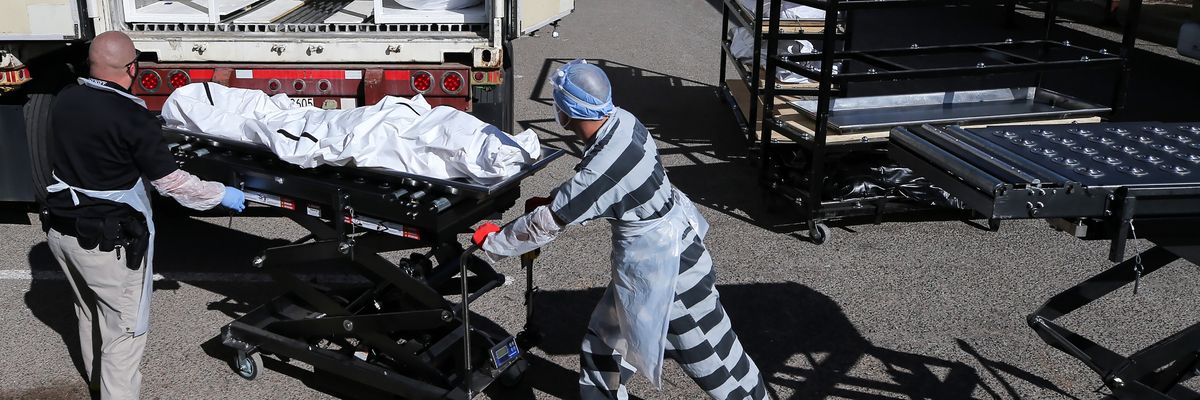
An El Paso County Jail inmate—who was paid $2 per hour—loads bodies into a refrigerated temporary morgue trailer outside the El Paso County Medical Examiner's office in Texas during the Covid-19 pandemic on November 17, 2020.
One of the U.N. experts who compiled the report after visiting the U.S. earlier this year said its findings "point to the critical need for comprehensive reform."
A report published Thursday by United Nations human rights experts condemns systemic racism in the U.S. criminal justice system and policing, while describing "appalling" prison conditions and decrying forced unpaid convict labor as a "contemporary form of slavery."
The U.N. International Independent Expert Mechanism to Advance Racial Justice and Equality in the Context of Law Enforcement report follows a visit to the U.S. earlier this year by a team of human rights experts. The U.N. officials collected testimonies from 133 affected people, visited five prisons and jails, and held meetings with advocacy groups and numerous government and police officials in Atlanta, Chicago, Los Angeles, Minneapolis, New York City, and Washington, D.C.
"In all the cities we went to, we heard dozens of heartbreaking testimonies on how victims do not get justice or redress. This is not new, and it's unacceptable," Tracie Keesee, an expert member of the mechanism, said in a statement. "This is a systemic issue that calls for a systemic response."
"Law enforcement and criminal justice institutions in the United States share and reproduce values, attitudes, and stereotypes of U.S. society and institutions. These must be reformed."
The experts found that "racism in the U.S.—a legacy of slavery, the slave trade, and 100 years of legalized apartheid that followed slavery's abolition—continues to exist today in the form of racial profiling, police killings, and many other human rights violations."
The report cites instances of prisoners locked away in solitary confinement—widely recognized as a form of psychological torture—for a decade or longer, children sentenced to life in prison, and pregnant inmates chained during childbirth, "who due to the chaining, lost their babies."
"All these practices—including shackling pregnant women before, during, and after labor—are an affront to human dignity and the best interest of the child," the report states. "Instruments of restraint shall never be used on women during labor, during childbirth, and immediately after childbirth, in accordance with the U.N. Standard Minimum Rules for the Treatment of Prisoners," also known as the Nelson Mandela Rules.
The experts were "astonished" that forced unpaid or poorly paid convict labor "exists to this day in the United States, constituting a contemporary form of slavery." The 13th Amendment to the U.S. Constitution outlawed slavery and involuntary servitude, "except as punishment for crime," and congressional efforts to close the loophole have been unsuccessful.
The report notes:
The delegation received shocking information over "plantation-style" prisons in Southern states, in which contemporary forms of slavery are reported. Commonly known as "Angola," the Louisiana State Penitentiary occupies an 18,000-acre former slave plantation, larger than the island of Manhattan. The plantation prison soil worked by incarcerated labor today is the same soil worked by slaves before the Civil War. Angola currently houses nearly 5,000 adult men, the majority of them Black men, forced to labor in the fields (even picking cotton) under the watch of white "freemen" on horseback, in conditions very similar to those of 150 years ago. The mechanism received direct testimonies from Angola victims and allegations of children being transferred to this prison, held in solitary confinement, and in general under appalling detention conditions.
Earlier this month, a federal judge ordered Louisiana officials to stop imprisoning children on Angola's former death row by September 15.
Addressing the more than 1,000 people killed annually by U.S. law enforcement officers—only 1% of which result in the killer being criminally charged—the report warns that such killings will continue unless police use of force regulations are aligned with international standards.
"We reject the 'bad apple' theory," There is strong evidence suggesting that the abusive behavior of some individual police officers is part of a broader and menacing pattern," said mechanism expert member Juan Méndez. "Law enforcement and criminal justice institutions in the United States share and reproduce values, attitudes, and stereotypes of U.S. society and institutions. These must be reformed."
To that end, the report contains a lengthy list of over 30 recommendations, including:
"Our findings," said Méndez, "point to the critical need for comprehensive reform."
Dear Common Dreams reader, It’s been nearly 30 years since I co-founded Common Dreams with my late wife, Lina Newhouser. We had the radical notion that journalism should serve the public good, not corporate profits. It was clear to us from the outset what it would take to build such a project. No paid advertisements. No corporate sponsors. No millionaire publisher telling us what to think or do. Many people said we wouldn't last a year, but we proved those doubters wrong. Together with a tremendous team of journalists and dedicated staff, we built an independent media outlet free from the constraints of profits and corporate control. Our mission has always been simple: To inform. To inspire. To ignite change for the common good. Building Common Dreams was not easy. Our survival was never guaranteed. When you take on the most powerful forces—Wall Street greed, fossil fuel industry destruction, Big Tech lobbyists, and uber-rich oligarchs who have spent billions upon billions rigging the economy and democracy in their favor—the only bulwark you have is supporters who believe in your work. But here’s the urgent message from me today. It's never been this bad out there. And it's never been this hard to keep us going. At the very moment Common Dreams is most needed, the threats we face are intensifying. We need your support now more than ever. We don't accept corporate advertising and never will. We don't have a paywall because we don't think people should be blocked from critical news based on their ability to pay. Everything we do is funded by the donations of readers like you. When everyone does the little they can afford, we are strong. But if that support retreats or dries up, so do we. Will you donate now to make sure Common Dreams not only survives but thrives? —Craig Brown, Co-founder |
A report published Thursday by United Nations human rights experts condemns systemic racism in the U.S. criminal justice system and policing, while describing "appalling" prison conditions and decrying forced unpaid convict labor as a "contemporary form of slavery."
The U.N. International Independent Expert Mechanism to Advance Racial Justice and Equality in the Context of Law Enforcement report follows a visit to the U.S. earlier this year by a team of human rights experts. The U.N. officials collected testimonies from 133 affected people, visited five prisons and jails, and held meetings with advocacy groups and numerous government and police officials in Atlanta, Chicago, Los Angeles, Minneapolis, New York City, and Washington, D.C.
"In all the cities we went to, we heard dozens of heartbreaking testimonies on how victims do not get justice or redress. This is not new, and it's unacceptable," Tracie Keesee, an expert member of the mechanism, said in a statement. "This is a systemic issue that calls for a systemic response."
"Law enforcement and criminal justice institutions in the United States share and reproduce values, attitudes, and stereotypes of U.S. society and institutions. These must be reformed."
The experts found that "racism in the U.S.—a legacy of slavery, the slave trade, and 100 years of legalized apartheid that followed slavery's abolition—continues to exist today in the form of racial profiling, police killings, and many other human rights violations."
The report cites instances of prisoners locked away in solitary confinement—widely recognized as a form of psychological torture—for a decade or longer, children sentenced to life in prison, and pregnant inmates chained during childbirth, "who due to the chaining, lost their babies."
"All these practices—including shackling pregnant women before, during, and after labor—are an affront to human dignity and the best interest of the child," the report states. "Instruments of restraint shall never be used on women during labor, during childbirth, and immediately after childbirth, in accordance with the U.N. Standard Minimum Rules for the Treatment of Prisoners," also known as the Nelson Mandela Rules.
The experts were "astonished" that forced unpaid or poorly paid convict labor "exists to this day in the United States, constituting a contemporary form of slavery." The 13th Amendment to the U.S. Constitution outlawed slavery and involuntary servitude, "except as punishment for crime," and congressional efforts to close the loophole have been unsuccessful.
The report notes:
The delegation received shocking information over "plantation-style" prisons in Southern states, in which contemporary forms of slavery are reported. Commonly known as "Angola," the Louisiana State Penitentiary occupies an 18,000-acre former slave plantation, larger than the island of Manhattan. The plantation prison soil worked by incarcerated labor today is the same soil worked by slaves before the Civil War. Angola currently houses nearly 5,000 adult men, the majority of them Black men, forced to labor in the fields (even picking cotton) under the watch of white "freemen" on horseback, in conditions very similar to those of 150 years ago. The mechanism received direct testimonies from Angola victims and allegations of children being transferred to this prison, held in solitary confinement, and in general under appalling detention conditions.
Earlier this month, a federal judge ordered Louisiana officials to stop imprisoning children on Angola's former death row by September 15.
Addressing the more than 1,000 people killed annually by U.S. law enforcement officers—only 1% of which result in the killer being criminally charged—the report warns that such killings will continue unless police use of force regulations are aligned with international standards.
"We reject the 'bad apple' theory," There is strong evidence suggesting that the abusive behavior of some individual police officers is part of a broader and menacing pattern," said mechanism expert member Juan Méndez. "Law enforcement and criminal justice institutions in the United States share and reproduce values, attitudes, and stereotypes of U.S. society and institutions. These must be reformed."
To that end, the report contains a lengthy list of over 30 recommendations, including:
"Our findings," said Méndez, "point to the critical need for comprehensive reform."
A report published Thursday by United Nations human rights experts condemns systemic racism in the U.S. criminal justice system and policing, while describing "appalling" prison conditions and decrying forced unpaid convict labor as a "contemporary form of slavery."
The U.N. International Independent Expert Mechanism to Advance Racial Justice and Equality in the Context of Law Enforcement report follows a visit to the U.S. earlier this year by a team of human rights experts. The U.N. officials collected testimonies from 133 affected people, visited five prisons and jails, and held meetings with advocacy groups and numerous government and police officials in Atlanta, Chicago, Los Angeles, Minneapolis, New York City, and Washington, D.C.
"In all the cities we went to, we heard dozens of heartbreaking testimonies on how victims do not get justice or redress. This is not new, and it's unacceptable," Tracie Keesee, an expert member of the mechanism, said in a statement. "This is a systemic issue that calls for a systemic response."
"Law enforcement and criminal justice institutions in the United States share and reproduce values, attitudes, and stereotypes of U.S. society and institutions. These must be reformed."
The experts found that "racism in the U.S.—a legacy of slavery, the slave trade, and 100 years of legalized apartheid that followed slavery's abolition—continues to exist today in the form of racial profiling, police killings, and many other human rights violations."
The report cites instances of prisoners locked away in solitary confinement—widely recognized as a form of psychological torture—for a decade or longer, children sentenced to life in prison, and pregnant inmates chained during childbirth, "who due to the chaining, lost their babies."
"All these practices—including shackling pregnant women before, during, and after labor—are an affront to human dignity and the best interest of the child," the report states. "Instruments of restraint shall never be used on women during labor, during childbirth, and immediately after childbirth, in accordance with the U.N. Standard Minimum Rules for the Treatment of Prisoners," also known as the Nelson Mandela Rules.
The experts were "astonished" that forced unpaid or poorly paid convict labor "exists to this day in the United States, constituting a contemporary form of slavery." The 13th Amendment to the U.S. Constitution outlawed slavery and involuntary servitude, "except as punishment for crime," and congressional efforts to close the loophole have been unsuccessful.
The report notes:
The delegation received shocking information over "plantation-style" prisons in Southern states, in which contemporary forms of slavery are reported. Commonly known as "Angola," the Louisiana State Penitentiary occupies an 18,000-acre former slave plantation, larger than the island of Manhattan. The plantation prison soil worked by incarcerated labor today is the same soil worked by slaves before the Civil War. Angola currently houses nearly 5,000 adult men, the majority of them Black men, forced to labor in the fields (even picking cotton) under the watch of white "freemen" on horseback, in conditions very similar to those of 150 years ago. The mechanism received direct testimonies from Angola victims and allegations of children being transferred to this prison, held in solitary confinement, and in general under appalling detention conditions.
Earlier this month, a federal judge ordered Louisiana officials to stop imprisoning children on Angola's former death row by September 15.
Addressing the more than 1,000 people killed annually by U.S. law enforcement officers—only 1% of which result in the killer being criminally charged—the report warns that such killings will continue unless police use of force regulations are aligned with international standards.
"We reject the 'bad apple' theory," There is strong evidence suggesting that the abusive behavior of some individual police officers is part of a broader and menacing pattern," said mechanism expert member Juan Méndez. "Law enforcement and criminal justice institutions in the United States share and reproduce values, attitudes, and stereotypes of U.S. society and institutions. These must be reformed."
To that end, the report contains a lengthy list of over 30 recommendations, including:
"Our findings," said Méndez, "point to the critical need for comprehensive reform."