

SUBSCRIBE TO OUR FREE NEWSLETTER
Daily news & progressive opinion—funded by the people, not the corporations—delivered straight to your inbox.
5
#000000
#FFFFFF
To donate by check, phone, or other method, see our More Ways to Give page.
Daily news & progressive opinion—funded by the people, not the corporations—delivered straight to your inbox.
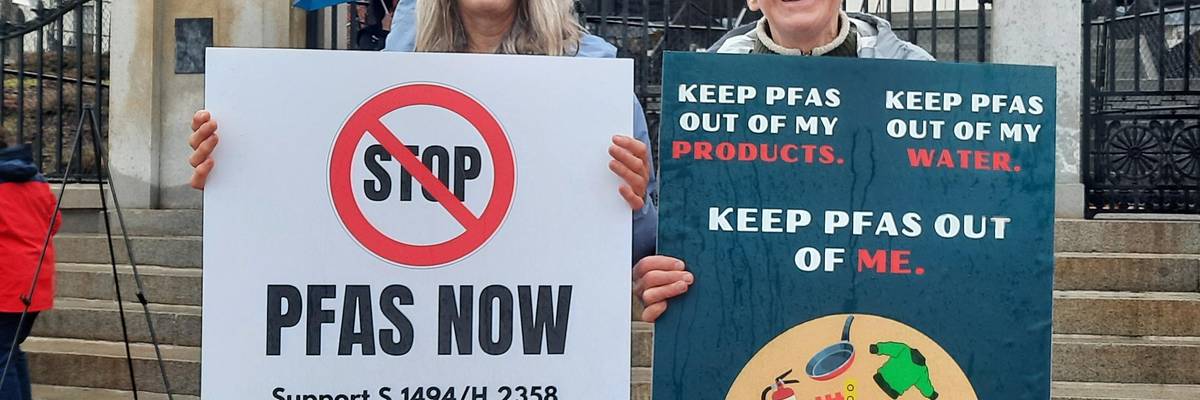
Activists protest PFAS outside the Massachusetts State House in Boston on June 16, 2022.
"These documents reveal clear evidence that the chemical industry knew about the dangers of PFAS and failed to let the public, regulators, and even their own employees know the risks."
An analysis of previously secret documents published Wednesday sheds new light on how chemical corporations aped Big Tobacco by conspiring to conceal the extreme toxicity of a class of synthetic compounds contaminating the Earth's air, water, soil, plants, and animals—including most of the world's people.
Commonly called "forever chemicals" because they do not biodegrade and accumulate in the human body, per- and polyfluoroalkyl substances (PFAS)—which include PFOS, PFOA, and GenX—have myriad uses, from nonstick cookware to waterproof clothing to firefighting foam. According to the U.S. Agency for Toxic Substances and Disease Registry, PFAS is linked to cancers of the kidneys and testicles, low infant weight, suppressed immune function, and other adverse health effects. It is found in the blood of 99% of Americans and a similar percentage of people around the world.
"The industry used several strategies that have been shown common to tobacco, pharmaceutical, and other industries to influence science and regulation—most notably, suppressing unfavorable research and distorting public discourse."
But that wasn't known until recently. Scientists and public health officials were some of the first to understand the dangers of PFAS, and in recent years, exposés like Stephanie Soechtig and Jeremy Seifer's 2018 documentary feature The Devil We Know and a 2022 episode of HBO's "Last Week Tonight" in which host John Oliver called PFAS "the devil's piss" raised awareness of the "forever chemicals." In 2018, Congress held its first hearing, and around that time it emerged that chemical giants DuPont and 3M understood—and covered up—the dangers of PFAS.
The Devil They Knew: Chemical Documents Analysis of Industry Influence on PFAS Science—a new paper published in the peer-reviewed journal Annals of Global Health—enriches understanding of the chemical industry's role in concealing the dangers of PFAS. It includes documents like a 1970 DuPont internal memo stating the PFOA C8—used to make the nonstick surface Teflon—is "highly toxic when inhaled and moderately toxic when injected."
"These documents reveal clear evidence that the chemical industry knew about the dangers of PFAS and failed to let the public, regulators, and even their own employees know the risks," Tracey J. Woodruff—who wrote the paper with Nadia Gaber and Lisa Bero—told Phys.org.
One 1979 DuPont report describes a range of highly toxic effects from testing PFAS on animals, including two beagles who died after being administered a single 450 mg dose of ammonium perfluorooctanoate, and rats that suffered enlarged livers and eye ulcers.
Another document, from 1980, shows DuPont and 3M learned that two out of eight pregnant employees who worked making C8 had babies with birth defects, but then lied the following year in a memo declaring that "we know of no evidence of birth defects" caused by C8.
"Further, the industry used several strategies that have been shown common to tobacco, pharmaceutical, and other industries to influence science and regulation—most notably, suppressing unfavorable research and distorting public discourse," the paper states.
The paper's authors did not find "evidence in this archive of funding favorable research or targeted dissemination of those results."
Among the paper's key findings:
"The lack of transparency in industry-driven research on industrial chemicals has significant legal, political, and public health consequences," the paper's authors concluded. "Industry strategies to suppress scientific research findings or early warnings about the hazards of industrial chemicals can be analyzed and exposed, in order to guide prevention."
Recent years have seen an exponential proliferation of PFAS-related litigation, sometimes resulting in verdicts like the $40 million awarded by an Ohio jury to a man who claimed exposure to PFOA in his drinking water gave him testicular cancer twice.
In recent days, states including Arizona, Maryland, Rhode Island, and Washington have sued companies that manufacture PFAS.
"These companies have known for decades that so-called 'forever chemicals' would contaminate water supplies for generations to come but chose to sell their products anyway," said Arizona Attorney General Kris Mayes, a Democrat. "The failure by these polluters to inform the state about the risks associated with these chemicals has harmed our environment and the health of Arizonans—and they must be held accountable."
Last week, Common Dreams reported that Minnesota Gov. Tim Walz, also a Democrat, signed into law the nation's broadest PFAS ban. The legislation gradually phases out most PFAS use until "forever chemicals" will be prohibited in all products not essential for public health by 2032.
Dear Common Dreams reader, It’s been nearly 30 years since I co-founded Common Dreams with my late wife, Lina Newhouser. We had the radical notion that journalism should serve the public good, not corporate profits. It was clear to us from the outset what it would take to build such a project. No paid advertisements. No corporate sponsors. No millionaire publisher telling us what to think or do. Many people said we wouldn't last a year, but we proved those doubters wrong. Together with a tremendous team of journalists and dedicated staff, we built an independent media outlet free from the constraints of profits and corporate control. Our mission has always been simple: To inform. To inspire. To ignite change for the common good. Building Common Dreams was not easy. Our survival was never guaranteed. When you take on the most powerful forces—Wall Street greed, fossil fuel industry destruction, Big Tech lobbyists, and uber-rich oligarchs who have spent billions upon billions rigging the economy and democracy in their favor—the only bulwark you have is supporters who believe in your work. But here’s the urgent message from me today. It's never been this bad out there. And it's never been this hard to keep us going. At the very moment Common Dreams is most needed, the threats we face are intensifying. We need your support now more than ever. We don't accept corporate advertising and never will. We don't have a paywall because we don't think people should be blocked from critical news based on their ability to pay. Everything we do is funded by the donations of readers like you. When everyone does the little they can afford, we are strong. But if that support retreats or dries up, so do we. Will you donate now to make sure Common Dreams not only survives but thrives? —Craig Brown, Co-founder |
An analysis of previously secret documents published Wednesday sheds new light on how chemical corporations aped Big Tobacco by conspiring to conceal the extreme toxicity of a class of synthetic compounds contaminating the Earth's air, water, soil, plants, and animals—including most of the world's people.
Commonly called "forever chemicals" because they do not biodegrade and accumulate in the human body, per- and polyfluoroalkyl substances (PFAS)—which include PFOS, PFOA, and GenX—have myriad uses, from nonstick cookware to waterproof clothing to firefighting foam. According to the U.S. Agency for Toxic Substances and Disease Registry, PFAS is linked to cancers of the kidneys and testicles, low infant weight, suppressed immune function, and other adverse health effects. It is found in the blood of 99% of Americans and a similar percentage of people around the world.
"The industry used several strategies that have been shown common to tobacco, pharmaceutical, and other industries to influence science and regulation—most notably, suppressing unfavorable research and distorting public discourse."
But that wasn't known until recently. Scientists and public health officials were some of the first to understand the dangers of PFAS, and in recent years, exposés like Stephanie Soechtig and Jeremy Seifer's 2018 documentary feature The Devil We Know and a 2022 episode of HBO's "Last Week Tonight" in which host John Oliver called PFAS "the devil's piss" raised awareness of the "forever chemicals." In 2018, Congress held its first hearing, and around that time it emerged that chemical giants DuPont and 3M understood—and covered up—the dangers of PFAS.
The Devil They Knew: Chemical Documents Analysis of Industry Influence on PFAS Science—a new paper published in the peer-reviewed journal Annals of Global Health—enriches understanding of the chemical industry's role in concealing the dangers of PFAS. It includes documents like a 1970 DuPont internal memo stating the PFOA C8—used to make the nonstick surface Teflon—is "highly toxic when inhaled and moderately toxic when injected."
"These documents reveal clear evidence that the chemical industry knew about the dangers of PFAS and failed to let the public, regulators, and even their own employees know the risks," Tracey J. Woodruff—who wrote the paper with Nadia Gaber and Lisa Bero—told Phys.org.
One 1979 DuPont report describes a range of highly toxic effects from testing PFAS on animals, including two beagles who died after being administered a single 450 mg dose of ammonium perfluorooctanoate, and rats that suffered enlarged livers and eye ulcers.
Another document, from 1980, shows DuPont and 3M learned that two out of eight pregnant employees who worked making C8 had babies with birth defects, but then lied the following year in a memo declaring that "we know of no evidence of birth defects" caused by C8.
"Further, the industry used several strategies that have been shown common to tobacco, pharmaceutical, and other industries to influence science and regulation—most notably, suppressing unfavorable research and distorting public discourse," the paper states.
The paper's authors did not find "evidence in this archive of funding favorable research or targeted dissemination of those results."
Among the paper's key findings:
"The lack of transparency in industry-driven research on industrial chemicals has significant legal, political, and public health consequences," the paper's authors concluded. "Industry strategies to suppress scientific research findings or early warnings about the hazards of industrial chemicals can be analyzed and exposed, in order to guide prevention."
Recent years have seen an exponential proliferation of PFAS-related litigation, sometimes resulting in verdicts like the $40 million awarded by an Ohio jury to a man who claimed exposure to PFOA in his drinking water gave him testicular cancer twice.
In recent days, states including Arizona, Maryland, Rhode Island, and Washington have sued companies that manufacture PFAS.
"These companies have known for decades that so-called 'forever chemicals' would contaminate water supplies for generations to come but chose to sell their products anyway," said Arizona Attorney General Kris Mayes, a Democrat. "The failure by these polluters to inform the state about the risks associated with these chemicals has harmed our environment and the health of Arizonans—and they must be held accountable."
Last week, Common Dreams reported that Minnesota Gov. Tim Walz, also a Democrat, signed into law the nation's broadest PFAS ban. The legislation gradually phases out most PFAS use until "forever chemicals" will be prohibited in all products not essential for public health by 2032.
An analysis of previously secret documents published Wednesday sheds new light on how chemical corporations aped Big Tobacco by conspiring to conceal the extreme toxicity of a class of synthetic compounds contaminating the Earth's air, water, soil, plants, and animals—including most of the world's people.
Commonly called "forever chemicals" because they do not biodegrade and accumulate in the human body, per- and polyfluoroalkyl substances (PFAS)—which include PFOS, PFOA, and GenX—have myriad uses, from nonstick cookware to waterproof clothing to firefighting foam. According to the U.S. Agency for Toxic Substances and Disease Registry, PFAS is linked to cancers of the kidneys and testicles, low infant weight, suppressed immune function, and other adverse health effects. It is found in the blood of 99% of Americans and a similar percentage of people around the world.
"The industry used several strategies that have been shown common to tobacco, pharmaceutical, and other industries to influence science and regulation—most notably, suppressing unfavorable research and distorting public discourse."
But that wasn't known until recently. Scientists and public health officials were some of the first to understand the dangers of PFAS, and in recent years, exposés like Stephanie Soechtig and Jeremy Seifer's 2018 documentary feature The Devil We Know and a 2022 episode of HBO's "Last Week Tonight" in which host John Oliver called PFAS "the devil's piss" raised awareness of the "forever chemicals." In 2018, Congress held its first hearing, and around that time it emerged that chemical giants DuPont and 3M understood—and covered up—the dangers of PFAS.
The Devil They Knew: Chemical Documents Analysis of Industry Influence on PFAS Science—a new paper published in the peer-reviewed journal Annals of Global Health—enriches understanding of the chemical industry's role in concealing the dangers of PFAS. It includes documents like a 1970 DuPont internal memo stating the PFOA C8—used to make the nonstick surface Teflon—is "highly toxic when inhaled and moderately toxic when injected."
"These documents reveal clear evidence that the chemical industry knew about the dangers of PFAS and failed to let the public, regulators, and even their own employees know the risks," Tracey J. Woodruff—who wrote the paper with Nadia Gaber and Lisa Bero—told Phys.org.
One 1979 DuPont report describes a range of highly toxic effects from testing PFAS on animals, including two beagles who died after being administered a single 450 mg dose of ammonium perfluorooctanoate, and rats that suffered enlarged livers and eye ulcers.
Another document, from 1980, shows DuPont and 3M learned that two out of eight pregnant employees who worked making C8 had babies with birth defects, but then lied the following year in a memo declaring that "we know of no evidence of birth defects" caused by C8.
"Further, the industry used several strategies that have been shown common to tobacco, pharmaceutical, and other industries to influence science and regulation—most notably, suppressing unfavorable research and distorting public discourse," the paper states.
The paper's authors did not find "evidence in this archive of funding favorable research or targeted dissemination of those results."
Among the paper's key findings:
"The lack of transparency in industry-driven research on industrial chemicals has significant legal, political, and public health consequences," the paper's authors concluded. "Industry strategies to suppress scientific research findings or early warnings about the hazards of industrial chemicals can be analyzed and exposed, in order to guide prevention."
Recent years have seen an exponential proliferation of PFAS-related litigation, sometimes resulting in verdicts like the $40 million awarded by an Ohio jury to a man who claimed exposure to PFOA in his drinking water gave him testicular cancer twice.
In recent days, states including Arizona, Maryland, Rhode Island, and Washington have sued companies that manufacture PFAS.
"These companies have known for decades that so-called 'forever chemicals' would contaminate water supplies for generations to come but chose to sell their products anyway," said Arizona Attorney General Kris Mayes, a Democrat. "The failure by these polluters to inform the state about the risks associated with these chemicals has harmed our environment and the health of Arizonans—and they must be held accountable."
Last week, Common Dreams reported that Minnesota Gov. Tim Walz, also a Democrat, signed into law the nation's broadest PFAS ban. The legislation gradually phases out most PFAS use until "forever chemicals" will be prohibited in all products not essential for public health by 2032.

