SUBSCRIBE TO OUR FREE NEWSLETTER
Daily news & progressive opinion—funded by the people, not the corporations—delivered straight to your inbox.
5
#000000
#FFFFFF
To donate by check, phone, or other method, see our More Ways to Give page.
Daily news & progressive opinion—funded by the people, not the corporations—delivered straight to your inbox.
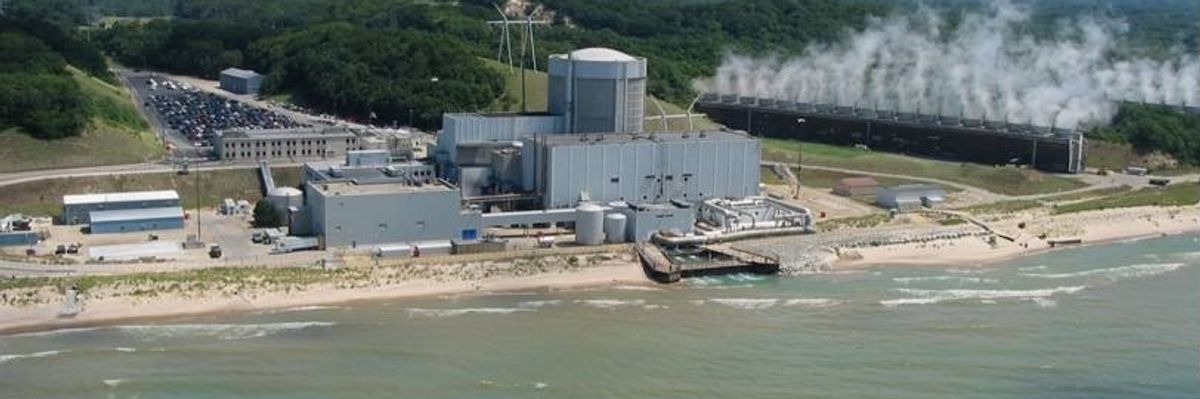
Palisades Nuclear Power Plant is seen in Covert, Michigan.
"This more than $10 billion in ratepayer and taxpayer robbery would merely fund an insanely high-risk game of radioactive Russian roulette on the Lake Michigan shoreline," said one critic.
A coalition of 191 individuals and 185 groups representing thousands of people on Wednesday implored the federal government for the third time not to fund the revival of a roughly 51-year-old nuclear power plant that was shut down last May in Covert, Michigan.
In a letter to the U.S. Department of Energy (DOE), the coalition warned that providing financial aid to Holtec International, which purchased the Palisades Nuclear Plant (PNP) last June, could lead to a massive public health and environmental disaster that reverberates far beyond the shoreline of Lake Michigan—a source of drinking water for millions of people in multiple states.
A little over a week after taking ownership of PNP "under the false pretense of decommissioning it," Holtec secretly applied for funding from the DOE's Civil Nuclear Credit (CNC) program in early July to reopen the plant, the coalition explained in a statement. The company's application—supported by Democratic Michigan Gov. Gretchen Whitmer, who had been advocating for a "dangerous 'zombie reactor' bailout and restart scheme at Palisades" since April 2022—was made public in early September.
Thanks in part to opposition from the coalition, which sent its first letter to U.S. Energy Secretary Jennifer Granholm in September, the DOE rejected Holtec's first funding request in mid-November. The following month, however, Holtec announced it would apply for federal funding during a second round of allocations, prompting a second letter of opposition from the coalition.
As The Holland Sentinel reported earlier this month: "Holtec is taking a different route with its second attempt at funding. Rather than applying through the CNC program, the company applied for funds from the U.S. Department of Energy loan office."
Terry Lodge, legal counsel for the coalition's lead groups, Beyond Nuclear and Don't Waste Michigan, wrote in Wednesday's letter that "DOE's recently issued amended 'guidance,' which was specifically rewritten to enable Holtec to apply for $1.2 billion of federal taxpayer funds, is not legal under the Infrastructure Investment and Jobs Act (IIJA)."
"We understand that Holtec... may be applying to DOE for a subsidized loan under a different law, with the intention of using funds from the IIJA to pay off the loan," wrote Lodge. "We question whether such a combined transaction would be lawful under the IIJA. Even if it is, IIJA credits may not be used to support Palisades. Congress intended the IIJA to support only currently operating commercial nuclear reactors that face termination of operations for economic reasons. Palisades does not meet any criteria for eligibility."
The coalition once again asked Granholm—a former Democratic governor and attorney general of Michigan—and other high-ranking officials at the DOE to deny Holtec's request that the non-operational PNP be certified to receive such federal funding.
Most importantly, PNP is unable "to operate safely due to a litany of chronic and acute problems associated with age-related degradation and neglected maintenance on safety-significant systems, structures, and components," the coalition argued in its statement. "This includes the worst neutron-embrittled reactor pressure vessel in the country and perhaps the world, at risk of pressurized thermal shock through-wall fracture, which would lead to reactor core meltdown."
"But additional pathways to catastrophic meltdown include a reactor lid, as well as steam generators, that have needed replacement for 17 years or longer," the coalition continued. "Palisades' control rod drive mechanism seal leaks have been uniquely bad in all of industry, for more than a half-century. Now added to this long list is Holtec's neglect of vital maintenance, such as of the turbo-generator, bending under its own immense weight, as well as the steam generators, to name but two examples."
Holtec has "applied to DOE for a billion dollar federal taxpayer-backed nuclear loan guarantee under the Inflation Reduction Act, which it would use to promote the reactor restart scheme, hoping to pay it back over time with the CNC program bailout," said the coalition. In addition, Holtec is "seeking a more than billion dollar subsidy from the state of Michigan, as well as yet another lucrative, above-market rate power purchase agreement with an unnamed utility company in the area. Also, Holtec has applied to DOE for $7.4 billion in federal nuclear loan guarantees, authorized under the 2005 Energy Policy Act and congressionally appropriated on December 23, 2007, for the design certification, construction, and operation of four small modular (nuclear) reactors, more than one of which would also be located at the Palisades site."
In the words of Kevin Kamps, a radioactive waste specialist at Beyond Nuclear and board member of Don't Waste Michigan, "This more than $10 billion in ratepayer and taxpayer robbery would merely fund an insanely high-risk game of radioactive Russian roulette on the Lake Michigan shoreline."
"Both extremes of the risk spectrum would be co-located at the Palisades site, if Holtec gets its way," said Kamps. "The ever-worsening breakdown phase risks at the old reactor would exist alongside the break-in phase risks of the new reactors, risking a Chernobyl-scale catastrophe, with the potential for Fukushima-style, domino-effect, multiple meltdowns."
According to The Holland Sentinel: "Holtec has acknowledged there will be 'a number of hurdles' to reopening the plant even if funding is secured. Those include financial commitment from the state, procuring a power purchasing agreement, upgrading the switchyard, partnering with a licensed operator for the restart, rehiring qualified and trained staff, and maintenance and delayed capital improvements of the facility—the plant closed earlier than planned due to failure of a control rod drive seal."
Citing comments a U.S. Nuclear Regulatory Commission official made during a public meeting on Monday, MLive reported this week that PNP "would be the first plant to enter the decommissioning phase and then try to restart."
During the meeting, Kamps declared, "Over my dead body are you all going to get away with this."
Dear Common Dreams reader, It’s been nearly 30 years since I co-founded Common Dreams with my late wife, Lina Newhouser. We had the radical notion that journalism should serve the public good, not corporate profits. It was clear to us from the outset what it would take to build such a project. No paid advertisements. No corporate sponsors. No millionaire publisher telling us what to think or do. Many people said we wouldn't last a year, but we proved those doubters wrong. Together with a tremendous team of journalists and dedicated staff, we built an independent media outlet free from the constraints of profits and corporate control. Our mission has always been simple: To inform. To inspire. To ignite change for the common good. Building Common Dreams was not easy. Our survival was never guaranteed. When you take on the most powerful forces—Wall Street greed, fossil fuel industry destruction, Big Tech lobbyists, and uber-rich oligarchs who have spent billions upon billions rigging the economy and democracy in their favor—the only bulwark you have is supporters who believe in your work. But here’s the urgent message from me today. It's never been this bad out there. And it's never been this hard to keep us going. At the very moment Common Dreams is most needed, the threats we face are intensifying. We need your support now more than ever. We don't accept corporate advertising and never will. We don't have a paywall because we don't think people should be blocked from critical news based on their ability to pay. Everything we do is funded by the donations of readers like you. When everyone does the little they can afford, we are strong. But if that support retreats or dries up, so do we. Will you donate now to make sure Common Dreams not only survives but thrives? —Craig Brown, Co-founder |
A coalition of 191 individuals and 185 groups representing thousands of people on Wednesday implored the federal government for the third time not to fund the revival of a roughly 51-year-old nuclear power plant that was shut down last May in Covert, Michigan.
In a letter to the U.S. Department of Energy (DOE), the coalition warned that providing financial aid to Holtec International, which purchased the Palisades Nuclear Plant (PNP) last June, could lead to a massive public health and environmental disaster that reverberates far beyond the shoreline of Lake Michigan—a source of drinking water for millions of people in multiple states.
A little over a week after taking ownership of PNP "under the false pretense of decommissioning it," Holtec secretly applied for funding from the DOE's Civil Nuclear Credit (CNC) program in early July to reopen the plant, the coalition explained in a statement. The company's application—supported by Democratic Michigan Gov. Gretchen Whitmer, who had been advocating for a "dangerous 'zombie reactor' bailout and restart scheme at Palisades" since April 2022—was made public in early September.
Thanks in part to opposition from the coalition, which sent its first letter to U.S. Energy Secretary Jennifer Granholm in September, the DOE rejected Holtec's first funding request in mid-November. The following month, however, Holtec announced it would apply for federal funding during a second round of allocations, prompting a second letter of opposition from the coalition.
As The Holland Sentinel reported earlier this month: "Holtec is taking a different route with its second attempt at funding. Rather than applying through the CNC program, the company applied for funds from the U.S. Department of Energy loan office."
Terry Lodge, legal counsel for the coalition's lead groups, Beyond Nuclear and Don't Waste Michigan, wrote in Wednesday's letter that "DOE's recently issued amended 'guidance,' which was specifically rewritten to enable Holtec to apply for $1.2 billion of federal taxpayer funds, is not legal under the Infrastructure Investment and Jobs Act (IIJA)."
"We understand that Holtec... may be applying to DOE for a subsidized loan under a different law, with the intention of using funds from the IIJA to pay off the loan," wrote Lodge. "We question whether such a combined transaction would be lawful under the IIJA. Even if it is, IIJA credits may not be used to support Palisades. Congress intended the IIJA to support only currently operating commercial nuclear reactors that face termination of operations for economic reasons. Palisades does not meet any criteria for eligibility."
The coalition once again asked Granholm—a former Democratic governor and attorney general of Michigan—and other high-ranking officials at the DOE to deny Holtec's request that the non-operational PNP be certified to receive such federal funding.
Most importantly, PNP is unable "to operate safely due to a litany of chronic and acute problems associated with age-related degradation and neglected maintenance on safety-significant systems, structures, and components," the coalition argued in its statement. "This includes the worst neutron-embrittled reactor pressure vessel in the country and perhaps the world, at risk of pressurized thermal shock through-wall fracture, which would lead to reactor core meltdown."
"But additional pathways to catastrophic meltdown include a reactor lid, as well as steam generators, that have needed replacement for 17 years or longer," the coalition continued. "Palisades' control rod drive mechanism seal leaks have been uniquely bad in all of industry, for more than a half-century. Now added to this long list is Holtec's neglect of vital maintenance, such as of the turbo-generator, bending under its own immense weight, as well as the steam generators, to name but two examples."
Holtec has "applied to DOE for a billion dollar federal taxpayer-backed nuclear loan guarantee under the Inflation Reduction Act, which it would use to promote the reactor restart scheme, hoping to pay it back over time with the CNC program bailout," said the coalition. In addition, Holtec is "seeking a more than billion dollar subsidy from the state of Michigan, as well as yet another lucrative, above-market rate power purchase agreement with an unnamed utility company in the area. Also, Holtec has applied to DOE for $7.4 billion in federal nuclear loan guarantees, authorized under the 2005 Energy Policy Act and congressionally appropriated on December 23, 2007, for the design certification, construction, and operation of four small modular (nuclear) reactors, more than one of which would also be located at the Palisades site."
In the words of Kevin Kamps, a radioactive waste specialist at Beyond Nuclear and board member of Don't Waste Michigan, "This more than $10 billion in ratepayer and taxpayer robbery would merely fund an insanely high-risk game of radioactive Russian roulette on the Lake Michigan shoreline."
"Both extremes of the risk spectrum would be co-located at the Palisades site, if Holtec gets its way," said Kamps. "The ever-worsening breakdown phase risks at the old reactor would exist alongside the break-in phase risks of the new reactors, risking a Chernobyl-scale catastrophe, with the potential for Fukushima-style, domino-effect, multiple meltdowns."
According to The Holland Sentinel: "Holtec has acknowledged there will be 'a number of hurdles' to reopening the plant even if funding is secured. Those include financial commitment from the state, procuring a power purchasing agreement, upgrading the switchyard, partnering with a licensed operator for the restart, rehiring qualified and trained staff, and maintenance and delayed capital improvements of the facility—the plant closed earlier than planned due to failure of a control rod drive seal."
Citing comments a U.S. Nuclear Regulatory Commission official made during a public meeting on Monday, MLive reported this week that PNP "would be the first plant to enter the decommissioning phase and then try to restart."
During the meeting, Kamps declared, "Over my dead body are you all going to get away with this."
A coalition of 191 individuals and 185 groups representing thousands of people on Wednesday implored the federal government for the third time not to fund the revival of a roughly 51-year-old nuclear power plant that was shut down last May in Covert, Michigan.
In a letter to the U.S. Department of Energy (DOE), the coalition warned that providing financial aid to Holtec International, which purchased the Palisades Nuclear Plant (PNP) last June, could lead to a massive public health and environmental disaster that reverberates far beyond the shoreline of Lake Michigan—a source of drinking water for millions of people in multiple states.
A little over a week after taking ownership of PNP "under the false pretense of decommissioning it," Holtec secretly applied for funding from the DOE's Civil Nuclear Credit (CNC) program in early July to reopen the plant, the coalition explained in a statement. The company's application—supported by Democratic Michigan Gov. Gretchen Whitmer, who had been advocating for a "dangerous 'zombie reactor' bailout and restart scheme at Palisades" since April 2022—was made public in early September.
Thanks in part to opposition from the coalition, which sent its first letter to U.S. Energy Secretary Jennifer Granholm in September, the DOE rejected Holtec's first funding request in mid-November. The following month, however, Holtec announced it would apply for federal funding during a second round of allocations, prompting a second letter of opposition from the coalition.
As The Holland Sentinel reported earlier this month: "Holtec is taking a different route with its second attempt at funding. Rather than applying through the CNC program, the company applied for funds from the U.S. Department of Energy loan office."
Terry Lodge, legal counsel for the coalition's lead groups, Beyond Nuclear and Don't Waste Michigan, wrote in Wednesday's letter that "DOE's recently issued amended 'guidance,' which was specifically rewritten to enable Holtec to apply for $1.2 billion of federal taxpayer funds, is not legal under the Infrastructure Investment and Jobs Act (IIJA)."
"We understand that Holtec... may be applying to DOE for a subsidized loan under a different law, with the intention of using funds from the IIJA to pay off the loan," wrote Lodge. "We question whether such a combined transaction would be lawful under the IIJA. Even if it is, IIJA credits may not be used to support Palisades. Congress intended the IIJA to support only currently operating commercial nuclear reactors that face termination of operations for economic reasons. Palisades does not meet any criteria for eligibility."
The coalition once again asked Granholm—a former Democratic governor and attorney general of Michigan—and other high-ranking officials at the DOE to deny Holtec's request that the non-operational PNP be certified to receive such federal funding.
Most importantly, PNP is unable "to operate safely due to a litany of chronic and acute problems associated with age-related degradation and neglected maintenance on safety-significant systems, structures, and components," the coalition argued in its statement. "This includes the worst neutron-embrittled reactor pressure vessel in the country and perhaps the world, at risk of pressurized thermal shock through-wall fracture, which would lead to reactor core meltdown."
"But additional pathways to catastrophic meltdown include a reactor lid, as well as steam generators, that have needed replacement for 17 years or longer," the coalition continued. "Palisades' control rod drive mechanism seal leaks have been uniquely bad in all of industry, for more than a half-century. Now added to this long list is Holtec's neglect of vital maintenance, such as of the turbo-generator, bending under its own immense weight, as well as the steam generators, to name but two examples."
Holtec has "applied to DOE for a billion dollar federal taxpayer-backed nuclear loan guarantee under the Inflation Reduction Act, which it would use to promote the reactor restart scheme, hoping to pay it back over time with the CNC program bailout," said the coalition. In addition, Holtec is "seeking a more than billion dollar subsidy from the state of Michigan, as well as yet another lucrative, above-market rate power purchase agreement with an unnamed utility company in the area. Also, Holtec has applied to DOE for $7.4 billion in federal nuclear loan guarantees, authorized under the 2005 Energy Policy Act and congressionally appropriated on December 23, 2007, for the design certification, construction, and operation of four small modular (nuclear) reactors, more than one of which would also be located at the Palisades site."
In the words of Kevin Kamps, a radioactive waste specialist at Beyond Nuclear and board member of Don't Waste Michigan, "This more than $10 billion in ratepayer and taxpayer robbery would merely fund an insanely high-risk game of radioactive Russian roulette on the Lake Michigan shoreline."
"Both extremes of the risk spectrum would be co-located at the Palisades site, if Holtec gets its way," said Kamps. "The ever-worsening breakdown phase risks at the old reactor would exist alongside the break-in phase risks of the new reactors, risking a Chernobyl-scale catastrophe, with the potential for Fukushima-style, domino-effect, multiple meltdowns."
According to The Holland Sentinel: "Holtec has acknowledged there will be 'a number of hurdles' to reopening the plant even if funding is secured. Those include financial commitment from the state, procuring a power purchasing agreement, upgrading the switchyard, partnering with a licensed operator for the restart, rehiring qualified and trained staff, and maintenance and delayed capital improvements of the facility—the plant closed earlier than planned due to failure of a control rod drive seal."
Citing comments a U.S. Nuclear Regulatory Commission official made during a public meeting on Monday, MLive reported this week that PNP "would be the first plant to enter the decommissioning phase and then try to restart."
During the meeting, Kamps declared, "Over my dead body are you all going to get away with this."