SUBSCRIBE TO OUR FREE NEWSLETTER
Daily news & progressive opinion—funded by the people, not the corporations—delivered straight to your inbox.
5
#000000
#FFFFFF
To donate by check, phone, or other method, see our More Ways to Give page.
Daily news & progressive opinion—funded by the people, not the corporations—delivered straight to your inbox.
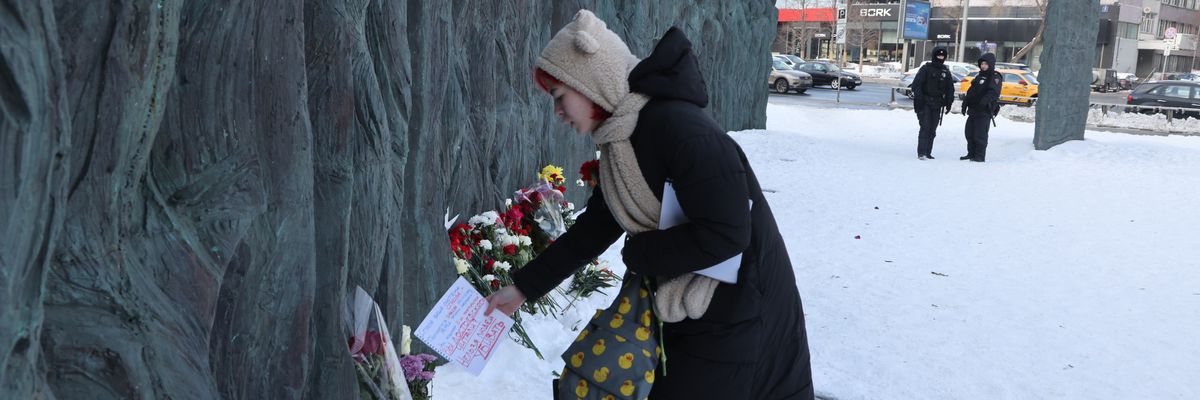
Russian police look on as a woman brings a carnation and a small text about opposition leader Alexei Navalny to the Wall of Grief on February 19, 2024, in Moscow, Russia.
"These callous acts are not only shockingly insensitive, but they are also a flagrant violation of the rights to freedom of expression and peaceful assembly."
Amnesty International on Monday demanded that Russian authorities end their "widespread campaign of persecution" under which they've arrested nearly 400 people for mourning opposition leader Aleksei Navalny, whose death in prison was reported last Friday.
In at least 39 cities across Russia, police have arrested people for gathering at peaceful vigils to remember the anti-corruption political leader and steadfast opponent of President Vladimir Putin, laying flowers at monuments, and even carrying photographs of Navalny, in the case of Boris Kazadayev and Ilya Povyshev in Moscow.
The pair were arrested on Sunday in Moscow after police searched their backpacks near a memorial that had been set up for another late opposition politician, Boris Nemtsov. According to OVD-Info, police in Moscow searched selected attendees at Navalny memorials and "confiscated photographs of him as well as notes bearing his name."
"The crackdown we are witnessing following Aleksei Navalny's death in custody is not only a tragic reminder of what he fought against but also a clear indication that the Russian authorities are aiming to erase his memory," said Oleg Kozlovsky, Russia researcher for Amnesty. "The removal of photos of Navalny and the swift dismantling of memorial events across the country, sometimes directly in front of mourners, reveals how the authorities are seeking to expunge his name from the history books."
Navalny's death was reported by Russia's Federal Penitentiary Service on Friday; he allegedly lost consciousness after taking a walk in the penal colony where he had been relocated in December. He had been imprisoned for three years after exposing government corruption and organizing anti-Kremlin protests. He was also convicted last year of "extremism," having established himself as Putin's top political foe.
At least 387 people have been arrested for mourning Navalny since Friday, according to the rights group, with more than 200 detained in Saint Petersburg "simply for gathering peacefully to pay respect to the politician." The city's courts have also placed at least 26 people in "administrative detention"—accusing them of disobeying police, violating "the established procedure for organizing or holding an assembly," and other alleged offenses.
"Those who are detaining people are afraid of any opinion that isn't connected to propaganda, to the pervading ideology," a woman who identified herself only as Lena told The New York Times on Monday as she paid tribute at the Solovetsky Stone in Moscow. "They are scared of Navalny in jail, they are scared of dead Navalny, they are scared of the people who bring flowers here to the stone."
Kozlovzky highlighted cases of violent arrests, including that of Bakyt Karypbaev, who was reportedly tortured at a police station in Surgut, "including being beaten and having a gun pointed at his head for laying flowers."
A priest named Grigory Mikhnov-Vaitenko also "had a stroke after police arrested him to halt his plan to hold a memorial service," said Kozlovsky.
"These are not isolated incidents, but part of a country-wide campaign to silence dissent and instil fear across the nation," said the researcher.
Along with a prompt independent investigation into Navalny's death, Amnesty International demanded that the Russian authorities stop their campaign against those paying tribute, "immediately release all those detained solely for mourning or protesting peacefully, and ensure accountability for the abuses perpetrated against them."
"The Russian authorities have resorted to arbitrary arrests, excessive use of force and unlawful detentions of people across the country who are just trying to mourn Aleksei Navalny," said Kozlovsky. "These callous acts are not only shockingly insensitive, but they are also a flagrant violation of the rights to freedom of expression and peaceful assembly."
Dear Common Dreams reader, It’s been nearly 30 years since I co-founded Common Dreams with my late wife, Lina Newhouser. We had the radical notion that journalism should serve the public good, not corporate profits. It was clear to us from the outset what it would take to build such a project. No paid advertisements. No corporate sponsors. No millionaire publisher telling us what to think or do. Many people said we wouldn't last a year, but we proved those doubters wrong. Together with a tremendous team of journalists and dedicated staff, we built an independent media outlet free from the constraints of profits and corporate control. Our mission has always been simple: To inform. To inspire. To ignite change for the common good. Building Common Dreams was not easy. Our survival was never guaranteed. When you take on the most powerful forces—Wall Street greed, fossil fuel industry destruction, Big Tech lobbyists, and uber-rich oligarchs who have spent billions upon billions rigging the economy and democracy in their favor—the only bulwark you have is supporters who believe in your work. But here’s the urgent message from me today. It's never been this bad out there. And it's never been this hard to keep us going. At the very moment Common Dreams is most needed, the threats we face are intensifying. We need your support now more than ever. We don't accept corporate advertising and never will. We don't have a paywall because we don't think people should be blocked from critical news based on their ability to pay. Everything we do is funded by the donations of readers like you. When everyone does the little they can afford, we are strong. But if that support retreats or dries up, so do we. Will you donate now to make sure Common Dreams not only survives but thrives? —Craig Brown, Co-founder |
Amnesty International on Monday demanded that Russian authorities end their "widespread campaign of persecution" under which they've arrested nearly 400 people for mourning opposition leader Aleksei Navalny, whose death in prison was reported last Friday.
In at least 39 cities across Russia, police have arrested people for gathering at peaceful vigils to remember the anti-corruption political leader and steadfast opponent of President Vladimir Putin, laying flowers at monuments, and even carrying photographs of Navalny, in the case of Boris Kazadayev and Ilya Povyshev in Moscow.
The pair were arrested on Sunday in Moscow after police searched their backpacks near a memorial that had been set up for another late opposition politician, Boris Nemtsov. According to OVD-Info, police in Moscow searched selected attendees at Navalny memorials and "confiscated photographs of him as well as notes bearing his name."
"The crackdown we are witnessing following Aleksei Navalny's death in custody is not only a tragic reminder of what he fought against but also a clear indication that the Russian authorities are aiming to erase his memory," said Oleg Kozlovsky, Russia researcher for Amnesty. "The removal of photos of Navalny and the swift dismantling of memorial events across the country, sometimes directly in front of mourners, reveals how the authorities are seeking to expunge his name from the history books."
Navalny's death was reported by Russia's Federal Penitentiary Service on Friday; he allegedly lost consciousness after taking a walk in the penal colony where he had been relocated in December. He had been imprisoned for three years after exposing government corruption and organizing anti-Kremlin protests. He was also convicted last year of "extremism," having established himself as Putin's top political foe.
At least 387 people have been arrested for mourning Navalny since Friday, according to the rights group, with more than 200 detained in Saint Petersburg "simply for gathering peacefully to pay respect to the politician." The city's courts have also placed at least 26 people in "administrative detention"—accusing them of disobeying police, violating "the established procedure for organizing or holding an assembly," and other alleged offenses.
"Those who are detaining people are afraid of any opinion that isn't connected to propaganda, to the pervading ideology," a woman who identified herself only as Lena told The New York Times on Monday as she paid tribute at the Solovetsky Stone in Moscow. "They are scared of Navalny in jail, they are scared of dead Navalny, they are scared of the people who bring flowers here to the stone."
Kozlovzky highlighted cases of violent arrests, including that of Bakyt Karypbaev, who was reportedly tortured at a police station in Surgut, "including being beaten and having a gun pointed at his head for laying flowers."
A priest named Grigory Mikhnov-Vaitenko also "had a stroke after police arrested him to halt his plan to hold a memorial service," said Kozlovsky.
"These are not isolated incidents, but part of a country-wide campaign to silence dissent and instil fear across the nation," said the researcher.
Along with a prompt independent investigation into Navalny's death, Amnesty International demanded that the Russian authorities stop their campaign against those paying tribute, "immediately release all those detained solely for mourning or protesting peacefully, and ensure accountability for the abuses perpetrated against them."
"The Russian authorities have resorted to arbitrary arrests, excessive use of force and unlawful detentions of people across the country who are just trying to mourn Aleksei Navalny," said Kozlovsky. "These callous acts are not only shockingly insensitive, but they are also a flagrant violation of the rights to freedom of expression and peaceful assembly."
Amnesty International on Monday demanded that Russian authorities end their "widespread campaign of persecution" under which they've arrested nearly 400 people for mourning opposition leader Aleksei Navalny, whose death in prison was reported last Friday.
In at least 39 cities across Russia, police have arrested people for gathering at peaceful vigils to remember the anti-corruption political leader and steadfast opponent of President Vladimir Putin, laying flowers at monuments, and even carrying photographs of Navalny, in the case of Boris Kazadayev and Ilya Povyshev in Moscow.
The pair were arrested on Sunday in Moscow after police searched their backpacks near a memorial that had been set up for another late opposition politician, Boris Nemtsov. According to OVD-Info, police in Moscow searched selected attendees at Navalny memorials and "confiscated photographs of him as well as notes bearing his name."
"The crackdown we are witnessing following Aleksei Navalny's death in custody is not only a tragic reminder of what he fought against but also a clear indication that the Russian authorities are aiming to erase his memory," said Oleg Kozlovsky, Russia researcher for Amnesty. "The removal of photos of Navalny and the swift dismantling of memorial events across the country, sometimes directly in front of mourners, reveals how the authorities are seeking to expunge his name from the history books."
Navalny's death was reported by Russia's Federal Penitentiary Service on Friday; he allegedly lost consciousness after taking a walk in the penal colony where he had been relocated in December. He had been imprisoned for three years after exposing government corruption and organizing anti-Kremlin protests. He was also convicted last year of "extremism," having established himself as Putin's top political foe.
At least 387 people have been arrested for mourning Navalny since Friday, according to the rights group, with more than 200 detained in Saint Petersburg "simply for gathering peacefully to pay respect to the politician." The city's courts have also placed at least 26 people in "administrative detention"—accusing them of disobeying police, violating "the established procedure for organizing or holding an assembly," and other alleged offenses.
"Those who are detaining people are afraid of any opinion that isn't connected to propaganda, to the pervading ideology," a woman who identified herself only as Lena told The New York Times on Monday as she paid tribute at the Solovetsky Stone in Moscow. "They are scared of Navalny in jail, they are scared of dead Navalny, they are scared of the people who bring flowers here to the stone."
Kozlovzky highlighted cases of violent arrests, including that of Bakyt Karypbaev, who was reportedly tortured at a police station in Surgut, "including being beaten and having a gun pointed at his head for laying flowers."
A priest named Grigory Mikhnov-Vaitenko also "had a stroke after police arrested him to halt his plan to hold a memorial service," said Kozlovsky.
"These are not isolated incidents, but part of a country-wide campaign to silence dissent and instil fear across the nation," said the researcher.
Along with a prompt independent investigation into Navalny's death, Amnesty International demanded that the Russian authorities stop their campaign against those paying tribute, "immediately release all those detained solely for mourning or protesting peacefully, and ensure accountability for the abuses perpetrated against them."
"The Russian authorities have resorted to arbitrary arrests, excessive use of force and unlawful detentions of people across the country who are just trying to mourn Aleksei Navalny," said Kozlovsky. "These callous acts are not only shockingly insensitive, but they are also a flagrant violation of the rights to freedom of expression and peaceful assembly."