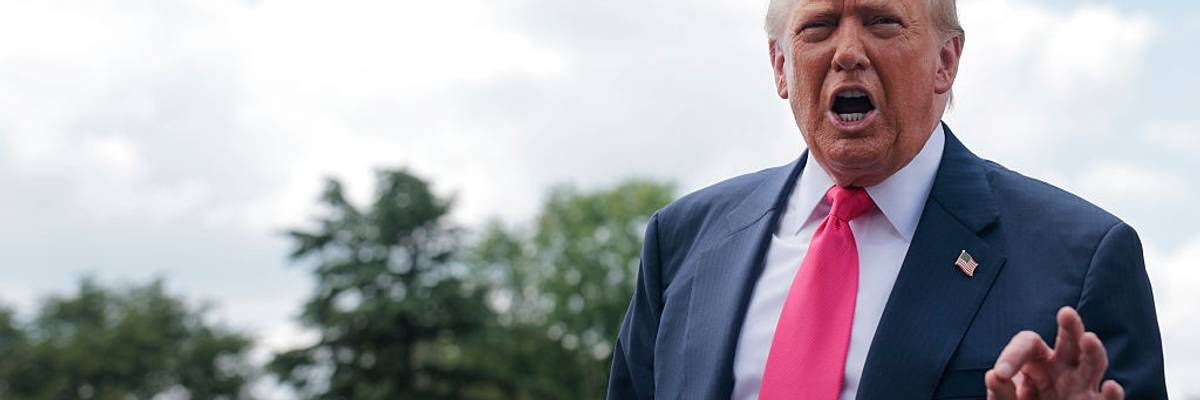
President Donald Trump speaks to the media as he departs the White House on July 15, 2025 in Washington, D.C. (Photo: Anna Moneymaker/Getty Images)
'The Orban Playbook': Trump Assault on Media Matters Seen as Dire Warning to Other Critics
"The speed of the collapse in the media environment is something I had not foreseen," wrote John Hopkins University economist Filipe Campante.
U.S. President Donald Trump and his allies have been waging legal war for months against liberal media watchdog Media Matters for America, and a report from The New York Times on Friday claimed that the organization is now in dire financial straits as it's been racking up millions in legal expenses.
According to the Times, Media Matters has incurred legal expenses of $15 million in its efforts to defend itself against lawsuits from X owner Elon Musk, as well as investigations launched by the Federal Trade Commission and two Republican state attorneys general. The expenses from the lawsuits have also had the add-on effect of making donors to the organization "skittish," writes the Times, and the organization has had to slash its staff in half.
To make matters worse, even victories in court for Media Matters bring it little reprieve given that Musk, with his limitless resources as the world's wealthiest man, will file appeals that will force the organization to shell out even more legal fees.
John Hopkins University economist Filipe Campante, who regularly writes about authoritarian threats to democracy, commented on Bluesky that the plight of Media Matters is linked to Trump's other efforts to clamp down on the free press, such as his lawsuit against CBS News that resulted in parent company Paramount agreeing to pay out $16 million shortly before the Federal Communications Commission signed off on its $8 billion merger with studio Skydance.
In fact, he likened the Trump administration's current actions to those of Hungarian Prime Minister Viktor Orbán, who has successfully strangled independent media in his country over the span of several years.
"This, yet again, is competitive authoritarianism in practice," wrote Campante. "The speed of the collapse in the media environment is something I had not foreseen... weaponization of lawsuits, persecution by regulators, donors scared away. It's the Orbán playbook, on steroids."
And Campante isn't the only expert making comparisons to Orbán.
Gábor Scheiring, a former Hungarian member of parliament who is now an assistant professor of comparative politics at Georgetown University Qatar, told CNN's Brian Stelter on Friday that Trump's strategy for taming the news media is almost the exact same strategy he once saw Orbán employ. Scheiring zeroed in on CBS' recent announcement that frequent Trump critic Stephen Colbert would have his show canceled next year as particularly Orbán-esque.
"Most of Orban's tactical weapons to take over the media resemble the moves that led to Colbert's cancellation," he explained. "The legal warfare, the lawsuit against CBS, the regulatory capture and threats, the financial pressures, the sale of the parent company, and the new owner's apparent friendliness to Trump."
Scheiring added that Orbán was able to achieve this result by isolating media owners and picking them off one by one to ensure they never forged a sense of solidarity with one another.
"Media owners, both foreign and domestic, largely capitulated individually rather than mounting collective resistance, which enabled Orbán's systematic capture strategy," he said.
Even media moguls ideologically allied with the president haven't escaped his wrath, as Trump filed a lawsuit against right-wing media mogul Rupert Murdoch earlier this month after the Murdoch-owned Wall Street Journal published a story detailing an obscene birthday card the president allegedly gave to convicted sex offender Jeffrey Epstein.
We are at a crossroads
This country and this world are at a monumental crossroads. In a few short weeks, US voters will have an opportunity to beat back the forces of fascism and confront the billionaires who are rigging the economy, our media system, and our democracy, making it increasingly impossible for ordinary people to get by. We’re not just talking about the election. We’re talking about what must be done once these fascist elements are vanquished from power. We need a bolder set of solutions than what either major party has so far been willing to offer and a working-class movement ready to fight like hell for it. Trump didn't emerge from nowhere. The conditions that fueled MAGA authoritarianism were created by decades of radical neoliberal economic policies and a corrupt political system dominated by corporate interests. They slashed taxes on the super-rich, promising that the benefits would trickle down. They said giveaways to the corporate titans would make life more affordable for the rest of us. It was all bullshit. And when a bitter, betrayed populace searches for someone to blame, right-wing demagogues have little trouble finding scapegoats. People know when they're being lied to, but you won't hear any of this from the corporate media. Only independent journalism—powered and funded by people who believe in building a better world—can deliver truly trustworthy daily news. Our Fall Campaign is underway, and we need your help. To power our newsroom through the rest of the year, we need to raise $125,000 by midnight on October 31. So if you share our vision, please contribute whatever you can to sustain our work. |
U.S. President Donald Trump and his allies have been waging legal war for months against liberal media watchdog Media Matters for America, and a report from The New York Times on Friday claimed that the organization is now in dire financial straits as it's been racking up millions in legal expenses.
According to the Times, Media Matters has incurred legal expenses of $15 million in its efforts to defend itself against lawsuits from X owner Elon Musk, as well as investigations launched by the Federal Trade Commission and two Republican state attorneys general. The expenses from the lawsuits have also had the add-on effect of making donors to the organization "skittish," writes the Times, and the organization has had to slash its staff in half.
To make matters worse, even victories in court for Media Matters bring it little reprieve given that Musk, with his limitless resources as the world's wealthiest man, will file appeals that will force the organization to shell out even more legal fees.
John Hopkins University economist Filipe Campante, who regularly writes about authoritarian threats to democracy, commented on Bluesky that the plight of Media Matters is linked to Trump's other efforts to clamp down on the free press, such as his lawsuit against CBS News that resulted in parent company Paramount agreeing to pay out $16 million shortly before the Federal Communications Commission signed off on its $8 billion merger with studio Skydance.
In fact, he likened the Trump administration's current actions to those of Hungarian Prime Minister Viktor Orbán, who has successfully strangled independent media in his country over the span of several years.
"This, yet again, is competitive authoritarianism in practice," wrote Campante. "The speed of the collapse in the media environment is something I had not foreseen... weaponization of lawsuits, persecution by regulators, donors scared away. It's the Orbán playbook, on steroids."
And Campante isn't the only expert making comparisons to Orbán.
Gábor Scheiring, a former Hungarian member of parliament who is now an assistant professor of comparative politics at Georgetown University Qatar, told CNN's Brian Stelter on Friday that Trump's strategy for taming the news media is almost the exact same strategy he once saw Orbán employ. Scheiring zeroed in on CBS' recent announcement that frequent Trump critic Stephen Colbert would have his show canceled next year as particularly Orbán-esque.
"Most of Orban's tactical weapons to take over the media resemble the moves that led to Colbert's cancellation," he explained. "The legal warfare, the lawsuit against CBS, the regulatory capture and threats, the financial pressures, the sale of the parent company, and the new owner's apparent friendliness to Trump."
Scheiring added that Orbán was able to achieve this result by isolating media owners and picking them off one by one to ensure they never forged a sense of solidarity with one another.
"Media owners, both foreign and domestic, largely capitulated individually rather than mounting collective resistance, which enabled Orbán's systematic capture strategy," he said.
Even media moguls ideologically allied with the president haven't escaped his wrath, as Trump filed a lawsuit against right-wing media mogul Rupert Murdoch earlier this month after the Murdoch-owned Wall Street Journal published a story detailing an obscene birthday card the president allegedly gave to convicted sex offender Jeffrey Epstein.
- In Latest Attack on Media, Trump Sues Wall Street Journal Over Epstein Report ›
- Lina Khan Calls Republican FTC's Decision to Drop PepsiCo Suit 'Disturbing Behavior' ›
- 'Sad Day for Free Speech': Media Matters Layoffs Follow 'Thermonuclear' Attack by Elon Musk ›
- 'End This White House Cover-Up': House Dems Pounce on Latest Trump-Epstein Bombshell | Common Dreams ›
U.S. President Donald Trump and his allies have been waging legal war for months against liberal media watchdog Media Matters for America, and a report from The New York Times on Friday claimed that the organization is now in dire financial straits as it's been racking up millions in legal expenses.
According to the Times, Media Matters has incurred legal expenses of $15 million in its efforts to defend itself against lawsuits from X owner Elon Musk, as well as investigations launched by the Federal Trade Commission and two Republican state attorneys general. The expenses from the lawsuits have also had the add-on effect of making donors to the organization "skittish," writes the Times, and the organization has had to slash its staff in half.
To make matters worse, even victories in court for Media Matters bring it little reprieve given that Musk, with his limitless resources as the world's wealthiest man, will file appeals that will force the organization to shell out even more legal fees.
John Hopkins University economist Filipe Campante, who regularly writes about authoritarian threats to democracy, commented on Bluesky that the plight of Media Matters is linked to Trump's other efforts to clamp down on the free press, such as his lawsuit against CBS News that resulted in parent company Paramount agreeing to pay out $16 million shortly before the Federal Communications Commission signed off on its $8 billion merger with studio Skydance.
In fact, he likened the Trump administration's current actions to those of Hungarian Prime Minister Viktor Orbán, who has successfully strangled independent media in his country over the span of several years.
"This, yet again, is competitive authoritarianism in practice," wrote Campante. "The speed of the collapse in the media environment is something I had not foreseen... weaponization of lawsuits, persecution by regulators, donors scared away. It's the Orbán playbook, on steroids."
And Campante isn't the only expert making comparisons to Orbán.
Gábor Scheiring, a former Hungarian member of parliament who is now an assistant professor of comparative politics at Georgetown University Qatar, told CNN's Brian Stelter on Friday that Trump's strategy for taming the news media is almost the exact same strategy he once saw Orbán employ. Scheiring zeroed in on CBS' recent announcement that frequent Trump critic Stephen Colbert would have his show canceled next year as particularly Orbán-esque.
"Most of Orban's tactical weapons to take over the media resemble the moves that led to Colbert's cancellation," he explained. "The legal warfare, the lawsuit against CBS, the regulatory capture and threats, the financial pressures, the sale of the parent company, and the new owner's apparent friendliness to Trump."
Scheiring added that Orbán was able to achieve this result by isolating media owners and picking them off one by one to ensure they never forged a sense of solidarity with one another.
"Media owners, both foreign and domestic, largely capitulated individually rather than mounting collective resistance, which enabled Orbán's systematic capture strategy," he said.
Even media moguls ideologically allied with the president haven't escaped his wrath, as Trump filed a lawsuit against right-wing media mogul Rupert Murdoch earlier this month after the Murdoch-owned Wall Street Journal published a story detailing an obscene birthday card the president allegedly gave to convicted sex offender Jeffrey Epstein.
- In Latest Attack on Media, Trump Sues Wall Street Journal Over Epstein Report ›
- Lina Khan Calls Republican FTC's Decision to Drop PepsiCo Suit 'Disturbing Behavior' ›
- 'Sad Day for Free Speech': Media Matters Layoffs Follow 'Thermonuclear' Attack by Elon Musk ›
- 'End This White House Cover-Up': House Dems Pounce on Latest Trump-Epstein Bombshell | Common Dreams ›