SUBSCRIBE TO OUR FREE NEWSLETTER
Daily news & progressive opinion—funded by the people, not the corporations—delivered straight to your inbox.
5
#000000
#FFFFFF
To donate by check, phone, or other method, see our More Ways to Give page.
Daily news & progressive opinion—funded by the people, not the corporations—delivered straight to your inbox.
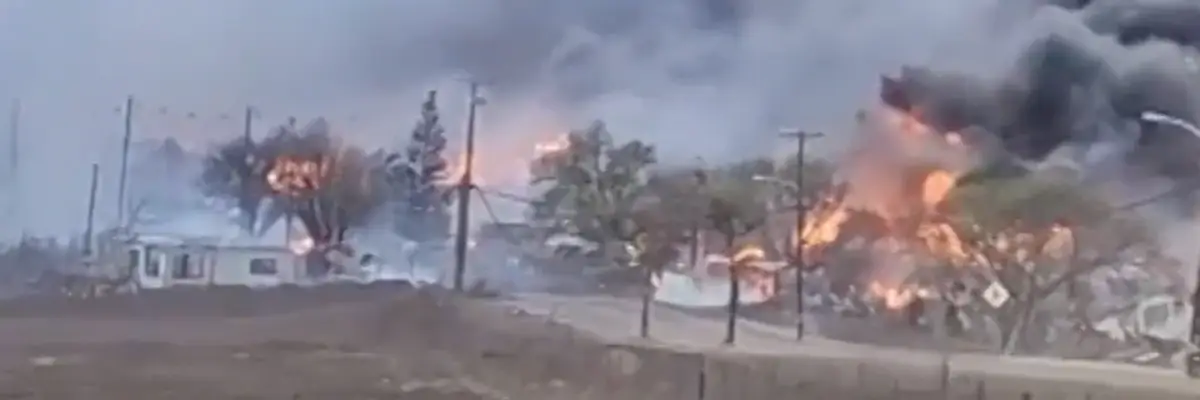
A wildfire is seen on the Hawaiian island of Maui on August 9, 2023.
"This is happening too often," said one advocacy group. "We are angry at the fossil fuel companies and greed that enabled these climate disasters, and we are determined to keep fighting for our future."
Wildfires that rapidly spread across the Hawaiian island of Maui claimed the lives of at least six people on Wednesday, devastating the historic town of Lahaina and forcing some people to jump into the ocean to escape the flames.
"Dangerous fire weather conditions" were created by Hurricane Dora's strong winds as the Category 4 storm traveled south of Hawaii, coupled with dry vegetation and low humidity levels, according to the National Weather Service (NWS).
Hawaii Lt. Gov. Sylvia Luke told CNN that the disaster has knocked out cellphone and 911 service across the island and quickly led to overcrowding in local hospitals.
"Our hospital system on Maui, they are overburdened with burn patients, people suffering from inhalation," the Democrat said. "The reality is that we need to fly people out of Maui to give them burn support because Maui hospital cannot do extensive burn treatment."
About 14,000 homes and businesses lost power due to the fires.
The Coast Guard told CNN that a dozen people were rescued off the coast of Lahaina after "entering the ocean due to smoke and fire conditions," and were transported to safety.
"Lahaina has been devastated," a resident named Clint Hansen told CNN. "People jumping in the ocean to escape the flames, being rescued by the Coast Guard. All boat owners are being asked to rescue people. It's apocalyptic."
The Hawaii Wildfire Management Organization told The Washington Post that wildfires have become more common in Hawaii in the last century as humans have introduced nonnative grasses and shrubs that have then become "more flammable as climate change brings warmer, drier conditions."
The conditions have contributed to the rapid spread of the flames and made it more difficult for firefighters to control the blaze, Scientific American reported.
"The fire can be a mile or more from your house, but in a minute or two, it can be at your house," Jeff Giesea, assistant fire chief of Maui County, said.
The disaster comes as the southwestern U.S. is continuing to face extreme heat and parts of Texas are at risk of fires. Scientists have found that the recent record-breaking temperatures and the heat dome that settled over the Southwest would have been "virtually impossible" without the fossil fuel-driven climate crisis.
"This is happening too often," said environmental legal advocacy group Earthjustice.
Kaniela Ing, a former Hawaii state representative and national director of the Green New Deal Network, called the devastation of Maui "heartbreaking."
"Colonial greed is burning down our home," said Ing. "And it's U.S. politicians and polluters to blame."
Dear Common Dreams reader, It’s been nearly 30 years since I co-founded Common Dreams with my late wife, Lina Newhouser. We had the radical notion that journalism should serve the public good, not corporate profits. It was clear to us from the outset what it would take to build such a project. No paid advertisements. No corporate sponsors. No millionaire publisher telling us what to think or do. Many people said we wouldn't last a year, but we proved those doubters wrong. Together with a tremendous team of journalists and dedicated staff, we built an independent media outlet free from the constraints of profits and corporate control. Our mission has always been simple: To inform. To inspire. To ignite change for the common good. Building Common Dreams was not easy. Our survival was never guaranteed. When you take on the most powerful forces—Wall Street greed, fossil fuel industry destruction, Big Tech lobbyists, and uber-rich oligarchs who have spent billions upon billions rigging the economy and democracy in their favor—the only bulwark you have is supporters who believe in your work. But here’s the urgent message from me today. It's never been this bad out there. And it's never been this hard to keep us going. At the very moment Common Dreams is most needed, the threats we face are intensifying. We need your support now more than ever. We don't accept corporate advertising and never will. We don't have a paywall because we don't think people should be blocked from critical news based on their ability to pay. Everything we do is funded by the donations of readers like you. When everyone does the little they can afford, we are strong. But if that support retreats or dries up, so do we. Will you donate now to make sure Common Dreams not only survives but thrives? —Craig Brown, Co-founder |
Wildfires that rapidly spread across the Hawaiian island of Maui claimed the lives of at least six people on Wednesday, devastating the historic town of Lahaina and forcing some people to jump into the ocean to escape the flames.
"Dangerous fire weather conditions" were created by Hurricane Dora's strong winds as the Category 4 storm traveled south of Hawaii, coupled with dry vegetation and low humidity levels, according to the National Weather Service (NWS).
Hawaii Lt. Gov. Sylvia Luke told CNN that the disaster has knocked out cellphone and 911 service across the island and quickly led to overcrowding in local hospitals.
"Our hospital system on Maui, they are overburdened with burn patients, people suffering from inhalation," the Democrat said. "The reality is that we need to fly people out of Maui to give them burn support because Maui hospital cannot do extensive burn treatment."
About 14,000 homes and businesses lost power due to the fires.
The Coast Guard told CNN that a dozen people were rescued off the coast of Lahaina after "entering the ocean due to smoke and fire conditions," and were transported to safety.
"Lahaina has been devastated," a resident named Clint Hansen told CNN. "People jumping in the ocean to escape the flames, being rescued by the Coast Guard. All boat owners are being asked to rescue people. It's apocalyptic."
The Hawaii Wildfire Management Organization told The Washington Post that wildfires have become more common in Hawaii in the last century as humans have introduced nonnative grasses and shrubs that have then become "more flammable as climate change brings warmer, drier conditions."
The conditions have contributed to the rapid spread of the flames and made it more difficult for firefighters to control the blaze, Scientific American reported.
"The fire can be a mile or more from your house, but in a minute or two, it can be at your house," Jeff Giesea, assistant fire chief of Maui County, said.
The disaster comes as the southwestern U.S. is continuing to face extreme heat and parts of Texas are at risk of fires. Scientists have found that the recent record-breaking temperatures and the heat dome that settled over the Southwest would have been "virtually impossible" without the fossil fuel-driven climate crisis.
"This is happening too often," said environmental legal advocacy group Earthjustice.
Kaniela Ing, a former Hawaii state representative and national director of the Green New Deal Network, called the devastation of Maui "heartbreaking."
"Colonial greed is burning down our home," said Ing. "And it's U.S. politicians and polluters to blame."
Wildfires that rapidly spread across the Hawaiian island of Maui claimed the lives of at least six people on Wednesday, devastating the historic town of Lahaina and forcing some people to jump into the ocean to escape the flames.
"Dangerous fire weather conditions" were created by Hurricane Dora's strong winds as the Category 4 storm traveled south of Hawaii, coupled with dry vegetation and low humidity levels, according to the National Weather Service (NWS).
Hawaii Lt. Gov. Sylvia Luke told CNN that the disaster has knocked out cellphone and 911 service across the island and quickly led to overcrowding in local hospitals.
"Our hospital system on Maui, they are overburdened with burn patients, people suffering from inhalation," the Democrat said. "The reality is that we need to fly people out of Maui to give them burn support because Maui hospital cannot do extensive burn treatment."
About 14,000 homes and businesses lost power due to the fires.
The Coast Guard told CNN that a dozen people were rescued off the coast of Lahaina after "entering the ocean due to smoke and fire conditions," and were transported to safety.
"Lahaina has been devastated," a resident named Clint Hansen told CNN. "People jumping in the ocean to escape the flames, being rescued by the Coast Guard. All boat owners are being asked to rescue people. It's apocalyptic."
The Hawaii Wildfire Management Organization told The Washington Post that wildfires have become more common in Hawaii in the last century as humans have introduced nonnative grasses and shrubs that have then become "more flammable as climate change brings warmer, drier conditions."
The conditions have contributed to the rapid spread of the flames and made it more difficult for firefighters to control the blaze, Scientific American reported.
"The fire can be a mile or more from your house, but in a minute or two, it can be at your house," Jeff Giesea, assistant fire chief of Maui County, said.
The disaster comes as the southwestern U.S. is continuing to face extreme heat and parts of Texas are at risk of fires. Scientists have found that the recent record-breaking temperatures and the heat dome that settled over the Southwest would have been "virtually impossible" without the fossil fuel-driven climate crisis.
"This is happening too often," said environmental legal advocacy group Earthjustice.
Kaniela Ing, a former Hawaii state representative and national director of the Green New Deal Network, called the devastation of Maui "heartbreaking."
"Colonial greed is burning down our home," said Ing. "And it's U.S. politicians and polluters to blame."