SUBSCRIBE TO OUR FREE NEWSLETTER
Daily news & progressive opinion—funded by the people, not the corporations—delivered straight to your inbox.
5
#000000
#FFFFFF
To donate by check, phone, or other method, see our More Ways to Give page.
Daily news & progressive opinion—funded by the people, not the corporations—delivered straight to your inbox.
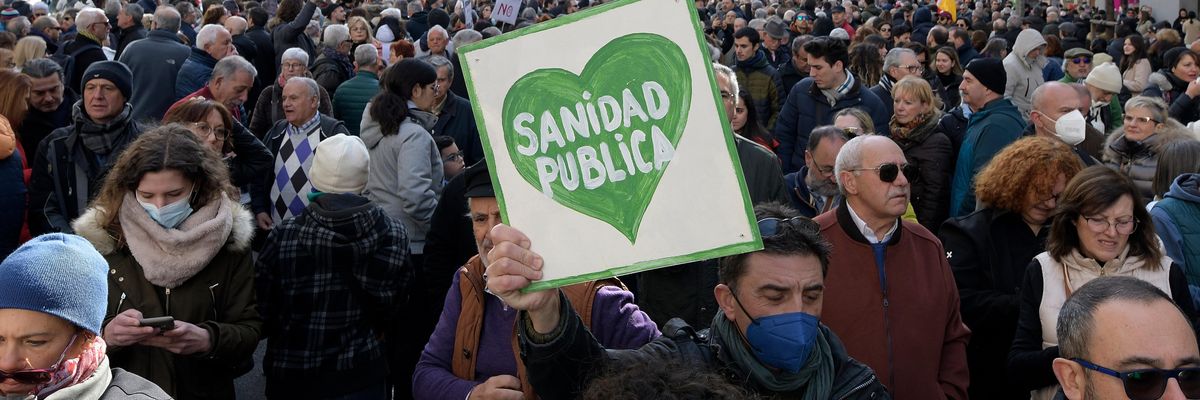
Protesters rally to demand public health and solutions to primary care on February 12, 2023 in Madrid.
The funneling of healthcare dollars to the private sector by Madrid's right-wing government has left the public health system "in danger of extinction," said one worker.
Madrid residents on Sunday marched to protest the right-wing regional government's attacks on the public healthcare system, with hundreds of thousands of participants showing that concern over the shredding of the public sector is growing.
Government officials said around 250,000 people took part in the demonstration, compared to tens of thousands who marched last month, while organizers' estimate for Sunday's protest was close to one million.
Isabel Diaz Ayuso, the right-wing regional president of Madrid, has been the target of much of the outcry over healthcare, as she has overseen "the transfer of funds to private healthcare," according to public health advocates.
Spain's private healthcare sector has long been far smaller than its public system, in which more than 99% of Spain residents are covered and able to access government-funded medical care. The country's 17 regional governments have jurisdiction over health budgets and delivery of service, and Ayuso's administration is reportedly spending less per capita on public healthcare than any other regional government, despite Madrid having the highest per capita income.
"They have cut our wages instead of raising them. We are overwhelmed with work and do not have any support."
Roughly half of healthcare spending by Ayuso, who took office in 2019, goes to the private sector, according to march organizers.
The loss of funding for public health services has resulted in underpaid medical workers and an exodus of staff, healthcare workers say. Patients have been forced to seek care in emergency departments, leading to overcrowding.
"The situation is dramatic," Maite Lopez, a nurse who attended the demonstration, told AFP. "We can't take proper care of the patients."
Ayuso attacked the healthcare workers and supporters who rallied in Madrid, saying the protest was orchestrated by her political opponents and writing on social media, "We all believe in public health."
Some demonstrators carried signs and a model of Ayuso with a long nose, comparing her to Pinocchio. Others carried banners reading, "The right to health is a human right" and "Defend the health service."
In addition to Sunday's protest and the march held in January, tens of thousands of demonstrators took part in what they called a "white tidal wave" in Madrid in November, with healthcare workers wearing white lab coats and proclaiming, "Madrid rises up for public health."
Some primary care doctors and pediatricians have staged intermittant work stoppages since the November protest, with Sunday's march the largest outpouring of support thus far.
One healthcare worker told Reuters that Spain's public health sector, which experts have frequently ranked as one of the best in the world, is "in danger of extinction" in Madrid.
"They have cut our wages instead of raising them," Lilian Ramis told Reuters. "We are overwhelmed with work and do not have any support."
The outcry over the attack on Madrid's public health service comes days after healthcare workers in the United Kingdom went on strike over the Conservative government's refusal to pay them fairly, and a day after nearly a million people in France held nationwide protests over President Emmanuel Macron's plan to raise the retirement age.
Dear Common Dreams reader, It’s been nearly 30 years since I co-founded Common Dreams with my late wife, Lina Newhouser. We had the radical notion that journalism should serve the public good, not corporate profits. It was clear to us from the outset what it would take to build such a project. No paid advertisements. No corporate sponsors. No millionaire publisher telling us what to think or do. Many people said we wouldn't last a year, but we proved those doubters wrong. Together with a tremendous team of journalists and dedicated staff, we built an independent media outlet free from the constraints of profits and corporate control. Our mission has always been simple: To inform. To inspire. To ignite change for the common good. Building Common Dreams was not easy. Our survival was never guaranteed. When you take on the most powerful forces—Wall Street greed, fossil fuel industry destruction, Big Tech lobbyists, and uber-rich oligarchs who have spent billions upon billions rigging the economy and democracy in their favor—the only bulwark you have is supporters who believe in your work. But here’s the urgent message from me today. It's never been this bad out there. And it's never been this hard to keep us going. At the very moment Common Dreams is most needed, the threats we face are intensifying. We need your support now more than ever. We don't accept corporate advertising and never will. We don't have a paywall because we don't think people should be blocked from critical news based on their ability to pay. Everything we do is funded by the donations of readers like you. When everyone does the little they can afford, we are strong. But if that support retreats or dries up, so do we. Will you donate now to make sure Common Dreams not only survives but thrives? —Craig Brown, Co-founder |
Madrid residents on Sunday marched to protest the right-wing regional government's attacks on the public healthcare system, with hundreds of thousands of participants showing that concern over the shredding of the public sector is growing.
Government officials said around 250,000 people took part in the demonstration, compared to tens of thousands who marched last month, while organizers' estimate for Sunday's protest was close to one million.
Isabel Diaz Ayuso, the right-wing regional president of Madrid, has been the target of much of the outcry over healthcare, as she has overseen "the transfer of funds to private healthcare," according to public health advocates.
Spain's private healthcare sector has long been far smaller than its public system, in which more than 99% of Spain residents are covered and able to access government-funded medical care. The country's 17 regional governments have jurisdiction over health budgets and delivery of service, and Ayuso's administration is reportedly spending less per capita on public healthcare than any other regional government, despite Madrid having the highest per capita income.
"They have cut our wages instead of raising them. We are overwhelmed with work and do not have any support."
Roughly half of healthcare spending by Ayuso, who took office in 2019, goes to the private sector, according to march organizers.
The loss of funding for public health services has resulted in underpaid medical workers and an exodus of staff, healthcare workers say. Patients have been forced to seek care in emergency departments, leading to overcrowding.
"The situation is dramatic," Maite Lopez, a nurse who attended the demonstration, told AFP. "We can't take proper care of the patients."
Ayuso attacked the healthcare workers and supporters who rallied in Madrid, saying the protest was orchestrated by her political opponents and writing on social media, "We all believe in public health."
Some demonstrators carried signs and a model of Ayuso with a long nose, comparing her to Pinocchio. Others carried banners reading, "The right to health is a human right" and "Defend the health service."
In addition to Sunday's protest and the march held in January, tens of thousands of demonstrators took part in what they called a "white tidal wave" in Madrid in November, with healthcare workers wearing white lab coats and proclaiming, "Madrid rises up for public health."
Some primary care doctors and pediatricians have staged intermittant work stoppages since the November protest, with Sunday's march the largest outpouring of support thus far.
One healthcare worker told Reuters that Spain's public health sector, which experts have frequently ranked as one of the best in the world, is "in danger of extinction" in Madrid.
"They have cut our wages instead of raising them," Lilian Ramis told Reuters. "We are overwhelmed with work and do not have any support."
The outcry over the attack on Madrid's public health service comes days after healthcare workers in the United Kingdom went on strike over the Conservative government's refusal to pay them fairly, and a day after nearly a million people in France held nationwide protests over President Emmanuel Macron's plan to raise the retirement age.
Madrid residents on Sunday marched to protest the right-wing regional government's attacks on the public healthcare system, with hundreds of thousands of participants showing that concern over the shredding of the public sector is growing.
Government officials said around 250,000 people took part in the demonstration, compared to tens of thousands who marched last month, while organizers' estimate for Sunday's protest was close to one million.
Isabel Diaz Ayuso, the right-wing regional president of Madrid, has been the target of much of the outcry over healthcare, as she has overseen "the transfer of funds to private healthcare," according to public health advocates.
Spain's private healthcare sector has long been far smaller than its public system, in which more than 99% of Spain residents are covered and able to access government-funded medical care. The country's 17 regional governments have jurisdiction over health budgets and delivery of service, and Ayuso's administration is reportedly spending less per capita on public healthcare than any other regional government, despite Madrid having the highest per capita income.
"They have cut our wages instead of raising them. We are overwhelmed with work and do not have any support."
Roughly half of healthcare spending by Ayuso, who took office in 2019, goes to the private sector, according to march organizers.
The loss of funding for public health services has resulted in underpaid medical workers and an exodus of staff, healthcare workers say. Patients have been forced to seek care in emergency departments, leading to overcrowding.
"The situation is dramatic," Maite Lopez, a nurse who attended the demonstration, told AFP. "We can't take proper care of the patients."
Ayuso attacked the healthcare workers and supporters who rallied in Madrid, saying the protest was orchestrated by her political opponents and writing on social media, "We all believe in public health."
Some demonstrators carried signs and a model of Ayuso with a long nose, comparing her to Pinocchio. Others carried banners reading, "The right to health is a human right" and "Defend the health service."
In addition to Sunday's protest and the march held in January, tens of thousands of demonstrators took part in what they called a "white tidal wave" in Madrid in November, with healthcare workers wearing white lab coats and proclaiming, "Madrid rises up for public health."
Some primary care doctors and pediatricians have staged intermittant work stoppages since the November protest, with Sunday's march the largest outpouring of support thus far.
One healthcare worker told Reuters that Spain's public health sector, which experts have frequently ranked as one of the best in the world, is "in danger of extinction" in Madrid.
"They have cut our wages instead of raising them," Lilian Ramis told Reuters. "We are overwhelmed with work and do not have any support."
The outcry over the attack on Madrid's public health service comes days after healthcare workers in the United Kingdom went on strike over the Conservative government's refusal to pay them fairly, and a day after nearly a million people in France held nationwide protests over President Emmanuel Macron's plan to raise the retirement age.