SUBSCRIBE TO OUR FREE NEWSLETTER
Daily news & progressive opinion—funded by the people, not the corporations—delivered straight to your inbox.
5
#000000
#FFFFFF
To donate by check, phone, or other method, see our More Ways to Give page.
Daily news & progressive opinion—funded by the people, not the corporations—delivered straight to your inbox.
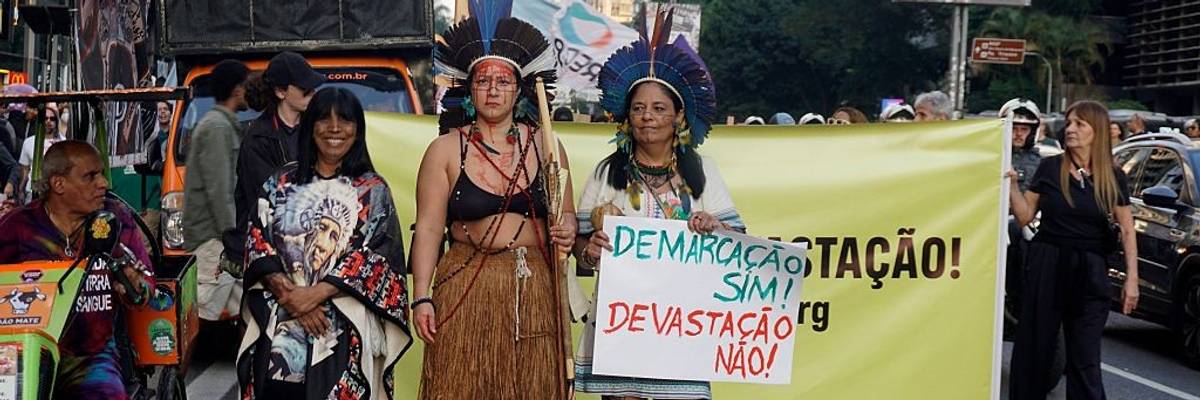
Indigenous people take part in a June 1, 2025 São Paulo protest against the so-called "Devastation Bill." One holds a sign reading, "Demarcation Yes, Devastation No."
"Lula says Brazil will lead the environmental agenda by example," said one prominent Brazilian climate defender. "A veto, on the eve of COP30, is the perfect opportunity to make the discourse into practice."
Opponents including native and Afro-descendant communities and environment defenders are urging progressive Brazilian President Luiz Inácio Lula da Silva to veto legislation passed Thursday by the lower house of the National Congress that would dramatically weaken environmental protections and Indigenous peoples' control over their own lands.
Bill 2159/2021—commonly called the "Devastation Bill"—was approved by the Chamber of Deputies in a 267-116 vote in the dead of night following its passage by the Senate in May. The vote, which took place at approximately 3:40 am, was called by Chamber of Deputies President Hugo Motta of the right-wing Republicans party. Both houses of the National Congress have strong right-wing majorities; some members of Lula's leftist Workers' Party also voted for the bill.
If approved by Lula, the legislation would introduce an online self-declaration process for environmental licensing for many mining and agricultural projects that critics say will fuel deforestation and other destruction. The bill also speeds up the review process for development projects prioritized by the federal government and eliminates reviews for highway upgrades.
"As approved, the bill encourages deforestation and aggravates the climate crisis," Marcio Astrini, executive director of the Climate Observatory," said following the vote.
"Lula says Brazil will lead the environmental agenda by example. A veto, on the eve of COP30, is the perfect opportunity to make the discourse into practice," he continued, referring to this November's United Nations Climate Change Conference in Belém.
"We hope that he will meet his campaign commitments and reject this absurd text approved by the Brazilian Congress," Astrini added.
Lula has 15 days to either approve or veto the measure. However, the right-wing congressional majority could overturn a veto, prompting the Supreme Court to intervene.
Proponents argue the bill would simplify the regulatory process.
"Finally, we have improved legislation to unlock investments, streamline the system, and generate opportunities and income for the country," said Pedro Lupion, a deputy from the right-wing Progressistas party representing Paraná and president of the Parliamentary Agriculture Front.
However, Climate Observatory public policy coordinator Suely Araújo said that the proposal represents "the greatest setback to Brazil's environmental legislation" since licensing requirements were introduced in the 1980s.
Some critics of the bill pointed to Article 225 of the Brazilian Constitution, which states that "everyone has the right to an ecologically balanced environment, which is an asset of common use and essential to a healthy quality of life, and both the government and the community shall have the duty to defend and preserve it for present and future generations."
Brazilian Minister for Indigenous Peoples Sônia Guajajara, a member of the Socialism and Liberty Party (PSOL), said on the social media site X that Thursday's vote "should be forever remembered as the moment when the Chamber of Deputies attacked Brazilian environmental legislation and showed its lack of commitment to the future."
"In the year we will host the COP, our parliamentarians show what example not to set for the world," she added.
Célia Xakriabá, a PSOL deputy representing Minas Gerais, called the bill "legislative ecocide."
Quilombolas—residents of quilombos, Afro-Brazilian communities formed by self-liberated slaves or their descendants—and their advocates also sounded the alarm over the bill, pointing to existing efforts by extractive industries to kick them off their lands.
"The Devastation Bill threatens over 80% of quilombos and 32% of Indigenous lands in Brazil," progressive Rio de Janeiro consultant Lázaro Rosa noted on X. "Let's put strong pressure to ensure this abomination is not approved."
Erika Hilton, a PSOL federal deputy representing São Paulo, said that if the bill is approved by Lula, "mining companies will be able to renew their licenses automatically, without technical studies or prior analysis."
"This is a recipe for new tragedies like those in Brumadinho, Mariana, and Braskem in Maceió," she warned. "Other points of the bill include the end of environmental licensing for agriculture to deforest and the end of control over the use of our water resources... And the Devastation Bill will also destroy the control of pollutant emissions, putting at risk the very air we breathe."
Hilton continued: "Even so, the tendency is that, with the narrative that all our environmental legislation is bureaucracy that hinders development, the deputies will approve this horror. But what country develops with an environmental tragedy every other day? What country develops if children start being born without brains due to pollution, like in the '70s in Cubatão? What country develops if the people no longer have water to drink, air to breathe, and life to live?"
"These are the questions that the deputies are ignoring," she added.
Journalist Amanda Miranda denounced members of Congress who voted to authorize "the destruction of Brazil while its citizens sleep."
"Brazil will be handed over to the interests of businessmen who will help reelect each one of them," she added. "Every climate catastrophe is part of this reckoning too."This country and this world are at a monumental crossroads. US voters have an opportunity to beat back the forces of fascism and confront the billionaires who are rigging the economy, our media system, and our democracy, making it increasingly impossible for ordinary people to get by. We’re not just talking about the election. We’re talking about what must be done once these fascist elements are vanquished from power. We need a bolder set of solutions than what either major party has so far been willing to offer and a working-class movement ready to fight like hell for it. Trump didn't emerge from nowhere. The conditions that fueled MAGA authoritarianism were created by decades of radical neoliberal economic policies and a corrupt political system dominated by corporate interests. They slashed taxes on the super-rich, promising that the benefits would trickle down. They said giveaways to the corporate titans would make life more affordable for the rest of us. It was all bullshit. And when a bitter, betrayed populace searches for someone to blame, right-wing demagogues have little trouble finding scapegoats. People know when they're being lied to, but you won't hear any of this from the corporate media. Only independent journalism—powered and funded by people who believe in building a better world—can deliver truly trustworthy daily news. If you share our vision, please contribute whatever you can to sustain our work. |
Opponents including native and Afro-descendant communities and environment defenders are urging progressive Brazilian President Luiz Inácio Lula da Silva to veto legislation passed Thursday by the lower house of the National Congress that would dramatically weaken environmental protections and Indigenous peoples' control over their own lands.
Bill 2159/2021—commonly called the "Devastation Bill"—was approved by the Chamber of Deputies in a 267-116 vote in the dead of night following its passage by the Senate in May. The vote, which took place at approximately 3:40 am, was called by Chamber of Deputies President Hugo Motta of the right-wing Republicans party. Both houses of the National Congress have strong right-wing majorities; some members of Lula's leftist Workers' Party also voted for the bill.
If approved by Lula, the legislation would introduce an online self-declaration process for environmental licensing for many mining and agricultural projects that critics say will fuel deforestation and other destruction. The bill also speeds up the review process for development projects prioritized by the federal government and eliminates reviews for highway upgrades.
"As approved, the bill encourages deforestation and aggravates the climate crisis," Marcio Astrini, executive director of the Climate Observatory," said following the vote.
"Lula says Brazil will lead the environmental agenda by example. A veto, on the eve of COP30, is the perfect opportunity to make the discourse into practice," he continued, referring to this November's United Nations Climate Change Conference in Belém.
"We hope that he will meet his campaign commitments and reject this absurd text approved by the Brazilian Congress," Astrini added.
Lula has 15 days to either approve or veto the measure. However, the right-wing congressional majority could overturn a veto, prompting the Supreme Court to intervene.
Proponents argue the bill would simplify the regulatory process.
"Finally, we have improved legislation to unlock investments, streamline the system, and generate opportunities and income for the country," said Pedro Lupion, a deputy from the right-wing Progressistas party representing Paraná and president of the Parliamentary Agriculture Front.
However, Climate Observatory public policy coordinator Suely Araújo said that the proposal represents "the greatest setback to Brazil's environmental legislation" since licensing requirements were introduced in the 1980s.
Some critics of the bill pointed to Article 225 of the Brazilian Constitution, which states that "everyone has the right to an ecologically balanced environment, which is an asset of common use and essential to a healthy quality of life, and both the government and the community shall have the duty to defend and preserve it for present and future generations."
Brazilian Minister for Indigenous Peoples Sônia Guajajara, a member of the Socialism and Liberty Party (PSOL), said on the social media site X that Thursday's vote "should be forever remembered as the moment when the Chamber of Deputies attacked Brazilian environmental legislation and showed its lack of commitment to the future."
"In the year we will host the COP, our parliamentarians show what example not to set for the world," she added.
Célia Xakriabá, a PSOL deputy representing Minas Gerais, called the bill "legislative ecocide."
Quilombolas—residents of quilombos, Afro-Brazilian communities formed by self-liberated slaves or their descendants—and their advocates also sounded the alarm over the bill, pointing to existing efforts by extractive industries to kick them off their lands.
"The Devastation Bill threatens over 80% of quilombos and 32% of Indigenous lands in Brazil," progressive Rio de Janeiro consultant Lázaro Rosa noted on X. "Let's put strong pressure to ensure this abomination is not approved."
Erika Hilton, a PSOL federal deputy representing São Paulo, said that if the bill is approved by Lula, "mining companies will be able to renew their licenses automatically, without technical studies or prior analysis."
"This is a recipe for new tragedies like those in Brumadinho, Mariana, and Braskem in Maceió," she warned. "Other points of the bill include the end of environmental licensing for agriculture to deforest and the end of control over the use of our water resources... And the Devastation Bill will also destroy the control of pollutant emissions, putting at risk the very air we breathe."
Hilton continued: "Even so, the tendency is that, with the narrative that all our environmental legislation is bureaucracy that hinders development, the deputies will approve this horror. But what country develops with an environmental tragedy every other day? What country develops if children start being born without brains due to pollution, like in the '70s in Cubatão? What country develops if the people no longer have water to drink, air to breathe, and life to live?"
"These are the questions that the deputies are ignoring," she added.
Journalist Amanda Miranda denounced members of Congress who voted to authorize "the destruction of Brazil while its citizens sleep."
"Brazil will be handed over to the interests of businessmen who will help reelect each one of them," she added. "Every climate catastrophe is part of this reckoning too."Opponents including native and Afro-descendant communities and environment defenders are urging progressive Brazilian President Luiz Inácio Lula da Silva to veto legislation passed Thursday by the lower house of the National Congress that would dramatically weaken environmental protections and Indigenous peoples' control over their own lands.
Bill 2159/2021—commonly called the "Devastation Bill"—was approved by the Chamber of Deputies in a 267-116 vote in the dead of night following its passage by the Senate in May. The vote, which took place at approximately 3:40 am, was called by Chamber of Deputies President Hugo Motta of the right-wing Republicans party. Both houses of the National Congress have strong right-wing majorities; some members of Lula's leftist Workers' Party also voted for the bill.
If approved by Lula, the legislation would introduce an online self-declaration process for environmental licensing for many mining and agricultural projects that critics say will fuel deforestation and other destruction. The bill also speeds up the review process for development projects prioritized by the federal government and eliminates reviews for highway upgrades.
"As approved, the bill encourages deforestation and aggravates the climate crisis," Marcio Astrini, executive director of the Climate Observatory," said following the vote.
"Lula says Brazil will lead the environmental agenda by example. A veto, on the eve of COP30, is the perfect opportunity to make the discourse into practice," he continued, referring to this November's United Nations Climate Change Conference in Belém.
"We hope that he will meet his campaign commitments and reject this absurd text approved by the Brazilian Congress," Astrini added.
Lula has 15 days to either approve or veto the measure. However, the right-wing congressional majority could overturn a veto, prompting the Supreme Court to intervene.
Proponents argue the bill would simplify the regulatory process.
"Finally, we have improved legislation to unlock investments, streamline the system, and generate opportunities and income for the country," said Pedro Lupion, a deputy from the right-wing Progressistas party representing Paraná and president of the Parliamentary Agriculture Front.
However, Climate Observatory public policy coordinator Suely Araújo said that the proposal represents "the greatest setback to Brazil's environmental legislation" since licensing requirements were introduced in the 1980s.
Some critics of the bill pointed to Article 225 of the Brazilian Constitution, which states that "everyone has the right to an ecologically balanced environment, which is an asset of common use and essential to a healthy quality of life, and both the government and the community shall have the duty to defend and preserve it for present and future generations."
Brazilian Minister for Indigenous Peoples Sônia Guajajara, a member of the Socialism and Liberty Party (PSOL), said on the social media site X that Thursday's vote "should be forever remembered as the moment when the Chamber of Deputies attacked Brazilian environmental legislation and showed its lack of commitment to the future."
"In the year we will host the COP, our parliamentarians show what example not to set for the world," she added.
Célia Xakriabá, a PSOL deputy representing Minas Gerais, called the bill "legislative ecocide."
Quilombolas—residents of quilombos, Afro-Brazilian communities formed by self-liberated slaves or their descendants—and their advocates also sounded the alarm over the bill, pointing to existing efforts by extractive industries to kick them off their lands.
"The Devastation Bill threatens over 80% of quilombos and 32% of Indigenous lands in Brazil," progressive Rio de Janeiro consultant Lázaro Rosa noted on X. "Let's put strong pressure to ensure this abomination is not approved."
Erika Hilton, a PSOL federal deputy representing São Paulo, said that if the bill is approved by Lula, "mining companies will be able to renew their licenses automatically, without technical studies or prior analysis."
"This is a recipe for new tragedies like those in Brumadinho, Mariana, and Braskem in Maceió," she warned. "Other points of the bill include the end of environmental licensing for agriculture to deforest and the end of control over the use of our water resources... And the Devastation Bill will also destroy the control of pollutant emissions, putting at risk the very air we breathe."
Hilton continued: "Even so, the tendency is that, with the narrative that all our environmental legislation is bureaucracy that hinders development, the deputies will approve this horror. But what country develops with an environmental tragedy every other day? What country develops if children start being born without brains due to pollution, like in the '70s in Cubatão? What country develops if the people no longer have water to drink, air to breathe, and life to live?"
"These are the questions that the deputies are ignoring," she added.
Journalist Amanda Miranda denounced members of Congress who voted to authorize "the destruction of Brazil while its citizens sleep."
"Brazil will be handed over to the interests of businessmen who will help reelect each one of them," she added. "Every climate catastrophe is part of this reckoning too."