SUBSCRIBE TO OUR FREE NEWSLETTER
Daily news & progressive opinion—funded by the people, not the corporations—delivered straight to your inbox.
5
#000000
#FFFFFF
To donate by check, phone, or other method, see our More Ways to Give page.
Daily news & progressive opinion—funded by the people, not the corporations—delivered straight to your inbox.
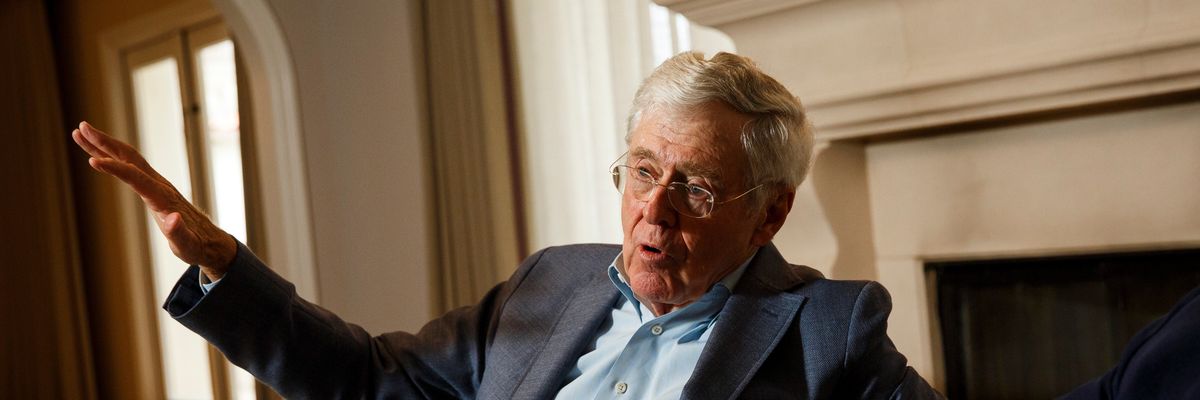
Charles Koch speaks during an interview on August 3, 2015 in Dana Point, California.
"For years, regulated interests have funded a full-scale campaign to delegitimize and dismantle federal regulations."
Hours before ProPublica revealed new details about U.S. Supreme Court Justice Clarence Thomas' relationship with the Koch network, a group of Democratic senators filed a brief on Thursday warning that Koch-backed entities are closely involved in an upcoming case that could further gut the federal government's regulatory power—and enhance the strength of the conservative-dominated high court.
The case in question is Loper Bright Enterprises v. Raimondo, which stems from a New Jersey-based fishing company's challenge to a law requiring certain fishing boats to carry federal compliance monitors to enforce regulations.
Loper Bright Enterprises specifically objected to an interpretation of federal law by the National Marine Fisheries Service, which said the Magnuson-Stevens Act allows the agency to require industry to pay the costs of the monitors.
The dispute over an obscure federal statute has since exploded into a matter of great interest to industry groups and environmentalists, with the latter warning that if the Supreme Court sides with the plaintiffs, it will be much more difficult for federal agencies to implement climate regulations.
Sens. Sheldon Whitehouse (D-R.I.), Mazie Hirono (D-Hawaii), Dianne Feinstein (D-Calif.), and Elizabeth Warren (D-Mass.) echoed that concern and spotlighted the attention the case has attracted from right-wing and corporate-funded groups.
"This case is the product of a decades-long effort by pro-corporate interests to eviscerate the federal government's regulatory apparatus, to the detriment of the American people," the lawmakers wrote, noting that a number of groups connected to the Koch network and other powerful right-wing organizations have submitted briefs in support of the plaintiffs in Loper v. Raimondo.
"For example, amici The Buckeye Institute, Cato Institute, Competitive Enterprise Institute, Landmark Legal Foundation, Mountain States Legal Foundation, National Right to Work Legal Defense Foundation, New Civil Liberties Alliance, and Pacific Legal Foundation have all received hundreds of thousands, and sometimes millions, of dollars from Donors Trust and Donors Capital Fund—two donor-advised funds that allow ultra-wealthy interests to direct funding anonymously."
"The Buckeye Institute, Cato Institute, Competitive Enterprise Institute, New Civil Liberties Alliance, and Pacific Legal Foundation
have also received substantial funding from the Koch family foundations—another top-ten funder for the climate change counter-movement," the senators added.
"The court should proceed cautiously before contributing to their sought-for degradation of our American regulatory system."
At the center of Loper v. Raimondo is the so-called Chevron doctrine, a decades-old administrative law principle that says courts should defer to a federal agency's "reasonable" interpretation of a statute when the law's language is ambiguous.
The plaintiffs in the case and their corporate-backed supporters have called on the Supreme Court to either weaken the Chevron doctrine or overrule it entirely.
In its amicus brief in the case, the Cato Institute—which was co-founded by billionaire oil tycoon Charles Koch—declares that the Chevron doctrine is "unconstitutional and ahistorical" and has "wreaked havoc in the lower courts upon people and businesses."
The Democratic senators counter in their brief that the Chevron doctrine has been critical in "allowing Congress to rely on agency capacity and subject-matter expertise to help carry out Congress' broad policy objectives."
"Administrative regulations reined in dangerous industry activities," the senators added, "and our society became safer and more prosperous."
A ruling that effectively casts the principle aside, the lawmakers argued, "would not just conflict with Congress' well-established policymaking desires; it would erode the separation of powers by shifting policymaking power from Congress and the executive to the unaccountable judiciary."
The brief was submitted a day before ProPublica reported that Thomas, one of the justices poised to rule on Loper v. Raimondo, has attended at least two donor events for the Koch network during his time on the Supreme Court.
ProPublica noted that Thomas used to support the Chevron doctrine but has changed his position in recent years amid a growing corporate onslaught against the regulatory principle.
The Democratic senators stressed in their brief that "the assault in this case on the regulatory system is not an isolated effort."
"For years, regulated interests have funded a full-scale campaign to delegitimize and dismantle federal regulations,” the lawmakers wrote. "The court should proceed cautiously before contributing to their sought-for degradation of our American regulatory system."
Dear Common Dreams reader, It’s been nearly 30 years since I co-founded Common Dreams with my late wife, Lina Newhouser. We had the radical notion that journalism should serve the public good, not corporate profits. It was clear to us from the outset what it would take to build such a project. No paid advertisements. No corporate sponsors. No millionaire publisher telling us what to think or do. Many people said we wouldn't last a year, but we proved those doubters wrong. Together with a tremendous team of journalists and dedicated staff, we built an independent media outlet free from the constraints of profits and corporate control. Our mission has always been simple: To inform. To inspire. To ignite change for the common good. Building Common Dreams was not easy. Our survival was never guaranteed. When you take on the most powerful forces—Wall Street greed, fossil fuel industry destruction, Big Tech lobbyists, and uber-rich oligarchs who have spent billions upon billions rigging the economy and democracy in their favor—the only bulwark you have is supporters who believe in your work. But here’s the urgent message from me today. It's never been this bad out there. And it's never been this hard to keep us going. At the very moment Common Dreams is most needed, the threats we face are intensifying. We need your support now more than ever. We don't accept corporate advertising and never will. We don't have a paywall because we don't think people should be blocked from critical news based on their ability to pay. Everything we do is funded by the donations of readers like you. When everyone does the little they can afford, we are strong. But if that support retreats or dries up, so do we. Will you donate now to make sure Common Dreams not only survives but thrives? —Craig Brown, Co-founder |
Hours before ProPublica revealed new details about U.S. Supreme Court Justice Clarence Thomas' relationship with the Koch network, a group of Democratic senators filed a brief on Thursday warning that Koch-backed entities are closely involved in an upcoming case that could further gut the federal government's regulatory power—and enhance the strength of the conservative-dominated high court.
The case in question is Loper Bright Enterprises v. Raimondo, which stems from a New Jersey-based fishing company's challenge to a law requiring certain fishing boats to carry federal compliance monitors to enforce regulations.
Loper Bright Enterprises specifically objected to an interpretation of federal law by the National Marine Fisheries Service, which said the Magnuson-Stevens Act allows the agency to require industry to pay the costs of the monitors.
The dispute over an obscure federal statute has since exploded into a matter of great interest to industry groups and environmentalists, with the latter warning that if the Supreme Court sides with the plaintiffs, it will be much more difficult for federal agencies to implement climate regulations.
Sens. Sheldon Whitehouse (D-R.I.), Mazie Hirono (D-Hawaii), Dianne Feinstein (D-Calif.), and Elizabeth Warren (D-Mass.) echoed that concern and spotlighted the attention the case has attracted from right-wing and corporate-funded groups.
"This case is the product of a decades-long effort by pro-corporate interests to eviscerate the federal government's regulatory apparatus, to the detriment of the American people," the lawmakers wrote, noting that a number of groups connected to the Koch network and other powerful right-wing organizations have submitted briefs in support of the plaintiffs in Loper v. Raimondo.
"For example, amici The Buckeye Institute, Cato Institute, Competitive Enterprise Institute, Landmark Legal Foundation, Mountain States Legal Foundation, National Right to Work Legal Defense Foundation, New Civil Liberties Alliance, and Pacific Legal Foundation have all received hundreds of thousands, and sometimes millions, of dollars from Donors Trust and Donors Capital Fund—two donor-advised funds that allow ultra-wealthy interests to direct funding anonymously."
"The Buckeye Institute, Cato Institute, Competitive Enterprise Institute, New Civil Liberties Alliance, and Pacific Legal Foundation
have also received substantial funding from the Koch family foundations—another top-ten funder for the climate change counter-movement," the senators added.
"The court should proceed cautiously before contributing to their sought-for degradation of our American regulatory system."
At the center of Loper v. Raimondo is the so-called Chevron doctrine, a decades-old administrative law principle that says courts should defer to a federal agency's "reasonable" interpretation of a statute when the law's language is ambiguous.
The plaintiffs in the case and their corporate-backed supporters have called on the Supreme Court to either weaken the Chevron doctrine or overrule it entirely.
In its amicus brief in the case, the Cato Institute—which was co-founded by billionaire oil tycoon Charles Koch—declares that the Chevron doctrine is "unconstitutional and ahistorical" and has "wreaked havoc in the lower courts upon people and businesses."
The Democratic senators counter in their brief that the Chevron doctrine has been critical in "allowing Congress to rely on agency capacity and subject-matter expertise to help carry out Congress' broad policy objectives."
"Administrative regulations reined in dangerous industry activities," the senators added, "and our society became safer and more prosperous."
A ruling that effectively casts the principle aside, the lawmakers argued, "would not just conflict with Congress' well-established policymaking desires; it would erode the separation of powers by shifting policymaking power from Congress and the executive to the unaccountable judiciary."
The brief was submitted a day before ProPublica reported that Thomas, one of the justices poised to rule on Loper v. Raimondo, has attended at least two donor events for the Koch network during his time on the Supreme Court.
ProPublica noted that Thomas used to support the Chevron doctrine but has changed his position in recent years amid a growing corporate onslaught against the regulatory principle.
The Democratic senators stressed in their brief that "the assault in this case on the regulatory system is not an isolated effort."
"For years, regulated interests have funded a full-scale campaign to delegitimize and dismantle federal regulations,” the lawmakers wrote. "The court should proceed cautiously before contributing to their sought-for degradation of our American regulatory system."
Hours before ProPublica revealed new details about U.S. Supreme Court Justice Clarence Thomas' relationship with the Koch network, a group of Democratic senators filed a brief on Thursday warning that Koch-backed entities are closely involved in an upcoming case that could further gut the federal government's regulatory power—and enhance the strength of the conservative-dominated high court.
The case in question is Loper Bright Enterprises v. Raimondo, which stems from a New Jersey-based fishing company's challenge to a law requiring certain fishing boats to carry federal compliance monitors to enforce regulations.
Loper Bright Enterprises specifically objected to an interpretation of federal law by the National Marine Fisheries Service, which said the Magnuson-Stevens Act allows the agency to require industry to pay the costs of the monitors.
The dispute over an obscure federal statute has since exploded into a matter of great interest to industry groups and environmentalists, with the latter warning that if the Supreme Court sides with the plaintiffs, it will be much more difficult for federal agencies to implement climate regulations.
Sens. Sheldon Whitehouse (D-R.I.), Mazie Hirono (D-Hawaii), Dianne Feinstein (D-Calif.), and Elizabeth Warren (D-Mass.) echoed that concern and spotlighted the attention the case has attracted from right-wing and corporate-funded groups.
"This case is the product of a decades-long effort by pro-corporate interests to eviscerate the federal government's regulatory apparatus, to the detriment of the American people," the lawmakers wrote, noting that a number of groups connected to the Koch network and other powerful right-wing organizations have submitted briefs in support of the plaintiffs in Loper v. Raimondo.
"For example, amici The Buckeye Institute, Cato Institute, Competitive Enterprise Institute, Landmark Legal Foundation, Mountain States Legal Foundation, National Right to Work Legal Defense Foundation, New Civil Liberties Alliance, and Pacific Legal Foundation have all received hundreds of thousands, and sometimes millions, of dollars from Donors Trust and Donors Capital Fund—two donor-advised funds that allow ultra-wealthy interests to direct funding anonymously."
"The Buckeye Institute, Cato Institute, Competitive Enterprise Institute, New Civil Liberties Alliance, and Pacific Legal Foundation
have also received substantial funding from the Koch family foundations—another top-ten funder for the climate change counter-movement," the senators added.
"The court should proceed cautiously before contributing to their sought-for degradation of our American regulatory system."
At the center of Loper v. Raimondo is the so-called Chevron doctrine, a decades-old administrative law principle that says courts should defer to a federal agency's "reasonable" interpretation of a statute when the law's language is ambiguous.
The plaintiffs in the case and their corporate-backed supporters have called on the Supreme Court to either weaken the Chevron doctrine or overrule it entirely.
In its amicus brief in the case, the Cato Institute—which was co-founded by billionaire oil tycoon Charles Koch—declares that the Chevron doctrine is "unconstitutional and ahistorical" and has "wreaked havoc in the lower courts upon people and businesses."
The Democratic senators counter in their brief that the Chevron doctrine has been critical in "allowing Congress to rely on agency capacity and subject-matter expertise to help carry out Congress' broad policy objectives."
"Administrative regulations reined in dangerous industry activities," the senators added, "and our society became safer and more prosperous."
A ruling that effectively casts the principle aside, the lawmakers argued, "would not just conflict with Congress' well-established policymaking desires; it would erode the separation of powers by shifting policymaking power from Congress and the executive to the unaccountable judiciary."
The brief was submitted a day before ProPublica reported that Thomas, one of the justices poised to rule on Loper v. Raimondo, has attended at least two donor events for the Koch network during his time on the Supreme Court.
ProPublica noted that Thomas used to support the Chevron doctrine but has changed his position in recent years amid a growing corporate onslaught against the regulatory principle.
The Democratic senators stressed in their brief that "the assault in this case on the regulatory system is not an isolated effort."
"For years, regulated interests have funded a full-scale campaign to delegitimize and dismantle federal regulations,” the lawmakers wrote. "The court should proceed cautiously before contributing to their sought-for degradation of our American regulatory system."