SUBSCRIBE TO OUR FREE NEWSLETTER
Daily news & progressive opinion—funded by the people, not the corporations—delivered straight to your inbox.
5
#000000
#FFFFFF
To donate by check, phone, or other method, see our More Ways to Give page.

Daily news & progressive opinion—funded by the people, not the corporations—delivered straight to your inbox.
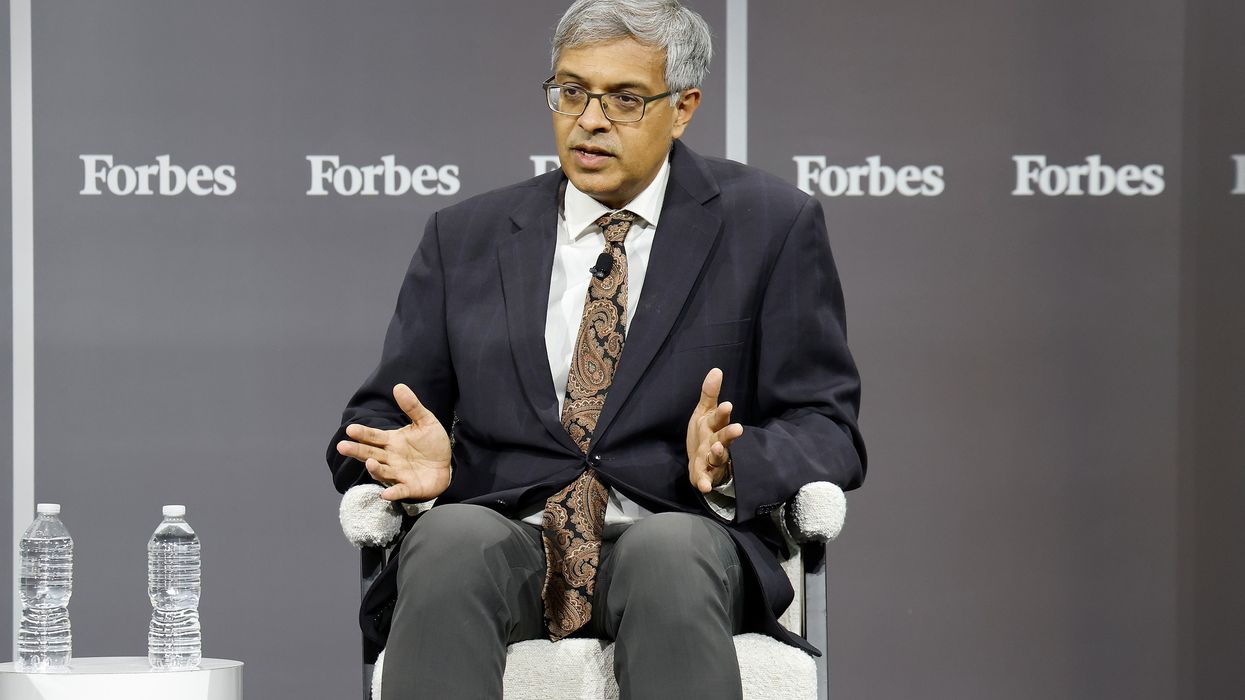
If you line up all the wicked, unqualified, strange, and misshapen beings who will guide Trump's administration into the stormy seas of fascism, not a single one can be linked to the incalculable measures of suffering that Jay Bhattacharya shepherded into history.
If I have to pick only one from the list of nepotistic freaks, ghouls, B-list celebs, lost souls, Hitlerian zealots, and bunglers that will comprise U.S. President Donald Trump's inner circle of appointees, satellite charlatans, and court jesters, I am going to go with the one with the highest body count. There are plenty of zombies in Trump's starting lineup that would give you goosebumps—people who would cause you to choke on a sip of coffee and double check the pistol under your suit jacket if you met them in a diner to talk about internment camps and environmental deregulation. Picking the most terrible of these dregs is no easy task.
We have a serial pet murderer, a dumpy bald version of Reinhard Heydrich, and a bevy of cheerleaders for ecocide. Among Trump's cabinet picks there is a guy with a fetish for bear meat and whale carcasses and a viable plan to bring back smallpox and polio, but it takes more than a nostalgic and wistful longing for diseases of long ago to excite me. There is a certain irony to choose the most upright, clean-cut, impressively credentialed, and soft spoken of this hall of Hell hounds to be my best of the worst. Few things inspire cold sweat beads of fear like a murderer masquerading as a nice guy. Think of Ted Bundy as a Trump appointee.
I have to select Jay Bhattacharya (Trump's nominee to take over Francis Collins' former niche as director of The National Institutes of Health) as my absolute favorite monster from among the whole entourage of moral mutants and groveling sycophants. Bhattacharya would not raise your suspicions if he knocked on your door to deliver pamphlets—I would happily take a copy of The Watchtower and Awake from this reassuring man. He would bring a glow of satisfaction to most parents if their daughter brought him home. Hell, he even has ardent fans on the so-called left—the Tucker Carlson fan club comprised of Glenn Greenwald, Jimmy Dore, and Matt Taibbi. You can toss Russell Brand in there too. In a game of free association, we casually link Bhattacharya with the issue of free speech—recall that Twitter once censored this honest doctor. Jacobin, in 2020, did a softball interview with one of Bhattacharya's ideological partners, Martin Kulldorff. On the left we sometimes worry more about a killer's rights to free speech than we do about his raised dagger.
Bhattacharya was never about free speech, he was about giving a thunderous voice to the corporate aspiration to kill you for profit.
Free speech has been a distracting shibboleth for many sincere people, even though free speech has little meaning in a media system dominated by cash. The narrative promoted by both fascists and assorted enablers holds that Bhattacharya challenged the powerful forces of the “deep state” and was censored for his courage.
You might recall that the Stanford Professor of medicine coauthored the Great Barrington Declaration (GBD) along with Sunetra Gupta of Oxford, and Martin Kulldorff of Harvard. The rightwing Covid-19 gambit enjoyed unlimited oil industry funding and a mandate to assemble tenured prostitutes from academia to bamboozle the public. Jeffrey Tucker of the American Institute for Economic Research—a Koch Network outpost in Great Barrington, Massachusetts with a plump endowment from stock trading—must have had great confidence in the public tendency to skip the fine print. Leading up to, and following the pandemic, Bhattacharya has held fellowships and professional associations with The Hoover Institute, The Epoch Times, Hillsdale College, and The Brownstone Institute. The Brownstone is an Astroturfed organization with a Brooklyn visual motif and an Austin, Texas mailing address.
This Great Barrington Declaration spinoff—yet another brain child of the restlessly promiscuous, Koch affiliated, Jeffrey Tucker—specializes in Covid-19 minimizing, and anti-vax propaganda while dabbling in climate change denial. Walker Bragman and Alex Kotch revealed that the Brownstone is largely funded by dark money. To appreciate Bhattacharya’s mastery of absurdity, consider his statement in this 2022 interview posted at The Hoover Institute's Website:
It's a disaster that it's become a partisan thing. Public health, when it is partisan, is a failed public health.
If there is one essential talent that a fascist henchman needs, it is an utter immunity to self scrutiny, irony, and hypocrisy. I recall that Rudolf Hoss—the infamous commandant at Auschwitz—remarked in his dutifully composed autobiography (requisitioned by his British Jailers, postwar, prior to hanging), that his administration succeeded (I am paraphrasing) due to the cooperation of staff and prisoners alike. He could not wrap his head around the concept of victims and perpetrators having different agendas. They all worked together in a common purpose in Hoss' broken brain. Likewise, Bhattacharya has a Hoss-like inability to imagine that his narrative might be transparently nonsensical—how can a man affiliated with nearly every institution in the Koch Network not be self conscious when complaining of partisan medical narratives?
Bhattacharya's GBD is little more than libertarian rhetoric shaped to the contours of public health. Libertarian public health is a flagrant oxymoron—the task that Bhattacharya will be handed in a fascist oligarchy will be one that he has already done quite brilliantly—get the fuck out of the way and pretend that the mountain of bodies is an offering to the god of freedom.
Libertarian metaphor is wonderfully adaptable, like an elastic pair of stretch pants—one size fits all. Inaction is always in the service of human well-being. The climate regulates itself—"drill baby, drill." Guns need no regulations either, the "good guy with a gun" provides a natural balance. Bhattacharya, Gupta, and Kulldorff figured out the libertarian essence of the Covid-19 story—the pandemic would fizzle out via the designs of nature (herd immunity!). The mandate for the government public health agencies was to use magic and disappear. And that is what Bhattacharya will do, make healthcare as ephemeral as a slight-of-hand handkerchief. His role is one of absence, abdication, retreat—but ultimately one of corporate fidelity, privatization, and the empowering of insurance companies and other profit-seeking medical companies to feed upon a sickly public.
Herd immunity was the whole tale in the GBD—the entire document can be read by a second grader in 20 seconds, but I can condense it into a three second sentence: Let everyone walk into the pandemic like it was a fourth of July stroll in the park, and, bingo—herd immunity!
There was a tiny bit about "focused protection" for the old and the sick. There was even a suggestion that old folks ought to have their groceries delivered, but not a whisper about who would pay for it. Of course we all know that some 40% of U.S. residents are afflicted with obesity, an enormous risk factor for Covid-19 mortality. We might add in all the smokers, lead- and mercury-poisoned masses, and the generally compromised health of a nation long on high fructose corn syrup and short on medical coverage. What you won't find in the GBD is a word about contact tracing, isolation, support for workers, mask wearing, and equipment for afflicted individuals—you know, the stuff that South Korea did to reduce Covid-19 harms by a factor of five compared to the U.S. Bizarrely, Bhattacharya belatedly renounced “herd immunity” in a Salon interview. WTF? It was all about focused protection he explained.
The deep state censored Bhattacharya, the truth teller, and now he will lead the very agency that suppressed him. The truth is a little more nuanced. Bhattacharya and his fellow medically credentialed whores had a bigger platform than former Chief Medical Adviser Anthony Fauci ever had. With Trump's appointment of Scott Atlas to his Covid-19 Task Force, the GBD nearly became the de facto inspiration for U.S. policy.
According to The Lancet, some 40% of US Covid-19 deaths were preventable—about a half a million deaths could be loosely traced to public recalcitrance regarding pandemic protocol. How many of these victims can be directly traced to the influence of Bhattacharya and the GBD? I can't venture an exact figure, but if you line up all the wicked, unqualified, strange, and misshapen beings who will guide Trump's administration into the stormy seas of fascism, not a single one—not Kash Patel, RFK Jr., Kimberly Guilfoyle, Mike Huckabee, Kari Lake, Jared Kushner, Tulsi Gabbard, or anyone else can be linked to the incalculable measures of suffering that Jay Bhattacharya shepherded into history.
This is how Benjamin Mateus, writing for the World Socialist Web Site described the GBD:
The AIER, a libertarian think-tank, which posits as their aim “a society based on property rights and open markets,” is engaged in a highly reactionary, anti-working-class, and anti-socialist enterprise. The declaration has been partly funded by the right-wing billionaire, Charles Koch, who hosted a private soiree of scientists, economists, and journalists to provide the homicidal declaration a modicum of respectability and formulate herd immunity as a necessary global policy in response to the pandemic.
Derrick Z. Jackson described the GBD as a plan for "herding people to slaughter." If any of you take issue with my favoring Jay Bhattacharya as Trump's most evil selection, when did Elon Musk, Vivek Ramaswamy, or Tulsi Gabbard ever herd people to slaughter?
I am not denying that there are other abominable sociopaths who will be vying for crumbs at the master's table. Lee Zeldin and Doug Burgum as heads of the Environmental Protection Agency and Secretary of the Interior respectively, might someday cause more deaths than the piddling few hundred thousand that I have speculatively traced to Bhattacharya. In fact, the wholesale, escalating assassination of the natural world will act in tandem with our disassembled, privatized medical system. You will get to live downstream from an industrial pig slaughterhouse, with no medical insurance, and no funding for public health.
Zeldin, Burgum, and Bhattacharya might be thought of as crossing guards for the grim reaper, or maybe you might prefer to picture them as scare crows, mannequins, or plastic fuck dolls—things that have no inner lives and serve as extensions of our fantasies.
Bhattacharya was never about free speech, he was about giving a thunderous voice to the corporate aspiration to kill you for profit. Bhattacharya whined about school closings but never acknowledged the 6 million U.S. children now potentially ruined by long Covid.
As you read about the fires turning LA into an ash heap, and Trump's plans to drill and frack until the entire globe achieves end-Permian parity, be aware that the styrofoam inhabitants of Trump's administration will do no more to alleviate your misery than so many cardboard boxes sitting in the storage rooms of Amazon. If we want relief we'll have to plan unprecedented acts of resistance.
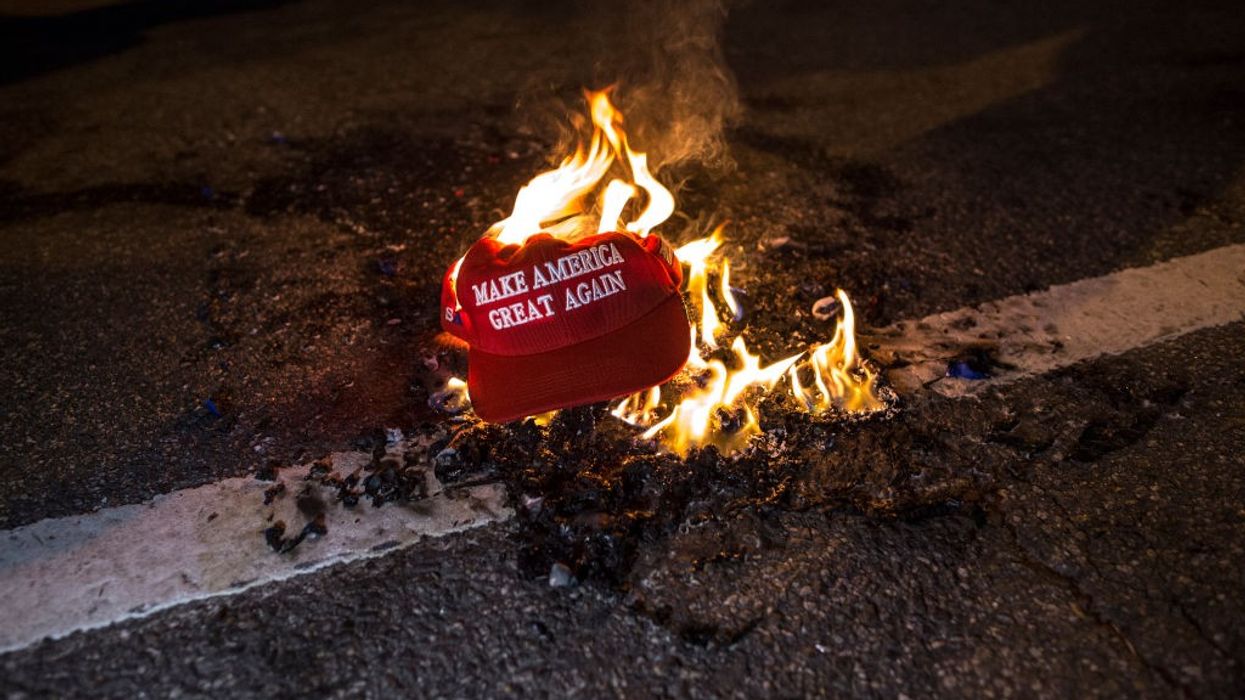
One last thought—look at the Rorschach blot below and ask yourself...
Is this an image that summons worries about free speech denied, or does this picture remind you that the oil industry owns our future?
"With fear for our democracy," said Justice Sonia Sotomayor, "I dissent."
Following twin court rulings Monday, the Washington Post should update its “Democracy Dies in Darkness” banner. The MAGA Supreme Court has coldly and emphatically demonstrated this term that both democracy—and many of the public protections American families and workers count on—die in public, but only if we let it.
The cascade of disastrous and even deadly rulings will rightfully put a long-term stain on what is likely the most far-right Supreme Court since the monstrous days of Jim Crow. Especially if Trump is allowed to return to office and run a bulldozer over every vestige of what has constituted political and legal norms in the nation for at least the past half century.
But, there’s another point that much of the torrent of coverage has somewhat overlooked. Opponents of Trump and Trumpism have held out hope that the Republican Party old guard would somehow wake up and cast aside the wannabe dictator they have unleashed on the country.
Our challenge is to support legislation to reverse these decisions, and to defeat Trump and everything Trumpism and neoliberalism stands for in November.
Especially in its cascade of decisions “kneecapping the administrative state,” as Slate writer Mark Joseph Stern puts it, the Court has unambiguously embraced a principle goal of solidifying in legal precedent pro-corporate neoliberal policies that drove much of traditional Republican philosophy, especially since the first days of the Reagan administration. The centerpiece was the Court’s ruling in Loper Bright Enterprises v. Raimondo reversing the so-called 1994 Chevron deference case under which regulatory agencies were given authority to interpret, implement, and enforce ambiguous laws passed by Congress. The Court’s ruling effectively signals that the neoliberalism empire has struck back.
It marks a massive triumph for deregulation that Sherrilyn Ifill, law professor and former president and director-counsel of the NAACP Legal Defense Fund, aptly termed “a seismic shift in how U.S. government operates,” with “devastating and potentially catastrophic” consequences.
The traditional Wall Street wing of the Republican Party (which also mostly governs the Democratic Party establishment) had already, despite some ballyhooed misgivings over Trump’s multitude of criminal and autocratic behavior, welcomed Trump’s one major accomplishment of his first term — the massive tax gift for big business and the uber rich.
No doubt already salivating over Trump’s pledge to extend and expand his 2017 law, which slashed the corporate tax rate from 35 to 21 percent and handed the 296 most profitable corporations a $240 billion dollar tax present, the corporate tycoons and their most devout legislators now have another reason to hug Trump tightly. That would be the vision of agencies—purged of perceived enemies—overseeing environmental, food safety, workplace standards, worker and union rights, and so many other critical protections eliminated by a new Trump administration stacked with Trump cult loyalists.
They can also probably be ready to overlook the new power the Court on Monday granted Trump to emulate the worst criminality of Mussolini, Franco, or King George (what was that 1776 ruckus about anyway?). As Chief Justice Roberts wrote, Trump gets “a presumptive immunity from prosecution for all his official acts.” As if Trump or his enablers will ever really distinguish official from non-official acts. The Strict Scrutiny podcast offers probably the best analysis.
In her dissent, for once dropping the polite “respectfully” from her dissent wording, Justice Sonia Sotomayor made the consequences abundantly clear.
When he uses his official powers in any way, under the majority’s reasoning, he now will be insulated from criminal prosecution. Orders the Navy’s Seal Team 6 to assassinate a political rival? Immune. Organize a military coup to hold onto power? Immune. Takes a bribe in exchange for a pardon? Immune. Immune. Immune… Never in the history of our Republic has a president had reason to believe that he would be immune from criminal prosecution if he used the trappings of his office to violate the criminal law. If the occupant of that office misuses official power for personal gain, the criminal law that the rest of us must abide will not provide a backstop. With fear for our democracy, I dissent.
Will the neoliberal establishment be at peace with a dictator like Pinochet? We now know the answer to that question. Citing political historian Karl Polanyi, American Prospect co-founder Robert Kuttner in 2019 warned, “in regimes that border on neofascist, klepto-capitalists get along just fine with dictators, undermining the neoliberal premise of capitalism and democracy as complements.”
Neoliberalism has a few godfathers, beginning with Austrian academic Friedrich Hayek who in the late 1930s and 1940s was railing against President Roosevelt’s New Deal and Britian’s post-World War II embrace of such reforms as creation of the National Health service, as “manifestations of a collectivism,” wrote George Monbiot.
Another was infamous economist Milton Friedman, who in a celebratory tour of apartheid South Africa in 1976, wrote Zachary Carter, delivered a diatribe against “political democracy—an explicit rejection of, in Friedman’s words, ‘one person, one vote,’ delivered to a nation in which more than half of the population was disenfranchised by race.”
Will the neoliberal establishment be at peace with a dictator like Pinochet? We now know the answer to that question.
Hayek and Friedman both enthusiastically embraced Pinochet’s brutal coup and subsequent repressive policies in Chile. In “Democracy in Chains,” historian Nancy MacLean notes Hayek visited Pinochet, voicing distaste with “unlimited democracy,” and Friedman endorsed his policies of “shock treatment.” Economist James Buchanan, also a prominent advocate of neoliberal policies, helped guide Pinochet’s rewrite of his country’s constitution to put democracy “in chains,” which to this day continues to hamstring efforts at political reform in Chile.
In advocating market fundamentalism, Hayek and Friedman, says Kuttner, “promoted rules created by and for private owners of capital, to keep democratic government from asserting rules of fair competition or countervailing social interests.”
Thus, the tenets of neoliberal policy—lifting all constraints from capital, of which deregulation is a central focus, privatization, austerity through starving, if not outright elimination, of social programs, and decapitating worker resistance with a frontal attack on unions and worker’s rights. Neoliberalism in the U.S. was a counter revolution to progressive government social and political reforms of the 1950s and 1960s that raised standards of living, especially for white American workers and families.
One starting date was the infamous 1971 Powell Memo, authored by future Supreme Court justice Lewis Powell who called for political combat: “Business must learn the lesson . . . that political power is necessary; that such power must be assiduously cultivated; and that when necessary, it must be used aggressively and with determination.”
While President Jimmy Carter carried out some deregulation, especially on airlines, it was President Ronald Reagan who supercharged neoliberalism. His first act, notably, was to break the air-traffic controllers’ union, firing the federal employees who had gone on strike and presiding over decertification of their union. Chevron, explains Ian Millhiser, was originally established by the Supreme Court in 1984 to limit decisions by lower federal courts dominated by Democratic appointees who were “prone to striking down the Reagan administration’s deregulatory actions.”
It matters when those administrative agencies are staffed by scientists who write rules to limit toxic smog, and other experts who work to ensure that health plans cover basic medical services, ensure the safety of drugs and protect consumers from risky corporate financial behavior,” as they were especially under President Biden, and not by opponents of regulatory public protections, such as Reagan and Trump.
Other Democratic presidents have been co-signers of deregulation and other elements of neoliberalism, notably President Clinton with his deregulation of key banking regulation that led directly to the 2008 financial meltdown. But Biden has attacked much of the underpinnings of neoliberalism in his most important domestic policies.
In his first address to Congress, Biden, unlike Clinton, vigorously defended the role of government, saying “public investment and infrastructure has literally transformed America,” bringing us railroads, highways, schools, colleges, vaccines, the internet, and “so much more.” As Eric Levitz wrote last year, “this defense of state intervention in markets crescendoed with the declaration that, in our democracy, the government is 'you and I' and not some powerful force that we have no control over. It’s us.”
Even in the face of obstruction from nearly unanimous Republican opposition, and limits by conservative Democrats, Biden successfully shepherded passage of major legislation extending aid for families devastated by the pandemic, and enacted critical health care reforms, especially for seniors, and a major infrastructure program. His agencies also initiated challenges to corporate malfeasance such as anti-trust challenges and price gouging that were a major cause of inflation. And, of course, Biden was the most pro-labor president, especially his policies through the National Labor Relations Board and Occupational Safety and Health Administration, since at least President Roosevelt.
That was the intended target of the Court’s anti-regulatory cases, attacking the Environmental Protection Agency, the Security and Exchanges Commission, and all other administrative agencies in the Looper Bright case, transferring authority to the courts, especially the MAGA court.
Under that decision, Millhiser explains “questions like whether a product derived from red rice yeast, which purportedly helps promote healthy cholesterol levels, counts as a “drug” or a “dietary supplement” under federal law? Under Chevron, this question would be decided by FDA officials who’ve spent decades studying drugs and dietary supplements. Now it will be resolved by political appointees with law degrees and black robes.”
It is no coincidence that the Koch network were the main financial backers of the case that formed the basis of Looper Bright. The billionaire Koch brothers, who built their massive wealth through the fossil fuel industry have a direct line from decades of also funding an entire academic and legal industry of neoliberalism and deregulatory challenges in particular.
Law professor Kate Shaw adds, “an error in one of this week’s opinions provided a stark illustration of the costs of the court’s lack of expertise: On Thursday, in the case dealing with the Environmental Protection Agency—Ohio v. E.P.A.—the released version of the majority opinion made five references to “nitrous oxide,” commonly referred to as laughing gas, rather than the “nitrogen oxide” compounds at issue. The error was quickly fixed, but no agency official working on the regulation of this compound would have made such an error—and in many ways that is Chevron’s whole point.” She also noted the tortured and factual misleading explanations the court majority concocted to justify its pro-gun violence ruling defending murderous bump stocks.
The Court even found a way Monday to make it worse with a follow-up ruling. In a decision that handed corporations even more time to challenge regulations, “ruling that a six-year statute of limitations for filing lawsuits begins to run when a regulation first affects a company rather than when it is first issued.” But in reality, the Strict Scrutiny law professors said, the decision “massively expands the amount of time that essentially anybody has to challenge an agency rule if they don’t like it. Even if the rule has been on the books for years or decades.”
In her dissent, Justice Ketanji Brown Jackson noted, “the court’s baseless conclusion means there is effectively no longer any limitations period for lawsuits that challenge agency regulations… Allowing every new commercial entity to bring fresh facial challenges to long existing regulations is profoundly destabilizing for both government and businesses. It also allows well-heeled litigants to game the system by creating new entities or finding new plaintiffs whenever they blow past the statutory deadline.”
Amidst the wreckage of this decision, we also have to point to the weak defense of public safety regulation by decades of too many Democratic elected officials, and the broader public.
With the arrival of summer, many families plan family visits to county fairs, amusement parks, or traveling carnivals. They’ll hop on roller coasters and other thrill seeker rides probably not dwelling on what keeps them safe on those sometimes aging, rickety contraptions. I spent two summers in my youth working for a traveling carnival, marveling at all those people lining up for journeys on clearly dubious, creaking machines.
Whether federal, state or local regulatory agencies, most Americans assume someone is looking out for their safety. We rely on public oversight and enforceable standards and rules established by experienced and expert civil servants at regulatory agencies.
We rarely stop to think about the importance of what these agencies do, but we ignore their key role at our peril. As Georgetown University Law Center professor Lisa Heinzerling, who previously served in the EPA, told Slate “people care when their drinking water is contaminated with lead. They care if their medicines aren’t safe and effective, or if somebody takes all the money out of their investment accounts.” Or when you board a plane and hope the doors don’t fly off today, or go to a hospital for emergency medical care when you can’t breathe because the local refinery released toxic emissions into the air.
It’s time to care. It’s long past time to mount that defense of the positive role government and regulatory work in the public interest can and must do. Our challenge is to support legislation to reverse these decisions, and to defeat Trump and everything Trumpism and neoliberalism stands for in November.
"Preventing the disclosure of the sources of political spending would deprive voters of critical information and undermine the essential need for checks on monetary power," warned one democracy watchdog.
All three Republican members of the Federal Election Commission on Thursday voted in favor of a new rule change that would have made it even easier for right-wing megadonors to hide their political campaign contributions from public view.
While the three Democratic members forced a deadlocked vote that prevented passage of the proposal, pro-democracy watchdogs said the unanimous vote by the Republican-appointed members shows the powerful commitment by GOP forces to increase the ability for wealthy individuals and corporate interests to mask their political giving.
FEC chairman Sean Cooksey was joined by his two Republican colleagues Allen Dickerson and James "Trey" Trainor III in backing the measure, but all three Democrats—Commissioners Shana Broussard, Dara Lindenbaum, and vice chair Ellen Weintraub—voted against to nullify it.
The proposal, Sludge reported earlier this week, would "supercharge" the flow of so-called "dark money" in political campaigns and was proposed by Dickerson, a Trump-nominated member who "previously worked at an anti-campaign finance regulation organization funded by conservative political megadonors."
"As democracy faces its biggest test yet around the world, it is difficult to believe that the world's oldest democracy is even considering further eroding the public's right to know who is influencing their elections."
Dickerson's proposed rule change, per the FEC, would have allowed advocacy groups or campaigns to "withhold, redact, or modify contributors’ identifying information in campaign finance disclosure reports"—reports currently mandated so that the public is made aware of who is funding such organizations.
Ahead of the vote, Scott Greytak, director of advocacy for Transparency International U.S., said the implications if it passed would reach far beyond the United States.
"With half of the world's population living in countries that will hold a nationwide vote this year, the United States must embody and exemplify the importance of transparent and informed elections," Greytak said in a statement opposing the proposal. "As democracy faces its biggest test yet around the world, it is difficult to believe that the world's oldest democracy is even considering further eroding the public's right to know who is influencing their elections."
In a May 2 memo detailing his argument in favor of exempting donors from mandated disclosure requirements, Dickerson claims it is "a Constitutional right" because "Americans are entitled to make political contributions without being attacked, threatened, or fired."
In view of such arguments, which right-wing forces have made for some time, Stuart McPhail, director of campaign finance litigation with Citizens for Responsibility and Ethics in Washington (CREW), has explained why such bad-faith misdirection is an effort to obscure what's really going on.
While it's true that some groups historically were granted exemptions for donor disclosures—including the NAACP and the Socialist Workers Party (SWP), whose supporters and members faced coordinated, state-sponsored violence due to their political activities—claims like the one Dickerson makes, McPhail contends, fails on various merits.
"Campaign finance disclosure does not subject any viewpoint to discriminatory burdens," McPhail explained in a 2022 blog post. "Rather, the aim of the laws has nothing to do with expression at all: they target transfers of wealth that could be and are used to corruptly influence officials, defraud voters and undermine democracy. Rather than state-sponsored suppression, dark money funders face criticism from concerned and less powerful citizens."
It should be clear, he continued, that powerful "Dark money groups, their donors, and the candidates are trying to evade responsibility, not prevent retaliation." When people like Dickerson make such moves, argued McPhail, they are trying to help groups and their allies "to avoid accountability by hiding their donors and silencing critics who may speak out against them."
This is why Thursday's votes in favor of such a proposal, said Craig Holman, Ph.D., a government ethics expert with Public Citizen, should be viewed with alarm.
"Commissioners of the FEC, regardless of party affiliation, have always defended the need for disclosure of campaign money sources – until now," Holman said following the 3-3 vote. "Preventing the disclosure of the sources of political spending would deprive voters of critical information and undermine the essential need for checks on monetary power. It is truly disturbing to see half of the Commission now undermining that core principle, which is so important to an open democratic society."
As context, the median household income in Kansas is just shy of $70,000, meaning that Mr. Koch’s windfall would be the equivalent of more than 12 years’ worth of income for the typical Kansas household.
Last week, both houses of the Kansas legislature approved a significant tax cut centered around replacing the state’s graduated rate income tax structure with a flat tax instead. The bulk of this would flow to upper-income families, mostly through lowering the state’s top income tax rate from 5.7 to 5.25 percent. This tax cut would be especially lucrative for the state’s wealthiest individual, billionaire Charles Koch. We estimate that Mr. Koch could expect to receive a tax cut in the neighborhood of $875,000 per year. As context, the median household income in Kansas is just shy of $70,000, meaning that Mr. Koch’s windfall would be the equivalent of more than 12 years’ worth of income for the typical Kansas household.
It bears noting that an $875,000 annual tax cut is more than 7,500 times larger than the $116 average tax cut that the middle 20 percent of earners could expect to receive under this legislation.
The figure below combines data from the ITEP Tax Microsimulation Model with an off-model analysis performed using data on Mr. Koch’s finances that were reported by Pro Publica and Forbes. According to the ITEP Model, the top 1 percent of earners in Kansas would see far larger tax cuts under this legislation than anyone among the bottom 99 percent of families. The $6,608 average tax cut going to top earners is 57 times larger than the average cut for middle-income earners and 114 times larger than the average cut for the state’s lowest-income residents. But some members of the top 1 percent, almost certainly including Mr. Koch, would receive tax cuts far larger than $6,608.
The ITEP Model analyzes tax impacts across the income scale for all state and local tax types. But the model’s ability to estimate effects at the extreme reaches of the economic scale, particularly at the state level, is limited by IRS restrictions on reporting of top earners’ incomes and deductions. Typically, the highest income group for which we report tax data is the top 1 percent of earners. Supplementing our model data with additional data on the nation’s wealthiest families allows us to offer a fuller picture of tax impacts than the model alone can provide.
Without access to Mr. Koch’s Kansas tax filings, it is not possible to compute his precise tax cut with certainty. But a reasonable estimate can be arrived at using federal tax return data reported by ProPublica.
That reporting indicated that Mr. Koch enjoyed an average federal adjusted gross income of $213 million dollars per year across the six-year period spanning 2013 to 2018, and average federal taxable income of approximately $141 million per year. Adjusting those figures to account for differences in state and federal definitions of taxable income, and growing them in line with recent increases in Mr. Koch’s wealth as reported by Forbes, leads us to conclude that his state taxable income is likely in the vicinity of $194 million today. For somebody with an income at that level, the tax bracket and exemption changes contained in the legislation that recently passed the Kansas legislature would provide a tax cut of roughly $875,000 per year.
Choosing to cut taxes for high-income families in Kansas will inevitably require the state to do less of something else instead, be it fewer teacher pay raises, less frequent infrastructure maintenance, or any number of other reductions in public services.
Mr. Koch could also expect to receive additional sales and property tax cuts under the bill, but those would amount to little more than a rounding error relative to the far larger windfall he would receive from the top income tax rate reduction.
It bears noting that an $875,000 annual tax cut is more than 7,500 times larger than the $116 average tax cut that the middle 20 percent of earners could expect to receive under this legislation. Similar, it is more than 15,000 times larger than the $58 average tax cut that the state’s lowest earners could expect to receive.
Across the country, state revenue and budget outlooks are rapidly becoming less rosy than they have been during the last few years. As surpluses dwindle and some states begin to face shortfalls, the tradeoffs associated with deep tax cutting will become harder to ignore. Choosing to cut taxes for high-income families in Kansas will inevitably require the state to do less of something else instead, be it fewer teacher pay raises, less frequent infrastructure maintenance, or any number of other reductions in public services. Lawmakers should imagine what Kansas could do for its residents with $875,000 a year, and then ask a simple question: is that money better spent on helping our communities thrive, or lining the pockets of a single billionaire?
The 40-year trickle-down delusion, fashioned by right-wing economists, politicians, and financial experts, has deprived average Americans of the means to support their families in a comfortable, debt-free manner. It was planned. It's insidious. It's ongoing. And it should outrage every last one of us.
Middle America's anger is misdirected: toward liberals because of the misperception that educated elites are trying to foist socialism on a capitalist nation; toward minorities and immigrants, even though their financial struggles are similar to those of moderate-income white Americans; and toward the federal government, even as Republican state leaders reject Medicaid expansion and food assistance for hungry children and families. But largely unnoticed is the 50-year quietly coordinated and insidious campaign to transfer American wealth to the richest people.
A 2020 TIME magazine article reported that in just over four decades $50 trillion has been transferred from working Americans to multi-millionaires. According to the Credit Suisse 2022 Global Wealth Databook, in approximately the last decade (2010-2021) America's wealth has grown by over $80 trillion, up to $60 trillion of which was taken by the country's millionaires and multi-millionaires (about 10% of the population).
The sordid history of the wealth grab is one of power, greed, and manipulation.
This is a staggering takeaway of wealth. The TIME article suggests that the amount is "enough to more than double median income—enough to pay every single working American in the bottom nine deciles an additional $1,144 a month. Every month. Every single year."
This is where America's anger should be directed. The 40-year trickle-down delusion, fashioned by economists, politicians, and financial experts, has deprived average Americans of the means to support their families in a comfortable, debt-free manner. It allows multi-millionaires to siphon off our country's wealth effortlessly with the inevitable rise in the stock market. And it undoubtedly has contributed to the surge in "deaths of despair"—those from drug and alcohol abuses as well as suicide—that continue to increase among poor Americans.
The sordid history of the wealth grab is one of power, greed, and manipulation. In 1971, corporate lawyer and soon-to-be Supreme Court justice Lewis F. Powell wrote a lengthy memo that rallied conservatives in their desire for business growth and free markets. Government, universities, and the media were the enemies. Political equality and shared prosperity were un-American.
Defenders of the rich argue that they've earned their wealth. But for the most part, they've simply learned how to exploit American prosperity.
Conservative think tanks sprung up. The "greed is good" philosophy of Ayn Rand was becoming justified. The influential economist Milton Friedman said "The free market system distributes the fruits of economic progress among all people" and then infamously teamed with economist Arthur Laffer to convince American leaders that decreasing taxes on the wealthy would allow increased revenues to "trickle down" to the rest of the country.
We were then comforted in years to follow, as inequality grew, by the Wall Street Journal claiming that "income inequality is simply not a significant problem" and The Economist boasting that "the world now knows how to reduce poverty." The Charles Koch Foundation tried to shame us into compliance with the reassurance that earning $34,000 a year placed you in the Top 1% in the world.
Defenders of the rich argue that they've earned their wealth. But for the most part, they've simply learned how to exploit American prosperity. Beginning in the 1950s, funding for modern computer technology came almost entirely from taxpayer dollars through the Department of Defense and other branches of government. As explained by Mariana Mazzucato: "From the Internet that allows you to surf the Web, to GPS that lets you use Google Maps, to touchscreen display and even the SIRI voice activated system—all of these things were funded by Uncle Sam." Adds political economist Gar Alperovitz: "Between the mid-1980s and the mid-1990s the National Science Foundation spent $200 million to build and operate a network of regional supercomputing hubs called the NSFNET. Connected to the ARPANET, this network established Internet access for nearly all U.S. universities, making it a civilian network in all but name."
In a similar vein, pharmaceutical companies wouldn't exist without money from the taxpayers, who have provided support for decades through the National Institutes of Health, and who still pay for most of the basic research for new drugs and vaccines. Yet both the tech and pharmaceutical companies claim patents on the products paid for and developed by the American people.
Overall, in the U.S. today, the federal government continues to be the largest source of funding of basic research.
Stock growth represents American prosperity driven by 75 years of shared effort. Everyone should benefit, probably by receiving a guaranteed income. Just a two-percent tax on total financial wealth would generate enough revenue to provide an $18,000 annual stipend to every American household (including those of the richest families).
With typical overreaction, the Wall Street Journal laments that "A tax on securities trades would...create large economic and societal distortions." We already have economic and societal distortions. Taxing stock ownership would be straightforward and fair-minded, while barely disrupting the portfolios of the millionaires and multi-millionaires who own close to 90% of all stocks.
Perhaps, with a tax on the effortless accumulation of stock market wealth, average taxpayers would finally receive a return on 75 years of American prosperity.
How will we pay for a more equitable, sustainable, and secure economy? The answer starts with tax the rich.
The United States is, by every reasonable measure, the most unequal of the world’s rich countries and, for more than four decades, it’s been getting worse. After too many years of inaction and complicity, a growing number of Democrats seem to get it. The Republicans and their patrons, on the other hand, are hell-bent on making it worse. Indeed, it’s an essential part of their mission.
And note well—this is not just a “troubling development” or one more example of Republican cruelty. This massive transfer of income and wealth toward the top represents a major restructuring of the US political-economy—a major shift in economic and political power in the US.
Evidence of extreme and rising economic inequality in the U.S. is overwhelming. In 1979, the top 1% earned about 9% of all income; in 2022, the top 1% earned 21% of all income. More than half of all income growth since 1976 has ended up in the pockets of the top 1%. The incomes of the top 0.1% have grown even faster, and the incomes of the top .01% (the top ten thousandth) have grown faster still. In 1965 the typical CEO earned about 20 times as much as the average worker. In 2022, this ratio was 344. And corporate profits continue to break records.
Meanwhile, the incomes of the shrinking middle class have stagnated, and the incomes of those with a high school education or less have fallen substantially. Since 1980, labor productivity—the market value of what the typical U.S. worker produces in an hour—has increased by 65% while real wages (what workers get paid for an hour of work) have barely budged. Since 1970, the purchasing power of the minimum wage has fallen by more than 40%. 11.5% of US residents (about one in nine) live in poverty.
The next time an economist or a banker or a Republican or a “fiscally conservative” Democrat tells you that we “can’t afford” universal health care or affordable higher education or Social Security or public investments in clean energy or commitments to housing security, clean air and clean water, think about this massive shift of income and wealth.
Carter Price and Kathryn Edwards estimate that from 1975-2018, there was a shift of $47 trillion (and counting) from the bottom 90% of income earners in the U.S. to the top 1%. That is, if the distribution of income in 2018 had looked like the distribution of income in 1975 (if the incomes of the bottom 90% had grown as fast as aggregate income) the annual income of the “bottom” 90% of Americans would have been $2.5 trillion higher in 2018 alone. That’s enough to pay every U.S. household in the bottom 90% an additional $1,144 per month. Every month. Every year.
The next time an economist or a banker or a Republican or a “fiscally conservative” Democrat tells you that we “can’t afford” universal health care or affordable higher education or Social Security or public investments in clean energy or commitments to housing security, clean air, and clean water, think about this massive shift of income and wealth. How will we pay for a more equitable, sustainable, and secure economy? The answer starts with tax the rich.
And while much has been made of the (very real) hard times endured by the “white working class” in recent decades, profound racial inequality remains a defining feature of the U.S. economy. The income of the median African American household is about 60% that of the median white household, and this ratio is lower than it was in 1960. The wealth of the median African American household is about one-ninth that of the median white household. One in six African Americans (17%) live in poverty—twice the rate for whites—and one in four African American children live in poverty. This appalling racial inequality manifests itself in other realms of social life as well: education, health care, housing, employment, capital markets, exposure to toxins, life expectancy, infant mortality, the “criminal justice system,” and more. (African Americans are five times more likely to be incarcerated than white Americans.)
Many millions are a lay-off, a health crisis, or a divorce away from bankruptcy and/or poverty.
Tens of millions are without adequate health care. Twenty-six million are uninsured. (The U.S. is the only rich country without universal health care. Two-thirds of bankruptcies in the U.S.—more than half a million per year —are caused by medical debt.) Our schools are underfunded, we work too hard, and the organization of economic life—the ways in which we produce, distribute, and consume stuff—has put our bodies, our planet, and our grandchildren’s prospects at risk.
Isn’t rising inequality inevitable in a capitalist economy? No! It has not always been this way.
And, by the way, the burdens of climate change are (and will continue to be) felt disproportionately by the poor – in the U.S., and around the world.
OK. But isn’t rising inequality inevitable in a capitalist economy? No! It has not always been this way. Between 1948 and 1975, the income of the median US household doubled. The incomes of the bottom 20% actually grew a little faster than the incomes of the top 20% over this period. Between 1928 and 1950, the distribution of income and wealth in the U.S. actually became dramatically more equal. And many of the world’s richest capitalist countries thrive with dramatically lower levels of inequality.
Why should we be concerned about inequality? America is about opportunity, not guarantees—right? Actually, no. Among the world’s rich countries, the US is tied for last in class mobility; a US resident’s economic success is in fact very highly correlated with their parents’ wealth and status.
And further, economic inequality inevitably means political inequality. The right-wing Koch brothers and their billionaire allies have spent hundreds of millions of dollars advancing their self-serving agenda: tax cuts, deregulation, union busting, climate change denial, cuts to Medicare, Medicaid and Social Security, voter suppression, appointments of right-wing justices (who reliably affirm the Koch agenda), and political hits on legislators who dare to step out of line. When asked why he—along with virtually every other Republican in the US Congress – would vote for President Trump’s massive (and widely unpopular) corporate tax cuts in 2017, Republican Chris Collins of New York answered: "My donors are basically saying ‘get it done, or don’t ever call me again.’” Increasingly—at the federal and state level—legislation is literally being written by corporate lobbyists and think tanks funded by rich right-wingers. As Republicans attempt to explain their economic policy agenda, you can almost see the Koch Brothers’ lips moving.
Increasingly—at the federal and state level—legislation is literally being written by corporate lobbyists and think tanks funded by rich right-wingers.
There is also compelling evidence that inequality is socially corrosive. In their magnificent book, The Spirit Level, Richard Wilkinson and Kate Pickett show that unequal societies suffer from higher rates of violent crime, incarceration, infant mortality, stress, mental illness, substance abuse, and suicide. Inequality is also associated with lower life expectancy, lower levels of educational performance, and lower levels of trust. Inequality is not just bad for the poor. It's toxic. In her powerful book, Weathering: The Extraordinary Stress of Ordinary Life in an Unjust Society, Dr. Arline T. Geronimus shows that the deep and relentless stress associated with social, economic, and political marginalization has dramatic and, often, lethal health effects. Differences in health outcomes depend essentially on how society treats us, rather than how well we take care of ourselves.
Despite this grim reality, the Republican Party’s economic policy agenda has not changed for decades. Cut taxes for the top 1%. (The effective tax rate on the 0.1% richest Americans has fallen by a third since 1980.) Reduce corporate accountability (“deregulation”) so that banks, hedge funds and private equity can run wild and corporations can pollute with impunity. Attack the bargaining power of workers. And then blame the inevitable decline in workers’ incomes on people of color—"illegal immigrants," "welfare queens," food stamp recipients, those who’ve “cut the line” thanks to "quotas" and "special preferences," and “unfair trade deals” with Mexico and China.
Sound familiar? After more than four decades, it should. This is trickle-down economics (enriched by a shameless racist narrative). The “logic” here is that the economy will grow if we provide a better “business climate”—lower taxes and fewer regulations will liberate corporations to create jobs. The problem is that it doesn’t work. Nearly four decades of lower (and lower) taxes and reckless deregulation have saddled us with soaring inequality, the financial meltdown of 2008, a devastating recession, an epidemic of housing insecurity, rising tuition at our public universities, diminishing opportunities, and eroding economic security for millions of Americans, and a planet in peril. And yet—like a zombie that will not die—trickle-down economics is alive and well in the U.S., despite its long record of failure. Ask a Republican about the economy, and they are likely to tell you that we need more of this toxic concoction.
But it is wrong to conclude that trickle-down economics has “failed.” The U.S. economy doesn’t serve most of us because it is not designed to. It’s designed to generate profits – which it does extraordinarily well. University of Cambridge economist Ha-Joon Chang hits this nail on the head: "Once you realize that trickle-down economics does not work, you will see the excessive tax cuts for the rich as what they are—a simple upward redistribution of income, rather than a way to make all of us richer, as we were told."
The U.S. economy doesn’t serve most of us because it is not designed to.
The lost income of workers of all sorts—union and non-union, black, brown and white, public sector and private sector, etc.—can be found in the pockets of the 1 percent.
The U.S. remains a very rich country. We have the capacity to do much better. We have the capacity to deliver equitable, sustainable prosperity—and we know how to do it. A detailed plan is beyond the scope of this short essay, but here’s a start: a tax on wealth; tax increases on corporations and the super-rich; a higher minimum wage; deliberate, active efforts to improve worker bargaining power; affordable health care for all; a well-funded effort to provide affordable housing for all; the promotion of renewable energy and sustainable production technologies, and affordable higher education—including the elimination of student debt. More generally, we need to reject the presumptions that (a) our well-being depends on growth and (b) prosperity requires that we pander to corporations.
Inequality is, to a considerable degree, a political choice. And there are powerful forces out there fighting with all of their might and all of their abundant resources to preserve the status quo.
Soaring inequality is not inevitable. It’s not about the “inexorable” forces of globalization or technological change. Inequality is, to a considerable degree, a political choice. And there are powerful forces out there fighting with all of their might and all of their abundant resources to preserve the status quo. The US economy is working for them.
The construction of an economy that meets the needs of the 99% will require a determined, united, inspired political movement—a movement that presents an alternative vision for our economy, and recognizes that we have a monumental struggle on our hands, a struggle to dis-empower the entrenched, self-serving corporate elite that has had its way for too long.An in-depth look at the Freedom Foundation and its campaign against public unions.
One day, I received a very nice card in the mail. It had a picture of Uncle Sam pointing out at me over the words “Give yourself a raise,” and included a tear-off mailer addressed to “UESF Membership Specialist.” It read, “Effective immediately, I resign any membership I may have in all levels of United Educators of San Francisco (UESF).” All I needed to do to get my raise was sign it and send it back to that membership specialist, c/o Freedom Foundation in Orange, California.
Just who were these nice people, I wondered, who were looking out for my financial well-being—and even had a specialist devoted to my local union? The answer turned out to be quite the story.
Heading to the Freedom Foundation website, I found a prominently placed video telling how “Los Angeles high school teacher, Glenn Laird, reached his breaking point after his teacher (UTLA) demanded we defund the police.” Given that Glenn is a teacher himself, I gathered that the questionable grammar and the mistake of referring to United Teachers of Los Angeles as a “teacher” rather than a union were likely typos on the part of the freedom folks. Odd though, I thought, that such an obviously well-funded organization would not employ the services of a proofreader, but then the website quickly makes it quite clear that it’s not the education business that these folks are in.
The Freedom Foundation is hardwired to hard-right money.
The business they are in is union-busting. In their words: “The Freedom Foundation is more than a think tank. We’re more than an action tank. We’re a battle tank that’s battering the entrenched power of left-wing government union bosses who represent a permanent lobby for bigger government, higher taxes, and radical social agendas.”
“Why We Fight,” the organization’s statement of purpose, proclaims that “government unions are a root cause of every growing national dysfunction in America.” (Every one of them!) And the mailing I had received, I learned, was part of the organization’s Nationwide Opt Out Project, aimed at “taking on government union bosses and defunding their radical unconstitutional agenda” because “GOVERNMENT UNIONS ARE THE SINGLE GREATEST OBSTACLE TO A FREE AMERICA” (All caps on the website) that “REPRESENT NOTHING LESS THAN A LOBBY FOR NATIONAL DECLINE AND DESTRUCTION. WE MUST DEFEAT THEM FIRST BEFORE THEY DESTROY OUR COUNTRY.” The website’s interactive 50-state map will allow you to locate the specific local union that the foundation would like you to leave, and its “dues calculator” allows you to compute how much you will have saved in union dues—compounded at 6%—by the time of your retirement.
While government employee unions are the organization’s particular bugbear, they’re not really too keen on unions of any sort. While conceding that “organized labor began as a way for workers to improve their standing in our country,” the foundation believes that “slowly it transformed into a weapon to destroy it.” And then there’s those darned “Liberal state governments” that are “like cockroaches eking out survival amid the fallout of a nuclear war.”
The freedom folks find evidence of this “national decline” pervasive throughout American society, extending to the “fiscal crisis” that “has forced government to take increasingly perverse actions to keep the system afloat, including multi-trillion bailouts of state government in the form of ‘Covid Emergency’ funds that were airdropped across America in 2020 at the height of mass hysteria over the virus.” For their part, they look forward to “a day when opportunity, responsible self-governance, and free markets flourish in America because its citizens understand and defend the principles from which freedom is derived.” As far as the foundation itself goes, “We accept no government support.”
What never? Well, hardly ever. It would appear that even these hardcore free marketeers were not immune to the Covid “mass hysteria.” Noting that at the time “unions specifically weren’t eligible for the paycheck protection program, so they were left to fend for themselves,” the July 8, 2020, Seattle Times reported, “Not so the Freedom Foundation, though—it got between $350,000 to $1 million from the federal relief fund, records show.” ProPublica reports the exact figure was a $644,125 Paycheck Protection Program loan given to protect the jobs of 82 campaigners against excess government spending. (The amount subsequently forgiven the resolutely anti-government bailout organization was $651,157, the difference representing accrued interest.)
To be fair, though, this government “airdrop” by no means represents the core of the organization’s funding. The June 28, 2018, Los Angeles Times reported that although the group’s labor policy director “declined to identify any of the group’s donors, which he said include businesses, foundations, and individuals ‘from all different walks of life,’” the group’s “tax filings reveal a who’s-who of wealthy conservative groups. Among them are the Sarah Scaife Foundation, backed by the estate of right-wing billionaire Richard Mellon Scaife; Donors Trust, which has gotten millions of dollars from a charity backed by conservative billionaire brothers Charles and David Koch; from the Richard and Helen DeVos Foundation, backed by the family of U.S. Secretary of Education Betsy DeVos; and the State Policy Network, which has received funding from Donors Trust and is chaired by a vice president of the Lynde and Harry Bradley Foundation.”
They are people whose job is specifically to reduce the resources available to support economic equity campaigns, and to reduce the resources available to oppose the careers of rich men’s friends in government.
Who are these individuals and organizations? According to SourceWatch, a project of the Center for Media and Democracy, the Sarah Scaife Foundation gives “tens of millions of dollars annually to fund right-wing organizations such as the American Legislative Exchange Council, the American Enterprise Institute, and the Heritage Foundation, and anti-immigrant and islamophobic organizations such as the Center for Immigration Studies and the David Horowitz Freedom Center.”
In her August 23, 2010, New Yorker article “Covert Operations,” Jane Mayer described the billionaire Koch brothers as “longtime libertarians who believe in drastically lower personal and corporate taxes, minimal social services for the needy, and much less oversight of industry—especially environmental regulation.” DeVos, of course, we know from the Trump administration, as well by association with her brother Eric Prince, who founded the mercenary organization formerly known as Blackwater. SourceWatch says that “Harry Bradley was one of the original charter members of the far right-wing John Birch Society, along with another Birch Society board member, Fred Koch, the father of Koch Industries' billionaire brothers and owners, Charles and David Koch.”
In other words, the Freedom Foundation is hardwired to hard-right money. In a 2016 fundraising letter, Tracy Sharp, president and CEO of the State Policy Network—which counts the Freedom Foundation as an affiliate—was quite clear as to the orientation and policy goals of these organizations: “The Big Government unions are the #1 obstacle to freedom in the states” because, among other things, they support “a universal $15 minimum wage” and “defend Obamacare at all costs,” and—here we cut to the prime motivation behind the expenditure of all this hard right money—“They want to redistribute wealth.” She concludes, “And yes, they are the funding arm of the Progressive Left.”
The letter also touts the network’s victories in defunding the left in a number of states including Wisconsin and Michigan. Close followers of the Electoral College map will remember that in 2016 Donald Trump won Wisconsin by 23,000 votes and Michigan by 11,000, as well as the fact that his failure to repeat those narrow wins caused his eviction from the White House four years later. (State Policy Network donors include Philip Morris, Kraft Foods, Facebook, Microsoft, AT&T, Time Warner Cable, Verizon, and Comcast. Its Indiana affiliate was once headed by former Vice President Mike Pence.)
Although the Freedom Foundation operates as a tax-exempt 501(c)(3) charitable organization, a status requiring abstention from partisan politics, it’s not shy about expressing its views in the political arena. The 2018 Supreme Court decision in the case of Janus v. AFSCME ended the ability of public sector unions to collect “agency fees” from non-members, a practice designed to reimburse a union for the costs accrued in their representation of non-members as part of the bargaining unit. This decision, long sought by right-wing organizations, would not have happened had Donald Trump not recently appointed Neil Gorsuch to the court, an appointment with a specific political history.
As the foundation recounts on its website, “the liberal Judge Merrick Garland—who would later serve as attorney general under President Biden—was handpicked by President Obama to succeed Scalia” (Antonin Scalia, the Justice whose sudden February 13, 2016, death opened a seat on the court) but “conservatives stood and fought—and it made all the difference. The U.S. Senate, under the leadership of Majority Leader Mitch McConnell, refused to debate the Garland nomination until after the 2016 presidential election. As we all know, that fateful election ultimately put Donald Trump in the White House. And it ended any chance of Judge Garland moving to the high court. Shortly after President Trump’s inauguration, Judge Neil Gorsuch ultimately was confirmed as a conservative successor to Justice Scalia.”
But the foundation cannot be accused of Trump loyalism, in that Florida Gov. Ron DeSantis, his opponent in the bitterly contested Republican presidential nomination race, also came in for high praise when he signed legislation further restricting the ability of his state’s public employee unions to collect dues. Rusty Brown, the foundation’s southern director, thanked him for “standing up for government employees who have been held hostage by their unions,” declaring that “The Freedom Foundation applauds... Gov. DeSantis for ending this government union charade against public employees.”
So, back to the question of who those nice people who want me to get a pay raise actually are. They are people who oppose a $15 an hour minimum wage, expanded publicly funded health insurance coverage, and the redistribution of wealth. They are people who admire Mitch McConnell, Donald Trump, and Ron DeSantis. They are people funded by right-wing, dark money networks. They are people whose job is specifically to reduce the resources available to support economic equity campaigns, and to reduce the resources available to oppose the careers of rich men’s friends in government.
Should you decide to help them on their way by opting out of your union, you’ll probably want to avail yourself of their “dues calculator,” because if they have their way, the gap between their major funders and the rest of us is going to just keep growing.
The right-wing billionaire's foundation pumped over $52 million into higher education last year to advance its libertarian agenda.
Charles Koch contributed $52.6 million in grants to colleges and universities through his Charles Koch Foundation in 2022, an analysis of the personal foundation’s latest IRS filing obtained by the Center for Media and Democracy (CMD) found.
Last year’s total is $29 million less than the Charles Koch Foundation spent on higher education in 2021, and a small fraction of what the Koch political network spends in one year. A CMD analysis found that a fleet of 27 organizations controlled by the Koch patriarch, his son Chase, and other Koch Industries executives spent a combined net total of $656.8 million on political and charitable causes in 2021.
Koch political network spending is likely to go up in 2022 with news of Charles Koch’s gift of $4.3 billion of Koch Industries stock to the newly formed nonprofit Believe in People that Forbes reported on last month. Believe in People’s 2022 IRS filing is not publicly available as of publishing.
The new filing shows that the Charles Koch Foundation now has $793.7 million in net assets after less than $300,000 was contributed, but investment income brought in $108.9 million.
CMD identified 126 higher education grants in the filing, with some schools receiving multiple donations. Again, George Mason University received the largest amount of Koch cash, raking in a total $8.2 million. $5.9 million of this was directed to the university’s Institute for Humane Studies. Charles Koch currently sits on the Institute’s board of directors as chairman emeritus along with the Koch Foundation’s Ryan Stowers, who is the current chairman, and Stand Together‘s Brian Hooks.
Grant agreements posted on the Charles Koch Foundation website show that the remaining $2.9 million went to George Mason’s law school, economics department, and its Center for the Study of Social Change, Institutions, and Policy.
The next largest recipient of Koch Foundation funds was Utah State University, which received $3.1 million. $625,000 was directed to the Center for Growth and Opportunity (CGO) at the school, and the grant agreement with Koch shows that the remaining $2.5 million is for the Huntsman Scholar Program at the School of Business.
CGO was founded in 2017 with a $50 million commitment from the Charles Koch Foundation and the Huntsman Foundation. Jon Huntsman was the founder of the Huntsman Corporation, a multinational chemical manufacturer.
Rounding out the top three higher education grantees was New York University with a $3 million contribution from Koch. According to the grant agreement, this Koch cash is to support The Center for Social Media and Politics to “study how information flows online.”
While these grants were published by Koch, only a selection of grant agreements are listed to date in the section of the site dedicated to sharing information on annual grant agreements.
Almost 50 years ago, Charles Koch urged the Institute for Humane Studies Board of Directors to avoid giving money to universities unless they would help advance business interests:
[W]e have supported the very institutions from which the attack on free markets emanates. Although much of our support has been involuntary through taxes, we have also contributed voluntarily to colleges and universities on the erroneous assumption that this assistance benefits businesses and the free enterprise system, even though these institutions encourage extreme hostility to American business. We should cease financing our own destruction and follow the counsel of David Packard, former Deputy Secretary of Defense, by supporting only those programs, departments or schools that ‘contribute in some way to our individual companies or to the general welfare of our free enterprise system.’
In addition to the higher education grants, the Koch Foundation sent $2.3 million to right-wing litigation, advocacy, and other tax-exempt groups. The lion’s share of that funding, $1.9 million, went to the U.S. Chamber of Commerce Foundation.
Charles Koch is the CEO and chairman of Koch Industries and is worth $52.4 billion, according to Forbes.
"All justices personally close to proprietors of shady financial services firms should recuse themselves, full stop," said Revolving Door Project's Jeff Hauser.
U.S. Supreme Court Justice Clarence Thomas on Monday faced mounting pressure to recuse himself from a case that experts warn "poses an existential threat" to a consumer-focused federal agency in the wake of revelations that he secretly served as an in-person "fundraising draw" for Koch network donor events.
ProPublica's Friday reporting on Thomas' Koch connections came amid heightened scrutiny of the justice's ties to billionaires with business before the court. Next week, the court is scheduled to hear oral arguments in Consumer Financial Protection Bureau (CFPB) v. Community Financial Services Association of America (CFSA)—a case challenging the agency's funding structure brought by a group that represents payday lenders.
"His repeated abuse of his office for personal gain is a national disgrace."
"Clarence Thomas' close ties to the Koch network—which has spent billions trying to make it easier for corporate predators to rip off everyday Americans and face zero accountability—are grounds for his immediate recusal from the CFPB case," Revolving Door Project (RDP) senior researcher Vishal Shankar argued Monday.
"He cannot be trusted to rule impartially on matters that would financially benefit his billionaire benefactors, and by extension himself," Shankar said of Thomas. "His repeated abuse of his office for personal gain is a national disgrace."
Critics—including Democrats in Congress and watchdog groups—have called for new Supreme Court ethics policies, a U.S. Department of Justice probe, and even Thomas' resignation over recent reporting about his relationship with billionaire Harlan Crow and other rich GOP donors who have showered the justice with luxury vacations and other gifts.
Crow's "real estate empire has bankrolled the National Multifamily Housing Council—a landlord lobbying group that has opposed CFPB regulation of the tenant screening industry," RDP highlighted Monday.
"While the artificial 'Community Financial Services Association of America' is the named litigant opposite the CFPB, all observers understand that the stakes in this litigation are shared by every investor in the types of companies that profit from unfair, deceptive, or abusive practices," said RDP executive director Jeff Hauser. "Just because Koch and others have used a shell organization to back this lawsuit doesn't mean that their ties to justices are any less relevant."
RDP also noted that attorney John Eastman—an ex-adviser to former President Donald Trump who was indicted in the Georgia election interference case and corresponded with right-wing activist Ginni Thomas, the justice's wife, before the January 6, 2021 insurrection—filed an amicus brief in CFPB v. CFSA supporting the payday lenders.
RDP's recusal demand echoed Accountable.US senior adviser Kyle Herrig's response to ProPublica's reporting last week.
"It's clear that Justice Thomas sees his position on our nation's highest court as a way to upgrade his own lifestyle with no regard for ethics or consequences," Herrig said Friday. "It was his own decadeslong improper financial relationship with Harlan Crow that sparked the Supreme Court corruption crisis in the first place—and that was just the tip of the iceberg."
"As ethics violations by Thomas and others keep piling up, Chief Justice Roberts' lack of action becomes more egregious," he added. "The chief justice must demand Justice Thomas recuse himself from upcoming cases with Koch network conflicts of interest. We need accountability and reform now."
As Common Dreams reported last Monday, Justice Samuel Alito, another member of the court's right-wing supermajority, has also faced calls to recuse himself from CFPB v. CFSA, given his private jet travel with billionaire Paul Singer, whose investment management firm holds at least $90 million in financial companies overseen by the agency.
"All justices personally close to proprietors of shady financial services firms should recuse themselves, full stop," Hauser declared Monday. "And if any justices persist in hearing this case despite being self-evidently biased, the case for rebalancing the Supreme Court to create an ethical majority will become even stronger."
"For years, regulated interests have funded a full-scale campaign to delegitimize and dismantle federal regulations."
Hours before ProPublica revealed new details about U.S. Supreme Court Justice Clarence Thomas' relationship with the Koch network, a group of Democratic senators filed a brief on Thursday warning that Koch-backed entities are closely involved in an upcoming case that could further gut the federal government's regulatory power—and enhance the strength of the conservative-dominated high court.
The case in question is Loper Bright Enterprises v. Raimondo, which stems from a New Jersey-based fishing company's challenge to a law requiring certain fishing boats to carry federal compliance monitors to enforce regulations.
Loper Bright Enterprises specifically objected to an interpretation of federal law by the National Marine Fisheries Service, which said the Magnuson-Stevens Act allows the agency to require industry to pay the costs of the monitors.
The dispute over an obscure federal statute has since exploded into a matter of great interest to industry groups and environmentalists, with the latter warning that if the Supreme Court sides with the plaintiffs, it will be much more difficult for federal agencies to implement climate regulations.
Sens. Sheldon Whitehouse (D-R.I.), Mazie Hirono (D-Hawaii), Dianne Feinstein (D-Calif.), and Elizabeth Warren (D-Mass.) echoed that concern and spotlighted the attention the case has attracted from right-wing and corporate-funded groups.
"This case is the product of a decades-long effort by pro-corporate interests to eviscerate the federal government's regulatory apparatus, to the detriment of the American people," the lawmakers wrote, noting that a number of groups connected to the Koch network and other powerful right-wing organizations have submitted briefs in support of the plaintiffs in Loper v. Raimondo.
"For example, amici The Buckeye Institute, Cato Institute, Competitive Enterprise Institute, Landmark Legal Foundation, Mountain States Legal Foundation, National Right to Work Legal Defense Foundation, New Civil Liberties Alliance, and Pacific Legal Foundation have all received hundreds of thousands, and sometimes millions, of dollars from Donors Trust and Donors Capital Fund—two donor-advised funds that allow ultra-wealthy interests to direct funding anonymously."
"The Buckeye Institute, Cato Institute, Competitive Enterprise Institute, New Civil Liberties Alliance, and Pacific Legal Foundation
have also received substantial funding from the Koch family foundations—another top-ten funder for the climate change counter-movement," the senators added.
"The court should proceed cautiously before contributing to their sought-for degradation of our American regulatory system."
At the center of Loper v. Raimondo is the so-called Chevron doctrine, a decades-old administrative law principle that says courts should defer to a federal agency's "reasonable" interpretation of a statute when the law's language is ambiguous.
The plaintiffs in the case and their corporate-backed supporters have called on the Supreme Court to either weaken the Chevron doctrine or overrule it entirely.
In its amicus brief in the case, the Cato Institute—which was co-founded by billionaire oil tycoon Charles Koch—declares that the Chevron doctrine is "unconstitutional and ahistorical" and has "wreaked havoc in the lower courts upon people and businesses."
The Democratic senators counter in their brief that the Chevron doctrine has been critical in "allowing Congress to rely on agency capacity and subject-matter expertise to help carry out Congress' broad policy objectives."
"Administrative regulations reined in dangerous industry activities," the senators added, "and our society became safer and more prosperous."
A ruling that effectively casts the principle aside, the lawmakers argued, "would not just conflict with Congress' well-established policymaking desires; it would erode the separation of powers by shifting policymaking power from Congress and the executive to the unaccountable judiciary."
The brief was submitted a day before ProPublica reported that Thomas, one of the justices poised to rule on Loper v. Raimondo, has attended at least two donor events for the Koch network during his time on the Supreme Court.
ProPublica noted that Thomas used to support the Chevron doctrine but has changed his position in recent years amid a growing corporate onslaught against the regulatory principle.
The Democratic senators stressed in their brief that "the assault in this case on the regulatory system is not an isolated effort."
"For years, regulated interests have funded a full-scale campaign to delegitimize and dismantle federal regulations,” the lawmakers wrote. "The court should proceed cautiously before contributing to their sought-for degradation of our American regulatory system."