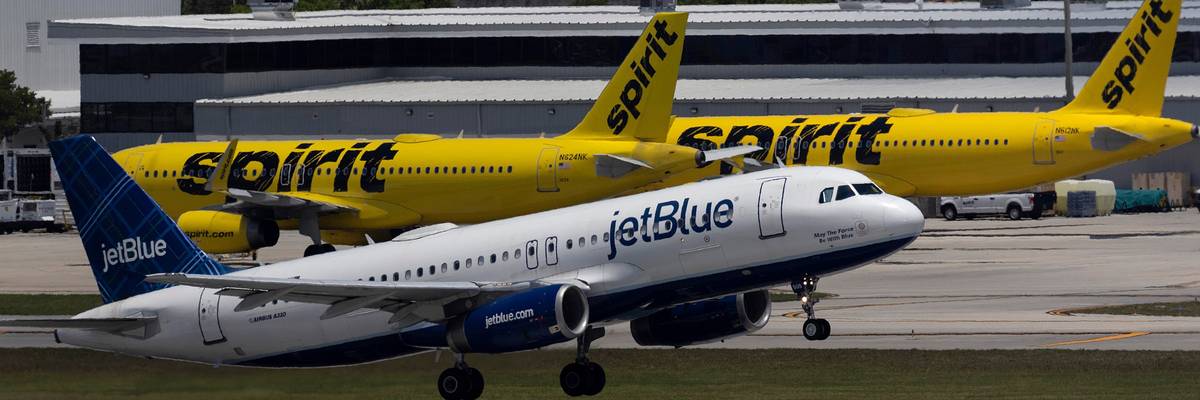
A JetBlue Airbus A320 takes off while Spirit Airlines planes sit off-runway at Fort Lauderdale-Hollywood International Airport in Florida on May 16, 2022.
DOJ Sues to Block 'Blatantly Anti-Competitive' JetBlue-Spirit Airlines Merger
"The Department of Justice is standing up for passengers, workers, and communities across the country," said one expert.
Consumer and labor advocates on Tuesday welcomed a U.S. Department of Justice antitrust lawsuit seeking to block JetBlue's proposed $3.8 billion acquisition of Spirit Airlines, its biggest competitor, a deal that critics say would harm passengers and workers.
The Department of Justice (DOJ), along with the attorneys general of Massachusetts, New York, and Washington, D.C., allege in the civil antitrust suit that "by eliminating that competition and further consolidating the United States airlines industry, the proposed transaction will increase fares and reduce choice on routes across the country, raising costs for the flying public and harming cost-conscious fliers most acutely."
While the two airlines argue that their merger would increase competition, U.S. Attorney General Merrick Garland said in a statement that the deal "would result in higher fares and fewer choices for tens of millions of travelers, with the greatest impact felt by those who rely on what are known as ultra-low-cost carriers in order to fly."
"Americans want more choices and lower prices for airline tickets, not another giant merger."
Consumer advocacy groups agreed with Garland's assessment.
"In blocking this blatantly anti-competitive deal, the Department of Justice is standing up for passengers, workers, and communities across the country," William J. McGee, senior fellow for aviation and travel at the American Economic Liberties Project, said in a statement. "Don't believe JetBlue's corporate spin: Allowing JetBlue to gobble up a low-cost competitor and accelerate concentration in the aviation industry will immediately drive up fares nationwide."
Transport Workers Union of America (TWU)—which represents JetBlue flight attendants—also opposes the deal.
"We have yet to see a credible argument that a consolidated JetBlue-Spirit will enhance competition in the domestic airline industry," TWU international president John Samuelsen wrote in a letter to Garland and U.S. Transportation Secretary Pete Buttigieg last month.
"Workers and passengers will be harmed, just as they have been in many past airline consolidations, as the new airline follows the business practices, pricing strategies, and labor cost-cutting practices previous combined carriers have undergone," Samuelsen added.
Some opponents of the airline megadeal noted that the U.S. Department of Transportation (DOT) has the power to do more to block anti-competitive mergers and acquisitions.
As the Economic Liberties Project noted: "The DOT already has broad, existing authority under the Clayton Act to block airline mergers. Similarly, under Title 49 of the U.S. Code, DOT has broad authority to investigate and prosecute anti-competitive airline mergers, and to deny route transfers that contravene the public interest or affect domestic competition."
The group also highlighted President Joe Biden's call for Buttigieg to deliver financial relief to air travelers and align the DOT with the White House's plan to promote a more competitive economy.
"Secretary Buttigieg and the Department of Transportation have broad authority to block harmful mergers and promote competition throughout the airline industry," McGee said. "We're also pleased to see reporting that DOT plans to use their power, embracing President Biden's competition agenda, to stop the JetBlue-Spirit deal."
We are at a crossroads
This country and this world are at a monumental crossroads. In a few short weeks, US voters will have an opportunity to beat back the forces of fascism and confront the billionaires who are rigging the economy, our media system, and our democracy, making it increasingly impossible for ordinary people to get by. We’re not just talking about the election. We’re talking about what must be done once these fascist elements are vanquished from power. We need a bolder set of solutions than what either major party has so far been willing to offer and a working-class movement ready to fight like hell for it. Trump didn't emerge from nowhere. The conditions that fueled MAGA authoritarianism were created by decades of radical neoliberal economic policies and a corrupt political system dominated by corporate interests. They slashed taxes on the super-rich, promising that the benefits would trickle down. They said giveaways to the corporate titans would make life more affordable for the rest of us. It was all bullshit. And when a bitter, betrayed populace searches for someone to blame, right-wing demagogues have little trouble finding scapegoats. People know when they're being lied to, but you won't hear any of this from the corporate media. Only independent journalism—powered and funded by people who believe in building a better world—can deliver truly trustworthy daily news. Our Fall Campaign is underway, and we need your help. To power our newsroom through the rest of the year, we need to raise $125,000 by midnight on October 31. So if you share our vision, please contribute whatever you can to sustain our work. |
Consumer and labor advocates on Tuesday welcomed a U.S. Department of Justice antitrust lawsuit seeking to block JetBlue's proposed $3.8 billion acquisition of Spirit Airlines, its biggest competitor, a deal that critics say would harm passengers and workers.
The Department of Justice (DOJ), along with the attorneys general of Massachusetts, New York, and Washington, D.C., allege in the civil antitrust suit that "by eliminating that competition and further consolidating the United States airlines industry, the proposed transaction will increase fares and reduce choice on routes across the country, raising costs for the flying public and harming cost-conscious fliers most acutely."
While the two airlines argue that their merger would increase competition, U.S. Attorney General Merrick Garland said in a statement that the deal "would result in higher fares and fewer choices for tens of millions of travelers, with the greatest impact felt by those who rely on what are known as ultra-low-cost carriers in order to fly."
"Americans want more choices and lower prices for airline tickets, not another giant merger."
Consumer advocacy groups agreed with Garland's assessment.
"In blocking this blatantly anti-competitive deal, the Department of Justice is standing up for passengers, workers, and communities across the country," William J. McGee, senior fellow for aviation and travel at the American Economic Liberties Project, said in a statement. "Don't believe JetBlue's corporate spin: Allowing JetBlue to gobble up a low-cost competitor and accelerate concentration in the aviation industry will immediately drive up fares nationwide."
Transport Workers Union of America (TWU)—which represents JetBlue flight attendants—also opposes the deal.
"We have yet to see a credible argument that a consolidated JetBlue-Spirit will enhance competition in the domestic airline industry," TWU international president John Samuelsen wrote in a letter to Garland and U.S. Transportation Secretary Pete Buttigieg last month.
"Workers and passengers will be harmed, just as they have been in many past airline consolidations, as the new airline follows the business practices, pricing strategies, and labor cost-cutting practices previous combined carriers have undergone," Samuelsen added.
Some opponents of the airline megadeal noted that the U.S. Department of Transportation (DOT) has the power to do more to block anti-competitive mergers and acquisitions.
As the Economic Liberties Project noted: "The DOT already has broad, existing authority under the Clayton Act to block airline mergers. Similarly, under Title 49 of the U.S. Code, DOT has broad authority to investigate and prosecute anti-competitive airline mergers, and to deny route transfers that contravene the public interest or affect domestic competition."
The group also highlighted President Joe Biden's call for Buttigieg to deliver financial relief to air travelers and align the DOT with the White House's plan to promote a more competitive economy.
"Secretary Buttigieg and the Department of Transportation have broad authority to block harmful mergers and promote competition throughout the airline industry," McGee said. "We're also pleased to see reporting that DOT plans to use their power, embracing President Biden's competition agenda, to stop the JetBlue-Spirit deal."
Consumer and labor advocates on Tuesday welcomed a U.S. Department of Justice antitrust lawsuit seeking to block JetBlue's proposed $3.8 billion acquisition of Spirit Airlines, its biggest competitor, a deal that critics say would harm passengers and workers.
The Department of Justice (DOJ), along with the attorneys general of Massachusetts, New York, and Washington, D.C., allege in the civil antitrust suit that "by eliminating that competition and further consolidating the United States airlines industry, the proposed transaction will increase fares and reduce choice on routes across the country, raising costs for the flying public and harming cost-conscious fliers most acutely."
While the two airlines argue that their merger would increase competition, U.S. Attorney General Merrick Garland said in a statement that the deal "would result in higher fares and fewer choices for tens of millions of travelers, with the greatest impact felt by those who rely on what are known as ultra-low-cost carriers in order to fly."
"Americans want more choices and lower prices for airline tickets, not another giant merger."
Consumer advocacy groups agreed with Garland's assessment.
"In blocking this blatantly anti-competitive deal, the Department of Justice is standing up for passengers, workers, and communities across the country," William J. McGee, senior fellow for aviation and travel at the American Economic Liberties Project, said in a statement. "Don't believe JetBlue's corporate spin: Allowing JetBlue to gobble up a low-cost competitor and accelerate concentration in the aviation industry will immediately drive up fares nationwide."
Transport Workers Union of America (TWU)—which represents JetBlue flight attendants—also opposes the deal.
"We have yet to see a credible argument that a consolidated JetBlue-Spirit will enhance competition in the domestic airline industry," TWU international president John Samuelsen wrote in a letter to Garland and U.S. Transportation Secretary Pete Buttigieg last month.
"Workers and passengers will be harmed, just as they have been in many past airline consolidations, as the new airline follows the business practices, pricing strategies, and labor cost-cutting practices previous combined carriers have undergone," Samuelsen added.
Some opponents of the airline megadeal noted that the U.S. Department of Transportation (DOT) has the power to do more to block anti-competitive mergers and acquisitions.
As the Economic Liberties Project noted: "The DOT already has broad, existing authority under the Clayton Act to block airline mergers. Similarly, under Title 49 of the U.S. Code, DOT has broad authority to investigate and prosecute anti-competitive airline mergers, and to deny route transfers that contravene the public interest or affect domestic competition."
The group also highlighted President Joe Biden's call for Buttigieg to deliver financial relief to air travelers and align the DOT with the White House's plan to promote a more competitive economy.
"Secretary Buttigieg and the Department of Transportation have broad authority to block harmful mergers and promote competition throughout the airline industry," McGee said. "We're also pleased to see reporting that DOT plans to use their power, embracing President Biden's competition agenda, to stop the JetBlue-Spirit deal."