SUBSCRIBE TO OUR FREE NEWSLETTER
Daily news & progressive opinion—funded by the people, not the corporations—delivered straight to your inbox.
5
#000000
#FFFFFF
To donate by check, phone, or other method, see our More Ways to Give page.
Daily news & progressive opinion—funded by the people, not the corporations—delivered straight to your inbox.
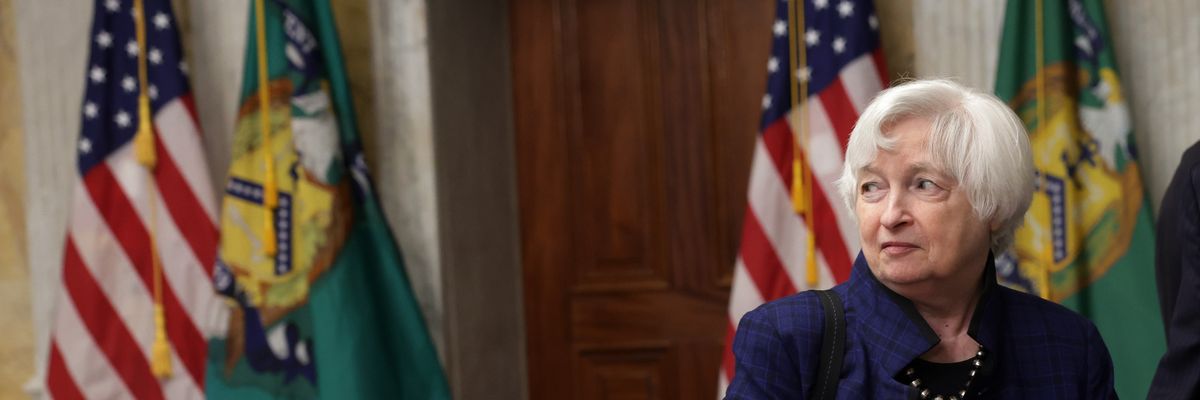
U.S. Treasury Secretary Janet Yellen leaves after an open session of a Financial Stability Oversight Council meeting at the Department of the Treasury on April 21, 2023 in Washington, D.C.
The treasury secretary's warning came as a Biden administration official said the president won't invoke the 14th Amendment in order to avoid a first-ever U.S. default.
U.S. Treasury Secretary Janet Yellen on Friday warned Congress that the United States government will run out of money to pay its bills on June 5 if lawmakers don't reach an agreement to raise the nation's debt ceiling.
"Based on the most recent available data, we now estimate that Treasury will have insufficient resources to satisfy the government's obligations if Congress has not raised or suspended the debt limit by June 5," Yellen wrote in a letter to House Speaker Kevin McCarthy (R-Calif.).
"We have learned from past debt limit impasses that waiting until the last minute to suspend or increase the debt limit can cause serious harm to business and consumer confidence, raise short-term borrowing costs for taxpayers, and negatively impact the credit rating of the United States," Yellen noted. "In fact, we have already seen Treasury's borrowing costs increase substantially for securities maturing in early June."
Earlier this month, Yellen said that the so-called "X-date"—the day on which the first-ever U.S. default will occur—could come as early as June 1.
"If Congress fails to increase the debt limit, it would cause severe hardship to American families, harm our global leadership position, and raise questions about our ability to defend our national security interests," she stressed in Friday's letter.
As The New York Times notes:
Ms. Yellen's letter comes as the White House and House Republicans have been racing to agree on a deal that would lift the nation's $31.4 trillion borrowing cap and prevent the United States from defaulting on its debt. The Treasury Department hit the debt limit on January 19 and has since been employing accounting maneuvers to ensure the United States can continue paying its bills on time...
On Friday, she detailed that the federal government is due to make more than $130 billion in scheduled payments during the first two days of June—including payments to veterans and Social Security and Medicare recipients—leaving the Treasury Department with "an extremely low level of resources"...
While negotiators have been in round-the-clock talks, no deal has been announced. Still, the contours of an agreement between the White House and Republicans are taking shape. That deal would raise the debt limit for two years while imposing strict caps on discretionary spending not related to the military or veterans for the same period.
Biden administration officials and congressional Democrats have accused Republicans of "hostage-taking" during the debt limit standoff, an allegation embraced by Rep. Matt Gaetz (R-Fla.) earlier this week.
Scores of Democratic lawmakers and progressive advocates have called on President Joe Biden to exercise his constitutional authority and invoke the 14th Amendment—which states in part that "the validity of the public debt of the United States... shall not be questioned."
However, Deputy Treasury Secretary Wally Adeyemo said Friday that Biden will not invoke the 14th Amendment.
"The 14th Amendment can't solve our challenges," Adeyemo asserted on CNN. "Now, ultimately, the only thing that can do that is Congress doing what it's done 78 other times, raising the debt limit."
"We don't have a Plan B that allows us to meet the commitments that we've made to our creditors, to our seniors, to our veterans, to the American people," Adeyemo added ominously.
Dear Common Dreams reader, It’s been nearly 30 years since I co-founded Common Dreams with my late wife, Lina Newhouser. We had the radical notion that journalism should serve the public good, not corporate profits. It was clear to us from the outset what it would take to build such a project. No paid advertisements. No corporate sponsors. No millionaire publisher telling us what to think or do. Many people said we wouldn't last a year, but we proved those doubters wrong. Together with a tremendous team of journalists and dedicated staff, we built an independent media outlet free from the constraints of profits and corporate control. Our mission has always been simple: To inform. To inspire. To ignite change for the common good. Building Common Dreams was not easy. Our survival was never guaranteed. When you take on the most powerful forces—Wall Street greed, fossil fuel industry destruction, Big Tech lobbyists, and uber-rich oligarchs who have spent billions upon billions rigging the economy and democracy in their favor—the only bulwark you have is supporters who believe in your work. But here’s the urgent message from me today. It's never been this bad out there. And it's never been this hard to keep us going. At the very moment Common Dreams is most needed, the threats we face are intensifying. We need your support now more than ever. We don't accept corporate advertising and never will. We don't have a paywall because we don't think people should be blocked from critical news based on their ability to pay. Everything we do is funded by the donations of readers like you. When everyone does the little they can afford, we are strong. But if that support retreats or dries up, so do we. Will you donate now to make sure Common Dreams not only survives but thrives? —Craig Brown, Co-founder |
U.S. Treasury Secretary Janet Yellen on Friday warned Congress that the United States government will run out of money to pay its bills on June 5 if lawmakers don't reach an agreement to raise the nation's debt ceiling.
"Based on the most recent available data, we now estimate that Treasury will have insufficient resources to satisfy the government's obligations if Congress has not raised or suspended the debt limit by June 5," Yellen wrote in a letter to House Speaker Kevin McCarthy (R-Calif.).
"We have learned from past debt limit impasses that waiting until the last minute to suspend or increase the debt limit can cause serious harm to business and consumer confidence, raise short-term borrowing costs for taxpayers, and negatively impact the credit rating of the United States," Yellen noted. "In fact, we have already seen Treasury's borrowing costs increase substantially for securities maturing in early June."
Earlier this month, Yellen said that the so-called "X-date"—the day on which the first-ever U.S. default will occur—could come as early as June 1.
"If Congress fails to increase the debt limit, it would cause severe hardship to American families, harm our global leadership position, and raise questions about our ability to defend our national security interests," she stressed in Friday's letter.
As The New York Times notes:
Ms. Yellen's letter comes as the White House and House Republicans have been racing to agree on a deal that would lift the nation's $31.4 trillion borrowing cap and prevent the United States from defaulting on its debt. The Treasury Department hit the debt limit on January 19 and has since been employing accounting maneuvers to ensure the United States can continue paying its bills on time...
On Friday, she detailed that the federal government is due to make more than $130 billion in scheduled payments during the first two days of June—including payments to veterans and Social Security and Medicare recipients—leaving the Treasury Department with "an extremely low level of resources"...
While negotiators have been in round-the-clock talks, no deal has been announced. Still, the contours of an agreement between the White House and Republicans are taking shape. That deal would raise the debt limit for two years while imposing strict caps on discretionary spending not related to the military or veterans for the same period.
Biden administration officials and congressional Democrats have accused Republicans of "hostage-taking" during the debt limit standoff, an allegation embraced by Rep. Matt Gaetz (R-Fla.) earlier this week.
Scores of Democratic lawmakers and progressive advocates have called on President Joe Biden to exercise his constitutional authority and invoke the 14th Amendment—which states in part that "the validity of the public debt of the United States... shall not be questioned."
However, Deputy Treasury Secretary Wally Adeyemo said Friday that Biden will not invoke the 14th Amendment.
"The 14th Amendment can't solve our challenges," Adeyemo asserted on CNN. "Now, ultimately, the only thing that can do that is Congress doing what it's done 78 other times, raising the debt limit."
"We don't have a Plan B that allows us to meet the commitments that we've made to our creditors, to our seniors, to our veterans, to the American people," Adeyemo added ominously.
U.S. Treasury Secretary Janet Yellen on Friday warned Congress that the United States government will run out of money to pay its bills on June 5 if lawmakers don't reach an agreement to raise the nation's debt ceiling.
"Based on the most recent available data, we now estimate that Treasury will have insufficient resources to satisfy the government's obligations if Congress has not raised or suspended the debt limit by June 5," Yellen wrote in a letter to House Speaker Kevin McCarthy (R-Calif.).
"We have learned from past debt limit impasses that waiting until the last minute to suspend or increase the debt limit can cause serious harm to business and consumer confidence, raise short-term borrowing costs for taxpayers, and negatively impact the credit rating of the United States," Yellen noted. "In fact, we have already seen Treasury's borrowing costs increase substantially for securities maturing in early June."
Earlier this month, Yellen said that the so-called "X-date"—the day on which the first-ever U.S. default will occur—could come as early as June 1.
"If Congress fails to increase the debt limit, it would cause severe hardship to American families, harm our global leadership position, and raise questions about our ability to defend our national security interests," she stressed in Friday's letter.
As The New York Times notes:
Ms. Yellen's letter comes as the White House and House Republicans have been racing to agree on a deal that would lift the nation's $31.4 trillion borrowing cap and prevent the United States from defaulting on its debt. The Treasury Department hit the debt limit on January 19 and has since been employing accounting maneuvers to ensure the United States can continue paying its bills on time...
On Friday, she detailed that the federal government is due to make more than $130 billion in scheduled payments during the first two days of June—including payments to veterans and Social Security and Medicare recipients—leaving the Treasury Department with "an extremely low level of resources"...
While negotiators have been in round-the-clock talks, no deal has been announced. Still, the contours of an agreement between the White House and Republicans are taking shape. That deal would raise the debt limit for two years while imposing strict caps on discretionary spending not related to the military or veterans for the same period.
Biden administration officials and congressional Democrats have accused Republicans of "hostage-taking" during the debt limit standoff, an allegation embraced by Rep. Matt Gaetz (R-Fla.) earlier this week.
Scores of Democratic lawmakers and progressive advocates have called on President Joe Biden to exercise his constitutional authority and invoke the 14th Amendment—which states in part that "the validity of the public debt of the United States... shall not be questioned."
However, Deputy Treasury Secretary Wally Adeyemo said Friday that Biden will not invoke the 14th Amendment.
"The 14th Amendment can't solve our challenges," Adeyemo asserted on CNN. "Now, ultimately, the only thing that can do that is Congress doing what it's done 78 other times, raising the debt limit."
"We don't have a Plan B that allows us to meet the commitments that we've made to our creditors, to our seniors, to our veterans, to the American people," Adeyemo added ominously.