SUBSCRIBE TO OUR FREE NEWSLETTER
Daily news & progressive opinion—funded by the people, not the corporations—delivered straight to your inbox.
5
#000000
#FFFFFF
To donate by check, phone, or other method, see our More Ways to Give page.
Daily news & progressive opinion—funded by the people, not the corporations—delivered straight to your inbox.
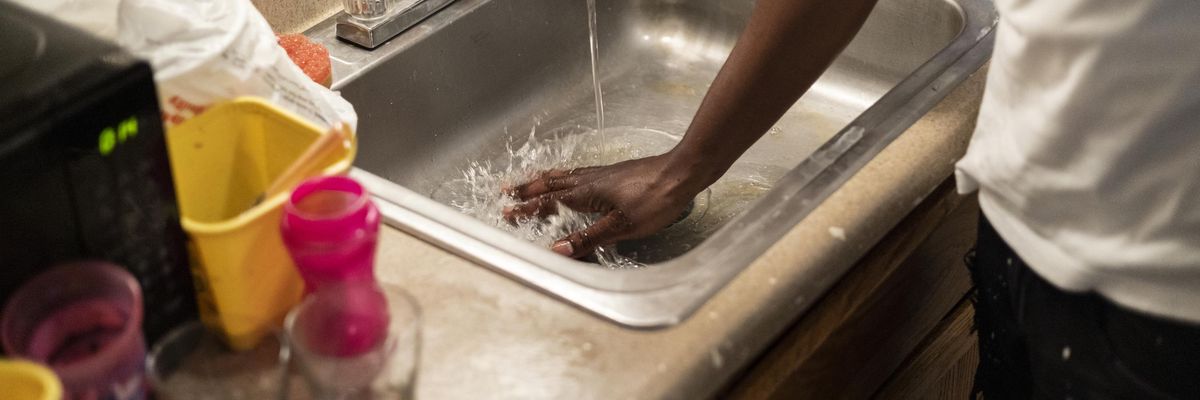
Terrence Carter mixes bleach and soap with water before washing dishes on September 1, 2022 in Jackson, Mississippi.
"Water is life," said one organizer. "This petition is about making sure our voices, and our needs as residents, are centered in this process."
A coalition of Mississippi and national advocacy groups on Wednesday filed an emergency petition with the U.S. Environmental Protection Agency imploring urgent action to provide relief for communities suffering an ongoing water crisis in Jackson, the state capital.
The Mississippi Poor People's Campaign (PPC-MS) and the People's Advocacy Institute (PAI) led the petition on behalf of the Mississippi Rapid Response Coalition. The filing—which was submitted under a provision of the Safe Drinking Water Act (SDWA)—asks the EPA to use its emergency powers to order national, state, and local government agencies to ensure Jackson residents have access to safe drinking water and real-time alert systems to notify them about tap water issues.
"We are absolutely committed to ensuring that our communities are heard," PPC-MS organizer Danyelle Holmes said in a statement. "We are talking about our health, our lives, our ability to make a living. Water is life. This petition is about making sure our voices, and our needs as residents, are centered in this process. It's only right."
As the Center for Constitutional Rights (CCR), a coalition member, explained:
In August 2022, flooding shut down Jackson's main water treatment plant, leaving thousands without safe drinking water. For the 160,000 residents of this 83% African-American city, this was only one episode in a multigenerational environmental injustice that has included lead contamination, hundreds of "boil water notices" due to the risk of the presence of disease-causing pathogens, and three complete shutoffs. A lack of trust in the system led most residents to stop drinking the water years ago.
Last November, the U.S. Department of Justice (DOJ) sued Jackson on behalf of the EPA over the city's failure to provide residents with safe drinking water. City and state agencies subsequently agreed to accept federal oversight of Jackson's water system. The DOJ hired Tedd Henifin—the retired manager of the Hampton Roads Sanitation District in Virginia—for one year at $400,000 to oversee an overhaul of Jackson's water system.
But coalition members allege Henifin "has excluded community members from regular, institutionalized engagement; failed to consistently and transparently inform residents about the status of the water system and repairs that led to the EPA filing the SDWA suit; and contracted with nonlocal businesses."
Brooke Floyd, co-director of coalition member JXN People's Assembly at the PAI, said: "What's been missing in this process is community. This is about our health and safety, and these issues are too important to be decided without our participation."
Republican Mississippi Gov. Tate Reeves—who on the campaign trail cited the role he played as lieutenant governor in blocking funding for Jackson's failing water system as proof of his fiscal conservatism—said last year that he is open to privatizing the system, which was suffering from decades of discriminatory neglect long before the current crisis.
Although Congress has allocated over $600 million to fix Jackson's water system, it is unclear how much of that will actually be spent on its intended purpose, given Reeves' boast.
As CCR noted, "The Jackson water crisis is similar to those facing other majority-Black and Latinx cities and communities around the country."
"Corroded and outdated water and wastewater systems," the group says, "are threatening the health of residents in, among other places, Alexandria, Louisiana; Baltimore, Maryland; Laredo, Texas; and Lowndes County, Alabama."
Dear Common Dreams reader, It’s been nearly 30 years since I co-founded Common Dreams with my late wife, Lina Newhouser. We had the radical notion that journalism should serve the public good, not corporate profits. It was clear to us from the outset what it would take to build such a project. No paid advertisements. No corporate sponsors. No millionaire publisher telling us what to think or do. Many people said we wouldn't last a year, but we proved those doubters wrong. Together with a tremendous team of journalists and dedicated staff, we built an independent media outlet free from the constraints of profits and corporate control. Our mission has always been simple: To inform. To inspire. To ignite change for the common good. Building Common Dreams was not easy. Our survival was never guaranteed. When you take on the most powerful forces—Wall Street greed, fossil fuel industry destruction, Big Tech lobbyists, and uber-rich oligarchs who have spent billions upon billions rigging the economy and democracy in their favor—the only bulwark you have is supporters who believe in your work. But here’s the urgent message from me today. It's never been this bad out there. And it's never been this hard to keep us going. At the very moment Common Dreams is most needed, the threats we face are intensifying. We need your support now more than ever. We don't accept corporate advertising and never will. We don't have a paywall because we don't think people should be blocked from critical news based on their ability to pay. Everything we do is funded by the donations of readers like you. When everyone does the little they can afford, we are strong. But if that support retreats or dries up, so do we. Will you donate now to make sure Common Dreams not only survives but thrives? —Craig Brown, Co-founder |
A coalition of Mississippi and national advocacy groups on Wednesday filed an emergency petition with the U.S. Environmental Protection Agency imploring urgent action to provide relief for communities suffering an ongoing water crisis in Jackson, the state capital.
The Mississippi Poor People's Campaign (PPC-MS) and the People's Advocacy Institute (PAI) led the petition on behalf of the Mississippi Rapid Response Coalition. The filing—which was submitted under a provision of the Safe Drinking Water Act (SDWA)—asks the EPA to use its emergency powers to order national, state, and local government agencies to ensure Jackson residents have access to safe drinking water and real-time alert systems to notify them about tap water issues.
"We are absolutely committed to ensuring that our communities are heard," PPC-MS organizer Danyelle Holmes said in a statement. "We are talking about our health, our lives, our ability to make a living. Water is life. This petition is about making sure our voices, and our needs as residents, are centered in this process. It's only right."
As the Center for Constitutional Rights (CCR), a coalition member, explained:
In August 2022, flooding shut down Jackson's main water treatment plant, leaving thousands without safe drinking water. For the 160,000 residents of this 83% African-American city, this was only one episode in a multigenerational environmental injustice that has included lead contamination, hundreds of "boil water notices" due to the risk of the presence of disease-causing pathogens, and three complete shutoffs. A lack of trust in the system led most residents to stop drinking the water years ago.
Last November, the U.S. Department of Justice (DOJ) sued Jackson on behalf of the EPA over the city's failure to provide residents with safe drinking water. City and state agencies subsequently agreed to accept federal oversight of Jackson's water system. The DOJ hired Tedd Henifin—the retired manager of the Hampton Roads Sanitation District in Virginia—for one year at $400,000 to oversee an overhaul of Jackson's water system.
But coalition members allege Henifin "has excluded community members from regular, institutionalized engagement; failed to consistently and transparently inform residents about the status of the water system and repairs that led to the EPA filing the SDWA suit; and contracted with nonlocal businesses."
Brooke Floyd, co-director of coalition member JXN People's Assembly at the PAI, said: "What's been missing in this process is community. This is about our health and safety, and these issues are too important to be decided without our participation."
Republican Mississippi Gov. Tate Reeves—who on the campaign trail cited the role he played as lieutenant governor in blocking funding for Jackson's failing water system as proof of his fiscal conservatism—said last year that he is open to privatizing the system, which was suffering from decades of discriminatory neglect long before the current crisis.
Although Congress has allocated over $600 million to fix Jackson's water system, it is unclear how much of that will actually be spent on its intended purpose, given Reeves' boast.
As CCR noted, "The Jackson water crisis is similar to those facing other majority-Black and Latinx cities and communities around the country."
"Corroded and outdated water and wastewater systems," the group says, "are threatening the health of residents in, among other places, Alexandria, Louisiana; Baltimore, Maryland; Laredo, Texas; and Lowndes County, Alabama."
A coalition of Mississippi and national advocacy groups on Wednesday filed an emergency petition with the U.S. Environmental Protection Agency imploring urgent action to provide relief for communities suffering an ongoing water crisis in Jackson, the state capital.
The Mississippi Poor People's Campaign (PPC-MS) and the People's Advocacy Institute (PAI) led the petition on behalf of the Mississippi Rapid Response Coalition. The filing—which was submitted under a provision of the Safe Drinking Water Act (SDWA)—asks the EPA to use its emergency powers to order national, state, and local government agencies to ensure Jackson residents have access to safe drinking water and real-time alert systems to notify them about tap water issues.
"We are absolutely committed to ensuring that our communities are heard," PPC-MS organizer Danyelle Holmes said in a statement. "We are talking about our health, our lives, our ability to make a living. Water is life. This petition is about making sure our voices, and our needs as residents, are centered in this process. It's only right."
As the Center for Constitutional Rights (CCR), a coalition member, explained:
In August 2022, flooding shut down Jackson's main water treatment plant, leaving thousands without safe drinking water. For the 160,000 residents of this 83% African-American city, this was only one episode in a multigenerational environmental injustice that has included lead contamination, hundreds of "boil water notices" due to the risk of the presence of disease-causing pathogens, and three complete shutoffs. A lack of trust in the system led most residents to stop drinking the water years ago.
Last November, the U.S. Department of Justice (DOJ) sued Jackson on behalf of the EPA over the city's failure to provide residents with safe drinking water. City and state agencies subsequently agreed to accept federal oversight of Jackson's water system. The DOJ hired Tedd Henifin—the retired manager of the Hampton Roads Sanitation District in Virginia—for one year at $400,000 to oversee an overhaul of Jackson's water system.
But coalition members allege Henifin "has excluded community members from regular, institutionalized engagement; failed to consistently and transparently inform residents about the status of the water system and repairs that led to the EPA filing the SDWA suit; and contracted with nonlocal businesses."
Brooke Floyd, co-director of coalition member JXN People's Assembly at the PAI, said: "What's been missing in this process is community. This is about our health and safety, and these issues are too important to be decided without our participation."
Republican Mississippi Gov. Tate Reeves—who on the campaign trail cited the role he played as lieutenant governor in blocking funding for Jackson's failing water system as proof of his fiscal conservatism—said last year that he is open to privatizing the system, which was suffering from decades of discriminatory neglect long before the current crisis.
Although Congress has allocated over $600 million to fix Jackson's water system, it is unclear how much of that will actually be spent on its intended purpose, given Reeves' boast.
As CCR noted, "The Jackson water crisis is similar to those facing other majority-Black and Latinx cities and communities around the country."
"Corroded and outdated water and wastewater systems," the group says, "are threatening the health of residents in, among other places, Alexandria, Louisiana; Baltimore, Maryland; Laredo, Texas; and Lowndes County, Alabama."