SUBSCRIBE TO OUR FREE NEWSLETTER
Daily news & progressive opinion—funded by the people, not the corporations—delivered straight to your inbox.
5
#000000
#FFFFFF
To donate by check, phone, or other method, see our More Ways to Give page.
Daily news & progressive opinion—funded by the people, not the corporations—delivered straight to your inbox.
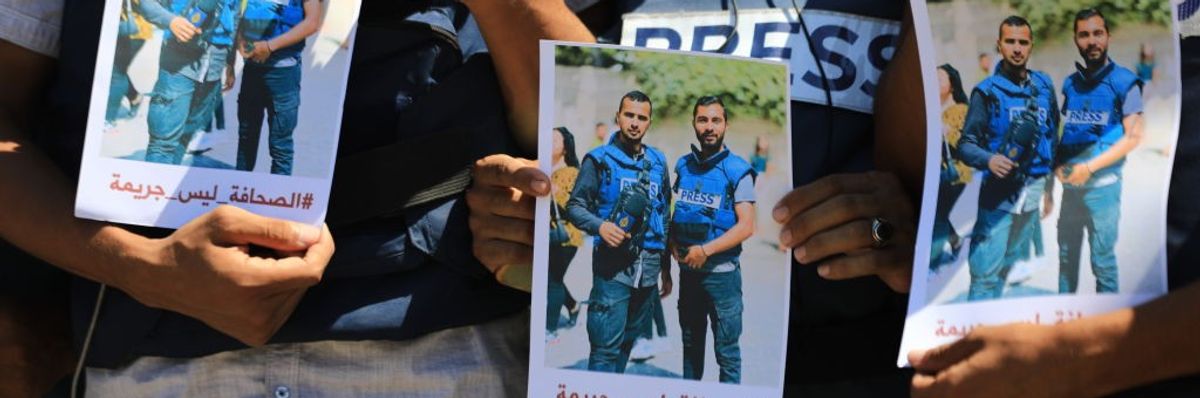
Palestinian Al Jazeera journalist Ismail al-Ghoul and cameraman Rami al-Rifee were killed by Israeli forces on July 31, 2024.
International outcry and a reporter's pointed questions weren't enough to get the State Department to denounce the killings of Al Jazeera journalists.
A Palestinian journalist on Thursday pressed a U.S. State Department spokesperson to characterize the killings of two Al Jazeera journalists by Israeli forces as summary execution.
The heated press briefing followed an airstrike on Wednesday that killed Al Jazeera reporter Ismail al-Ghoul and cameraman Rami al-Rifee, and sparked global outrage. Israel's military acknowledged targeting al-Ghoul, saying he was "eliminated" because he was a Hamas "terrorist," an allegation the Qatar-based network said was "baseless."
The death toll of Palestinian journalists and media workers now stands at least 108, including several intentionally targeted by Israel forces, according to the Committee to Protect Journalists (CPJ).
Said Arikat, the Washington bureau chief of Al-Quds, an Arabic-language newspaper based in Jerusalem, called the strike a "premeditated crime to kill a journalist for doing their job" and a "summary execution" in the press briefing, but State Department spokesperson Vedant Patel declined to affirm the characterizations or condemn the airstrike.
. @SMArikat: Al Jazeera journalists were told to leave by the Israelis, they got in their car and moved and they were bombed, that is summary execution
Patel: We continue to engage with our partners in Israel
Said: Do you call on Israel to release journalists held without charge… pic.twitter.com/ijDd3ztqSs
— Assal Rad (@AssalRad) August 1, 2024
Al-Ghoul and al-Rifee were killed in northern Gaza after reporting from near the home of Ismail Haniyeh, the Hamas political leader who was assassinated in Tehran earlier on Wednesday. They wore press vests and had signs on their vehicle identifying them as journalists; they had last contacted their news desk just 15 minutes before the strike, Al Jazeera reported.
The Israel Defense Forces (IDF) presented no evidence in a social media post claiming that al-Ghoul was a terrorist and Hamas operative. In March, al-Ghoul reported being stripped, handcuffed, and blindfolded during the course of a 12-hour detainment by Israeli forces; he had been covering an Israeli attack on al-Shifa hospital in Gaza City. Witnesses said Israeli forces severely beat al-Ghoul at the hospital before arresting him.
Anas al-Sharif, another Al Jazeera reporter in Gaza, was on site at a different hospital on Wednesday when his colleagues' bodies were brought in, and he spoke about the role al-Ghoul had played in the outlet's war coverage.
"Ismail was conveying the suffering of the displaced Palestinians and the suffering of the wounded and the massacres committed by the [Israeli] occupation against the innocent people in Gaza," he told his own news outlet.
"The feeling—no words can describe what happened," he added.
In protest of the killings, Palestinian journalists gathered to throw off their press vests and vowed to continue showing the suffering of Gazans through their work, despite the dangers they faced.
Palestinian journalists in Gaza threw their press vests to the ground in protest against Israel’s killing of Al Jazeera correspondent Ismail al-Ghoul and cameraman Rami al-Rifi. pic.twitter.com/Dmi4D1MoQ3
— Al Jazeera English (@AJEnglish) August 1, 2024
Condemnation of the killings of the two Al Jazeera journalists came not just from Gaza but all over the world.
CPJ CEO Jodie Ginsberg said in a statement that she was "dismayed" by the killings and that journalists are civilians who should never be targeted.
Defending Rights & Dissent, a U.S.-based civil liberties nonprofit, also condemned the killing of al-Ghoul and said the reasons for it were clear.
"When you 'eliminate' journalists, it's much easier to hide war crimes, it's easier to spread lies, it's easier to commit genocide," Sue Udry, the group's executive director, said in a statement.
In response to the killing, the International Committee of the Red Cross (ICRC) said that journalists "must be protected, and we decry attacks against them."
William Schomburg, head of the ICRC's sub-delegation in Gaza, said in a statement that his team had just met with al-Ghoul the previous week to get an update on the humanitarian situation in Gaza. "Journalists in all wars play a central role in highlighting the plight of civilians and in speaking for the voiceless," Schomburg said.
Reporters Without Borders (RSF, in French), a Paris-based nonprofit, wrote in unequivocal terms about the need for Israel to stop killing journalists.
"RSF is deeply disturbed to see the Israel Defense Forces using social media to justify their targeted killing of Al Jazeera journalist Ismail al-Ghoul," the organization wrote on social media. "Journalists are not terrorists. This campaign of violence against media in Gaza must stop now."
The Freedom of the Press Foundation also responded forcefully to the IDF's claim about al-Ghoul.
"Documenting a war isn't terrorism, it's journalism," the group wrote on social media. "If the IDF can prove al-Ghoul was working for Hamas' military, it should do so immediately. If not, this looks like a flimsy excuse for intentionally murdering a journalist from an outlet Israel dislikes."
Israeli forces have killed at seven journalists or media workers affiliated with Al Jazeera during the war, and Israel shut down the network's local operations in May, citing a security threat, though critics said it was a case of censorship—an attempt to hide the brutality of the assault on Gaza.
In total, 113 journalists and media workers have died since the war began, including two Israelis and three Lebanese, according to CPJ, which says this has been the deadliest period for journalists anywhere in the world since it began collecting data in 1992.
The international outcry over all of the killings has ramped up pressure on the U.S.—which has backed the Israeli assault with weapons and diplomatic support— to condemn them, and Wednesday's strike on al-Ghoul and al-Rifee has only increased that pressure. Still, Patel, the spokesperson, wouldn't issue any such condemnation on Thursday.
Arikat also pressed Patel to call for the release of Palestinian journalists being held in Israeli detention centers without charges, but Patel didn't do so.
Dear Common Dreams reader, It’s been nearly 30 years since I co-founded Common Dreams with my late wife, Lina Newhouser. We had the radical notion that journalism should serve the public good, not corporate profits. It was clear to us from the outset what it would take to build such a project. No paid advertisements. No corporate sponsors. No millionaire publisher telling us what to think or do. Many people said we wouldn't last a year, but we proved those doubters wrong. Together with a tremendous team of journalists and dedicated staff, we built an independent media outlet free from the constraints of profits and corporate control. Our mission has always been simple: To inform. To inspire. To ignite change for the common good. Building Common Dreams was not easy. Our survival was never guaranteed. When you take on the most powerful forces—Wall Street greed, fossil fuel industry destruction, Big Tech lobbyists, and uber-rich oligarchs who have spent billions upon billions rigging the economy and democracy in their favor—the only bulwark you have is supporters who believe in your work. But here’s the urgent message from me today. It's never been this bad out there. And it's never been this hard to keep us going. At the very moment Common Dreams is most needed, the threats we face are intensifying. We need your support now more than ever. We don't accept corporate advertising and never will. We don't have a paywall because we don't think people should be blocked from critical news based on their ability to pay. Everything we do is funded by the donations of readers like you. When everyone does the little they can afford, we are strong. But if that support retreats or dries up, so do we. Will you donate now to make sure Common Dreams not only survives but thrives? —Craig Brown, Co-founder |
A Palestinian journalist on Thursday pressed a U.S. State Department spokesperson to characterize the killings of two Al Jazeera journalists by Israeli forces as summary execution.
The heated press briefing followed an airstrike on Wednesday that killed Al Jazeera reporter Ismail al-Ghoul and cameraman Rami al-Rifee, and sparked global outrage. Israel's military acknowledged targeting al-Ghoul, saying he was "eliminated" because he was a Hamas "terrorist," an allegation the Qatar-based network said was "baseless."
The death toll of Palestinian journalists and media workers now stands at least 108, including several intentionally targeted by Israel forces, according to the Committee to Protect Journalists (CPJ).
Said Arikat, the Washington bureau chief of Al-Quds, an Arabic-language newspaper based in Jerusalem, called the strike a "premeditated crime to kill a journalist for doing their job" and a "summary execution" in the press briefing, but State Department spokesperson Vedant Patel declined to affirm the characterizations or condemn the airstrike.
. @SMArikat: Al Jazeera journalists were told to leave by the Israelis, they got in their car and moved and they were bombed, that is summary execution
Patel: We continue to engage with our partners in Israel
Said: Do you call on Israel to release journalists held without charge… pic.twitter.com/ijDd3ztqSs
— Assal Rad (@AssalRad) August 1, 2024
Al-Ghoul and al-Rifee were killed in northern Gaza after reporting from near the home of Ismail Haniyeh, the Hamas political leader who was assassinated in Tehran earlier on Wednesday. They wore press vests and had signs on their vehicle identifying them as journalists; they had last contacted their news desk just 15 minutes before the strike, Al Jazeera reported.
The Israel Defense Forces (IDF) presented no evidence in a social media post claiming that al-Ghoul was a terrorist and Hamas operative. In March, al-Ghoul reported being stripped, handcuffed, and blindfolded during the course of a 12-hour detainment by Israeli forces; he had been covering an Israeli attack on al-Shifa hospital in Gaza City. Witnesses said Israeli forces severely beat al-Ghoul at the hospital before arresting him.
Anas al-Sharif, another Al Jazeera reporter in Gaza, was on site at a different hospital on Wednesday when his colleagues' bodies were brought in, and he spoke about the role al-Ghoul had played in the outlet's war coverage.
"Ismail was conveying the suffering of the displaced Palestinians and the suffering of the wounded and the massacres committed by the [Israeli] occupation against the innocent people in Gaza," he told his own news outlet.
"The feeling—no words can describe what happened," he added.
In protest of the killings, Palestinian journalists gathered to throw off their press vests and vowed to continue showing the suffering of Gazans through their work, despite the dangers they faced.
Palestinian journalists in Gaza threw their press vests to the ground in protest against Israel’s killing of Al Jazeera correspondent Ismail al-Ghoul and cameraman Rami al-Rifi. pic.twitter.com/Dmi4D1MoQ3
— Al Jazeera English (@AJEnglish) August 1, 2024
Condemnation of the killings of the two Al Jazeera journalists came not just from Gaza but all over the world.
CPJ CEO Jodie Ginsberg said in a statement that she was "dismayed" by the killings and that journalists are civilians who should never be targeted.
Defending Rights & Dissent, a U.S.-based civil liberties nonprofit, also condemned the killing of al-Ghoul and said the reasons for it were clear.
"When you 'eliminate' journalists, it's much easier to hide war crimes, it's easier to spread lies, it's easier to commit genocide," Sue Udry, the group's executive director, said in a statement.
In response to the killing, the International Committee of the Red Cross (ICRC) said that journalists "must be protected, and we decry attacks against them."
William Schomburg, head of the ICRC's sub-delegation in Gaza, said in a statement that his team had just met with al-Ghoul the previous week to get an update on the humanitarian situation in Gaza. "Journalists in all wars play a central role in highlighting the plight of civilians and in speaking for the voiceless," Schomburg said.
Reporters Without Borders (RSF, in French), a Paris-based nonprofit, wrote in unequivocal terms about the need for Israel to stop killing journalists.
"RSF is deeply disturbed to see the Israel Defense Forces using social media to justify their targeted killing of Al Jazeera journalist Ismail al-Ghoul," the organization wrote on social media. "Journalists are not terrorists. This campaign of violence against media in Gaza must stop now."
The Freedom of the Press Foundation also responded forcefully to the IDF's claim about al-Ghoul.
"Documenting a war isn't terrorism, it's journalism," the group wrote on social media. "If the IDF can prove al-Ghoul was working for Hamas' military, it should do so immediately. If not, this looks like a flimsy excuse for intentionally murdering a journalist from an outlet Israel dislikes."
Israeli forces have killed at seven journalists or media workers affiliated with Al Jazeera during the war, and Israel shut down the network's local operations in May, citing a security threat, though critics said it was a case of censorship—an attempt to hide the brutality of the assault on Gaza.
In total, 113 journalists and media workers have died since the war began, including two Israelis and three Lebanese, according to CPJ, which says this has been the deadliest period for journalists anywhere in the world since it began collecting data in 1992.
The international outcry over all of the killings has ramped up pressure on the U.S.—which has backed the Israeli assault with weapons and diplomatic support— to condemn them, and Wednesday's strike on al-Ghoul and al-Rifee has only increased that pressure. Still, Patel, the spokesperson, wouldn't issue any such condemnation on Thursday.
Arikat also pressed Patel to call for the release of Palestinian journalists being held in Israeli detention centers without charges, but Patel didn't do so.
A Palestinian journalist on Thursday pressed a U.S. State Department spokesperson to characterize the killings of two Al Jazeera journalists by Israeli forces as summary execution.
The heated press briefing followed an airstrike on Wednesday that killed Al Jazeera reporter Ismail al-Ghoul and cameraman Rami al-Rifee, and sparked global outrage. Israel's military acknowledged targeting al-Ghoul, saying he was "eliminated" because he was a Hamas "terrorist," an allegation the Qatar-based network said was "baseless."
The death toll of Palestinian journalists and media workers now stands at least 108, including several intentionally targeted by Israel forces, according to the Committee to Protect Journalists (CPJ).
Said Arikat, the Washington bureau chief of Al-Quds, an Arabic-language newspaper based in Jerusalem, called the strike a "premeditated crime to kill a journalist for doing their job" and a "summary execution" in the press briefing, but State Department spokesperson Vedant Patel declined to affirm the characterizations or condemn the airstrike.
. @SMArikat: Al Jazeera journalists were told to leave by the Israelis, they got in their car and moved and they were bombed, that is summary execution
Patel: We continue to engage with our partners in Israel
Said: Do you call on Israel to release journalists held without charge… pic.twitter.com/ijDd3ztqSs
— Assal Rad (@AssalRad) August 1, 2024
Al-Ghoul and al-Rifee were killed in northern Gaza after reporting from near the home of Ismail Haniyeh, the Hamas political leader who was assassinated in Tehran earlier on Wednesday. They wore press vests and had signs on their vehicle identifying them as journalists; they had last contacted their news desk just 15 minutes before the strike, Al Jazeera reported.
The Israel Defense Forces (IDF) presented no evidence in a social media post claiming that al-Ghoul was a terrorist and Hamas operative. In March, al-Ghoul reported being stripped, handcuffed, and blindfolded during the course of a 12-hour detainment by Israeli forces; he had been covering an Israeli attack on al-Shifa hospital in Gaza City. Witnesses said Israeli forces severely beat al-Ghoul at the hospital before arresting him.
Anas al-Sharif, another Al Jazeera reporter in Gaza, was on site at a different hospital on Wednesday when his colleagues' bodies were brought in, and he spoke about the role al-Ghoul had played in the outlet's war coverage.
"Ismail was conveying the suffering of the displaced Palestinians and the suffering of the wounded and the massacres committed by the [Israeli] occupation against the innocent people in Gaza," he told his own news outlet.
"The feeling—no words can describe what happened," he added.
In protest of the killings, Palestinian journalists gathered to throw off their press vests and vowed to continue showing the suffering of Gazans through their work, despite the dangers they faced.
Palestinian journalists in Gaza threw their press vests to the ground in protest against Israel’s killing of Al Jazeera correspondent Ismail al-Ghoul and cameraman Rami al-Rifi. pic.twitter.com/Dmi4D1MoQ3
— Al Jazeera English (@AJEnglish) August 1, 2024
Condemnation of the killings of the two Al Jazeera journalists came not just from Gaza but all over the world.
CPJ CEO Jodie Ginsberg said in a statement that she was "dismayed" by the killings and that journalists are civilians who should never be targeted.
Defending Rights & Dissent, a U.S.-based civil liberties nonprofit, also condemned the killing of al-Ghoul and said the reasons for it were clear.
"When you 'eliminate' journalists, it's much easier to hide war crimes, it's easier to spread lies, it's easier to commit genocide," Sue Udry, the group's executive director, said in a statement.
In response to the killing, the International Committee of the Red Cross (ICRC) said that journalists "must be protected, and we decry attacks against them."
William Schomburg, head of the ICRC's sub-delegation in Gaza, said in a statement that his team had just met with al-Ghoul the previous week to get an update on the humanitarian situation in Gaza. "Journalists in all wars play a central role in highlighting the plight of civilians and in speaking for the voiceless," Schomburg said.
Reporters Without Borders (RSF, in French), a Paris-based nonprofit, wrote in unequivocal terms about the need for Israel to stop killing journalists.
"RSF is deeply disturbed to see the Israel Defense Forces using social media to justify their targeted killing of Al Jazeera journalist Ismail al-Ghoul," the organization wrote on social media. "Journalists are not terrorists. This campaign of violence against media in Gaza must stop now."
The Freedom of the Press Foundation also responded forcefully to the IDF's claim about al-Ghoul.
"Documenting a war isn't terrorism, it's journalism," the group wrote on social media. "If the IDF can prove al-Ghoul was working for Hamas' military, it should do so immediately. If not, this looks like a flimsy excuse for intentionally murdering a journalist from an outlet Israel dislikes."
Israeli forces have killed at seven journalists or media workers affiliated with Al Jazeera during the war, and Israel shut down the network's local operations in May, citing a security threat, though critics said it was a case of censorship—an attempt to hide the brutality of the assault on Gaza.
In total, 113 journalists and media workers have died since the war began, including two Israelis and three Lebanese, according to CPJ, which says this has been the deadliest period for journalists anywhere in the world since it began collecting data in 1992.
The international outcry over all of the killings has ramped up pressure on the U.S.—which has backed the Israeli assault with weapons and diplomatic support— to condemn them, and Wednesday's strike on al-Ghoul and al-Rifee has only increased that pressure. Still, Patel, the spokesperson, wouldn't issue any such condemnation on Thursday.
Arikat also pressed Patel to call for the release of Palestinian journalists being held in Israeli detention centers without charges, but Patel didn't do so.