SUBSCRIBE TO OUR FREE NEWSLETTER
Daily news & progressive opinion—funded by the people, not the corporations—delivered straight to your inbox.
5
#000000
#FFFFFF
To donate by check, phone, or other method, see our More Ways to Give page.
Daily news & progressive opinion—funded by the people, not the corporations—delivered straight to your inbox.
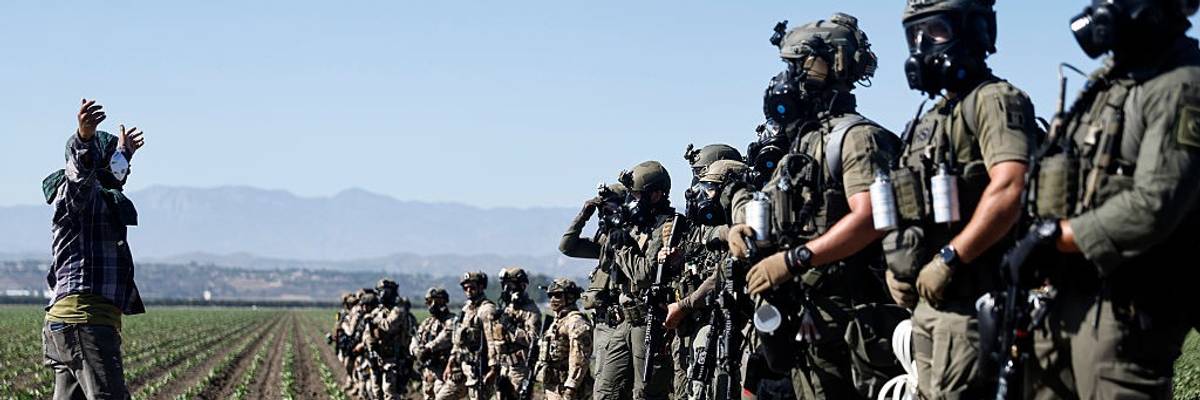
Federal agents block people protesting an ICE immigration raid at a nearby licensed cannabis farm on July 10, 2025 near Camarillo, California. Protestors stood off with federal agents for hours outside the farm in the farmworker community in Ventura County.
The 9th Circuit upholds lower court ruling against ICE raids denounced as 'unconstitutional' by legal plaintiffs in California.
The U.S. Court of Appeals for the Ninth Circuit late Friday backed a lower court ruling which found immigration raids targeting people based on their apparent racial identity, language spoken, or vicinity of their capture are unlawful—a decision which dealt a further blow to President Donald Trump's authoritarian policies aimed at migrant workers and working-class communities in California and beyond.
In its ruling, the 3-judge panel of the federal court upheld a previous ruling by a U.S. District Court in early July which found the targeting of migrants during the raids was based not on suspicion of wrongdoing or criminal activity of any kind, but simply for speaking Spanish, appearing to be a certain ethnicity, or being near a location where certain workers tend to congregate, such as a bus stop, large hardware store, or agriculture site.
The ruling stems from a case brought against the Trump administration by the ACLU Foundation of Southern California, Public Counsel, workers, and others who argue the raids, which have touched off community anger and unease for months, are, in the words of Public Counsel's senior attorney Mark Rosenbaum, "unconstitutional, unsupported by evidence, and rooted in fear and harmful stereotypes, not public safety."
The 9th Circuit ruling means the lower court's ban on such raids in certain areas of southern California will remain in place while the case proceeds.
"Every person, regardless of immigration status, has the right to live, work, and belong in their community without being hunted, harassed, or locked away." —Lindsay Toczylowski, Immigrant Defenders Law Center
As the New York Times notes, the latest ruling leaves the Trump administration with two legal options. "It can ask all the active Ninth Circuit judges to reconsider the panel’s Friday night decision," the newspaper notes, "or it could ask the Supreme Court to issue a stay of [the lower court order issued on July 7.]"
In the meantime—though the legal battle is far from over—the plaintiffs in the case celebrated the ruling and vowed to continue their fight against Trump's far-right, anti-immigrant agenda.
"This decision is further confirmation that the administration's paramilitary invasion of Los Angeles violated the Constitution and caused irreparable injury across the region," said Mohammad Tajsar, senior staff attorney at the ACLU Foundation of Southern California. "We look forward to holding the federal government accountable for these authoritarian horrors it unleashed in Southern California, and we invite every person of conscience to join us in defending the integrity and freedom of communities of color across the country."
Lindsay Toczylowski, president and CEO of Immigrant Defenders Law Center, another party to the suit, also heralded the ruling.
"This decision reaffirms that nobody is above the law—not even the federal government," said Toczylowski. "Southern California was never going to back down in the face of lawless attacks on our immigrant communities. Every person, regardless of immigration status, has the right to live, work, and belong in their community without being hunted, harassed, or locked away. While we celebrate this hard-fought victory, we remain relentless in protecting our clients in the courtroom and beyond."
Dear Common Dreams reader, It’s been nearly 30 years since I co-founded Common Dreams with my late wife, Lina Newhouser. We had the radical notion that journalism should serve the public good, not corporate profits. It was clear to us from the outset what it would take to build such a project. No paid advertisements. No corporate sponsors. No millionaire publisher telling us what to think or do. Many people said we wouldn't last a year, but we proved those doubters wrong. Together with a tremendous team of journalists and dedicated staff, we built an independent media outlet free from the constraints of profits and corporate control. Our mission has always been simple: To inform. To inspire. To ignite change for the common good. Building Common Dreams was not easy. Our survival was never guaranteed. When you take on the most powerful forces—Wall Street greed, fossil fuel industry destruction, Big Tech lobbyists, and uber-rich oligarchs who have spent billions upon billions rigging the economy and democracy in their favor—the only bulwark you have is supporters who believe in your work. But here’s the urgent message from me today. It's never been this bad out there. And it's never been this hard to keep us going. At the very moment Common Dreams is most needed, the threats we face are intensifying. We need your support now more than ever. We don't accept corporate advertising and never will. We don't have a paywall because we don't think people should be blocked from critical news based on their ability to pay. Everything we do is funded by the donations of readers like you. When everyone does the little they can afford, we are strong. But if that support retreats or dries up, so do we. Will you donate now to make sure Common Dreams not only survives but thrives? —Craig Brown, Co-founder |
The U.S. Court of Appeals for the Ninth Circuit late Friday backed a lower court ruling which found immigration raids targeting people based on their apparent racial identity, language spoken, or vicinity of their capture are unlawful—a decision which dealt a further blow to President Donald Trump's authoritarian policies aimed at migrant workers and working-class communities in California and beyond.
In its ruling, the 3-judge panel of the federal court upheld a previous ruling by a U.S. District Court in early July which found the targeting of migrants during the raids was based not on suspicion of wrongdoing or criminal activity of any kind, but simply for speaking Spanish, appearing to be a certain ethnicity, or being near a location where certain workers tend to congregate, such as a bus stop, large hardware store, or agriculture site.
The ruling stems from a case brought against the Trump administration by the ACLU Foundation of Southern California, Public Counsel, workers, and others who argue the raids, which have touched off community anger and unease for months, are, in the words of Public Counsel's senior attorney Mark Rosenbaum, "unconstitutional, unsupported by evidence, and rooted in fear and harmful stereotypes, not public safety."
The 9th Circuit ruling means the lower court's ban on such raids in certain areas of southern California will remain in place while the case proceeds.
"Every person, regardless of immigration status, has the right to live, work, and belong in their community without being hunted, harassed, or locked away." —Lindsay Toczylowski, Immigrant Defenders Law Center
As the New York Times notes, the latest ruling leaves the Trump administration with two legal options. "It can ask all the active Ninth Circuit judges to reconsider the panel’s Friday night decision," the newspaper notes, "or it could ask the Supreme Court to issue a stay of [the lower court order issued on July 7.]"
In the meantime—though the legal battle is far from over—the plaintiffs in the case celebrated the ruling and vowed to continue their fight against Trump's far-right, anti-immigrant agenda.
"This decision is further confirmation that the administration's paramilitary invasion of Los Angeles violated the Constitution and caused irreparable injury across the region," said Mohammad Tajsar, senior staff attorney at the ACLU Foundation of Southern California. "We look forward to holding the federal government accountable for these authoritarian horrors it unleashed in Southern California, and we invite every person of conscience to join us in defending the integrity and freedom of communities of color across the country."
Lindsay Toczylowski, president and CEO of Immigrant Defenders Law Center, another party to the suit, also heralded the ruling.
"This decision reaffirms that nobody is above the law—not even the federal government," said Toczylowski. "Southern California was never going to back down in the face of lawless attacks on our immigrant communities. Every person, regardless of immigration status, has the right to live, work, and belong in their community without being hunted, harassed, or locked away. While we celebrate this hard-fought victory, we remain relentless in protecting our clients in the courtroom and beyond."
The U.S. Court of Appeals for the Ninth Circuit late Friday backed a lower court ruling which found immigration raids targeting people based on their apparent racial identity, language spoken, or vicinity of their capture are unlawful—a decision which dealt a further blow to President Donald Trump's authoritarian policies aimed at migrant workers and working-class communities in California and beyond.
In its ruling, the 3-judge panel of the federal court upheld a previous ruling by a U.S. District Court in early July which found the targeting of migrants during the raids was based not on suspicion of wrongdoing or criminal activity of any kind, but simply for speaking Spanish, appearing to be a certain ethnicity, or being near a location where certain workers tend to congregate, such as a bus stop, large hardware store, or agriculture site.
The ruling stems from a case brought against the Trump administration by the ACLU Foundation of Southern California, Public Counsel, workers, and others who argue the raids, which have touched off community anger and unease for months, are, in the words of Public Counsel's senior attorney Mark Rosenbaum, "unconstitutional, unsupported by evidence, and rooted in fear and harmful stereotypes, not public safety."
The 9th Circuit ruling means the lower court's ban on such raids in certain areas of southern California will remain in place while the case proceeds.
"Every person, regardless of immigration status, has the right to live, work, and belong in their community without being hunted, harassed, or locked away." —Lindsay Toczylowski, Immigrant Defenders Law Center
As the New York Times notes, the latest ruling leaves the Trump administration with two legal options. "It can ask all the active Ninth Circuit judges to reconsider the panel’s Friday night decision," the newspaper notes, "or it could ask the Supreme Court to issue a stay of [the lower court order issued on July 7.]"
In the meantime—though the legal battle is far from over—the plaintiffs in the case celebrated the ruling and vowed to continue their fight against Trump's far-right, anti-immigrant agenda.
"This decision is further confirmation that the administration's paramilitary invasion of Los Angeles violated the Constitution and caused irreparable injury across the region," said Mohammad Tajsar, senior staff attorney at the ACLU Foundation of Southern California. "We look forward to holding the federal government accountable for these authoritarian horrors it unleashed in Southern California, and we invite every person of conscience to join us in defending the integrity and freedom of communities of color across the country."
Lindsay Toczylowski, president and CEO of Immigrant Defenders Law Center, another party to the suit, also heralded the ruling.
"This decision reaffirms that nobody is above the law—not even the federal government," said Toczylowski. "Southern California was never going to back down in the face of lawless attacks on our immigrant communities. Every person, regardless of immigration status, has the right to live, work, and belong in their community without being hunted, harassed, or locked away. While we celebrate this hard-fought victory, we remain relentless in protecting our clients in the courtroom and beyond."