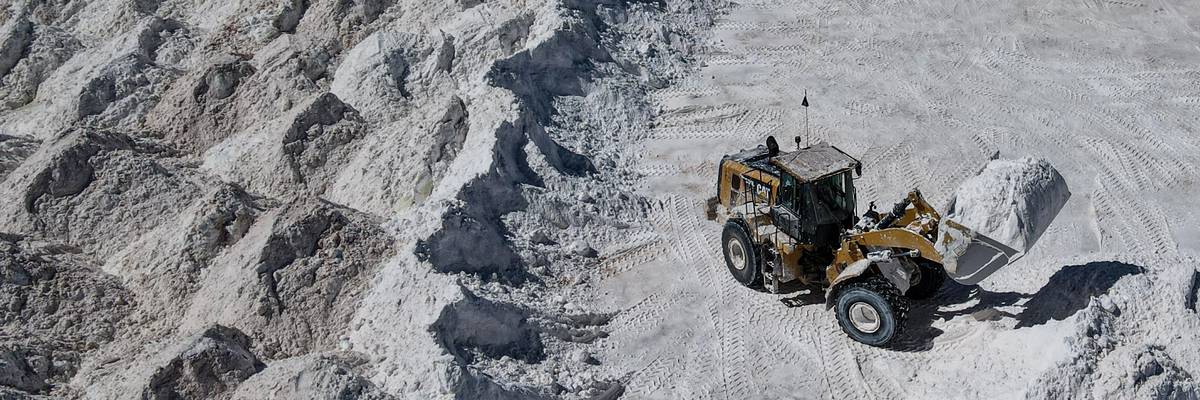
A lithium mining machine moves a salt by-product at the mine in the Atacama Desert in Salar de Atacama, Chili on October 25, 2022.
Amnesty Report Reveals 'Alarming' Human Rights Abuses in Extraction of EV Minerals
"As demand for electric vehicles increases, manufacturers must ensure people's human rights are respected."
A transition away from the fossil fuels that have powered vehicles across the globe for decades, worsening the climate emergency, is sorely needed—but an analysis out Tuesday warns that companies spearheading the shift toward electric vehicles must do so while obeying internationally recognized human rights principles, and exposes how the firms have exploited communities in pursuit of minerals for EV batteries.
In a new report, Recharge for Rights, Amnesty International ranked the human rights records of 13 major EV manufacturers, including China-based BYD, Mercedes-Benz, Tesla, and Mitsubishi, on a scale of 1-90.
None of the companies scored higher than 51, with Amnesty researchers identifying the companies' practices of forced evictions to make way for mining, subjecting workers to dangerous conditions, violating Indigenous peoples' rights, and exposing communities to environmental harm.
"While some progress was made, across the board, the scores were a massive disappointment," said Agnès Callamard, secretary general of Amnesty.
The companies have all stepped up mining development efforts as the International Energy Agency has said demand for minerals used in EV batteries—including cobalt, lithium, nickel, and copper—is expected to increase ninefold between 2024-50. Mineral industry analysts say more than 350 new mines will need to be opened by 2035 to meet demand.
But in the rush to extract the minerals, Callamard said, the companies are "putting immense pressures on mining-affected communities."
"The human rights abuses tied to the extraction of energy transition minerals are alarming and pervasive and the industry's response is sorely lacking," she said. "As demand for electric vehicles increases, manufacturers must ensure people's human rights are respected."
Previous research by Amnesty has found that "industrial cobalt is linked to forced evictions in the Democratic Republic of Congo," said Callamard. "Car companies need to use their massive leverage as global minerals buyers to influence upstream mining companies and smelters to mitigate these human rights risks."
The report ranked companies on whether they have publicly available human rights policies, monitor human rights due diligence, and remediate human rights grievances.
BYD, the world's second-largest EV manufacturer, performed the worst on the group's scorecard, with 11 out of 90. Along with Hyundai and Mitsubishi, also low performers, the company published little to no information about its human rights due diligence.
"None of these three multinationals published information demonstrating that they are trying to understand the human rights impacts of their battery metal sourcing," said Amnesty. "None of the three companies reported mapping these supply chains, nor demonstrated that they had identified specific risks."
Mercedes-Benz was the highest performing company with 51 out of 90, indicating "a moderate demonstration of alignment with international standards."
Amnesty called on companies to implement human rights due diligence processes "to identify, prevent, mitigate, and account for how they address adverse human rights impacts that they may cause, contribute to, or be directly linked to through their operations, products, or services."
All carmakers must bring their due diligence efforts "in line with international human rights standards" as outlined in the United Nations Guiding Principles on Business and Human Rights, said Callamard. "We are also calling on governments to strengthen their own human rights due diligence regulation over the companies incorporated on their territories or their exports and import licenses."
Companies and the governments that import and export their goods must acknowledge that "human rights isn't just a fluff phrase, but an issue they take seriously," added Callamard. "It's time to shift gears and ensure electric vehicles don't leave behind a legacy of human rights abuses—instead, the industry must drive a just energy future that leaves no one behind."
We are at a crossroads
This country and this world are at a monumental crossroads. In a few short weeks, US voters will have an opportunity to beat back the forces of fascism and confront the billionaires who are rigging the economy, our media system, and our democracy, making it increasingly impossible for ordinary people to get by. We’re not just talking about the election. We’re talking about what must be done once these fascist elements are vanquished from power. We need a bolder set of solutions than what either major party has so far been willing to offer and a working-class movement ready to fight like hell for it. Trump didn't emerge from nowhere. The conditions that fueled MAGA authoritarianism were created by decades of radical neoliberal economic policies and a corrupt political system dominated by corporate interests. They slashed taxes on the super-rich, promising that the benefits would trickle down. They said giveaways to the corporate titans would make life more affordable for the rest of us. It was all bullshit. And when a bitter, betrayed populace searches for someone to blame, right-wing demagogues have little trouble finding scapegoats. People know when they're being lied to, but you won't hear any of this from the corporate media. Only independent journalism—powered and funded by people who believe in building a better world—can deliver truly trustworthy daily news. Our Fall Campaign is underway, and we need your help. To power our newsroom through the rest of the year, we need to raise $125,000 by midnight on October 31. So if you share our vision, please contribute whatever you can to sustain our work. |
A transition away from the fossil fuels that have powered vehicles across the globe for decades, worsening the climate emergency, is sorely needed—but an analysis out Tuesday warns that companies spearheading the shift toward electric vehicles must do so while obeying internationally recognized human rights principles, and exposes how the firms have exploited communities in pursuit of minerals for EV batteries.
In a new report, Recharge for Rights, Amnesty International ranked the human rights records of 13 major EV manufacturers, including China-based BYD, Mercedes-Benz, Tesla, and Mitsubishi, on a scale of 1-90.
None of the companies scored higher than 51, with Amnesty researchers identifying the companies' practices of forced evictions to make way for mining, subjecting workers to dangerous conditions, violating Indigenous peoples' rights, and exposing communities to environmental harm.
"While some progress was made, across the board, the scores were a massive disappointment," said Agnès Callamard, secretary general of Amnesty.
The companies have all stepped up mining development efforts as the International Energy Agency has said demand for minerals used in EV batteries—including cobalt, lithium, nickel, and copper—is expected to increase ninefold between 2024-50. Mineral industry analysts say more than 350 new mines will need to be opened by 2035 to meet demand.
But in the rush to extract the minerals, Callamard said, the companies are "putting immense pressures on mining-affected communities."
"The human rights abuses tied to the extraction of energy transition minerals are alarming and pervasive and the industry's response is sorely lacking," she said. "As demand for electric vehicles increases, manufacturers must ensure people's human rights are respected."
Previous research by Amnesty has found that "industrial cobalt is linked to forced evictions in the Democratic Republic of Congo," said Callamard. "Car companies need to use their massive leverage as global minerals buyers to influence upstream mining companies and smelters to mitigate these human rights risks."
The report ranked companies on whether they have publicly available human rights policies, monitor human rights due diligence, and remediate human rights grievances.
BYD, the world's second-largest EV manufacturer, performed the worst on the group's scorecard, with 11 out of 90. Along with Hyundai and Mitsubishi, also low performers, the company published little to no information about its human rights due diligence.
"None of these three multinationals published information demonstrating that they are trying to understand the human rights impacts of their battery metal sourcing," said Amnesty. "None of the three companies reported mapping these supply chains, nor demonstrated that they had identified specific risks."
Mercedes-Benz was the highest performing company with 51 out of 90, indicating "a moderate demonstration of alignment with international standards."
Amnesty called on companies to implement human rights due diligence processes "to identify, prevent, mitigate, and account for how they address adverse human rights impacts that they may cause, contribute to, or be directly linked to through their operations, products, or services."
All carmakers must bring their due diligence efforts "in line with international human rights standards" as outlined in the United Nations Guiding Principles on Business and Human Rights, said Callamard. "We are also calling on governments to strengthen their own human rights due diligence regulation over the companies incorporated on their territories or their exports and import licenses."
Companies and the governments that import and export their goods must acknowledge that "human rights isn't just a fluff phrase, but an issue they take seriously," added Callamard. "It's time to shift gears and ensure electric vehicles don't leave behind a legacy of human rights abuses—instead, the industry must drive a just energy future that leaves no one behind."
- Greenpeace Says Ban Deep-Sea Mining, Not Our Right to Protest Against It ›
- 'Against Colonial Violence and Land Theft,' Indigenous Activists and Allies Target Mining Industry Convention in Toronto ›
- 'Great Joy' as Indigenous Q'eqchi' Win Case Against Guatemalan Nickel Mine ›
- Opinion | As US Firms Secure Deals for Congo's Minerals, Its Citizens Fight Back in Court | Common Dreams ›
A transition away from the fossil fuels that have powered vehicles across the globe for decades, worsening the climate emergency, is sorely needed—but an analysis out Tuesday warns that companies spearheading the shift toward electric vehicles must do so while obeying internationally recognized human rights principles, and exposes how the firms have exploited communities in pursuit of minerals for EV batteries.
In a new report, Recharge for Rights, Amnesty International ranked the human rights records of 13 major EV manufacturers, including China-based BYD, Mercedes-Benz, Tesla, and Mitsubishi, on a scale of 1-90.
None of the companies scored higher than 51, with Amnesty researchers identifying the companies' practices of forced evictions to make way for mining, subjecting workers to dangerous conditions, violating Indigenous peoples' rights, and exposing communities to environmental harm.
"While some progress was made, across the board, the scores were a massive disappointment," said Agnès Callamard, secretary general of Amnesty.
The companies have all stepped up mining development efforts as the International Energy Agency has said demand for minerals used in EV batteries—including cobalt, lithium, nickel, and copper—is expected to increase ninefold between 2024-50. Mineral industry analysts say more than 350 new mines will need to be opened by 2035 to meet demand.
But in the rush to extract the minerals, Callamard said, the companies are "putting immense pressures on mining-affected communities."
"The human rights abuses tied to the extraction of energy transition minerals are alarming and pervasive and the industry's response is sorely lacking," she said. "As demand for electric vehicles increases, manufacturers must ensure people's human rights are respected."
Previous research by Amnesty has found that "industrial cobalt is linked to forced evictions in the Democratic Republic of Congo," said Callamard. "Car companies need to use their massive leverage as global minerals buyers to influence upstream mining companies and smelters to mitigate these human rights risks."
The report ranked companies on whether they have publicly available human rights policies, monitor human rights due diligence, and remediate human rights grievances.
BYD, the world's second-largest EV manufacturer, performed the worst on the group's scorecard, with 11 out of 90. Along with Hyundai and Mitsubishi, also low performers, the company published little to no information about its human rights due diligence.
"None of these three multinationals published information demonstrating that they are trying to understand the human rights impacts of their battery metal sourcing," said Amnesty. "None of the three companies reported mapping these supply chains, nor demonstrated that they had identified specific risks."
Mercedes-Benz was the highest performing company with 51 out of 90, indicating "a moderate demonstration of alignment with international standards."
Amnesty called on companies to implement human rights due diligence processes "to identify, prevent, mitigate, and account for how they address adverse human rights impacts that they may cause, contribute to, or be directly linked to through their operations, products, or services."
All carmakers must bring their due diligence efforts "in line with international human rights standards" as outlined in the United Nations Guiding Principles on Business and Human Rights, said Callamard. "We are also calling on governments to strengthen their own human rights due diligence regulation over the companies incorporated on their territories or their exports and import licenses."
Companies and the governments that import and export their goods must acknowledge that "human rights isn't just a fluff phrase, but an issue they take seriously," added Callamard. "It's time to shift gears and ensure electric vehicles don't leave behind a legacy of human rights abuses—instead, the industry must drive a just energy future that leaves no one behind."
- Greenpeace Says Ban Deep-Sea Mining, Not Our Right to Protest Against It ›
- 'Against Colonial Violence and Land Theft,' Indigenous Activists and Allies Target Mining Industry Convention in Toronto ›
- 'Great Joy' as Indigenous Q'eqchi' Win Case Against Guatemalan Nickel Mine ›
- Opinion | As US Firms Secure Deals for Congo's Minerals, Its Citizens Fight Back in Court | Common Dreams ›