SUBSCRIBE TO OUR FREE NEWSLETTER
Daily news & progressive opinion—funded by the people, not the corporations—delivered straight to your inbox.
5
#000000
#FFFFFF
To donate by check, phone, or other method, see our More Ways to Give page.
Daily news & progressive opinion—funded by the people, not the corporations—delivered straight to your inbox.
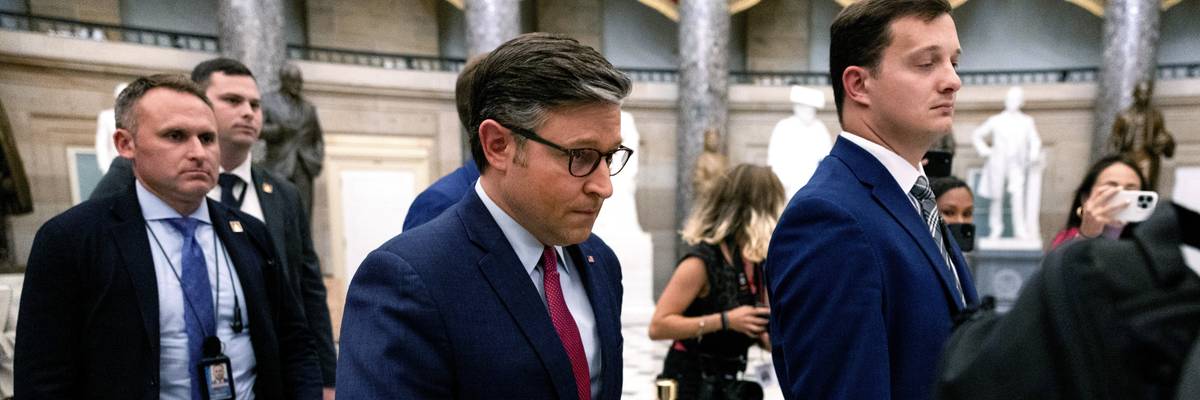
House Speaker Mike Johnson (R-La.) heads to the House floor for a vote on September 18, 2024.
"As long as House Republicans continue pushing Project 2025 funding bills, they will continue pushing our nation towards a government shutdown," said Democratic Rep. Brendan Boyle.
The U.S. House of Representatives on Wednesday rejected a GOP resolution that would have punted a fight over government funding until after the next president takes office and pushed through a noxious voter suppression measure backed by Republican nominee Donald Trump.
The final vote was 202-220, with 14 Republicans joining nearly every member of the House Democratic caucus in voting against the legislation. GOP opponents of the bill included far-right lawmakers who want to slash spending.
Reps. Jared Golden (D-Maine), Don Davis (D-N.C.), and Marie Gluesenkamp Perez (D-Wash.) broke with their party and backed the Republican continuing resolution, which would have largely extended government funding at current levels into March.
With Trump's backing, House Speaker Mike Johnson (R-La.) agreed to attach to the continuing resolution the SAVE Act, legislation purportedly aimed at preventing noncitizens from voting—which is already illegal. Voting rights advocates have condemned the SAVE Act as an "unnecessary and dangerous" bill that would "make it harder for voters of color and naturalized citizens to register to vote."
"Instead of working with Democrats to fund the government, House Republicans tied themselves into knots trying to give Trump what he wants."
House Democrats said Wednesday that the failure of the GOP continuing resolution was an inevitable consequence of the party's decision to push extremist spending bills instead of working on a bipartisan solution to government funding.
The government will shut down on October 1 unless Congress acts. Johnson said leading up to Wednesday's vote that there is "no Plan B."
"Once again, the House Republican majority has failed at its most basic tasks while trying to force Trump's extreme and unpopular Project 2025 agenda on the American people," said Rep. Rosa DeLauro (D-Conn.), the ranking member of the House Appropriations Committee. "Everyone in Washington, Democrats and Republicans, knew this ill-conceived continuing resolution was destined to fail. Why we spent a week and a half considering a partisan bill, just days from a government shutdown, is beyond comprehension."
"We have seven legislative days to keep the government open," she continued. "The time to begin negotiations on a continuing resolution that can gain the support of Democrats and Republicans in the House and Senate was last week—but right now will suffice, if Republicans are willing to meet us at the table and actually govern."
Rep. Brendan Boyle (D-Pa.), the top Democrat on the House Budget Committee, said late Wednesday that "as long as House Republicans continue pushing Project 2025 funding bills, they will continue pushing our nation towards a government shutdown."
"Trump said he'd 'shut down the government in a heartbeat' to push his Project 2025 agenda—and instead of working with Democrats to fund the government, House Republicans tied themselves into knots trying to give Trump what he wants," said Boyle. "Just as they've done for the last two years, House Republicans have proven they're more interested in imposing Trump's dangerous agenda than lifting a finger to help middle-class families and keep our government open. American families deserve better than this extreme bill and they deserve better than House Republicans."
Democratic lawmakers are reportedly expected to propose a clean three-month extension of government funding to avert a shutdown and buy time to negotiate a longer-term deal on government spending.
Ahead of Wednesday's vote, DeLauro warned that House Republicans believe delaying the government funding fight until March 2025 would give them "more leverage to force their unpopular cuts to services that American families depend on to make ends meet."
"This bill is an admission that a House Republican majority cannot govern," said DeLauro. "They would rather gamble on an intervening election than attempt to complete their work on time."
Dear Common Dreams reader, It’s been nearly 30 years since I co-founded Common Dreams with my late wife, Lina Newhouser. We had the radical notion that journalism should serve the public good, not corporate profits. It was clear to us from the outset what it would take to build such a project. No paid advertisements. No corporate sponsors. No millionaire publisher telling us what to think or do. Many people said we wouldn't last a year, but we proved those doubters wrong. Together with a tremendous team of journalists and dedicated staff, we built an independent media outlet free from the constraints of profits and corporate control. Our mission has always been simple: To inform. To inspire. To ignite change for the common good. Building Common Dreams was not easy. Our survival was never guaranteed. When you take on the most powerful forces—Wall Street greed, fossil fuel industry destruction, Big Tech lobbyists, and uber-rich oligarchs who have spent billions upon billions rigging the economy and democracy in their favor—the only bulwark you have is supporters who believe in your work. But here’s the urgent message from me today. It's never been this bad out there. And it's never been this hard to keep us going. At the very moment Common Dreams is most needed, the threats we face are intensifying. We need your support now more than ever. We don't accept corporate advertising and never will. We don't have a paywall because we don't think people should be blocked from critical news based on their ability to pay. Everything we do is funded by the donations of readers like you. When everyone does the little they can afford, we are strong. But if that support retreats or dries up, so do we. Will you donate now to make sure Common Dreams not only survives but thrives? —Craig Brown, Co-founder |
The U.S. House of Representatives on Wednesday rejected a GOP resolution that would have punted a fight over government funding until after the next president takes office and pushed through a noxious voter suppression measure backed by Republican nominee Donald Trump.
The final vote was 202-220, with 14 Republicans joining nearly every member of the House Democratic caucus in voting against the legislation. GOP opponents of the bill included far-right lawmakers who want to slash spending.
Reps. Jared Golden (D-Maine), Don Davis (D-N.C.), and Marie Gluesenkamp Perez (D-Wash.) broke with their party and backed the Republican continuing resolution, which would have largely extended government funding at current levels into March.
With Trump's backing, House Speaker Mike Johnson (R-La.) agreed to attach to the continuing resolution the SAVE Act, legislation purportedly aimed at preventing noncitizens from voting—which is already illegal. Voting rights advocates have condemned the SAVE Act as an "unnecessary and dangerous" bill that would "make it harder for voters of color and naturalized citizens to register to vote."
"Instead of working with Democrats to fund the government, House Republicans tied themselves into knots trying to give Trump what he wants."
House Democrats said Wednesday that the failure of the GOP continuing resolution was an inevitable consequence of the party's decision to push extremist spending bills instead of working on a bipartisan solution to government funding.
The government will shut down on October 1 unless Congress acts. Johnson said leading up to Wednesday's vote that there is "no Plan B."
"Once again, the House Republican majority has failed at its most basic tasks while trying to force Trump's extreme and unpopular Project 2025 agenda on the American people," said Rep. Rosa DeLauro (D-Conn.), the ranking member of the House Appropriations Committee. "Everyone in Washington, Democrats and Republicans, knew this ill-conceived continuing resolution was destined to fail. Why we spent a week and a half considering a partisan bill, just days from a government shutdown, is beyond comprehension."
"We have seven legislative days to keep the government open," she continued. "The time to begin negotiations on a continuing resolution that can gain the support of Democrats and Republicans in the House and Senate was last week—but right now will suffice, if Republicans are willing to meet us at the table and actually govern."
Rep. Brendan Boyle (D-Pa.), the top Democrat on the House Budget Committee, said late Wednesday that "as long as House Republicans continue pushing Project 2025 funding bills, they will continue pushing our nation towards a government shutdown."
"Trump said he'd 'shut down the government in a heartbeat' to push his Project 2025 agenda—and instead of working with Democrats to fund the government, House Republicans tied themselves into knots trying to give Trump what he wants," said Boyle. "Just as they've done for the last two years, House Republicans have proven they're more interested in imposing Trump's dangerous agenda than lifting a finger to help middle-class families and keep our government open. American families deserve better than this extreme bill and they deserve better than House Republicans."
Democratic lawmakers are reportedly expected to propose a clean three-month extension of government funding to avert a shutdown and buy time to negotiate a longer-term deal on government spending.
Ahead of Wednesday's vote, DeLauro warned that House Republicans believe delaying the government funding fight until March 2025 would give them "more leverage to force their unpopular cuts to services that American families depend on to make ends meet."
"This bill is an admission that a House Republican majority cannot govern," said DeLauro. "They would rather gamble on an intervening election than attempt to complete their work on time."
The U.S. House of Representatives on Wednesday rejected a GOP resolution that would have punted a fight over government funding until after the next president takes office and pushed through a noxious voter suppression measure backed by Republican nominee Donald Trump.
The final vote was 202-220, with 14 Republicans joining nearly every member of the House Democratic caucus in voting against the legislation. GOP opponents of the bill included far-right lawmakers who want to slash spending.
Reps. Jared Golden (D-Maine), Don Davis (D-N.C.), and Marie Gluesenkamp Perez (D-Wash.) broke with their party and backed the Republican continuing resolution, which would have largely extended government funding at current levels into March.
With Trump's backing, House Speaker Mike Johnson (R-La.) agreed to attach to the continuing resolution the SAVE Act, legislation purportedly aimed at preventing noncitizens from voting—which is already illegal. Voting rights advocates have condemned the SAVE Act as an "unnecessary and dangerous" bill that would "make it harder for voters of color and naturalized citizens to register to vote."
"Instead of working with Democrats to fund the government, House Republicans tied themselves into knots trying to give Trump what he wants."
House Democrats said Wednesday that the failure of the GOP continuing resolution was an inevitable consequence of the party's decision to push extremist spending bills instead of working on a bipartisan solution to government funding.
The government will shut down on October 1 unless Congress acts. Johnson said leading up to Wednesday's vote that there is "no Plan B."
"Once again, the House Republican majority has failed at its most basic tasks while trying to force Trump's extreme and unpopular Project 2025 agenda on the American people," said Rep. Rosa DeLauro (D-Conn.), the ranking member of the House Appropriations Committee. "Everyone in Washington, Democrats and Republicans, knew this ill-conceived continuing resolution was destined to fail. Why we spent a week and a half considering a partisan bill, just days from a government shutdown, is beyond comprehension."
"We have seven legislative days to keep the government open," she continued. "The time to begin negotiations on a continuing resolution that can gain the support of Democrats and Republicans in the House and Senate was last week—but right now will suffice, if Republicans are willing to meet us at the table and actually govern."
Rep. Brendan Boyle (D-Pa.), the top Democrat on the House Budget Committee, said late Wednesday that "as long as House Republicans continue pushing Project 2025 funding bills, they will continue pushing our nation towards a government shutdown."
"Trump said he'd 'shut down the government in a heartbeat' to push his Project 2025 agenda—and instead of working with Democrats to fund the government, House Republicans tied themselves into knots trying to give Trump what he wants," said Boyle. "Just as they've done for the last two years, House Republicans have proven they're more interested in imposing Trump's dangerous agenda than lifting a finger to help middle-class families and keep our government open. American families deserve better than this extreme bill and they deserve better than House Republicans."
Democratic lawmakers are reportedly expected to propose a clean three-month extension of government funding to avert a shutdown and buy time to negotiate a longer-term deal on government spending.
Ahead of Wednesday's vote, DeLauro warned that House Republicans believe delaying the government funding fight until March 2025 would give them "more leverage to force their unpopular cuts to services that American families depend on to make ends meet."
"This bill is an admission that a House Republican majority cannot govern," said DeLauro. "They would rather gamble on an intervening election than attempt to complete their work on time."