SUBSCRIBE TO OUR FREE NEWSLETTER
Daily news & progressive opinion—funded by the people, not the corporations—delivered straight to your inbox.
5
#000000
#FFFFFF
To donate by check, phone, or other method, see our More Ways to Give page.
Daily news & progressive opinion—funded by the people, not the corporations—delivered straight to your inbox.
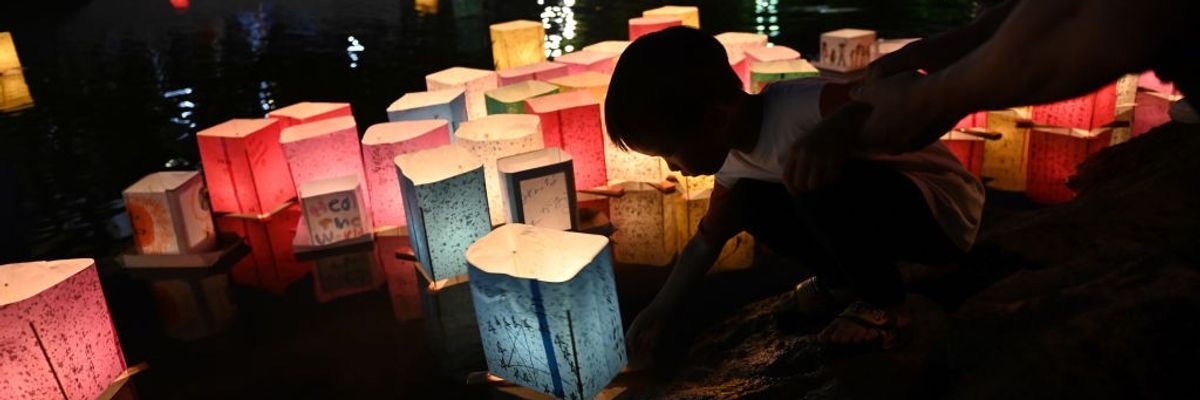
People attend the Peace Message Lantern Floating Ceremony at the Hiroshima Peace Memorial Park to pay tribute to the atomic bomb victims in Hiroshima, Japan, on August 06, 2023.
"Believers of proactive nuclear deterrence, who say nuclear weapons are indispensable to maintain peace, are only delaying the progress toward nuclear disarmament," Hiroshima's governor added.
Local, national, and global leaders warned of the dangers of nuclear weapons as they commemorated the 78th anniversary of the dropping of an atomic bomb on the city of Hiroshima Sunday.
This year's anniversary comes as the release of the film Oppenheimer has offered a high-profile reminder of the history of the atomic bomb and as nuclear tensions in the current day have heightened, in part due to Russia's invasion of Ukraine. At the start of the year, the Bulletin of the Atomic Scientists moved their doomsday clock to 90 seconds to midnight.
"Leaders around the world must confront the reality that nuclear threats now being voiced by certain policymakers reveal the folly of nuclear deterrence theory," Hiroshima Mayor Kazumi Matsui said during his peace address at the commemoration ceremony in Hiroshima Sunday, as The Associated Press reported. "They must immediately take concrete steps to lead us from the dangerous present toward our ideal world."
Matsui's remarks responded in part to the Group of Seven summit in the city in May, during which world leaders put out a statement that anti-nuclear advocates considered a major disappointment.
In that statement, the leaders agreed that no country should use nuclear weapons, but that merely possessing the weapons could still "serve defensive purposes, deter aggression, and prevent war and coercion," according to AP. Since then, former Russian President and current deputy chair of that country's Security Council Dmitry Medvedev threatened nuclear war if a NATO-backed Ukrainian offensive reclaims land annexed illegally by Russia.
Hiroshima's Gov. Hidehiko Yuzai agreed with its mayor that deterrence had failed.
"Believers of proactive nuclear deterrence, who say nuclear weapons are indispensable to maintain peace, are only delaying the progress toward nuclear disarmament," Yuzai said, according to AP.
The U.S. dropped an atomic bomb on Hiroshima on August 6, 1945, at 8:15 am local time. A second bomb was dropped on Nagasaki on August 9. The two bombings killed between 110,000 and 210,000 people, according to the Bulletin of the Atomic Scientists. Those who survived, called hibakusha in Japan, still contend with sickness and injury from the bombings even as they advocate for a nuclear free world, according to AP.
"For 78 years, the city of Hiroshima and the hibakusha have worked tirelessly to ensure that nuclear weapons are never used again," United Nations Secretary-General António Guterres said in remarks delivered at Sunday's ceremony by Under-Secretary-General and High Representative for Disarmament Affairs Izumi Nakamitsu.
People began to light candles and incense and pray at a memorial for the victims of the Hiroshima bombings as the sun rose on Sunday, according to The Washington Post. At the exact time of the bombing, a peace bell rang out, followed by a moment of silence, Reuters reported. Around 50,000 people attended the ceremony in 86°F heat.
Among them was Japanese Prime Minister Fumio Kishida, who also called for peace.
"The drums of nuclear war are beating once again."
"The tragedies of Hiroshima and Nagasaki caused by nuclear weapons must never be repeated," he said. "As the only country to have experienced the horror of nuclear devastation in war, Japan will press on tirelessly with its efforts to bring about 'a world without nuclear weapons' while continuing to firmly uphold the 'Three Non-Nuclear Principles.'"
Kishida added that this work had become "more difficult," in part because of disagreements over disarmament and threats from Russia.
"But it is precisely because of these circumstances that it is imperative for us to reinvigorate international momentum once more towards the realization of a 'world without nuclear weapons,'" he continued.
Kishida has been criticized in Japan by survivors for not signing the Treaty on the Prohibition of Nuclear Weapons, according to AP. The prime minister, for his part, has argued such an act would not be effective, since no country currently possessing nuclear weapons has signed the agreement.
Guterres, through Nakamitsu, spoke out in favor of the treaty, as well as the Treaty on Non-Proliferation of Nuclear Weapons.
"World leaders have visited this city, seen its monuments, spoken with its brave survivors, and emerged emboldened to take up the cause of nuclear disarmament," Guterres said. "More should do so, because the drums of nuclear war are beating once again."
And he was clear about what must be done to silence them.
"The only way to eliminate the nuclear risk," Guterres said, "is to eliminate nuclear weapons."
Dear Common Dreams reader, It’s been nearly 30 years since I co-founded Common Dreams with my late wife, Lina Newhouser. We had the radical notion that journalism should serve the public good, not corporate profits. It was clear to us from the outset what it would take to build such a project. No paid advertisements. No corporate sponsors. No millionaire publisher telling us what to think or do. Many people said we wouldn't last a year, but we proved those doubters wrong. Together with a tremendous team of journalists and dedicated staff, we built an independent media outlet free from the constraints of profits and corporate control. Our mission has always been simple: To inform. To inspire. To ignite change for the common good. Building Common Dreams was not easy. Our survival was never guaranteed. When you take on the most powerful forces—Wall Street greed, fossil fuel industry destruction, Big Tech lobbyists, and uber-rich oligarchs who have spent billions upon billions rigging the economy and democracy in their favor—the only bulwark you have is supporters who believe in your work. But here’s the urgent message from me today. It's never been this bad out there. And it's never been this hard to keep us going. At the very moment Common Dreams is most needed, the threats we face are intensifying. We need your support now more than ever. We don't accept corporate advertising and never will. We don't have a paywall because we don't think people should be blocked from critical news based on their ability to pay. Everything we do is funded by the donations of readers like you. When everyone does the little they can afford, we are strong. But if that support retreats or dries up, so do we. Will you donate now to make sure Common Dreams not only survives but thrives? —Craig Brown, Co-founder |
Local, national, and global leaders warned of the dangers of nuclear weapons as they commemorated the 78th anniversary of the dropping of an atomic bomb on the city of Hiroshima Sunday.
This year's anniversary comes as the release of the film Oppenheimer has offered a high-profile reminder of the history of the atomic bomb and as nuclear tensions in the current day have heightened, in part due to Russia's invasion of Ukraine. At the start of the year, the Bulletin of the Atomic Scientists moved their doomsday clock to 90 seconds to midnight.
"Leaders around the world must confront the reality that nuclear threats now being voiced by certain policymakers reveal the folly of nuclear deterrence theory," Hiroshima Mayor Kazumi Matsui said during his peace address at the commemoration ceremony in Hiroshima Sunday, as The Associated Press reported. "They must immediately take concrete steps to lead us from the dangerous present toward our ideal world."
Matsui's remarks responded in part to the Group of Seven summit in the city in May, during which world leaders put out a statement that anti-nuclear advocates considered a major disappointment.
In that statement, the leaders agreed that no country should use nuclear weapons, but that merely possessing the weapons could still "serve defensive purposes, deter aggression, and prevent war and coercion," according to AP. Since then, former Russian President and current deputy chair of that country's Security Council Dmitry Medvedev threatened nuclear war if a NATO-backed Ukrainian offensive reclaims land annexed illegally by Russia.
Hiroshima's Gov. Hidehiko Yuzai agreed with its mayor that deterrence had failed.
"Believers of proactive nuclear deterrence, who say nuclear weapons are indispensable to maintain peace, are only delaying the progress toward nuclear disarmament," Yuzai said, according to AP.
The U.S. dropped an atomic bomb on Hiroshima on August 6, 1945, at 8:15 am local time. A second bomb was dropped on Nagasaki on August 9. The two bombings killed between 110,000 and 210,000 people, according to the Bulletin of the Atomic Scientists. Those who survived, called hibakusha in Japan, still contend with sickness and injury from the bombings even as they advocate for a nuclear free world, according to AP.
"For 78 years, the city of Hiroshima and the hibakusha have worked tirelessly to ensure that nuclear weapons are never used again," United Nations Secretary-General António Guterres said in remarks delivered at Sunday's ceremony by Under-Secretary-General and High Representative for Disarmament Affairs Izumi Nakamitsu.
People began to light candles and incense and pray at a memorial for the victims of the Hiroshima bombings as the sun rose on Sunday, according to The Washington Post. At the exact time of the bombing, a peace bell rang out, followed by a moment of silence, Reuters reported. Around 50,000 people attended the ceremony in 86°F heat.
Among them was Japanese Prime Minister Fumio Kishida, who also called for peace.
"The drums of nuclear war are beating once again."
"The tragedies of Hiroshima and Nagasaki caused by nuclear weapons must never be repeated," he said. "As the only country to have experienced the horror of nuclear devastation in war, Japan will press on tirelessly with its efforts to bring about 'a world without nuclear weapons' while continuing to firmly uphold the 'Three Non-Nuclear Principles.'"
Kishida added that this work had become "more difficult," in part because of disagreements over disarmament and threats from Russia.
"But it is precisely because of these circumstances that it is imperative for us to reinvigorate international momentum once more towards the realization of a 'world without nuclear weapons,'" he continued.
Kishida has been criticized in Japan by survivors for not signing the Treaty on the Prohibition of Nuclear Weapons, according to AP. The prime minister, for his part, has argued such an act would not be effective, since no country currently possessing nuclear weapons has signed the agreement.
Guterres, through Nakamitsu, spoke out in favor of the treaty, as well as the Treaty on Non-Proliferation of Nuclear Weapons.
"World leaders have visited this city, seen its monuments, spoken with its brave survivors, and emerged emboldened to take up the cause of nuclear disarmament," Guterres said. "More should do so, because the drums of nuclear war are beating once again."
And he was clear about what must be done to silence them.
"The only way to eliminate the nuclear risk," Guterres said, "is to eliminate nuclear weapons."
Local, national, and global leaders warned of the dangers of nuclear weapons as they commemorated the 78th anniversary of the dropping of an atomic bomb on the city of Hiroshima Sunday.
This year's anniversary comes as the release of the film Oppenheimer has offered a high-profile reminder of the history of the atomic bomb and as nuclear tensions in the current day have heightened, in part due to Russia's invasion of Ukraine. At the start of the year, the Bulletin of the Atomic Scientists moved their doomsday clock to 90 seconds to midnight.
"Leaders around the world must confront the reality that nuclear threats now being voiced by certain policymakers reveal the folly of nuclear deterrence theory," Hiroshima Mayor Kazumi Matsui said during his peace address at the commemoration ceremony in Hiroshima Sunday, as The Associated Press reported. "They must immediately take concrete steps to lead us from the dangerous present toward our ideal world."
Matsui's remarks responded in part to the Group of Seven summit in the city in May, during which world leaders put out a statement that anti-nuclear advocates considered a major disappointment.
In that statement, the leaders agreed that no country should use nuclear weapons, but that merely possessing the weapons could still "serve defensive purposes, deter aggression, and prevent war and coercion," according to AP. Since then, former Russian President and current deputy chair of that country's Security Council Dmitry Medvedev threatened nuclear war if a NATO-backed Ukrainian offensive reclaims land annexed illegally by Russia.
Hiroshima's Gov. Hidehiko Yuzai agreed with its mayor that deterrence had failed.
"Believers of proactive nuclear deterrence, who say nuclear weapons are indispensable to maintain peace, are only delaying the progress toward nuclear disarmament," Yuzai said, according to AP.
The U.S. dropped an atomic bomb on Hiroshima on August 6, 1945, at 8:15 am local time. A second bomb was dropped on Nagasaki on August 9. The two bombings killed between 110,000 and 210,000 people, according to the Bulletin of the Atomic Scientists. Those who survived, called hibakusha in Japan, still contend with sickness and injury from the bombings even as they advocate for a nuclear free world, according to AP.
"For 78 years, the city of Hiroshima and the hibakusha have worked tirelessly to ensure that nuclear weapons are never used again," United Nations Secretary-General António Guterres said in remarks delivered at Sunday's ceremony by Under-Secretary-General and High Representative for Disarmament Affairs Izumi Nakamitsu.
People began to light candles and incense and pray at a memorial for the victims of the Hiroshima bombings as the sun rose on Sunday, according to The Washington Post. At the exact time of the bombing, a peace bell rang out, followed by a moment of silence, Reuters reported. Around 50,000 people attended the ceremony in 86°F heat.
Among them was Japanese Prime Minister Fumio Kishida, who also called for peace.
"The drums of nuclear war are beating once again."
"The tragedies of Hiroshima and Nagasaki caused by nuclear weapons must never be repeated," he said. "As the only country to have experienced the horror of nuclear devastation in war, Japan will press on tirelessly with its efforts to bring about 'a world without nuclear weapons' while continuing to firmly uphold the 'Three Non-Nuclear Principles.'"
Kishida added that this work had become "more difficult," in part because of disagreements over disarmament and threats from Russia.
"But it is precisely because of these circumstances that it is imperative for us to reinvigorate international momentum once more towards the realization of a 'world without nuclear weapons,'" he continued.
Kishida has been criticized in Japan by survivors for not signing the Treaty on the Prohibition of Nuclear Weapons, according to AP. The prime minister, for his part, has argued such an act would not be effective, since no country currently possessing nuclear weapons has signed the agreement.
Guterres, through Nakamitsu, spoke out in favor of the treaty, as well as the Treaty on Non-Proliferation of Nuclear Weapons.
"World leaders have visited this city, seen its monuments, spoken with its brave survivors, and emerged emboldened to take up the cause of nuclear disarmament," Guterres said. "More should do so, because the drums of nuclear war are beating once again."
And he was clear about what must be done to silence them.
"The only way to eliminate the nuclear risk," Guterres said, "is to eliminate nuclear weapons."