SUBSCRIBE TO OUR FREE NEWSLETTER
Daily news & progressive opinion—funded by the people, not the corporations—delivered straight to your inbox.
5
#000000
#FFFFFF
To donate by check, phone, or other method, see our More Ways to Give page.
Daily news & progressive opinion—funded by the people, not the corporations—delivered straight to your inbox.
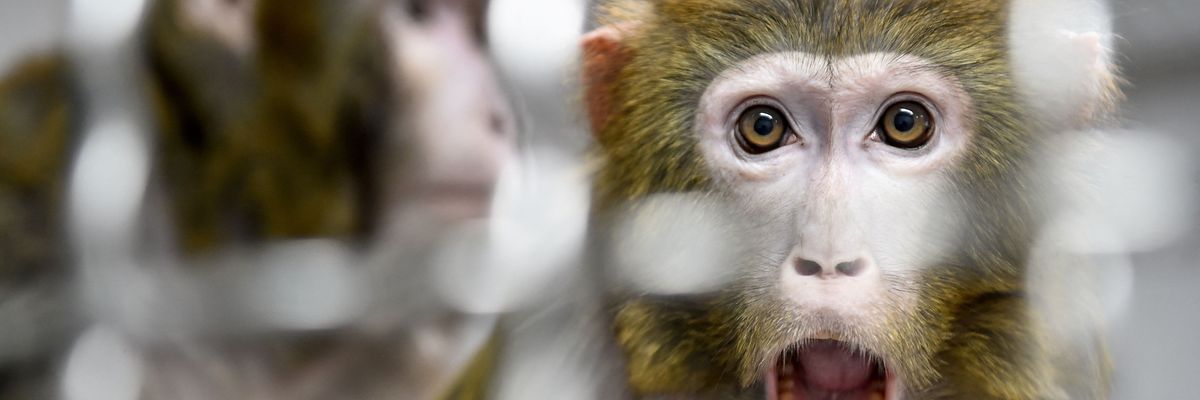
A Rhesus macaque, part of the 11 rescued monkeys from research laboratories, looks on from the quarantine room of the future animal shelter 'La Taniere', in Nogent-le-Phaye near Chartres, on March 13, 2019.
The animal rights group wants the military to stop "disturbing" tests meant to recreate symptoms of the mysterious "Havana syndrome" afflicting diplomats and other American and Canadian personnel.
People for the Ethical Treatment of Animals on Monday implored the U.S. military to reinstate a ban on the intentional wounding of animals in experiments and to stop radiation testing in an attempt to determine the cause of the mystery ailment popularly known as "Havana syndrome" that has afflicted U.S. government officials posted at diplomatic facilities in Washington, D.C. and several foreign countries.
In a letter to U.S. Defense Secretary Lloyd Austin III and Army Secretary Christine Wormuth, PETA science policy adviser Maggie Wiśniewska calls radio frequency wave testing in experiments trying to induce Havana syndrome on animals "not only cruel and wasteful but also, frankly, futile."
Wiśniewska urged the Pentagon "to renew the ban on weapons-wounding tests on dogs, cats, marine animals, and nonhuman primates and to no longer permit the wounding of any animals with weapons for medical research, development, testing, or evaluation."
This prohibition would apply to "an apparent military plan to expose monkeys to pulsed microwave radiation in a misguided attempt to determine human brain effects associated with an acquired neurosensory syndrome commonly referred to as 'Havana syndrome' and the ongoing experiment funded by the U.S. Army at Wayne State University that involves irradiating ferrets with a radio frequency directed weapon in an irrelevant attempt to study the cognitive, behavioral, vestibular, and cochlear health effects of Havana syndrome in humans."
In 1983, PETA exposed and fought to shut down a Pentagon "wound lab" where animals including dogs and goats were shot for medical training and experimentation. In 2005, U.S. Army Regulation 40-33 banned the use of dogs, cats, marine animals, and nonhuman primates in experiments "conducted for the development of biological, chemical, or nuclear weapons."
However, in 2020 the U.S. Army Medical Research and Development Command (USAMRDC) issued Policy 84, which permits the purchase of live animals to inflict wounds upon using a weapon for the purpose of conducting medical research, development, testing, or evaluation."
In March 2022 PETA filed a Freedom of Information Act (FOIA) request for documents and images related to USAMRDC-approved wound testing of animals. After initially stating it had at least 2,000 such files, USAMRDC backtracked and claimed that it had only one record relating to animal wound testing and that the responsive record to PETA's FOIA request is "classified... in the
interest of national defense or foreign policy."
PETA argues that the military's decision to use live animals in testing related to Havana syndrome is "counterproductive" due to biological differences between humans and species subjected to the experiments, as well as the widespread availability of non-wounding research methods and the likelihood that radio frequency waves did not cause the mysterious ailment.
The U.S. government has a long history of radiation experiments not only on animals but also on human beings. Scores of institutions, including some of North America's most prominent universities, laboratories, and hospitals hosted government and military experimentation on both volunteers and unwitting test subjects in the MK-ULTRA mind control experiments and other highly unethical and sometimes deadly programs.
People suffering from Havana syndrome—so named because it was first identified by U.S. and Canadian diplomats and embassy staff in the Cuban capital—experienced what The Lancet described as "an abrupt onset of unusual clinical symptoms."
"Affected individuals described hearing a sudden loud noise that was perceived to have directional features, and that was accompanied by pain in one or both ears or, in some cases, pressure or vibrations felt in their head," the British medical publication explained. "Some of the diplomats also reported tinnitus, visual problems, vertigo, and cognitive difficulties."
A global U.S. intelligence probe concluded earlier this month that it is "highly unlikely" that a foreign adversary is behind the illness, and that the symptoms reported by hundreds of U.S. personnel "were probably the result of factors that did not involve a foreign adversary, such as preexisting conditions, conventional illnesses, and environmental factors."
Dear Common Dreams reader, It’s been nearly 30 years since I co-founded Common Dreams with my late wife, Lina Newhouser. We had the radical notion that journalism should serve the public good, not corporate profits. It was clear to us from the outset what it would take to build such a project. No paid advertisements. No corporate sponsors. No millionaire publisher telling us what to think or do. Many people said we wouldn't last a year, but we proved those doubters wrong. Together with a tremendous team of journalists and dedicated staff, we built an independent media outlet free from the constraints of profits and corporate control. Our mission has always been simple: To inform. To inspire. To ignite change for the common good. Building Common Dreams was not easy. Our survival was never guaranteed. When you take on the most powerful forces—Wall Street greed, fossil fuel industry destruction, Big Tech lobbyists, and uber-rich oligarchs who have spent billions upon billions rigging the economy and democracy in their favor—the only bulwark you have is supporters who believe in your work. But here’s the urgent message from me today. It's never been this bad out there. And it's never been this hard to keep us going. At the very moment Common Dreams is most needed, the threats we face are intensifying. We need your support now more than ever. We don't accept corporate advertising and never will. We don't have a paywall because we don't think people should be blocked from critical news based on their ability to pay. Everything we do is funded by the donations of readers like you. When everyone does the little they can afford, we are strong. But if that support retreats or dries up, so do we. Will you donate now to make sure Common Dreams not only survives but thrives? —Craig Brown, Co-founder |
People for the Ethical Treatment of Animals on Monday implored the U.S. military to reinstate a ban on the intentional wounding of animals in experiments and to stop radiation testing in an attempt to determine the cause of the mystery ailment popularly known as "Havana syndrome" that has afflicted U.S. government officials posted at diplomatic facilities in Washington, D.C. and several foreign countries.
In a letter to U.S. Defense Secretary Lloyd Austin III and Army Secretary Christine Wormuth, PETA science policy adviser Maggie Wiśniewska calls radio frequency wave testing in experiments trying to induce Havana syndrome on animals "not only cruel and wasteful but also, frankly, futile."
Wiśniewska urged the Pentagon "to renew the ban on weapons-wounding tests on dogs, cats, marine animals, and nonhuman primates and to no longer permit the wounding of any animals with weapons for medical research, development, testing, or evaluation."
This prohibition would apply to "an apparent military plan to expose monkeys to pulsed microwave radiation in a misguided attempt to determine human brain effects associated with an acquired neurosensory syndrome commonly referred to as 'Havana syndrome' and the ongoing experiment funded by the U.S. Army at Wayne State University that involves irradiating ferrets with a radio frequency directed weapon in an irrelevant attempt to study the cognitive, behavioral, vestibular, and cochlear health effects of Havana syndrome in humans."
In 1983, PETA exposed and fought to shut down a Pentagon "wound lab" where animals including dogs and goats were shot for medical training and experimentation. In 2005, U.S. Army Regulation 40-33 banned the use of dogs, cats, marine animals, and nonhuman primates in experiments "conducted for the development of biological, chemical, or nuclear weapons."
However, in 2020 the U.S. Army Medical Research and Development Command (USAMRDC) issued Policy 84, which permits the purchase of live animals to inflict wounds upon using a weapon for the purpose of conducting medical research, development, testing, or evaluation."
In March 2022 PETA filed a Freedom of Information Act (FOIA) request for documents and images related to USAMRDC-approved wound testing of animals. After initially stating it had at least 2,000 such files, USAMRDC backtracked and claimed that it had only one record relating to animal wound testing and that the responsive record to PETA's FOIA request is "classified... in the
interest of national defense or foreign policy."
PETA argues that the military's decision to use live animals in testing related to Havana syndrome is "counterproductive" due to biological differences between humans and species subjected to the experiments, as well as the widespread availability of non-wounding research methods and the likelihood that radio frequency waves did not cause the mysterious ailment.
The U.S. government has a long history of radiation experiments not only on animals but also on human beings. Scores of institutions, including some of North America's most prominent universities, laboratories, and hospitals hosted government and military experimentation on both volunteers and unwitting test subjects in the MK-ULTRA mind control experiments and other highly unethical and sometimes deadly programs.
People suffering from Havana syndrome—so named because it was first identified by U.S. and Canadian diplomats and embassy staff in the Cuban capital—experienced what The Lancet described as "an abrupt onset of unusual clinical symptoms."
"Affected individuals described hearing a sudden loud noise that was perceived to have directional features, and that was accompanied by pain in one or both ears or, in some cases, pressure or vibrations felt in their head," the British medical publication explained. "Some of the diplomats also reported tinnitus, visual problems, vertigo, and cognitive difficulties."
A global U.S. intelligence probe concluded earlier this month that it is "highly unlikely" that a foreign adversary is behind the illness, and that the symptoms reported by hundreds of U.S. personnel "were probably the result of factors that did not involve a foreign adversary, such as preexisting conditions, conventional illnesses, and environmental factors."
People for the Ethical Treatment of Animals on Monday implored the U.S. military to reinstate a ban on the intentional wounding of animals in experiments and to stop radiation testing in an attempt to determine the cause of the mystery ailment popularly known as "Havana syndrome" that has afflicted U.S. government officials posted at diplomatic facilities in Washington, D.C. and several foreign countries.
In a letter to U.S. Defense Secretary Lloyd Austin III and Army Secretary Christine Wormuth, PETA science policy adviser Maggie Wiśniewska calls radio frequency wave testing in experiments trying to induce Havana syndrome on animals "not only cruel and wasteful but also, frankly, futile."
Wiśniewska urged the Pentagon "to renew the ban on weapons-wounding tests on dogs, cats, marine animals, and nonhuman primates and to no longer permit the wounding of any animals with weapons for medical research, development, testing, or evaluation."
This prohibition would apply to "an apparent military plan to expose monkeys to pulsed microwave radiation in a misguided attempt to determine human brain effects associated with an acquired neurosensory syndrome commonly referred to as 'Havana syndrome' and the ongoing experiment funded by the U.S. Army at Wayne State University that involves irradiating ferrets with a radio frequency directed weapon in an irrelevant attempt to study the cognitive, behavioral, vestibular, and cochlear health effects of Havana syndrome in humans."
In 1983, PETA exposed and fought to shut down a Pentagon "wound lab" where animals including dogs and goats were shot for medical training and experimentation. In 2005, U.S. Army Regulation 40-33 banned the use of dogs, cats, marine animals, and nonhuman primates in experiments "conducted for the development of biological, chemical, or nuclear weapons."
However, in 2020 the U.S. Army Medical Research and Development Command (USAMRDC) issued Policy 84, which permits the purchase of live animals to inflict wounds upon using a weapon for the purpose of conducting medical research, development, testing, or evaluation."
In March 2022 PETA filed a Freedom of Information Act (FOIA) request for documents and images related to USAMRDC-approved wound testing of animals. After initially stating it had at least 2,000 such files, USAMRDC backtracked and claimed that it had only one record relating to animal wound testing and that the responsive record to PETA's FOIA request is "classified... in the
interest of national defense or foreign policy."
PETA argues that the military's decision to use live animals in testing related to Havana syndrome is "counterproductive" due to biological differences between humans and species subjected to the experiments, as well as the widespread availability of non-wounding research methods and the likelihood that radio frequency waves did not cause the mysterious ailment.
The U.S. government has a long history of radiation experiments not only on animals but also on human beings. Scores of institutions, including some of North America's most prominent universities, laboratories, and hospitals hosted government and military experimentation on both volunteers and unwitting test subjects in the MK-ULTRA mind control experiments and other highly unethical and sometimes deadly programs.
People suffering from Havana syndrome—so named because it was first identified by U.S. and Canadian diplomats and embassy staff in the Cuban capital—experienced what The Lancet described as "an abrupt onset of unusual clinical symptoms."
"Affected individuals described hearing a sudden loud noise that was perceived to have directional features, and that was accompanied by pain in one or both ears or, in some cases, pressure or vibrations felt in their head," the British medical publication explained. "Some of the diplomats also reported tinnitus, visual problems, vertigo, and cognitive difficulties."
A global U.S. intelligence probe concluded earlier this month that it is "highly unlikely" that a foreign adversary is behind the illness, and that the symptoms reported by hundreds of U.S. personnel "were probably the result of factors that did not involve a foreign adversary, such as preexisting conditions, conventional illnesses, and environmental factors."