SUBSCRIBE TO OUR FREE NEWSLETTER
Daily news & progressive opinion—funded by the people, not the corporations—delivered straight to your inbox.
5
#000000
#FFFFFF
To donate by check, phone, or other method, see our More Ways to Give page.
Daily news & progressive opinion—funded by the people, not the corporations—delivered straight to your inbox.
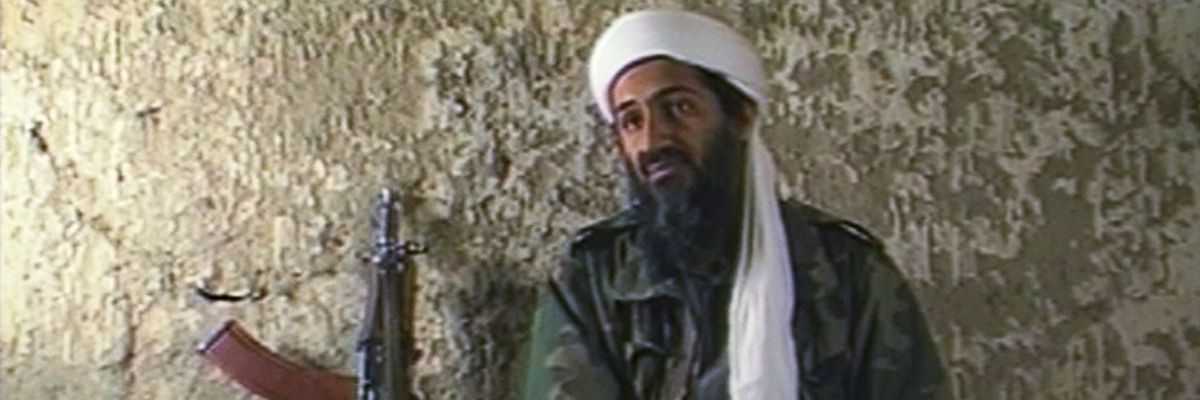
Osama bin Laden, the Saudi millionaire and fugitive leader of the terrorist group al Qaeda, explains why he has declared a "jihad" or holy war against the United States on August 20, 1998 from a cave hideout somewhere in Afghanistan.
The U.K. paper confirmed it had removed the letter because of its sudden surge in popularity on TikTok and other social media sites.
The Guardian has removed Osama bin Laden's "Letter to the American People," which had been on its website for more than 20 years, after it went viral on TikTok and other social media sites.
"This page previously displayed a document containing, in translation, the full text of Osama bin Laden's 'Letter to the American People,' as reported in The Observer on Sunday 24 November 2002," the page previously hosting the letter now reads. "The document, which was published here on the same day, was removed on 15 November 2023."
In the letter, which is still available via web archive, bin Laden outlines his grievances against the United States, including its support for Israel, its placement of military bases in Islamic countries, and its participation in or support of other military actions or economic sanctions against people in the Islamic world. He justifies his attacks on U.S. civilians by arguing that they have the power to vote for governments that support different policies. Bin Laden also makes homophobic and antisemitic remarks, including blaming Jews as a group for the excesses of U.S. capitalism.
"The transcript published on our website 20 years ago has been widely shared on social media without the full context."
The letter saw a surprising resurgence on TikTok over the past two days, as posters documented their responses to reading it for the first time.
"The TikToks are from people of all ages, races, ethnicities, and backgrounds," journalist Yashar Ali wrote on social media. "Many of them say that reading the letter has opened their eyes, and they'll never see geopolitical matters the same way again. Many of them—and I have watched a lot—say it has made them reevaluate their perspective on how what is often labeled as terrorism can be a legitimate form of resistance to a hostile power."
The Wrap sourced the trend to a video posted by Lynnette Adkins that TikTok says is currently unavailable.
"I need everyone to stop doing what they're doing right now and go read 'Letter to America,' I feel like I'm going through an existential crisis right now," Adkins reportedly said.
Ali said he saw thousands of similar videos on TikTok and more on other social media platforms. 404 Media reported Wednesday that searching for "Letter to America" on TikTok brought up a few dozen results, some with as many as hundreds of thousands of views. Videos using the hashtag #LettertoAmerica have together generated 1.3 million views. However, the outlet noted that some of the videos were "not particularly viral by TikTok standards." The top-liked video had 75,000 likes, but true TikTok phenomenons can bee seen hundreds of millions of times. It also noted that not all of the videos expressed support for bin Laden's views: Some simply explained the letter, the trend, or the 9/11 attacks.
The Guardian confirmed to both The Wrap and 404 Media that it had removed the letter because of its surge in online popularity.
"The transcript published on our website 20 years ago has been widely shared on social media without the full context," the paper said in the statement. "Therefore we have decided to take it down and direct readers to the news article that originally contextualized it instead."
404 Media noted that removing the letter absent major factual errors or danger to life was a "highly unusual move," one that has only prompted more commentary on TikTok and other social media platforms.
Dear Common Dreams reader, It’s been nearly 30 years since I co-founded Common Dreams with my late wife, Lina Newhouser. We had the radical notion that journalism should serve the public good, not corporate profits. It was clear to us from the outset what it would take to build such a project. No paid advertisements. No corporate sponsors. No millionaire publisher telling us what to think or do. Many people said we wouldn't last a year, but we proved those doubters wrong. Together with a tremendous team of journalists and dedicated staff, we built an independent media outlet free from the constraints of profits and corporate control. Our mission has always been simple: To inform. To inspire. To ignite change for the common good. Building Common Dreams was not easy. Our survival was never guaranteed. When you take on the most powerful forces—Wall Street greed, fossil fuel industry destruction, Big Tech lobbyists, and uber-rich oligarchs who have spent billions upon billions rigging the economy and democracy in their favor—the only bulwark you have is supporters who believe in your work. But here’s the urgent message from me today. It's never been this bad out there. And it's never been this hard to keep us going. At the very moment Common Dreams is most needed, the threats we face are intensifying. We need your support now more than ever. We don't accept corporate advertising and never will. We don't have a paywall because we don't think people should be blocked from critical news based on their ability to pay. Everything we do is funded by the donations of readers like you. When everyone does the little they can afford, we are strong. But if that support retreats or dries up, so do we. Will you donate now to make sure Common Dreams not only survives but thrives? —Craig Brown, Co-founder |
The Guardian has removed Osama bin Laden's "Letter to the American People," which had been on its website for more than 20 years, after it went viral on TikTok and other social media sites.
"This page previously displayed a document containing, in translation, the full text of Osama bin Laden's 'Letter to the American People,' as reported in The Observer on Sunday 24 November 2002," the page previously hosting the letter now reads. "The document, which was published here on the same day, was removed on 15 November 2023."
In the letter, which is still available via web archive, bin Laden outlines his grievances against the United States, including its support for Israel, its placement of military bases in Islamic countries, and its participation in or support of other military actions or economic sanctions against people in the Islamic world. He justifies his attacks on U.S. civilians by arguing that they have the power to vote for governments that support different policies. Bin Laden also makes homophobic and antisemitic remarks, including blaming Jews as a group for the excesses of U.S. capitalism.
"The transcript published on our website 20 years ago has been widely shared on social media without the full context."
The letter saw a surprising resurgence on TikTok over the past two days, as posters documented their responses to reading it for the first time.
"The TikToks are from people of all ages, races, ethnicities, and backgrounds," journalist Yashar Ali wrote on social media. "Many of them say that reading the letter has opened their eyes, and they'll never see geopolitical matters the same way again. Many of them—and I have watched a lot—say it has made them reevaluate their perspective on how what is often labeled as terrorism can be a legitimate form of resistance to a hostile power."
The Wrap sourced the trend to a video posted by Lynnette Adkins that TikTok says is currently unavailable.
"I need everyone to stop doing what they're doing right now and go read 'Letter to America,' I feel like I'm going through an existential crisis right now," Adkins reportedly said.
Ali said he saw thousands of similar videos on TikTok and more on other social media platforms. 404 Media reported Wednesday that searching for "Letter to America" on TikTok brought up a few dozen results, some with as many as hundreds of thousands of views. Videos using the hashtag #LettertoAmerica have together generated 1.3 million views. However, the outlet noted that some of the videos were "not particularly viral by TikTok standards." The top-liked video had 75,000 likes, but true TikTok phenomenons can bee seen hundreds of millions of times. It also noted that not all of the videos expressed support for bin Laden's views: Some simply explained the letter, the trend, or the 9/11 attacks.
The Guardian confirmed to both The Wrap and 404 Media that it had removed the letter because of its surge in online popularity.
"The transcript published on our website 20 years ago has been widely shared on social media without the full context," the paper said in the statement. "Therefore we have decided to take it down and direct readers to the news article that originally contextualized it instead."
404 Media noted that removing the letter absent major factual errors or danger to life was a "highly unusual move," one that has only prompted more commentary on TikTok and other social media platforms.
The Guardian has removed Osama bin Laden's "Letter to the American People," which had been on its website for more than 20 years, after it went viral on TikTok and other social media sites.
"This page previously displayed a document containing, in translation, the full text of Osama bin Laden's 'Letter to the American People,' as reported in The Observer on Sunday 24 November 2002," the page previously hosting the letter now reads. "The document, which was published here on the same day, was removed on 15 November 2023."
In the letter, which is still available via web archive, bin Laden outlines his grievances against the United States, including its support for Israel, its placement of military bases in Islamic countries, and its participation in or support of other military actions or economic sanctions against people in the Islamic world. He justifies his attacks on U.S. civilians by arguing that they have the power to vote for governments that support different policies. Bin Laden also makes homophobic and antisemitic remarks, including blaming Jews as a group for the excesses of U.S. capitalism.
"The transcript published on our website 20 years ago has been widely shared on social media without the full context."
The letter saw a surprising resurgence on TikTok over the past two days, as posters documented their responses to reading it for the first time.
"The TikToks are from people of all ages, races, ethnicities, and backgrounds," journalist Yashar Ali wrote on social media. "Many of them say that reading the letter has opened their eyes, and they'll never see geopolitical matters the same way again. Many of them—and I have watched a lot—say it has made them reevaluate their perspective on how what is often labeled as terrorism can be a legitimate form of resistance to a hostile power."
The Wrap sourced the trend to a video posted by Lynnette Adkins that TikTok says is currently unavailable.
"I need everyone to stop doing what they're doing right now and go read 'Letter to America,' I feel like I'm going through an existential crisis right now," Adkins reportedly said.
Ali said he saw thousands of similar videos on TikTok and more on other social media platforms. 404 Media reported Wednesday that searching for "Letter to America" on TikTok brought up a few dozen results, some with as many as hundreds of thousands of views. Videos using the hashtag #LettertoAmerica have together generated 1.3 million views. However, the outlet noted that some of the videos were "not particularly viral by TikTok standards." The top-liked video had 75,000 likes, but true TikTok phenomenons can bee seen hundreds of millions of times. It also noted that not all of the videos expressed support for bin Laden's views: Some simply explained the letter, the trend, or the 9/11 attacks.
The Guardian confirmed to both The Wrap and 404 Media that it had removed the letter because of its surge in online popularity.
"The transcript published on our website 20 years ago has been widely shared on social media without the full context," the paper said in the statement. "Therefore we have decided to take it down and direct readers to the news article that originally contextualized it instead."
404 Media noted that removing the letter absent major factual errors or danger to life was a "highly unusual move," one that has only prompted more commentary on TikTok and other social media platforms.