SUBSCRIBE TO OUR FREE NEWSLETTER
Daily news & progressive opinion—funded by the people, not the corporations—delivered straight to your inbox.
5
#000000
#FFFFFF
To donate by check, phone, or other method, see our More Ways to Give page.
Daily news & progressive opinion—funded by the people, not the corporations—delivered straight to your inbox.
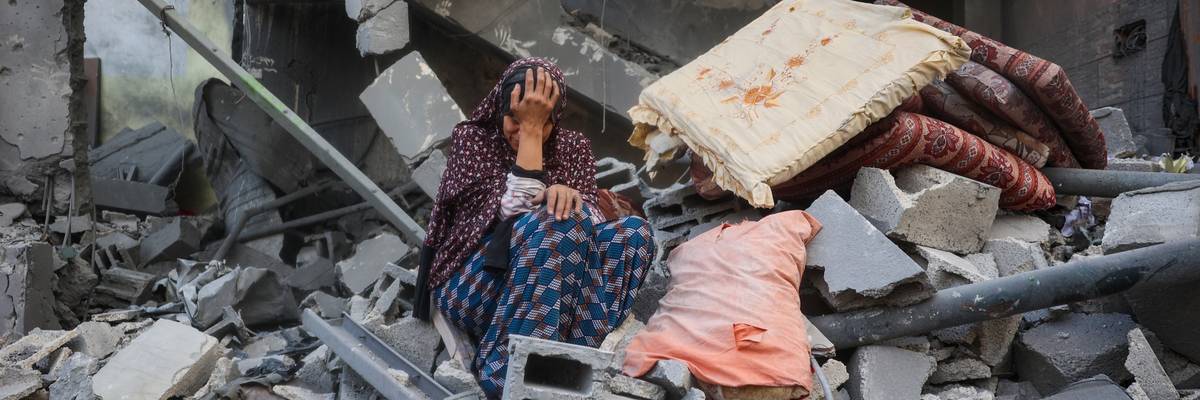
A woman cries while sitting on the rubble of her house, destroyed in an Israeli strike, in the Nuseirat refugee camp in central Gaza Strip on March 18, 2025.
"It's displacement under fire," one Gazan said on Sunday.
Over 50,000 Palestinians in Gaza have been killed since Israel began its campaign in the enclave, local health officials said Sunday. The grim milestone was reached at the end of a week of deadly strikes by Israeli security forces that upended a fragile cease-fire that went into effect in January.
Gaza's Health Ministry also announced that there have been over 113,200 people injured since October 7, 2023, when Hamas attacked southern Israel and took roughly 250 people hostage and killed over a thousand others—prompting Israel's fierce and deadly campaign.
On Sunday, Pope Francis, in his first public appearance after weeks of hospitalization, said that he is "saddened by the resumption of heavy Israeli bombing on the Gaza Strip, causing many deaths and injuries."
"I call for an immediate halt to the weapons; and for the courage to resume dialogue, so that all hostages may be released and a final ceasefire reached," he said.
In January, Hamas and Israel agreed to a cease-fire that paused hostilities and saw 25 living Israeli hostages released in exchange for the release of hundreds of Palestinian prisoners in Israeli detention.
Hamas wanted to open talks for the second phase of the deal, that was supposed to see Israel fully withdraw from the enclave and Hamas release remaining living hostages. Israel instead wanted to impose the terms of a new cease-fire presented by the Trump administration, according to NPR, and refused to hold the talks regarding a permanent end to the war.
Israel commenced bombing Gaza again on Tuesday.
"Israel brazenly resumed its devastating bombing campaign in Gaza killing at least 414 people in their sleep, including 174 children, and again wiping out entire families in a matter of hours. Palestinians in Gaza—who have barely had a chance to start piecing together their lives and continue to grapple with the trauma of Israel’s past attacks—have woken up once more to the hellish nightmare of intense bombardment," wrote Agnès Callamard, Amnesty International's secretary-general, in a statement on Tuesday.
Since Tuesday, 673 Palestinians have been killed, according to the Sunday update from the Ministry of Health in Gaza.
Overnight into Sunday, Israeli strikes hit the southern Gaza Strip, killing at least 26 Palestinians, including a Hamas leader and numerous women and children, according to the NPR. The Israeli military ordered people to leave the Tel al-Sultan neighborhood in the southern city of Rafah, the outlet reported.
"It's displacement under fire," one Gazan in the city of Rafah told NPR. "There are wounded people among us. The situation is very difficult," he said.
The Washington Post also reported Sunday that Israeli political and military leaders are considering plans for a new ground campaign in Gaza that "could include a military occupation of the entire enclave for months or more."
The outlet reported that "the new and more aggressive tactics, according to current and former Israeli officials and others briefed, will probably also include direct military control of humanitarian aid; targeting more of Hamas's civilian leadership; and evacuating women, children, and verified noncombatants from neighborhoods to 'humanitarian bubbles' and laying siege to those who remain—a more intense version of a tactic employed last year in northern Gaza."
Israeli forces also drew condemnation on Friday after bombing the only cancer hospital in the Gaza Strip. Israel Defense Forces troops carried out an airstrike on the abandoned Turkish-Palestinian Friendship Hospital in Gaza's Netzarim Corridor, where the IDF launched what it called a "limited ground operation" earlier this week.
Dear Common Dreams reader, It’s been nearly 30 years since I co-founded Common Dreams with my late wife, Lina Newhouser. We had the radical notion that journalism should serve the public good, not corporate profits. It was clear to us from the outset what it would take to build such a project. No paid advertisements. No corporate sponsors. No millionaire publisher telling us what to think or do. Many people said we wouldn't last a year, but we proved those doubters wrong. Together with a tremendous team of journalists and dedicated staff, we built an independent media outlet free from the constraints of profits and corporate control. Our mission has always been simple: To inform. To inspire. To ignite change for the common good. Building Common Dreams was not easy. Our survival was never guaranteed. When you take on the most powerful forces—Wall Street greed, fossil fuel industry destruction, Big Tech lobbyists, and uber-rich oligarchs who have spent billions upon billions rigging the economy and democracy in their favor—the only bulwark you have is supporters who believe in your work. But here’s the urgent message from me today. It's never been this bad out there. And it's never been this hard to keep us going. At the very moment Common Dreams is most needed, the threats we face are intensifying. We need your support now more than ever. We don't accept corporate advertising and never will. We don't have a paywall because we don't think people should be blocked from critical news based on their ability to pay. Everything we do is funded by the donations of readers like you. When everyone does the little they can afford, we are strong. But if that support retreats or dries up, so do we. Will you donate now to make sure Common Dreams not only survives but thrives? —Craig Brown, Co-founder |
Over 50,000 Palestinians in Gaza have been killed since Israel began its campaign in the enclave, local health officials said Sunday. The grim milestone was reached at the end of a week of deadly strikes by Israeli security forces that upended a fragile cease-fire that went into effect in January.
Gaza's Health Ministry also announced that there have been over 113,200 people injured since October 7, 2023, when Hamas attacked southern Israel and took roughly 250 people hostage and killed over a thousand others—prompting Israel's fierce and deadly campaign.
On Sunday, Pope Francis, in his first public appearance after weeks of hospitalization, said that he is "saddened by the resumption of heavy Israeli bombing on the Gaza Strip, causing many deaths and injuries."
"I call for an immediate halt to the weapons; and for the courage to resume dialogue, so that all hostages may be released and a final ceasefire reached," he said.
In January, Hamas and Israel agreed to a cease-fire that paused hostilities and saw 25 living Israeli hostages released in exchange for the release of hundreds of Palestinian prisoners in Israeli detention.
Hamas wanted to open talks for the second phase of the deal, that was supposed to see Israel fully withdraw from the enclave and Hamas release remaining living hostages. Israel instead wanted to impose the terms of a new cease-fire presented by the Trump administration, according to NPR, and refused to hold the talks regarding a permanent end to the war.
Israel commenced bombing Gaza again on Tuesday.
"Israel brazenly resumed its devastating bombing campaign in Gaza killing at least 414 people in their sleep, including 174 children, and again wiping out entire families in a matter of hours. Palestinians in Gaza—who have barely had a chance to start piecing together their lives and continue to grapple with the trauma of Israel’s past attacks—have woken up once more to the hellish nightmare of intense bombardment," wrote Agnès Callamard, Amnesty International's secretary-general, in a statement on Tuesday.
Since Tuesday, 673 Palestinians have been killed, according to the Sunday update from the Ministry of Health in Gaza.
Overnight into Sunday, Israeli strikes hit the southern Gaza Strip, killing at least 26 Palestinians, including a Hamas leader and numerous women and children, according to the NPR. The Israeli military ordered people to leave the Tel al-Sultan neighborhood in the southern city of Rafah, the outlet reported.
"It's displacement under fire," one Gazan in the city of Rafah told NPR. "There are wounded people among us. The situation is very difficult," he said.
The Washington Post also reported Sunday that Israeli political and military leaders are considering plans for a new ground campaign in Gaza that "could include a military occupation of the entire enclave for months or more."
The outlet reported that "the new and more aggressive tactics, according to current and former Israeli officials and others briefed, will probably also include direct military control of humanitarian aid; targeting more of Hamas's civilian leadership; and evacuating women, children, and verified noncombatants from neighborhoods to 'humanitarian bubbles' and laying siege to those who remain—a more intense version of a tactic employed last year in northern Gaza."
Israeli forces also drew condemnation on Friday after bombing the only cancer hospital in the Gaza Strip. Israel Defense Forces troops carried out an airstrike on the abandoned Turkish-Palestinian Friendship Hospital in Gaza's Netzarim Corridor, where the IDF launched what it called a "limited ground operation" earlier this week.
Over 50,000 Palestinians in Gaza have been killed since Israel began its campaign in the enclave, local health officials said Sunday. The grim milestone was reached at the end of a week of deadly strikes by Israeli security forces that upended a fragile cease-fire that went into effect in January.
Gaza's Health Ministry also announced that there have been over 113,200 people injured since October 7, 2023, when Hamas attacked southern Israel and took roughly 250 people hostage and killed over a thousand others—prompting Israel's fierce and deadly campaign.
On Sunday, Pope Francis, in his first public appearance after weeks of hospitalization, said that he is "saddened by the resumption of heavy Israeli bombing on the Gaza Strip, causing many deaths and injuries."
"I call for an immediate halt to the weapons; and for the courage to resume dialogue, so that all hostages may be released and a final ceasefire reached," he said.
In January, Hamas and Israel agreed to a cease-fire that paused hostilities and saw 25 living Israeli hostages released in exchange for the release of hundreds of Palestinian prisoners in Israeli detention.
Hamas wanted to open talks for the second phase of the deal, that was supposed to see Israel fully withdraw from the enclave and Hamas release remaining living hostages. Israel instead wanted to impose the terms of a new cease-fire presented by the Trump administration, according to NPR, and refused to hold the talks regarding a permanent end to the war.
Israel commenced bombing Gaza again on Tuesday.
"Israel brazenly resumed its devastating bombing campaign in Gaza killing at least 414 people in their sleep, including 174 children, and again wiping out entire families in a matter of hours. Palestinians in Gaza—who have barely had a chance to start piecing together their lives and continue to grapple with the trauma of Israel’s past attacks—have woken up once more to the hellish nightmare of intense bombardment," wrote Agnès Callamard, Amnesty International's secretary-general, in a statement on Tuesday.
Since Tuesday, 673 Palestinians have been killed, according to the Sunday update from the Ministry of Health in Gaza.
Overnight into Sunday, Israeli strikes hit the southern Gaza Strip, killing at least 26 Palestinians, including a Hamas leader and numerous women and children, according to the NPR. The Israeli military ordered people to leave the Tel al-Sultan neighborhood in the southern city of Rafah, the outlet reported.
"It's displacement under fire," one Gazan in the city of Rafah told NPR. "There are wounded people among us. The situation is very difficult," he said.
The Washington Post also reported Sunday that Israeli political and military leaders are considering plans for a new ground campaign in Gaza that "could include a military occupation of the entire enclave for months or more."
The outlet reported that "the new and more aggressive tactics, according to current and former Israeli officials and others briefed, will probably also include direct military control of humanitarian aid; targeting more of Hamas's civilian leadership; and evacuating women, children, and verified noncombatants from neighborhoods to 'humanitarian bubbles' and laying siege to those who remain—a more intense version of a tactic employed last year in northern Gaza."
Israeli forces also drew condemnation on Friday after bombing the only cancer hospital in the Gaza Strip. Israel Defense Forces troops carried out an airstrike on the abandoned Turkish-Palestinian Friendship Hospital in Gaza's Netzarim Corridor, where the IDF launched what it called a "limited ground operation" earlier this week.