SUBSCRIBE TO OUR FREE NEWSLETTER
Daily news & progressive opinion—funded by the people, not the corporations—delivered straight to your inbox.
5
#000000
#FFFFFF
To donate by check, phone, or other method, see our More Ways to Give page.
Daily news & progressive opinion—funded by the people, not the corporations—delivered straight to your inbox.
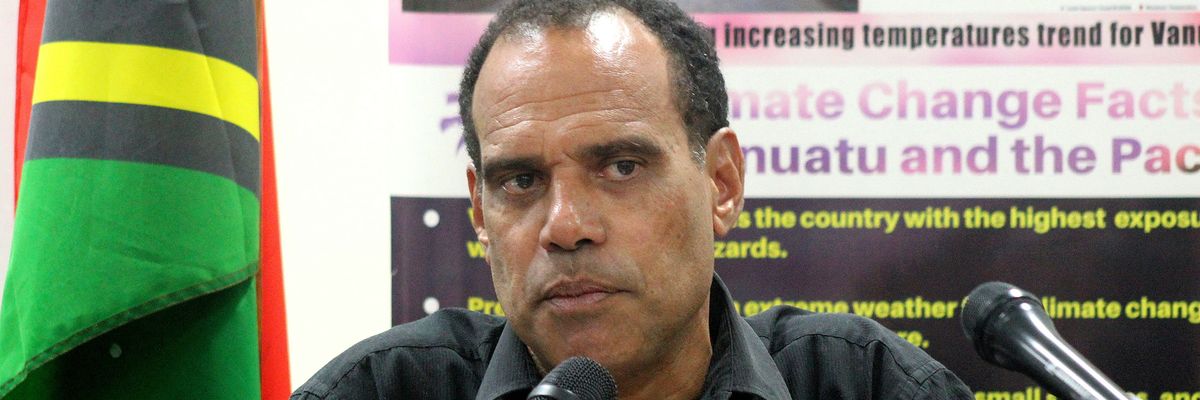
Vanuatu Climate Change Minister Ralph Regenvanu speaks to the media in Port Vila, Vanuatu on November 22, 2022.
"As Pacific leaders shoulder the burden of climate leadership," this call "is a reminder that despite the doom and gloom, another world is possible, a fossil fuel-free world that is just, equitable, and sustainable."
Climate justice advocates celebrated Friday after a half-dozen island nations committed to building a "fossil fuel-free Pacific" and urged all governments to join them in bringing about an equitable phaseout of coal, oil, and gas.
From Wednesday to Friday, Vanuatu and Tuvalu co-hosted the 2nd Pacific Ministerial Dialogue on Pathways for the Global Just Transition from Fossil Fuels in Port Vila, Vanuatu. The summit came amid an ongoing state of emergency in Vanuatu, which was hammered earlier this month by a pair of Category 4 cyclones. Participants described the current devastation as "just the most recent example of the extensive and ongoing fossil fuel-induced loss and damage suffered by" Pacific Islanders.
At the conclusion of the three-day meeting, ministers and officials from six countries—Vanuatu, Tuvalu, Tonga, Fiji, Niue, and the Solomon Islands—agreed on the Port Vila Call for a Just Transition to a Fossil Fuel-Free Pacific.
The resolution—issued "on behalf of present and future generations, communities on the frontlines, and all of humanity"—calls for immediate international action to accelerate a just transition from dirty to clean energy in accordance with what experts have shown is necessary to avert the worst consequences of the climate crisis.
"The science is clear that fossil fuels are to blame for the climate emergency," says the document. "This is a crisis driven by the greed of an exploitative industry and its enablers. It is not acceptable that countries and companies are still planning on producing more than double the amount of fossil fuels by 2030 than the world can burn to limit warming to 1.5°C."
"Every second wasted on climate inaction and clinging to fossil fuels puts lives, homes, livelihoods, cultures, and ecosystems in jeopardy."
Among other things, the resolution implores policymakers in the Pacific and around the world to join the Beyond Oil and Gas Alliance (BOGA) and negotiate a fossil fuel nonproliferation treaty (FFNPT) to end the expansion of coal, oil, and gas extraction and to expedite a fair global shift to renewables. It also cautions lawmakers to avoid phrases like "unabated" or "inefficient," warning that such terminology "creates loopholes for fossil fuel producers."
In a statement, Oil Change International global policy lead Romain Ioualalen said, "Faced with devastating climate impacts resulting from the world's continued addiction to fossil fuels, Pacific governments have once again demonstrated what true leadership looks like."
"The contrast between the U.S. and other rich countries approving new oil and gas fields in clear defiance of science, and the commitment to build a prosperous and resilient fossil fuel-free Pacific could not be more obvious and highlights the complete disregard the fossil fuel industry and its enablers have for people and communities most affected by the climate crisis," said Ioualalen. "Countries must urgently heed the call for an immediate end to fossil fuel expansion that is emanating from the Pacific. We look forward to Pacific countries continuing to be vocal champions for a just and equitable phaseout of fossil fuels on the global stage, including at COP28 later this year."
Samoan climate justice activist Brianna Fruean said that "this dialogue of Pacific ministers is stepping outside of the box and acknowledging that we must try new ways to save ourselves—and that is going to require a fossil fuel nonproliferation treaty."
"While the guilty continue to reap profit off the expansion of fossil fuels behind our backs," said Fruean, "the meeting is bringing renewed energy to Pacific leadership that will not just echo across our islands but drive action with our allies globally."
Despite bearing almost no historical responsibility for the climate crisis, Pacific Islanders are acutely vulnerable to rising sea levels and increasingly frequent and severe extreme weather. Policymakers from the region have long been leaders in demanding ambitious efforts to slash greenhouse gas pollution at speed and scale, including by putting the idea of a FFNPT on the table in 2016. Just last year, Vanuatu and Tuvalu became the first national governments to endorse such a measure, while Tuvalu also recently joined the BOGA as a core member.
"Every second wasted on climate inaction and clinging to fossil fuels puts lives, homes, livelihoods, cultures, and ecosystems in jeopardy," said Lavetanalagi Seru, regional policy coordinator at Pacific Islands Climate Action Network. "As Pacific leaders shoulder the burden of climate leadership, the Port Vila Call for a Just Transition to a Fossil Fuel-Free Pacific is a reminder that despite the doom and gloom, another world is possible, a fossil fuel-free world that is just, equitable, and sustainable."
The region's new resolution states that "we have the power and responsibility to lead, and we will. Pacific leaders called for the Paris agreement to limit warming to 1.5°C, and have demanded an end to the development and expansion of fossil fuel-extracting industries, starting with new coal mines. Pacific civil society has challenged the world to step up the fight for urgent fossil fuel phaseout and effective climate action."
In recent weeks, Vanuatu has been leading an ongoing push for an advisory opinion from the International Court of Justice (ICJ) on "how existing international laws can be applied to strengthen action on climate change, protect people and the environment, and save the Paris agreement."
The document unveiled Friday calls for "redoubled efforts to reaffirm, strengthen, and codify legal obligations with respect to the global phaseout of fossil fuels," including by supporting the adoption of the Vanuatu-led ICJ resolution at the meeting of the U.N. General Assembly at the end of this month.
"The contrast between the U.S. and other rich countries approving new oil and gas fields in clear defiance of science, and the commitment to build a prosperous and resilient fossil fuel-free Pacific could not be more obvious."
According to Seru, "The phaseout of fossil fuels is not only a challenge, but an opportunity to promote economic development and innovation in the Pacific region."
To that end, the Port Vila document calls for "new Pacific-tailored development pathways based on 100% renewable energy."
350.org Pacific managing director Joseph Sikulu welcomed this week's developments, saying in a statement that "our people need global leaders to follow the innovation of Pacific representatives at the Pacific Ministerial Dialogue, it is a matter of survival."
"Our people also need energy to power their homes, their fishing boats, and their schools, which is where we are ready to work with governments in their commitment to progress the development and implementation of fossil-free development pathways at the grassroots level," he added.
In order to make that a reality, the document calls for increasing "public and private finance for the just transition from fossil fuels to renewable energy at the scale required, with innovative, simplified mechanisms and reforms of existing financial institutions."
Cansin Leylim, 350.org associate director of global campaigns, applauded Pacific Island nations for "once again showing immense leadership in the fight against the climate crisis, a crisis they had no part in creating."
"Pacific leaders have told us time and again—in order to stay below 1.5°C, the historically responsible countries need to immediately commit to a fossil fuel-free future without loopholes," said Leylim. "This means ensuring adequate and grant-based climate finance is swiftly mobilized to both adapt to the crisis and limit the heating to survival limits, ensuring energy independence and resource resilience with renewable energy."
Tzeporah Berman, chair of the Fossil Fuel Non-Proliferation Treaty Initiative, predicted that this week's "historic meeting" will "have far-reaching consequences."
Dear Common Dreams reader, It’s been nearly 30 years since I co-founded Common Dreams with my late wife, Lina Newhouser. We had the radical notion that journalism should serve the public good, not corporate profits. It was clear to us from the outset what it would take to build such a project. No paid advertisements. No corporate sponsors. No millionaire publisher telling us what to think or do. Many people said we wouldn't last a year, but we proved those doubters wrong. Together with a tremendous team of journalists and dedicated staff, we built an independent media outlet free from the constraints of profits and corporate control. Our mission has always been simple: To inform. To inspire. To ignite change for the common good. Building Common Dreams was not easy. Our survival was never guaranteed. When you take on the most powerful forces—Wall Street greed, fossil fuel industry destruction, Big Tech lobbyists, and uber-rich oligarchs who have spent billions upon billions rigging the economy and democracy in their favor—the only bulwark you have is supporters who believe in your work. But here’s the urgent message from me today. It's never been this bad out there. And it's never been this hard to keep us going. At the very moment Common Dreams is most needed, the threats we face are intensifying. We need your support now more than ever. We don't accept corporate advertising and never will. We don't have a paywall because we don't think people should be blocked from critical news based on their ability to pay. Everything we do is funded by the donations of readers like you. When everyone does the little they can afford, we are strong. But if that support retreats or dries up, so do we. Will you donate now to make sure Common Dreams not only survives but thrives? —Craig Brown, Co-founder |
Climate justice advocates celebrated Friday after a half-dozen island nations committed to building a "fossil fuel-free Pacific" and urged all governments to join them in bringing about an equitable phaseout of coal, oil, and gas.
From Wednesday to Friday, Vanuatu and Tuvalu co-hosted the 2nd Pacific Ministerial Dialogue on Pathways for the Global Just Transition from Fossil Fuels in Port Vila, Vanuatu. The summit came amid an ongoing state of emergency in Vanuatu, which was hammered earlier this month by a pair of Category 4 cyclones. Participants described the current devastation as "just the most recent example of the extensive and ongoing fossil fuel-induced loss and damage suffered by" Pacific Islanders.
At the conclusion of the three-day meeting, ministers and officials from six countries—Vanuatu, Tuvalu, Tonga, Fiji, Niue, and the Solomon Islands—agreed on the Port Vila Call for a Just Transition to a Fossil Fuel-Free Pacific.
The resolution—issued "on behalf of present and future generations, communities on the frontlines, and all of humanity"—calls for immediate international action to accelerate a just transition from dirty to clean energy in accordance with what experts have shown is necessary to avert the worst consequences of the climate crisis.
"The science is clear that fossil fuels are to blame for the climate emergency," says the document. "This is a crisis driven by the greed of an exploitative industry and its enablers. It is not acceptable that countries and companies are still planning on producing more than double the amount of fossil fuels by 2030 than the world can burn to limit warming to 1.5°C."
"Every second wasted on climate inaction and clinging to fossil fuels puts lives, homes, livelihoods, cultures, and ecosystems in jeopardy."
Among other things, the resolution implores policymakers in the Pacific and around the world to join the Beyond Oil and Gas Alliance (BOGA) and negotiate a fossil fuel nonproliferation treaty (FFNPT) to end the expansion of coal, oil, and gas extraction and to expedite a fair global shift to renewables. It also cautions lawmakers to avoid phrases like "unabated" or "inefficient," warning that such terminology "creates loopholes for fossil fuel producers."
In a statement, Oil Change International global policy lead Romain Ioualalen said, "Faced with devastating climate impacts resulting from the world's continued addiction to fossil fuels, Pacific governments have once again demonstrated what true leadership looks like."
"The contrast between the U.S. and other rich countries approving new oil and gas fields in clear defiance of science, and the commitment to build a prosperous and resilient fossil fuel-free Pacific could not be more obvious and highlights the complete disregard the fossil fuel industry and its enablers have for people and communities most affected by the climate crisis," said Ioualalen. "Countries must urgently heed the call for an immediate end to fossil fuel expansion that is emanating from the Pacific. We look forward to Pacific countries continuing to be vocal champions for a just and equitable phaseout of fossil fuels on the global stage, including at COP28 later this year."
Samoan climate justice activist Brianna Fruean said that "this dialogue of Pacific ministers is stepping outside of the box and acknowledging that we must try new ways to save ourselves—and that is going to require a fossil fuel nonproliferation treaty."
"While the guilty continue to reap profit off the expansion of fossil fuels behind our backs," said Fruean, "the meeting is bringing renewed energy to Pacific leadership that will not just echo across our islands but drive action with our allies globally."
Despite bearing almost no historical responsibility for the climate crisis, Pacific Islanders are acutely vulnerable to rising sea levels and increasingly frequent and severe extreme weather. Policymakers from the region have long been leaders in demanding ambitious efforts to slash greenhouse gas pollution at speed and scale, including by putting the idea of a FFNPT on the table in 2016. Just last year, Vanuatu and Tuvalu became the first national governments to endorse such a measure, while Tuvalu also recently joined the BOGA as a core member.
"Every second wasted on climate inaction and clinging to fossil fuels puts lives, homes, livelihoods, cultures, and ecosystems in jeopardy," said Lavetanalagi Seru, regional policy coordinator at Pacific Islands Climate Action Network. "As Pacific leaders shoulder the burden of climate leadership, the Port Vila Call for a Just Transition to a Fossil Fuel-Free Pacific is a reminder that despite the doom and gloom, another world is possible, a fossil fuel-free world that is just, equitable, and sustainable."
The region's new resolution states that "we have the power and responsibility to lead, and we will. Pacific leaders called for the Paris agreement to limit warming to 1.5°C, and have demanded an end to the development and expansion of fossil fuel-extracting industries, starting with new coal mines. Pacific civil society has challenged the world to step up the fight for urgent fossil fuel phaseout and effective climate action."
In recent weeks, Vanuatu has been leading an ongoing push for an advisory opinion from the International Court of Justice (ICJ) on "how existing international laws can be applied to strengthen action on climate change, protect people and the environment, and save the Paris agreement."
The document unveiled Friday calls for "redoubled efforts to reaffirm, strengthen, and codify legal obligations with respect to the global phaseout of fossil fuels," including by supporting the adoption of the Vanuatu-led ICJ resolution at the meeting of the U.N. General Assembly at the end of this month.
"The contrast between the U.S. and other rich countries approving new oil and gas fields in clear defiance of science, and the commitment to build a prosperous and resilient fossil fuel-free Pacific could not be more obvious."
According to Seru, "The phaseout of fossil fuels is not only a challenge, but an opportunity to promote economic development and innovation in the Pacific region."
To that end, the Port Vila document calls for "new Pacific-tailored development pathways based on 100% renewable energy."
350.org Pacific managing director Joseph Sikulu welcomed this week's developments, saying in a statement that "our people need global leaders to follow the innovation of Pacific representatives at the Pacific Ministerial Dialogue, it is a matter of survival."
"Our people also need energy to power their homes, their fishing boats, and their schools, which is where we are ready to work with governments in their commitment to progress the development and implementation of fossil-free development pathways at the grassroots level," he added.
In order to make that a reality, the document calls for increasing "public and private finance for the just transition from fossil fuels to renewable energy at the scale required, with innovative, simplified mechanisms and reforms of existing financial institutions."
Cansin Leylim, 350.org associate director of global campaigns, applauded Pacific Island nations for "once again showing immense leadership in the fight against the climate crisis, a crisis they had no part in creating."
"Pacific leaders have told us time and again—in order to stay below 1.5°C, the historically responsible countries need to immediately commit to a fossil fuel-free future without loopholes," said Leylim. "This means ensuring adequate and grant-based climate finance is swiftly mobilized to both adapt to the crisis and limit the heating to survival limits, ensuring energy independence and resource resilience with renewable energy."
Tzeporah Berman, chair of the Fossil Fuel Non-Proliferation Treaty Initiative, predicted that this week's "historic meeting" will "have far-reaching consequences."
Climate justice advocates celebrated Friday after a half-dozen island nations committed to building a "fossil fuel-free Pacific" and urged all governments to join them in bringing about an equitable phaseout of coal, oil, and gas.
From Wednesday to Friday, Vanuatu and Tuvalu co-hosted the 2nd Pacific Ministerial Dialogue on Pathways for the Global Just Transition from Fossil Fuels in Port Vila, Vanuatu. The summit came amid an ongoing state of emergency in Vanuatu, which was hammered earlier this month by a pair of Category 4 cyclones. Participants described the current devastation as "just the most recent example of the extensive and ongoing fossil fuel-induced loss and damage suffered by" Pacific Islanders.
At the conclusion of the three-day meeting, ministers and officials from six countries—Vanuatu, Tuvalu, Tonga, Fiji, Niue, and the Solomon Islands—agreed on the Port Vila Call for a Just Transition to a Fossil Fuel-Free Pacific.
The resolution—issued "on behalf of present and future generations, communities on the frontlines, and all of humanity"—calls for immediate international action to accelerate a just transition from dirty to clean energy in accordance with what experts have shown is necessary to avert the worst consequences of the climate crisis.
"The science is clear that fossil fuels are to blame for the climate emergency," says the document. "This is a crisis driven by the greed of an exploitative industry and its enablers. It is not acceptable that countries and companies are still planning on producing more than double the amount of fossil fuels by 2030 than the world can burn to limit warming to 1.5°C."
"Every second wasted on climate inaction and clinging to fossil fuels puts lives, homes, livelihoods, cultures, and ecosystems in jeopardy."
Among other things, the resolution implores policymakers in the Pacific and around the world to join the Beyond Oil and Gas Alliance (BOGA) and negotiate a fossil fuel nonproliferation treaty (FFNPT) to end the expansion of coal, oil, and gas extraction and to expedite a fair global shift to renewables. It also cautions lawmakers to avoid phrases like "unabated" or "inefficient," warning that such terminology "creates loopholes for fossil fuel producers."
In a statement, Oil Change International global policy lead Romain Ioualalen said, "Faced with devastating climate impacts resulting from the world's continued addiction to fossil fuels, Pacific governments have once again demonstrated what true leadership looks like."
"The contrast between the U.S. and other rich countries approving new oil and gas fields in clear defiance of science, and the commitment to build a prosperous and resilient fossil fuel-free Pacific could not be more obvious and highlights the complete disregard the fossil fuel industry and its enablers have for people and communities most affected by the climate crisis," said Ioualalen. "Countries must urgently heed the call for an immediate end to fossil fuel expansion that is emanating from the Pacific. We look forward to Pacific countries continuing to be vocal champions for a just and equitable phaseout of fossil fuels on the global stage, including at COP28 later this year."
Samoan climate justice activist Brianna Fruean said that "this dialogue of Pacific ministers is stepping outside of the box and acknowledging that we must try new ways to save ourselves—and that is going to require a fossil fuel nonproliferation treaty."
"While the guilty continue to reap profit off the expansion of fossil fuels behind our backs," said Fruean, "the meeting is bringing renewed energy to Pacific leadership that will not just echo across our islands but drive action with our allies globally."
Despite bearing almost no historical responsibility for the climate crisis, Pacific Islanders are acutely vulnerable to rising sea levels and increasingly frequent and severe extreme weather. Policymakers from the region have long been leaders in demanding ambitious efforts to slash greenhouse gas pollution at speed and scale, including by putting the idea of a FFNPT on the table in 2016. Just last year, Vanuatu and Tuvalu became the first national governments to endorse such a measure, while Tuvalu also recently joined the BOGA as a core member.
"Every second wasted on climate inaction and clinging to fossil fuels puts lives, homes, livelihoods, cultures, and ecosystems in jeopardy," said Lavetanalagi Seru, regional policy coordinator at Pacific Islands Climate Action Network. "As Pacific leaders shoulder the burden of climate leadership, the Port Vila Call for a Just Transition to a Fossil Fuel-Free Pacific is a reminder that despite the doom and gloom, another world is possible, a fossil fuel-free world that is just, equitable, and sustainable."
The region's new resolution states that "we have the power and responsibility to lead, and we will. Pacific leaders called for the Paris agreement to limit warming to 1.5°C, and have demanded an end to the development and expansion of fossil fuel-extracting industries, starting with new coal mines. Pacific civil society has challenged the world to step up the fight for urgent fossil fuel phaseout and effective climate action."
In recent weeks, Vanuatu has been leading an ongoing push for an advisory opinion from the International Court of Justice (ICJ) on "how existing international laws can be applied to strengthen action on climate change, protect people and the environment, and save the Paris agreement."
The document unveiled Friday calls for "redoubled efforts to reaffirm, strengthen, and codify legal obligations with respect to the global phaseout of fossil fuels," including by supporting the adoption of the Vanuatu-led ICJ resolution at the meeting of the U.N. General Assembly at the end of this month.
"The contrast between the U.S. and other rich countries approving new oil and gas fields in clear defiance of science, and the commitment to build a prosperous and resilient fossil fuel-free Pacific could not be more obvious."
According to Seru, "The phaseout of fossil fuels is not only a challenge, but an opportunity to promote economic development and innovation in the Pacific region."
To that end, the Port Vila document calls for "new Pacific-tailored development pathways based on 100% renewable energy."
350.org Pacific managing director Joseph Sikulu welcomed this week's developments, saying in a statement that "our people need global leaders to follow the innovation of Pacific representatives at the Pacific Ministerial Dialogue, it is a matter of survival."
"Our people also need energy to power their homes, their fishing boats, and their schools, which is where we are ready to work with governments in their commitment to progress the development and implementation of fossil-free development pathways at the grassroots level," he added.
In order to make that a reality, the document calls for increasing "public and private finance for the just transition from fossil fuels to renewable energy at the scale required, with innovative, simplified mechanisms and reforms of existing financial institutions."
Cansin Leylim, 350.org associate director of global campaigns, applauded Pacific Island nations for "once again showing immense leadership in the fight against the climate crisis, a crisis they had no part in creating."
"Pacific leaders have told us time and again—in order to stay below 1.5°C, the historically responsible countries need to immediately commit to a fossil fuel-free future without loopholes," said Leylim. "This means ensuring adequate and grant-based climate finance is swiftly mobilized to both adapt to the crisis and limit the heating to survival limits, ensuring energy independence and resource resilience with renewable energy."
Tzeporah Berman, chair of the Fossil Fuel Non-Proliferation Treaty Initiative, predicted that this week's "historic meeting" will "have far-reaching consequences."