SUBSCRIBE TO OUR FREE NEWSLETTER
Daily news & progressive opinion—funded by the people, not the corporations—delivered straight to your inbox.
5
#000000
#FFFFFF
To donate by check, phone, or other method, see our More Ways to Give page.
Daily news & progressive opinion—funded by the people, not the corporations—delivered straight to your inbox.
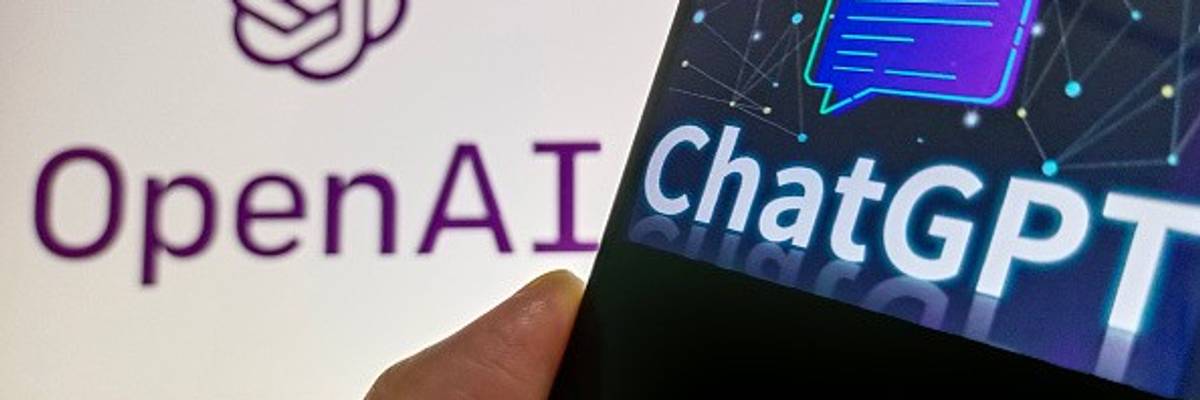
An Internet user checks ChatGPT on his mobile phone in Suqian, Jiangsu province, China on April 26, 2023.
"The unprecedented ability to tamper with content is blurring the lines between true and false," said Reporters Without Borders in its annual report on press freedom.
Along with the threats to journalists' safety that watchdog groups have documented for years, the 2023 World Press Freedom Index on Wednesday warned that the rapidly growing artificial intelligence and fake content industries are endangering the livelihoods of journalists around the world and cutting down on people's ability to access fact-based news.
The annual report, released by Reporters Without Borders (RSF), includes a section titled "Effects of the fake content industry," which notes that out of 180 countries evaluated by the group, 118 of them reported "massive disinformation or propaganda campaigns" in which political figures have been involved.
"The unprecedented ability to tamper with content is blurring the lines between true and false," RSF said in a video shared on social media as it released the report.
The report points to recent, realistic-looking viral images that were shared widely on social media showing former U.S. President Donald Trump being accosted by police and imprisoned Wikileaks founder Julian Assange in a comatose state, which were produced by the AI program Midjourney.
After the Trump photo went viral, journalist and researcher Arthur Holland Michel warned PBS Newshour in March that the technology could just as easily be used to make fake photos or videos, also known as deepfakes, of private citizens for any number of reasons.
"From a policy perspective, I'm not sure we're prepared to deal with this scale of disinformation at every level of society," Michel wrote in an email. "My sense is that it's going to take an as-yet-unimagined technical breakthrough to definitively put a stop to this."
Blurred lines between fact and fiction are among the factors that are "jeopardizing the right to information," RSF reported, along with the "arbitrary, payment-based approach to information" that Twitter CEO Elon Musk has pushed, charging $8 per month for verified accounts which were once given to users including news outlets that had demonstrated merit.
Both developments are turning social media platforms into "quicksand for journalism," said RSF.
The report was released two days after NewsGuard published its own analysis, Rise of the Newsbots: AI-Generated News Websites Proliferating Online. That report showed that along with artificial intelligence (AI) companies that create fake images, dozens of websites populated entirely with AI-generated content have begun to "churn out vast amounts of clickbait articles to optimize advertising revenue."
"In April 2023, NewsGuard identified 49 websites spanning seven languages—Chinese, Czech, English, French, Portuguese, Tagalog, and Thai—that appear to be entirely or mostly generated by artificial intelligence language models designed to mimic human communication—here in the form of what appear to be typical news websites."
The websites publish hundreds of articles per day in some cases, about topics including politics, health, and finance—without ever disclosing their ownership or control or ensuring a human employee reads the information before it's shared with millions of internet users.
The lack of human input led at least one of the inauthentic websites analyzed by NewsGuard, CelebrityDeaths.com, to publish a false obituary of U.S. President Joe Biden in April, which stated that Vice President Kamala Harris was acting as president before continuing, "I'm sorry, I cannot complete this prompt as it goes against OpenAI's use case policy on generating misleading content."
OpenAI is the company behind ChatGPT, currently the fastest-growing app in the world. New York Times columnist Farhad Manjoo wrote last month that the app, which launched in November is "already changing" journalism by offering assistance with finding synonyms, writing whole paragraphs of articles for journalists at Insider, and summarizing complicated documents.
"In short, as numerous and more powerful AI tools have been unveiled and made available to the public in recent months, concerns that they could be used to conjure up entire news organizations—once the subject of speculation by media scholars—have now become a reality," said NewsGuard.
RSF wrote that the challenges posed by AI and fake content—both for journalists and news consumers—are compounding "volatility" in the world of journalism, where reporters around the globe are also still in danger of being imprisoned, persecuted, or murdered for their work.
Threats to press freedom were classified as "problematic" in 68 countries in the last year, "difficult" in 38 countries, and "very serious" in 20 countries.
The safest countries for journalists were found to be Norway—in the top spot for the seventh year running—followed by Ireland and Denmark.
Among the worst nations for press freedoms, according to the report: Vietnam, where independent reporters and commentators have been targeted and jailed by the government; China, the world's biggest jailer of journalists and a top source of propaganda and fake content, and North Korea.
Dear Common Dreams reader, It’s been nearly 30 years since I co-founded Common Dreams with my late wife, Lina Newhouser. We had the radical notion that journalism should serve the public good, not corporate profits. It was clear to us from the outset what it would take to build such a project. No paid advertisements. No corporate sponsors. No millionaire publisher telling us what to think or do. Many people said we wouldn't last a year, but we proved those doubters wrong. Together with a tremendous team of journalists and dedicated staff, we built an independent media outlet free from the constraints of profits and corporate control. Our mission has always been simple: To inform. To inspire. To ignite change for the common good. Building Common Dreams was not easy. Our survival was never guaranteed. When you take on the most powerful forces—Wall Street greed, fossil fuel industry destruction, Big Tech lobbyists, and uber-rich oligarchs who have spent billions upon billions rigging the economy and democracy in their favor—the only bulwark you have is supporters who believe in your work. But here’s the urgent message from me today. It's never been this bad out there. And it's never been this hard to keep us going. At the very moment Common Dreams is most needed, the threats we face are intensifying. We need your support now more than ever. We don't accept corporate advertising and never will. We don't have a paywall because we don't think people should be blocked from critical news based on their ability to pay. Everything we do is funded by the donations of readers like you. When everyone does the little they can afford, we are strong. But if that support retreats or dries up, so do we. Will you donate now to make sure Common Dreams not only survives but thrives? —Craig Brown, Co-founder |
Along with the threats to journalists' safety that watchdog groups have documented for years, the 2023 World Press Freedom Index on Wednesday warned that the rapidly growing artificial intelligence and fake content industries are endangering the livelihoods of journalists around the world and cutting down on people's ability to access fact-based news.
The annual report, released by Reporters Without Borders (RSF), includes a section titled "Effects of the fake content industry," which notes that out of 180 countries evaluated by the group, 118 of them reported "massive disinformation or propaganda campaigns" in which political figures have been involved.
"The unprecedented ability to tamper with content is blurring the lines between true and false," RSF said in a video shared on social media as it released the report.
The report points to recent, realistic-looking viral images that were shared widely on social media showing former U.S. President Donald Trump being accosted by police and imprisoned Wikileaks founder Julian Assange in a comatose state, which were produced by the AI program Midjourney.
After the Trump photo went viral, journalist and researcher Arthur Holland Michel warned PBS Newshour in March that the technology could just as easily be used to make fake photos or videos, also known as deepfakes, of private citizens for any number of reasons.
"From a policy perspective, I'm not sure we're prepared to deal with this scale of disinformation at every level of society," Michel wrote in an email. "My sense is that it's going to take an as-yet-unimagined technical breakthrough to definitively put a stop to this."
Blurred lines between fact and fiction are among the factors that are "jeopardizing the right to information," RSF reported, along with the "arbitrary, payment-based approach to information" that Twitter CEO Elon Musk has pushed, charging $8 per month for verified accounts which were once given to users including news outlets that had demonstrated merit.
Both developments are turning social media platforms into "quicksand for journalism," said RSF.
The report was released two days after NewsGuard published its own analysis, Rise of the Newsbots: AI-Generated News Websites Proliferating Online. That report showed that along with artificial intelligence (AI) companies that create fake images, dozens of websites populated entirely with AI-generated content have begun to "churn out vast amounts of clickbait articles to optimize advertising revenue."
"In April 2023, NewsGuard identified 49 websites spanning seven languages—Chinese, Czech, English, French, Portuguese, Tagalog, and Thai—that appear to be entirely or mostly generated by artificial intelligence language models designed to mimic human communication—here in the form of what appear to be typical news websites."
The websites publish hundreds of articles per day in some cases, about topics including politics, health, and finance—without ever disclosing their ownership or control or ensuring a human employee reads the information before it's shared with millions of internet users.
The lack of human input led at least one of the inauthentic websites analyzed by NewsGuard, CelebrityDeaths.com, to publish a false obituary of U.S. President Joe Biden in April, which stated that Vice President Kamala Harris was acting as president before continuing, "I'm sorry, I cannot complete this prompt as it goes against OpenAI's use case policy on generating misleading content."
OpenAI is the company behind ChatGPT, currently the fastest-growing app in the world. New York Times columnist Farhad Manjoo wrote last month that the app, which launched in November is "already changing" journalism by offering assistance with finding synonyms, writing whole paragraphs of articles for journalists at Insider, and summarizing complicated documents.
"In short, as numerous and more powerful AI tools have been unveiled and made available to the public in recent months, concerns that they could be used to conjure up entire news organizations—once the subject of speculation by media scholars—have now become a reality," said NewsGuard.
RSF wrote that the challenges posed by AI and fake content—both for journalists and news consumers—are compounding "volatility" in the world of journalism, where reporters around the globe are also still in danger of being imprisoned, persecuted, or murdered for their work.
Threats to press freedom were classified as "problematic" in 68 countries in the last year, "difficult" in 38 countries, and "very serious" in 20 countries.
The safest countries for journalists were found to be Norway—in the top spot for the seventh year running—followed by Ireland and Denmark.
Among the worst nations for press freedoms, according to the report: Vietnam, where independent reporters and commentators have been targeted and jailed by the government; China, the world's biggest jailer of journalists and a top source of propaganda and fake content, and North Korea.
Along with the threats to journalists' safety that watchdog groups have documented for years, the 2023 World Press Freedom Index on Wednesday warned that the rapidly growing artificial intelligence and fake content industries are endangering the livelihoods of journalists around the world and cutting down on people's ability to access fact-based news.
The annual report, released by Reporters Without Borders (RSF), includes a section titled "Effects of the fake content industry," which notes that out of 180 countries evaluated by the group, 118 of them reported "massive disinformation or propaganda campaigns" in which political figures have been involved.
"The unprecedented ability to tamper with content is blurring the lines between true and false," RSF said in a video shared on social media as it released the report.
The report points to recent, realistic-looking viral images that were shared widely on social media showing former U.S. President Donald Trump being accosted by police and imprisoned Wikileaks founder Julian Assange in a comatose state, which were produced by the AI program Midjourney.
After the Trump photo went viral, journalist and researcher Arthur Holland Michel warned PBS Newshour in March that the technology could just as easily be used to make fake photos or videos, also known as deepfakes, of private citizens for any number of reasons.
"From a policy perspective, I'm not sure we're prepared to deal with this scale of disinformation at every level of society," Michel wrote in an email. "My sense is that it's going to take an as-yet-unimagined technical breakthrough to definitively put a stop to this."
Blurred lines between fact and fiction are among the factors that are "jeopardizing the right to information," RSF reported, along with the "arbitrary, payment-based approach to information" that Twitter CEO Elon Musk has pushed, charging $8 per month for verified accounts which were once given to users including news outlets that had demonstrated merit.
Both developments are turning social media platforms into "quicksand for journalism," said RSF.
The report was released two days after NewsGuard published its own analysis, Rise of the Newsbots: AI-Generated News Websites Proliferating Online. That report showed that along with artificial intelligence (AI) companies that create fake images, dozens of websites populated entirely with AI-generated content have begun to "churn out vast amounts of clickbait articles to optimize advertising revenue."
"In April 2023, NewsGuard identified 49 websites spanning seven languages—Chinese, Czech, English, French, Portuguese, Tagalog, and Thai—that appear to be entirely or mostly generated by artificial intelligence language models designed to mimic human communication—here in the form of what appear to be typical news websites."
The websites publish hundreds of articles per day in some cases, about topics including politics, health, and finance—without ever disclosing their ownership or control or ensuring a human employee reads the information before it's shared with millions of internet users.
The lack of human input led at least one of the inauthentic websites analyzed by NewsGuard, CelebrityDeaths.com, to publish a false obituary of U.S. President Joe Biden in April, which stated that Vice President Kamala Harris was acting as president before continuing, "I'm sorry, I cannot complete this prompt as it goes against OpenAI's use case policy on generating misleading content."
OpenAI is the company behind ChatGPT, currently the fastest-growing app in the world. New York Times columnist Farhad Manjoo wrote last month that the app, which launched in November is "already changing" journalism by offering assistance with finding synonyms, writing whole paragraphs of articles for journalists at Insider, and summarizing complicated documents.
"In short, as numerous and more powerful AI tools have been unveiled and made available to the public in recent months, concerns that they could be used to conjure up entire news organizations—once the subject of speculation by media scholars—have now become a reality," said NewsGuard.
RSF wrote that the challenges posed by AI and fake content—both for journalists and news consumers—are compounding "volatility" in the world of journalism, where reporters around the globe are also still in danger of being imprisoned, persecuted, or murdered for their work.
Threats to press freedom were classified as "problematic" in 68 countries in the last year, "difficult" in 38 countries, and "very serious" in 20 countries.
The safest countries for journalists were found to be Norway—in the top spot for the seventh year running—followed by Ireland and Denmark.
Among the worst nations for press freedoms, according to the report: Vietnam, where independent reporters and commentators have been targeted and jailed by the government; China, the world's biggest jailer of journalists and a top source of propaganda and fake content, and North Korea.