
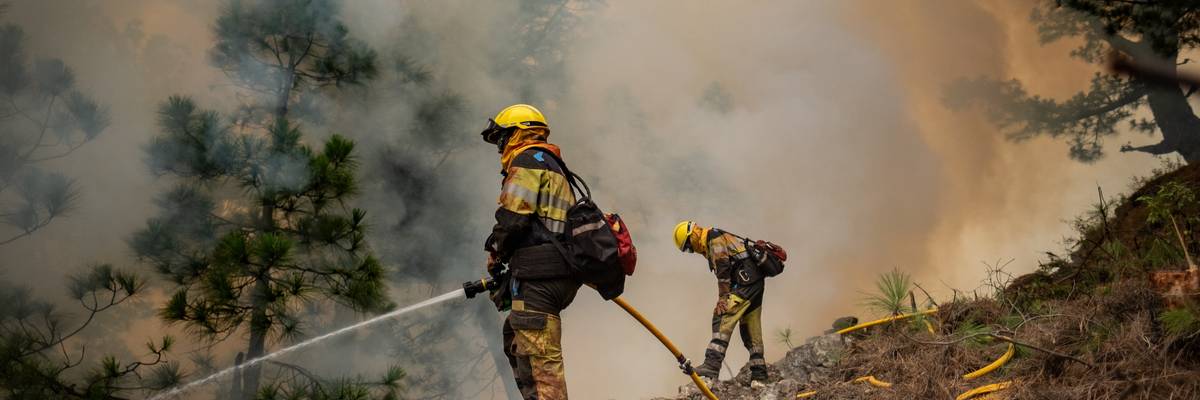
Firefighters work to put out a blaze in La Palma, one of Spain's Canary Islands, on July 16, 2023.
'The New Normal': Extreme Heat Imperils Millions Across Northern Hemisphere
"Getting off fossil fuels is the only way to stop this crisis from getting worse," said one campaigner.
Millions of people and ecosystems across the Northern Hemisphere continued to suffer Monday amid ongoing heatwaves exacerbated by the fossil fuel-driven climate emergency.
The "intolerable" conditions, some of which are detailed below, have reignited demands for far-reaching climate action. Meanwhile, many countries—including the wealthy ones most responsible for the greenhouse gas pollution causing increasingly common and severe extreme weather—are still permitting the increased production of planet-heating fossil fuels, ignoring the international scientific consensus and endangering societies and biodiversity around the globe.
Asia
China has confirmed the northwestern village of Sanbao reached 126°F on Sunday. This marks the hottest temperature ever recorded in the country, with little relief in sight this week. Fears are growing of a potential repeat of last year's historic drought. Elsewhere in the country, Typhoon Talim became the first to make landfall this year.
The Persian Gulf International Airport in Iran reported a heat index of 152°F on Sunday. This is the brutal result of a 104°F temperature combined with 65% relative humidity and approaches the limits of human survivability.
Japanese officials have reportedly issued heatstroke alerts for tens of millions of people residing in 20 of the country's 47 jurisdictions.
In South Korea, flooding and landslides provoked by monsoon rains killed at least 40 people over the weekend. Storms of this kind are growing in frequency and intensity as the warming atmosphere holds more moisture.
Europe
Several European nations continue to roast amid raging wildfires and a suffocating heatwave, already the third this summer. Many long-standing temperature records are expected to fall this week across Southern Europe.
Italian officials on Monday issued additional heat warnings as the islands of Sicily and Sardinia brace for temperatures of nearly 120°F in the coming days, possibly the hottest ever recorded in Europe.
"The heat is forecast to intensify by the middle of the week (July 19) in parts of the Mediterranean, including Greece and Turkey," the World Meteorological Organization (WMO) said Monday. "A further continuation into August is likely."
Wildfires burning near Athens prompted evacuations on Monday. Wildfires are also presently torching landscapes in Spain.
Research published last week revealed that last year's historically hot European summer killed more than 61,000 people across the continent.
North America
A second Canadian firefighter died Saturday as the country continues to battle hundreds of blazes during its worst-ever wildfire season—one that scientists say is inseparable from escalating heatwaves and droughts that leave behind large amounts of dry kindling.
Large swaths of the United States are also being pummeled by extreme weather, with roughly one-third of the country under heat warnings, wildfires burning, and multiple cities reeling in the aftermath of climate change-intensified floods. Temperatures in Death Valley along the California-Nevada border reached 128°F on Sunday, close to the area's likely all-time high of 130°F set in August 2020 and July 2021 (weather historians dispute the accuracy of a 134°F reading from 1913).
Fossil Free Media director Jamie Henn on Monday urged U.S. President Joe Biden to "declare a climate emergency and use the additional powers to rapidly scale renewables (and transmission lines) and stop new fossil fuel development."
"Getting off fossil fuels is the only way to stop this crisis from getting worse," he added.
Climate scientists said that last month was the hottest June since scientists began record-keeping in the 1880s. With its blistering start, this July is on track to shatter the monthly record set just years ago. The recent arrival of El Niño conditions is projected to make an already dangerous situation even worse, with the WMO warning earlier this month of "a likely surge in global temperatures and disruptive weather and climate patterns."
"In many parts of the world, today is predicted to be the hottest day on record," World Health Organization Director-General Tedros Adhanom Ghebreyesus tweeted Monday. "The climate crisis is not a warning. It's happening. I urge world leaders to act now."
"The struggle to avert systemic failure is the struggle between democracy and plutocracy. It always has been, but the stakes are now higher than ever."
U.S. climate envoy John Kerry arrived in Beijing on Monday for a series of talks with his Chinese counterpart Xie Zhenhua about four months ahead of the start of the United Nations' COP28 conference. The two diplomats—from the world's largest historic emitter of heat-trapping gases and its biggest current polluter, respectively—aim to discuss how their countries can jointly slash methane emissions and coal-fired power.
"In the next three days," Kerry said, "we hope we can begin taking some big steps that will send a signal to the world about the serious purpose of China and the United States to address a common risk, threat, challenge to all of humanity created by humans themselves."
But not all humans have played an equal role in creating or perpetuating the climate emergency.
Since raking in hundreds of billions of dollars in profits in 2022, oil and gas giants—which knowingly suppressed warnings about the climate crisis for decades—have reneged on their emission reduction targets and made clear they intend to expand drilling operations in the coming years. Policymakers have shown little willingness to stop them, as COP27 ended with no commitment to phase out fossil fuels.
On Saturday, The Guardian columnist George Monbiot alluded to overlooked new research sounding the alarm about the growing risk of simultaneous crop losses in the world's major growing regions due to climate breakdown and argued forcefully that "the struggle to avert systemic failure is the struggle between democracy and plutocracy."
"It always has been," he added, "but the stakes are now higher than ever."
On Monday, WMO Secretary-General Petteri Taalas similarly stressed that "extreme weather—an increasingly frequent occurrence in our warming climate—is having a major impact on human health, ecosystems, economies, agriculture, energy, and water supplies."
"This underlines the increasing urgency of cutting greenhouse gas emissions as quickly and as deeply as possible," said Taalas. "In addition, we have to step up efforts to help society adapt to what is unfortunately becoming the new normal."
We are at a crossroads
This country and this world are at a monumental crossroads. In a few short weeks, US voters will have an opportunity to beat back the forces of fascism and confront the billionaires who are rigging the economy, our media system, and our democracy, making it increasingly impossible for ordinary people to get by. We’re not just talking about the election. We’re talking about what must be done once these fascist elements are vanquished from power. We need a bolder set of solutions than what either major party has so far been willing to offer and a working-class movement ready to fight like hell for it. Trump didn't emerge from nowhere. The conditions that fueled MAGA authoritarianism were created by decades of radical neoliberal economic policies and a corrupt political system dominated by corporate interests. They slashed taxes on the super-rich, promising that the benefits would trickle down. They said giveaways to the corporate titans would make life more affordable for the rest of us. It was all bullshit. And when a bitter, betrayed populace searches for someone to blame, right-wing demagogues have little trouble finding scapegoats. People know when they're being lied to, but you won't hear any of this from the corporate media. Only independent journalism—powered and funded by people who believe in building a better world—can deliver truly trustworthy daily news. Our Fall Campaign is underway, and we need your help. To power our newsroom through the rest of the year, we need to raise $125,000 by midnight on October 31. So if you share our vision, please contribute whatever you can to sustain our work. |
Millions of people and ecosystems across the Northern Hemisphere continued to suffer Monday amid ongoing heatwaves exacerbated by the fossil fuel-driven climate emergency.
The "intolerable" conditions, some of which are detailed below, have reignited demands for far-reaching climate action. Meanwhile, many countries—including the wealthy ones most responsible for the greenhouse gas pollution causing increasingly common and severe extreme weather—are still permitting the increased production of planet-heating fossil fuels, ignoring the international scientific consensus and endangering societies and biodiversity around the globe.
Asia
China has confirmed the northwestern village of Sanbao reached 126°F on Sunday. This marks the hottest temperature ever recorded in the country, with little relief in sight this week. Fears are growing of a potential repeat of last year's historic drought. Elsewhere in the country, Typhoon Talim became the first to make landfall this year.
The Persian Gulf International Airport in Iran reported a heat index of 152°F on Sunday. This is the brutal result of a 104°F temperature combined with 65% relative humidity and approaches the limits of human survivability.
Japanese officials have reportedly issued heatstroke alerts for tens of millions of people residing in 20 of the country's 47 jurisdictions.
In South Korea, flooding and landslides provoked by monsoon rains killed at least 40 people over the weekend. Storms of this kind are growing in frequency and intensity as the warming atmosphere holds more moisture.
Europe
Several European nations continue to roast amid raging wildfires and a suffocating heatwave, already the third this summer. Many long-standing temperature records are expected to fall this week across Southern Europe.
Italian officials on Monday issued additional heat warnings as the islands of Sicily and Sardinia brace for temperatures of nearly 120°F in the coming days, possibly the hottest ever recorded in Europe.
"The heat is forecast to intensify by the middle of the week (July 19) in parts of the Mediterranean, including Greece and Turkey," the World Meteorological Organization (WMO) said Monday. "A further continuation into August is likely."
Wildfires burning near Athens prompted evacuations on Monday. Wildfires are also presently torching landscapes in Spain.
Research published last week revealed that last year's historically hot European summer killed more than 61,000 people across the continent.
North America
A second Canadian firefighter died Saturday as the country continues to battle hundreds of blazes during its worst-ever wildfire season—one that scientists say is inseparable from escalating heatwaves and droughts that leave behind large amounts of dry kindling.
Large swaths of the United States are also being pummeled by extreme weather, with roughly one-third of the country under heat warnings, wildfires burning, and multiple cities reeling in the aftermath of climate change-intensified floods. Temperatures in Death Valley along the California-Nevada border reached 128°F on Sunday, close to the area's likely all-time high of 130°F set in August 2020 and July 2021 (weather historians dispute the accuracy of a 134°F reading from 1913).
Fossil Free Media director Jamie Henn on Monday urged U.S. President Joe Biden to "declare a climate emergency and use the additional powers to rapidly scale renewables (and transmission lines) and stop new fossil fuel development."
"Getting off fossil fuels is the only way to stop this crisis from getting worse," he added.
Climate scientists said that last month was the hottest June since scientists began record-keeping in the 1880s. With its blistering start, this July is on track to shatter the monthly record set just years ago. The recent arrival of El Niño conditions is projected to make an already dangerous situation even worse, with the WMO warning earlier this month of "a likely surge in global temperatures and disruptive weather and climate patterns."
"In many parts of the world, today is predicted to be the hottest day on record," World Health Organization Director-General Tedros Adhanom Ghebreyesus tweeted Monday. "The climate crisis is not a warning. It's happening. I urge world leaders to act now."
"The struggle to avert systemic failure is the struggle between democracy and plutocracy. It always has been, but the stakes are now higher than ever."
U.S. climate envoy John Kerry arrived in Beijing on Monday for a series of talks with his Chinese counterpart Xie Zhenhua about four months ahead of the start of the United Nations' COP28 conference. The two diplomats—from the world's largest historic emitter of heat-trapping gases and its biggest current polluter, respectively—aim to discuss how their countries can jointly slash methane emissions and coal-fired power.
"In the next three days," Kerry said, "we hope we can begin taking some big steps that will send a signal to the world about the serious purpose of China and the United States to address a common risk, threat, challenge to all of humanity created by humans themselves."
But not all humans have played an equal role in creating or perpetuating the climate emergency.
Since raking in hundreds of billions of dollars in profits in 2022, oil and gas giants—which knowingly suppressed warnings about the climate crisis for decades—have reneged on their emission reduction targets and made clear they intend to expand drilling operations in the coming years. Policymakers have shown little willingness to stop them, as COP27 ended with no commitment to phase out fossil fuels.
On Saturday, The Guardian columnist George Monbiot alluded to overlooked new research sounding the alarm about the growing risk of simultaneous crop losses in the world's major growing regions due to climate breakdown and argued forcefully that "the struggle to avert systemic failure is the struggle between democracy and plutocracy."
"It always has been," he added, "but the stakes are now higher than ever."
On Monday, WMO Secretary-General Petteri Taalas similarly stressed that "extreme weather—an increasingly frequent occurrence in our warming climate—is having a major impact on human health, ecosystems, economies, agriculture, energy, and water supplies."
"This underlines the increasing urgency of cutting greenhouse gas emissions as quickly and as deeply as possible," said Taalas. "In addition, we have to step up efforts to help society adapt to what is unfortunately becoming the new normal."
- 'We've Run Out of Time': Experts and Activists Urge Climate Action Amid Summer of Extremes ›
- Opinion | There Is No New Climate Normal Until We Stop Burning Fossil Fuels | Common Dreams ›
- 'Unprecedented Heat': Iran Closes Offices and Schools as Temperatures Soar ›
- US Has Faced a Record 23 Billion-Dollar Extreme Weather Disasters in 2023 ›
- Amid Soaring Temps, Heat-Related Deaths Have More Than Doubled Since 1999 | Common Dreams ›
Millions of people and ecosystems across the Northern Hemisphere continued to suffer Monday amid ongoing heatwaves exacerbated by the fossil fuel-driven climate emergency.
The "intolerable" conditions, some of which are detailed below, have reignited demands for far-reaching climate action. Meanwhile, many countries—including the wealthy ones most responsible for the greenhouse gas pollution causing increasingly common and severe extreme weather—are still permitting the increased production of planet-heating fossil fuels, ignoring the international scientific consensus and endangering societies and biodiversity around the globe.
Asia
China has confirmed the northwestern village of Sanbao reached 126°F on Sunday. This marks the hottest temperature ever recorded in the country, with little relief in sight this week. Fears are growing of a potential repeat of last year's historic drought. Elsewhere in the country, Typhoon Talim became the first to make landfall this year.
The Persian Gulf International Airport in Iran reported a heat index of 152°F on Sunday. This is the brutal result of a 104°F temperature combined with 65% relative humidity and approaches the limits of human survivability.
Japanese officials have reportedly issued heatstroke alerts for tens of millions of people residing in 20 of the country's 47 jurisdictions.
In South Korea, flooding and landslides provoked by monsoon rains killed at least 40 people over the weekend. Storms of this kind are growing in frequency and intensity as the warming atmosphere holds more moisture.
Europe
Several European nations continue to roast amid raging wildfires and a suffocating heatwave, already the third this summer. Many long-standing temperature records are expected to fall this week across Southern Europe.
Italian officials on Monday issued additional heat warnings as the islands of Sicily and Sardinia brace for temperatures of nearly 120°F in the coming days, possibly the hottest ever recorded in Europe.
"The heat is forecast to intensify by the middle of the week (July 19) in parts of the Mediterranean, including Greece and Turkey," the World Meteorological Organization (WMO) said Monday. "A further continuation into August is likely."
Wildfires burning near Athens prompted evacuations on Monday. Wildfires are also presently torching landscapes in Spain.
Research published last week revealed that last year's historically hot European summer killed more than 61,000 people across the continent.
North America
A second Canadian firefighter died Saturday as the country continues to battle hundreds of blazes during its worst-ever wildfire season—one that scientists say is inseparable from escalating heatwaves and droughts that leave behind large amounts of dry kindling.
Large swaths of the United States are also being pummeled by extreme weather, with roughly one-third of the country under heat warnings, wildfires burning, and multiple cities reeling in the aftermath of climate change-intensified floods. Temperatures in Death Valley along the California-Nevada border reached 128°F on Sunday, close to the area's likely all-time high of 130°F set in August 2020 and July 2021 (weather historians dispute the accuracy of a 134°F reading from 1913).
Fossil Free Media director Jamie Henn on Monday urged U.S. President Joe Biden to "declare a climate emergency and use the additional powers to rapidly scale renewables (and transmission lines) and stop new fossil fuel development."
"Getting off fossil fuels is the only way to stop this crisis from getting worse," he added.
Climate scientists said that last month was the hottest June since scientists began record-keeping in the 1880s. With its blistering start, this July is on track to shatter the monthly record set just years ago. The recent arrival of El Niño conditions is projected to make an already dangerous situation even worse, with the WMO warning earlier this month of "a likely surge in global temperatures and disruptive weather and climate patterns."
"In many parts of the world, today is predicted to be the hottest day on record," World Health Organization Director-General Tedros Adhanom Ghebreyesus tweeted Monday. "The climate crisis is not a warning. It's happening. I urge world leaders to act now."
"The struggle to avert systemic failure is the struggle between democracy and plutocracy. It always has been, but the stakes are now higher than ever."
U.S. climate envoy John Kerry arrived in Beijing on Monday for a series of talks with his Chinese counterpart Xie Zhenhua about four months ahead of the start of the United Nations' COP28 conference. The two diplomats—from the world's largest historic emitter of heat-trapping gases and its biggest current polluter, respectively—aim to discuss how their countries can jointly slash methane emissions and coal-fired power.
"In the next three days," Kerry said, "we hope we can begin taking some big steps that will send a signal to the world about the serious purpose of China and the United States to address a common risk, threat, challenge to all of humanity created by humans themselves."
But not all humans have played an equal role in creating or perpetuating the climate emergency.
Since raking in hundreds of billions of dollars in profits in 2022, oil and gas giants—which knowingly suppressed warnings about the climate crisis for decades—have reneged on their emission reduction targets and made clear they intend to expand drilling operations in the coming years. Policymakers have shown little willingness to stop them, as COP27 ended with no commitment to phase out fossil fuels.
On Saturday, The Guardian columnist George Monbiot alluded to overlooked new research sounding the alarm about the growing risk of simultaneous crop losses in the world's major growing regions due to climate breakdown and argued forcefully that "the struggle to avert systemic failure is the struggle between democracy and plutocracy."
"It always has been," he added, "but the stakes are now higher than ever."
On Monday, WMO Secretary-General Petteri Taalas similarly stressed that "extreme weather—an increasingly frequent occurrence in our warming climate—is having a major impact on human health, ecosystems, economies, agriculture, energy, and water supplies."
"This underlines the increasing urgency of cutting greenhouse gas emissions as quickly and as deeply as possible," said Taalas. "In addition, we have to step up efforts to help society adapt to what is unfortunately becoming the new normal."
- 'We've Run Out of Time': Experts and Activists Urge Climate Action Amid Summer of Extremes ›
- Opinion | There Is No New Climate Normal Until We Stop Burning Fossil Fuels | Common Dreams ›
- 'Unprecedented Heat': Iran Closes Offices and Schools as Temperatures Soar ›
- US Has Faced a Record 23 Billion-Dollar Extreme Weather Disasters in 2023 ›
- Amid Soaring Temps, Heat-Related Deaths Have More Than Doubled Since 1999 | Common Dreams ›