SUBSCRIBE TO OUR FREE NEWSLETTER
Daily news & progressive opinion—funded by the people, not the corporations—delivered straight to your inbox.
5
#000000
#FFFFFF
To donate by check, phone, or other method, see our More Ways to Give page.
Daily news & progressive opinion—funded by the people, not the corporations—delivered straight to your inbox.
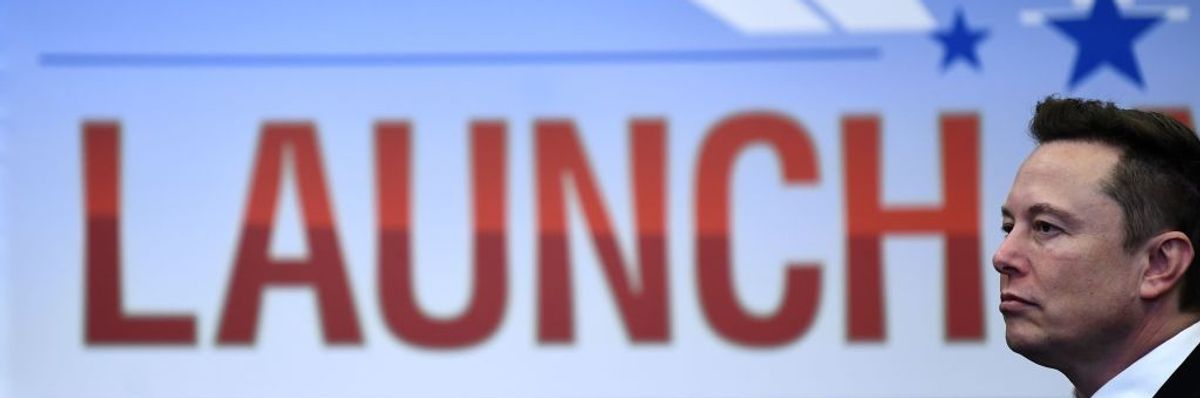
Elon Musk looks on as then-U.S. President Donald Trump attends SpaceX launch at the Kennedy Space Center in Florida on May 27, 2020.
"If you did not believe he was maniacal or evil, before this, well now you know," said a former congresswoman.
A super political action committee connected to billionaire Elon Musk is not only working to elect Republicans including former President Donald Trump but also collecting voter information in battleground states via a method that is setting off alarm bells, CNBC reported Friday.
CNBC political finance reporter Brian Schwartz explained how an online America PAC advertisement featuring footage of the recent assassination attempt targeting Trump sends viewers to different websites depending on their location.
"If a user lives in a state that is not considered competitive in the presidential election, like California or Wyoming for example, they'll be prompted to enter their email addresses and ZIP code and then directed quickly to a voter registration page for their state, or back to the original sign up section," he reported. "But for users who enter a ZIP code that indicates they live in a battleground state, like Pennsylvania or Georgia, the process is very different."
"Rather than be directed to their state's voter registration page, they instead are directed to a highly detailed personal information form, prompted to enter their address, cell phone number, and age," according to Schwartz. "If they agree to submit all that, the system still does not steer them to a voter registration page. Instead, it shows them a 'thank you' page."
One user on X—the Musk-owned social media platform formerly called Twitter—trialed the process and shared related screenshots:
"How is this legal!?" Veni Kunche of Diversify Tech asked on X in response to the reporting. "America PAC is misleading voters."
Georgetown University professor Don Moynihan also raised legal concerns, saying, "Getting people's personal information on the promise of helping them to register to vote, and then not helping them to register to vote definitely seems like election fraud."
Retired journalist Mary Beth Schneider said: "Scamming people into thinking they registered to vote? This should be illegal."
Jodi Jacobson, founder and executive director of Healthcare Across Borders, called for a federal investigation.
"Is anyone actually working over there?" she asked the U.S. Department of Justice on X. "Because here is something you should be investigating. Now."
Ciara Torres-Spelliscy, a professor at Stetson University College of Law in Florida and fellow at the Brennan Center for Justice at the New York University School of Law, criticized the super PAC and offered guidance on registering to vote in the United States.
"This is so shitty," she said of the group's actions. "To avoid... a fake registration webpage problem: Google your local board of elections and register directly through them. Typically your local board of elections is the name of the county you live in and 'board of elections.'"
Former Congresswoman Marie Newman (D-Ill.) took aim at Musk, saying, "If you did not believe he was maniacal or evil, before this, well now you know."
While a spokesperson for America PAC declined to comment and Musk did not reply to Schwartz's emails, the billionaire confirmed he created the political group during a July 22 video interview on X with right-wing commentator Jordan Peterson. Musk also denied a recent Wall Street Journal report that he is putting $45 million a month toward sending Trump back to the White House.
"I am making some donations to America PAC, but at a much lower level and the key values of the PAC are supporting a meritocracy and individual freedom," Musk wrote on X the following day. "Republicans are mostly, but not entirely, on the side of merit and freedom."
Super PACs are not subject to the same legal restrictions as campaigns and traditional political committees; they can raise and spend unlimited amounts of money from individuals, corporations, and groups. There are limits for coordinating with campaigns, but they can coordinate on canvassing, thanks to a Federal Election Commission advisory opinion from earlier this year.
America PAC has already raised millions of dollars, with donations from venture capitalists and cryptocurrency investors.
Last month, Sen. Bernie Sanders (I-Vt.) publicly thanked Musk for doing "an exceptional job of demonstrating a point that we have made for years—and that is the fact we live in an oligarchic society in which billionaires dominate not only our economic life and the information we consume, but our politics as well."
As
The New York Times detailed Thursday, America PAC is off to "a rocky start" and now "shaking up its field operation." Still, the group's potential impact on the presidential election—in which Trump is expected to face Democratic Vice President Kamala Harris—is generating concerns, particularly given the new revelations from CNBC.
Dear Common Dreams reader, It’s been nearly 30 years since I co-founded Common Dreams with my late wife, Lina Newhouser. We had the radical notion that journalism should serve the public good, not corporate profits. It was clear to us from the outset what it would take to build such a project. No paid advertisements. No corporate sponsors. No millionaire publisher telling us what to think or do. Many people said we wouldn't last a year, but we proved those doubters wrong. Together with a tremendous team of journalists and dedicated staff, we built an independent media outlet free from the constraints of profits and corporate control. Our mission has always been simple: To inform. To inspire. To ignite change for the common good. Building Common Dreams was not easy. Our survival was never guaranteed. When you take on the most powerful forces—Wall Street greed, fossil fuel industry destruction, Big Tech lobbyists, and uber-rich oligarchs who have spent billions upon billions rigging the economy and democracy in their favor—the only bulwark you have is supporters who believe in your work. But here’s the urgent message from me today. It's never been this bad out there. And it's never been this hard to keep us going. At the very moment Common Dreams is most needed, the threats we face are intensifying. We need your support now more than ever. We don't accept corporate advertising and never will. We don't have a paywall because we don't think people should be blocked from critical news based on their ability to pay. Everything we do is funded by the donations of readers like you. When everyone does the little they can afford, we are strong. But if that support retreats or dries up, so do we. Will you donate now to make sure Common Dreams not only survives but thrives? —Craig Brown, Co-founder |
A super political action committee connected to billionaire Elon Musk is not only working to elect Republicans including former President Donald Trump but also collecting voter information in battleground states via a method that is setting off alarm bells, CNBC reported Friday.
CNBC political finance reporter Brian Schwartz explained how an online America PAC advertisement featuring footage of the recent assassination attempt targeting Trump sends viewers to different websites depending on their location.
"If a user lives in a state that is not considered competitive in the presidential election, like California or Wyoming for example, they'll be prompted to enter their email addresses and ZIP code and then directed quickly to a voter registration page for their state, or back to the original sign up section," he reported. "But for users who enter a ZIP code that indicates they live in a battleground state, like Pennsylvania or Georgia, the process is very different."
"Rather than be directed to their state's voter registration page, they instead are directed to a highly detailed personal information form, prompted to enter their address, cell phone number, and age," according to Schwartz. "If they agree to submit all that, the system still does not steer them to a voter registration page. Instead, it shows them a 'thank you' page."
One user on X—the Musk-owned social media platform formerly called Twitter—trialed the process and shared related screenshots:
"How is this legal!?" Veni Kunche of Diversify Tech asked on X in response to the reporting. "America PAC is misleading voters."
Georgetown University professor Don Moynihan also raised legal concerns, saying, "Getting people's personal information on the promise of helping them to register to vote, and then not helping them to register to vote definitely seems like election fraud."
Retired journalist Mary Beth Schneider said: "Scamming people into thinking they registered to vote? This should be illegal."
Jodi Jacobson, founder and executive director of Healthcare Across Borders, called for a federal investigation.
"Is anyone actually working over there?" she asked the U.S. Department of Justice on X. "Because here is something you should be investigating. Now."
Ciara Torres-Spelliscy, a professor at Stetson University College of Law in Florida and fellow at the Brennan Center for Justice at the New York University School of Law, criticized the super PAC and offered guidance on registering to vote in the United States.
"This is so shitty," she said of the group's actions. "To avoid... a fake registration webpage problem: Google your local board of elections and register directly through them. Typically your local board of elections is the name of the county you live in and 'board of elections.'"
Former Congresswoman Marie Newman (D-Ill.) took aim at Musk, saying, "If you did not believe he was maniacal or evil, before this, well now you know."
While a spokesperson for America PAC declined to comment and Musk did not reply to Schwartz's emails, the billionaire confirmed he created the political group during a July 22 video interview on X with right-wing commentator Jordan Peterson. Musk also denied a recent Wall Street Journal report that he is putting $45 million a month toward sending Trump back to the White House.
"I am making some donations to America PAC, but at a much lower level and the key values of the PAC are supporting a meritocracy and individual freedom," Musk wrote on X the following day. "Republicans are mostly, but not entirely, on the side of merit and freedom."
Super PACs are not subject to the same legal restrictions as campaigns and traditional political committees; they can raise and spend unlimited amounts of money from individuals, corporations, and groups. There are limits for coordinating with campaigns, but they can coordinate on canvassing, thanks to a Federal Election Commission advisory opinion from earlier this year.
America PAC has already raised millions of dollars, with donations from venture capitalists and cryptocurrency investors.
Last month, Sen. Bernie Sanders (I-Vt.) publicly thanked Musk for doing "an exceptional job of demonstrating a point that we have made for years—and that is the fact we live in an oligarchic society in which billionaires dominate not only our economic life and the information we consume, but our politics as well."
As
The New York Times detailed Thursday, America PAC is off to "a rocky start" and now "shaking up its field operation." Still, the group's potential impact on the presidential election—in which Trump is expected to face Democratic Vice President Kamala Harris—is generating concerns, particularly given the new revelations from CNBC.
A super political action committee connected to billionaire Elon Musk is not only working to elect Republicans including former President Donald Trump but also collecting voter information in battleground states via a method that is setting off alarm bells, CNBC reported Friday.
CNBC political finance reporter Brian Schwartz explained how an online America PAC advertisement featuring footage of the recent assassination attempt targeting Trump sends viewers to different websites depending on their location.
"If a user lives in a state that is not considered competitive in the presidential election, like California or Wyoming for example, they'll be prompted to enter their email addresses and ZIP code and then directed quickly to a voter registration page for their state, or back to the original sign up section," he reported. "But for users who enter a ZIP code that indicates they live in a battleground state, like Pennsylvania or Georgia, the process is very different."
"Rather than be directed to their state's voter registration page, they instead are directed to a highly detailed personal information form, prompted to enter their address, cell phone number, and age," according to Schwartz. "If they agree to submit all that, the system still does not steer them to a voter registration page. Instead, it shows them a 'thank you' page."
One user on X—the Musk-owned social media platform formerly called Twitter—trialed the process and shared related screenshots:
"How is this legal!?" Veni Kunche of Diversify Tech asked on X in response to the reporting. "America PAC is misleading voters."
Georgetown University professor Don Moynihan also raised legal concerns, saying, "Getting people's personal information on the promise of helping them to register to vote, and then not helping them to register to vote definitely seems like election fraud."
Retired journalist Mary Beth Schneider said: "Scamming people into thinking they registered to vote? This should be illegal."
Jodi Jacobson, founder and executive director of Healthcare Across Borders, called for a federal investigation.
"Is anyone actually working over there?" she asked the U.S. Department of Justice on X. "Because here is something you should be investigating. Now."
Ciara Torres-Spelliscy, a professor at Stetson University College of Law in Florida and fellow at the Brennan Center for Justice at the New York University School of Law, criticized the super PAC and offered guidance on registering to vote in the United States.
"This is so shitty," she said of the group's actions. "To avoid... a fake registration webpage problem: Google your local board of elections and register directly through them. Typically your local board of elections is the name of the county you live in and 'board of elections.'"
Former Congresswoman Marie Newman (D-Ill.) took aim at Musk, saying, "If you did not believe he was maniacal or evil, before this, well now you know."
While a spokesperson for America PAC declined to comment and Musk did not reply to Schwartz's emails, the billionaire confirmed he created the political group during a July 22 video interview on X with right-wing commentator Jordan Peterson. Musk also denied a recent Wall Street Journal report that he is putting $45 million a month toward sending Trump back to the White House.
"I am making some donations to America PAC, but at a much lower level and the key values of the PAC are supporting a meritocracy and individual freedom," Musk wrote on X the following day. "Republicans are mostly, but not entirely, on the side of merit and freedom."
Super PACs are not subject to the same legal restrictions as campaigns and traditional political committees; they can raise and spend unlimited amounts of money from individuals, corporations, and groups. There are limits for coordinating with campaigns, but they can coordinate on canvassing, thanks to a Federal Election Commission advisory opinion from earlier this year.
America PAC has already raised millions of dollars, with donations from venture capitalists and cryptocurrency investors.
Last month, Sen. Bernie Sanders (I-Vt.) publicly thanked Musk for doing "an exceptional job of demonstrating a point that we have made for years—and that is the fact we live in an oligarchic society in which billionaires dominate not only our economic life and the information we consume, but our politics as well."
As
The New York Times detailed Thursday, America PAC is off to "a rocky start" and now "shaking up its field operation." Still, the group's potential impact on the presidential election—in which Trump is expected to face Democratic Vice President Kamala Harris—is generating concerns, particularly given the new revelations from CNBC.