SUBSCRIBE TO OUR FREE NEWSLETTER
Daily news & progressive opinion—funded by the people, not the corporations—delivered straight to your inbox.
5
#000000
#FFFFFF
To donate by check, phone, or other method, see our More Ways to Give page.
Daily news & progressive opinion—funded by the people, not the corporations—delivered straight to your inbox.
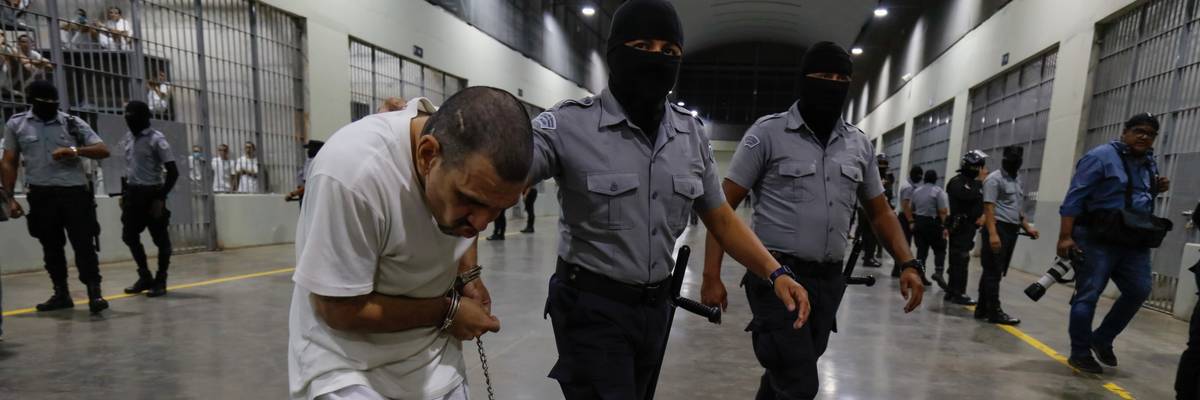
An inmate is escorted by a guard at a counter-terrorism confinement center on February 6, 2024 in San Vicente, El Salvador.
"Reducing gang violence by replacing it with state violence cannot be a success," said one Amnesty International official.
Two years after Salvadoran President Nayib Bukele declared a "state of exception" that was originally adopted for a 30-day period in response for a spate of apparent gang killings, the government is boasting that its policies have driven down the homicide rate by 70%—but international rights defenders on Wednesday warned the crackdown has plunged the country into a human rights crisis.
Amnesty International said that according to local victims' movements and human rights groups, El Salvador's former murder rate has been replaced by 327 cases of forced disappearances since March 2022, as well as 78,000 arbitrary detentions as police have raided neighborhoods, particularly in low-income areas.
"A total of approximately 102,000 people [are] now deprived of their freedom in the country—a situation of prison overcrowding of approximately 148% percent and at least 235 deaths in state custody," said Amnesty.
Bukele adopted the state of emergency after El Salvador reported its deadliest peak in apparent gang violence in recent history, with gangs blamed for 92 people's deaths over three days in March 2022.
Under the emergency order, authorities have suspended the right to privacy in communications, to be informed of the reason for one's arrest, and to be taken before a judge within 72 hours of an arrest. A report by Human Rights Watch in December 2022 also warned of "torture, or other cruel, inhumane, or degrading treatment against people accused of crimes." Officers told people during arrests only that they were following "orders from the president," and in some cases, told people they were being taken to a police station for "questioning" when they were actually under arrest.
"The insistence of Nayib Bukele's government on maintaining the state of emergency, the adoption of disproportionate measures, and the denial, minimization, and concealment of reported serious human rights violations reflect the government's unwillingness to fulfill its duty to respect and promote human rights in the country," Ana Piquer, Amnesty International's Americas director, said Wednesday. "It also demonstrates its inability to design comprehensive long-term measures to address the root causes of violence and criminality without forcing the population to choose between security and freedom."
Amnesty's statement came a day after Justice and Security Minister Gustavo Villatoro said Bukele's government plans to continue its strategy to "eradicate this endemic evil."
"This war against these terrorists will continue," said Villatoro in a televised address.
Despite outcry from domestic and international human rights groups, Bukele won his reelection campaign in a landslide last month. El Faro reported that Bukele's government had violated some election rules including airing ads within three days of the election and campaigning on Election Day. Some poll workers also wore clothes identifying them as supporters of Bukele's Nueva Ideas party, and police allegedly blocked journalists from working near polling locations, prompting accusations of intimidation and harassment by the Association of Journalists of El Salvador.
The Due Process of Law Foundation released a report Tuesday warning that Bukele's government could be guilty of crimes against humanity as it continues its crackdown.
"Well over 76,000 people, including minors, have been detained under the state of exception, accused of having ties to gangs," wrote the group. "Many or most of these detentions appear to be occurring without any reasonable grounds for suspecting that the person may have committed a crime. Mere physical appearance—including having tattoos—seems to be enough to put people at risk of arrest, with young men from poor districts a particular target. Arrests of this nature are in themselves discriminatory, and may well qualify as arbitrary. According to the United Nations Working Group on Arbitrary Detention, under customary
international law, 'The legal basis justifying... detention must be accessible, understandable, nonretroactive, and applied in a consistent and predictable way.'"
Amnesty noted on Wednesday that human rights defenders and dissidents also face "increased risk" under the state of emergency, "as they are criminalized." As Common Dreams reported this week, five water defenders are scheduled to stand trial on April 3 for allegedly killing a military informant, an accusation for which the government has produced no proof.
"In the absence of any kind of evaluation and checks and balances within the country, and with only a timid response from the international community, the false illusion has been created that President Bukele has found the magic formula to solve the very complex problems of violence and criminality in a seemingly simple way. But reducing gang violence by replacing it with state violence cannot be a success," said Piquer. "The authorities in El Salvador must focus the state response on comprehensive policies that respect human rights and seek long-term solutions."
"The international community," she added, "must respond in a robust, articulate and forceful manner, condemning any model of public security that is based on human rights violations."
Dear Common Dreams reader, It’s been nearly 30 years since I co-founded Common Dreams with my late wife, Lina Newhouser. We had the radical notion that journalism should serve the public good, not corporate profits. It was clear to us from the outset what it would take to build such a project. No paid advertisements. No corporate sponsors. No millionaire publisher telling us what to think or do. Many people said we wouldn't last a year, but we proved those doubters wrong. Together with a tremendous team of journalists and dedicated staff, we built an independent media outlet free from the constraints of profits and corporate control. Our mission has always been simple: To inform. To inspire. To ignite change for the common good. Building Common Dreams was not easy. Our survival was never guaranteed. When you take on the most powerful forces—Wall Street greed, fossil fuel industry destruction, Big Tech lobbyists, and uber-rich oligarchs who have spent billions upon billions rigging the economy and democracy in their favor—the only bulwark you have is supporters who believe in your work. But here’s the urgent message from me today. It's never been this bad out there. And it's never been this hard to keep us going. At the very moment Common Dreams is most needed, the threats we face are intensifying. We need your support now more than ever. We don't accept corporate advertising and never will. We don't have a paywall because we don't think people should be blocked from critical news based on their ability to pay. Everything we do is funded by the donations of readers like you. When everyone does the little they can afford, we are strong. But if that support retreats or dries up, so do we. Will you donate now to make sure Common Dreams not only survives but thrives? —Craig Brown, Co-founder |
Two years after Salvadoran President Nayib Bukele declared a "state of exception" that was originally adopted for a 30-day period in response for a spate of apparent gang killings, the government is boasting that its policies have driven down the homicide rate by 70%—but international rights defenders on Wednesday warned the crackdown has plunged the country into a human rights crisis.
Amnesty International said that according to local victims' movements and human rights groups, El Salvador's former murder rate has been replaced by 327 cases of forced disappearances since March 2022, as well as 78,000 arbitrary detentions as police have raided neighborhoods, particularly in low-income areas.
"A total of approximately 102,000 people [are] now deprived of their freedom in the country—a situation of prison overcrowding of approximately 148% percent and at least 235 deaths in state custody," said Amnesty.
Bukele adopted the state of emergency after El Salvador reported its deadliest peak in apparent gang violence in recent history, with gangs blamed for 92 people's deaths over three days in March 2022.
Under the emergency order, authorities have suspended the right to privacy in communications, to be informed of the reason for one's arrest, and to be taken before a judge within 72 hours of an arrest. A report by Human Rights Watch in December 2022 also warned of "torture, or other cruel, inhumane, or degrading treatment against people accused of crimes." Officers told people during arrests only that they were following "orders from the president," and in some cases, told people they were being taken to a police station for "questioning" when they were actually under arrest.
"The insistence of Nayib Bukele's government on maintaining the state of emergency, the adoption of disproportionate measures, and the denial, minimization, and concealment of reported serious human rights violations reflect the government's unwillingness to fulfill its duty to respect and promote human rights in the country," Ana Piquer, Amnesty International's Americas director, said Wednesday. "It also demonstrates its inability to design comprehensive long-term measures to address the root causes of violence and criminality without forcing the population to choose between security and freedom."
Amnesty's statement came a day after Justice and Security Minister Gustavo Villatoro said Bukele's government plans to continue its strategy to "eradicate this endemic evil."
"This war against these terrorists will continue," said Villatoro in a televised address.
Despite outcry from domestic and international human rights groups, Bukele won his reelection campaign in a landslide last month. El Faro reported that Bukele's government had violated some election rules including airing ads within three days of the election and campaigning on Election Day. Some poll workers also wore clothes identifying them as supporters of Bukele's Nueva Ideas party, and police allegedly blocked journalists from working near polling locations, prompting accusations of intimidation and harassment by the Association of Journalists of El Salvador.
The Due Process of Law Foundation released a report Tuesday warning that Bukele's government could be guilty of crimes against humanity as it continues its crackdown.
"Well over 76,000 people, including minors, have been detained under the state of exception, accused of having ties to gangs," wrote the group. "Many or most of these detentions appear to be occurring without any reasonable grounds for suspecting that the person may have committed a crime. Mere physical appearance—including having tattoos—seems to be enough to put people at risk of arrest, with young men from poor districts a particular target. Arrests of this nature are in themselves discriminatory, and may well qualify as arbitrary. According to the United Nations Working Group on Arbitrary Detention, under customary
international law, 'The legal basis justifying... detention must be accessible, understandable, nonretroactive, and applied in a consistent and predictable way.'"
Amnesty noted on Wednesday that human rights defenders and dissidents also face "increased risk" under the state of emergency, "as they are criminalized." As Common Dreams reported this week, five water defenders are scheduled to stand trial on April 3 for allegedly killing a military informant, an accusation for which the government has produced no proof.
"In the absence of any kind of evaluation and checks and balances within the country, and with only a timid response from the international community, the false illusion has been created that President Bukele has found the magic formula to solve the very complex problems of violence and criminality in a seemingly simple way. But reducing gang violence by replacing it with state violence cannot be a success," said Piquer. "The authorities in El Salvador must focus the state response on comprehensive policies that respect human rights and seek long-term solutions."
"The international community," she added, "must respond in a robust, articulate and forceful manner, condemning any model of public security that is based on human rights violations."
Two years after Salvadoran President Nayib Bukele declared a "state of exception" that was originally adopted for a 30-day period in response for a spate of apparent gang killings, the government is boasting that its policies have driven down the homicide rate by 70%—but international rights defenders on Wednesday warned the crackdown has plunged the country into a human rights crisis.
Amnesty International said that according to local victims' movements and human rights groups, El Salvador's former murder rate has been replaced by 327 cases of forced disappearances since March 2022, as well as 78,000 arbitrary detentions as police have raided neighborhoods, particularly in low-income areas.
"A total of approximately 102,000 people [are] now deprived of their freedom in the country—a situation of prison overcrowding of approximately 148% percent and at least 235 deaths in state custody," said Amnesty.
Bukele adopted the state of emergency after El Salvador reported its deadliest peak in apparent gang violence in recent history, with gangs blamed for 92 people's deaths over three days in March 2022.
Under the emergency order, authorities have suspended the right to privacy in communications, to be informed of the reason for one's arrest, and to be taken before a judge within 72 hours of an arrest. A report by Human Rights Watch in December 2022 also warned of "torture, or other cruel, inhumane, or degrading treatment against people accused of crimes." Officers told people during arrests only that they were following "orders from the president," and in some cases, told people they were being taken to a police station for "questioning" when they were actually under arrest.
"The insistence of Nayib Bukele's government on maintaining the state of emergency, the adoption of disproportionate measures, and the denial, minimization, and concealment of reported serious human rights violations reflect the government's unwillingness to fulfill its duty to respect and promote human rights in the country," Ana Piquer, Amnesty International's Americas director, said Wednesday. "It also demonstrates its inability to design comprehensive long-term measures to address the root causes of violence and criminality without forcing the population to choose between security and freedom."
Amnesty's statement came a day after Justice and Security Minister Gustavo Villatoro said Bukele's government plans to continue its strategy to "eradicate this endemic evil."
"This war against these terrorists will continue," said Villatoro in a televised address.
Despite outcry from domestic and international human rights groups, Bukele won his reelection campaign in a landslide last month. El Faro reported that Bukele's government had violated some election rules including airing ads within three days of the election and campaigning on Election Day. Some poll workers also wore clothes identifying them as supporters of Bukele's Nueva Ideas party, and police allegedly blocked journalists from working near polling locations, prompting accusations of intimidation and harassment by the Association of Journalists of El Salvador.
The Due Process of Law Foundation released a report Tuesday warning that Bukele's government could be guilty of crimes against humanity as it continues its crackdown.
"Well over 76,000 people, including minors, have been detained under the state of exception, accused of having ties to gangs," wrote the group. "Many or most of these detentions appear to be occurring without any reasonable grounds for suspecting that the person may have committed a crime. Mere physical appearance—including having tattoos—seems to be enough to put people at risk of arrest, with young men from poor districts a particular target. Arrests of this nature are in themselves discriminatory, and may well qualify as arbitrary. According to the United Nations Working Group on Arbitrary Detention, under customary
international law, 'The legal basis justifying... detention must be accessible, understandable, nonretroactive, and applied in a consistent and predictable way.'"
Amnesty noted on Wednesday that human rights defenders and dissidents also face "increased risk" under the state of emergency, "as they are criminalized." As Common Dreams reported this week, five water defenders are scheduled to stand trial on April 3 for allegedly killing a military informant, an accusation for which the government has produced no proof.
"In the absence of any kind of evaluation and checks and balances within the country, and with only a timid response from the international community, the false illusion has been created that President Bukele has found the magic formula to solve the very complex problems of violence and criminality in a seemingly simple way. But reducing gang violence by replacing it with state violence cannot be a success," said Piquer. "The authorities in El Salvador must focus the state response on comprehensive policies that respect human rights and seek long-term solutions."
"The international community," she added, "must respond in a robust, articulate and forceful manner, condemning any model of public security that is based on human rights violations."