SUBSCRIBE TO OUR FREE NEWSLETTER
Daily news & progressive opinion—funded by the people, not the corporations—delivered straight to your inbox.
5
#000000
#FFFFFF
To donate by check, phone, or other method, see our More Ways to Give page.
Daily news & progressive opinion—funded by the people, not the corporations—delivered straight to your inbox.
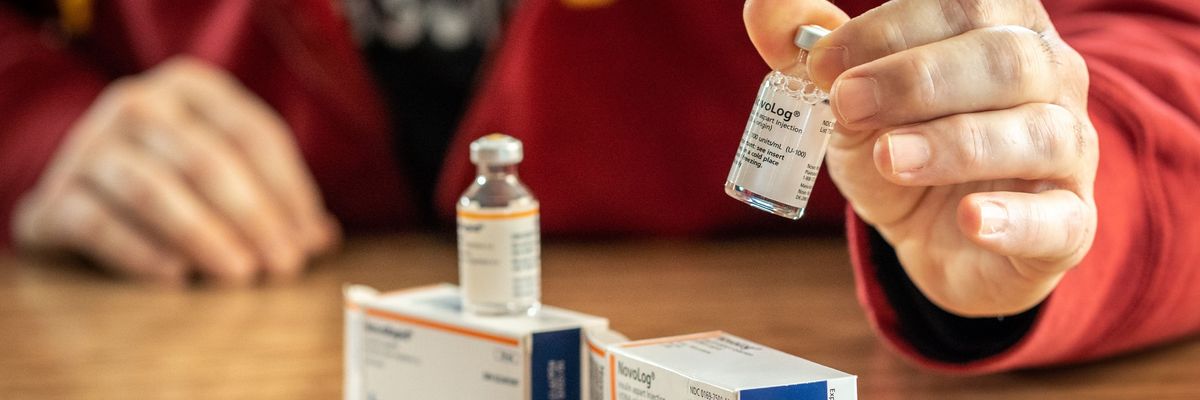
A man looks at NovoRapid, a Canadian insulin medication, and NovoLog, the U.S. version, at his house on January 16, 2020 in Eveleth, Minnesota.
The U.S. "has always accepted that we are the country that overpays relative to the rest of the world," said one health policy expert.
The Biden administration's Medicare drug price negotiations yielded lowered costs for 10 commonly used drugs, and the White House said last month that Americans would save an estimated $1.5 billion in out-of-pocket expenses thanks to the talks—but an analysis out Tuesday found that the U.S. will still be paying far more than other wealthy countries.
Reuters reviewed the maximum prices that Australia, Japan, Canada, and Sweden have agreed to pay for nine of the 10 drugs for which Medicare negotiated prices this year, and found that the U.S. will still be paying more than double the amount for the medications on average.
The new prices are set to go into effect on January 1, 2026, but two of the highest prices the U.S. will still pay are for Imbruvica, for blood cancers, and Stelara, for conditions including Crohn's disease and psoriasis.
Medicare will be charged $9,319 for a 30-day supply of the latter drug, compared to $4,607 in Sweden. For Stelara, the U.S. will pay $4,695 under the negotiated prices—more than four times the amount it costs in Sweden, Australia, and Canada.
For Enbrel, which treats conditions including arthritis, Medicare will pay $2,355 per month—far less than the list price of $7,106, but still more than $1,000 over what Sweden is charged: $709. Australia pays $573, while Canada pays $704, and Japan pays just over $300 for the drug.
"The government negotiations are especially significant for drugs where market forces were most limited and therefore had the least impact on producing price concessions."
Stacie Dusetzina, a professor of health policy at Vanderbilt University, told Reuters that the U.S. has "always accepted that we are the country that overpays relative to the rest of the world."
The analysis comes two weeks after the Brookings Institution published a review of the impact of the United States' first federal negotiations of prescription drug prices, finding that just three of the drugs which had little competition in the market accounted for more than half of the $6 billion the U.S. is expected to save in 2026.
"The government negotiations are especially significant for drugs where market forces were most limited and therefore had the least impact on producing price concessions," said Brookings.
Reuters noted that in other countries, prices generally come down over time, but U.S. drugmakers are able to raise prices annually and often extend patents by making small changes to medications, stopping less expensive generic versions from hitting the market and saving patients money.
Unlike in other wealthy countries, Johns Hopkins Bloomberg School of Public Health scientist Mariana Socal told Reuters, "the longer a drug is in the U.S. market, the more we pay."
With previous list prices well into the hundreds and thousands for the 10 drugs included in negotiations so far, Medicare agreed to pay close to $200 for a 30-day supply for drugs including Xarelto, Jardiance, and Farxiga—medications for which other governments examined by Reuters pay $78 or less, thanks to their longstanding negotiations.
The RAND Corporation found in a study in February that before the Medicare negotiations were included in the Inflation Reduction Act, U.S. health plans paid more than three times as much as other countries for brand-name drugs, even after discounts.
"A contributor to higher U.S. per capita drug spending is faster uptake of new and more expensive prescription drugs in the United States relative to other countries," wrote researchers at the London School of Economics in a study in 2013. "In contrast, the other OECD countries employed mechanisms such as health technology assessment and restrictions on patients' eligibility for new prescription drugs, and they required strict evidence of the value of new drugs."
The researchers suggested pharmaceutical companies in the U.S., like in other countries, should be required "to provide more evidence about the value of new drugs in relation to the cost" and negotiate prices accordingly.
As Merith Basey, executive director of Patients for Affordable Drugs, said in August after the results of the first round of negotiations were announced, advocates are still pushing for far more savings in upcoming talks between Medicare and drug manufacturers, which are expected to start next year.
"We remain committed to expanding the Medicare negotiation program to more drugs," said Basey last month, "and fighting for additional reforms to lower drug prices for all patients who need relief."
Dear Common Dreams reader, It’s been nearly 30 years since I co-founded Common Dreams with my late wife, Lina Newhouser. We had the radical notion that journalism should serve the public good, not corporate profits. It was clear to us from the outset what it would take to build such a project. No paid advertisements. No corporate sponsors. No millionaire publisher telling us what to think or do. Many people said we wouldn't last a year, but we proved those doubters wrong. Together with a tremendous team of journalists and dedicated staff, we built an independent media outlet free from the constraints of profits and corporate control. Our mission has always been simple: To inform. To inspire. To ignite change for the common good. Building Common Dreams was not easy. Our survival was never guaranteed. When you take on the most powerful forces—Wall Street greed, fossil fuel industry destruction, Big Tech lobbyists, and uber-rich oligarchs who have spent billions upon billions rigging the economy and democracy in their favor—the only bulwark you have is supporters who believe in your work. But here’s the urgent message from me today. It's never been this bad out there. And it's never been this hard to keep us going. At the very moment Common Dreams is most needed, the threats we face are intensifying. We need your support now more than ever. We don't accept corporate advertising and never will. We don't have a paywall because we don't think people should be blocked from critical news based on their ability to pay. Everything we do is funded by the donations of readers like you. When everyone does the little they can afford, we are strong. But if that support retreats or dries up, so do we. Will you donate now to make sure Common Dreams not only survives but thrives? —Craig Brown, Co-founder |
The Biden administration's Medicare drug price negotiations yielded lowered costs for 10 commonly used drugs, and the White House said last month that Americans would save an estimated $1.5 billion in out-of-pocket expenses thanks to the talks—but an analysis out Tuesday found that the U.S. will still be paying far more than other wealthy countries.
Reuters reviewed the maximum prices that Australia, Japan, Canada, and Sweden have agreed to pay for nine of the 10 drugs for which Medicare negotiated prices this year, and found that the U.S. will still be paying more than double the amount for the medications on average.
The new prices are set to go into effect on January 1, 2026, but two of the highest prices the U.S. will still pay are for Imbruvica, for blood cancers, and Stelara, for conditions including Crohn's disease and psoriasis.
Medicare will be charged $9,319 for a 30-day supply of the latter drug, compared to $4,607 in Sweden. For Stelara, the U.S. will pay $4,695 under the negotiated prices—more than four times the amount it costs in Sweden, Australia, and Canada.
For Enbrel, which treats conditions including arthritis, Medicare will pay $2,355 per month—far less than the list price of $7,106, but still more than $1,000 over what Sweden is charged: $709. Australia pays $573, while Canada pays $704, and Japan pays just over $300 for the drug.
"The government negotiations are especially significant for drugs where market forces were most limited and therefore had the least impact on producing price concessions."
Stacie Dusetzina, a professor of health policy at Vanderbilt University, told Reuters that the U.S. has "always accepted that we are the country that overpays relative to the rest of the world."
The analysis comes two weeks after the Brookings Institution published a review of the impact of the United States' first federal negotiations of prescription drug prices, finding that just three of the drugs which had little competition in the market accounted for more than half of the $6 billion the U.S. is expected to save in 2026.
"The government negotiations are especially significant for drugs where market forces were most limited and therefore had the least impact on producing price concessions," said Brookings.
Reuters noted that in other countries, prices generally come down over time, but U.S. drugmakers are able to raise prices annually and often extend patents by making small changes to medications, stopping less expensive generic versions from hitting the market and saving patients money.
Unlike in other wealthy countries, Johns Hopkins Bloomberg School of Public Health scientist Mariana Socal told Reuters, "the longer a drug is in the U.S. market, the more we pay."
With previous list prices well into the hundreds and thousands for the 10 drugs included in negotiations so far, Medicare agreed to pay close to $200 for a 30-day supply for drugs including Xarelto, Jardiance, and Farxiga—medications for which other governments examined by Reuters pay $78 or less, thanks to their longstanding negotiations.
The RAND Corporation found in a study in February that before the Medicare negotiations were included in the Inflation Reduction Act, U.S. health plans paid more than three times as much as other countries for brand-name drugs, even after discounts.
"A contributor to higher U.S. per capita drug spending is faster uptake of new and more expensive prescription drugs in the United States relative to other countries," wrote researchers at the London School of Economics in a study in 2013. "In contrast, the other OECD countries employed mechanisms such as health technology assessment and restrictions on patients' eligibility for new prescription drugs, and they required strict evidence of the value of new drugs."
The researchers suggested pharmaceutical companies in the U.S., like in other countries, should be required "to provide more evidence about the value of new drugs in relation to the cost" and negotiate prices accordingly.
As Merith Basey, executive director of Patients for Affordable Drugs, said in August after the results of the first round of negotiations were announced, advocates are still pushing for far more savings in upcoming talks between Medicare and drug manufacturers, which are expected to start next year.
"We remain committed to expanding the Medicare negotiation program to more drugs," said Basey last month, "and fighting for additional reforms to lower drug prices for all patients who need relief."
The Biden administration's Medicare drug price negotiations yielded lowered costs for 10 commonly used drugs, and the White House said last month that Americans would save an estimated $1.5 billion in out-of-pocket expenses thanks to the talks—but an analysis out Tuesday found that the U.S. will still be paying far more than other wealthy countries.
Reuters reviewed the maximum prices that Australia, Japan, Canada, and Sweden have agreed to pay for nine of the 10 drugs for which Medicare negotiated prices this year, and found that the U.S. will still be paying more than double the amount for the medications on average.
The new prices are set to go into effect on January 1, 2026, but two of the highest prices the U.S. will still pay are for Imbruvica, for blood cancers, and Stelara, for conditions including Crohn's disease and psoriasis.
Medicare will be charged $9,319 for a 30-day supply of the latter drug, compared to $4,607 in Sweden. For Stelara, the U.S. will pay $4,695 under the negotiated prices—more than four times the amount it costs in Sweden, Australia, and Canada.
For Enbrel, which treats conditions including arthritis, Medicare will pay $2,355 per month—far less than the list price of $7,106, but still more than $1,000 over what Sweden is charged: $709. Australia pays $573, while Canada pays $704, and Japan pays just over $300 for the drug.
"The government negotiations are especially significant for drugs where market forces were most limited and therefore had the least impact on producing price concessions."
Stacie Dusetzina, a professor of health policy at Vanderbilt University, told Reuters that the U.S. has "always accepted that we are the country that overpays relative to the rest of the world."
The analysis comes two weeks after the Brookings Institution published a review of the impact of the United States' first federal negotiations of prescription drug prices, finding that just three of the drugs which had little competition in the market accounted for more than half of the $6 billion the U.S. is expected to save in 2026.
"The government negotiations are especially significant for drugs where market forces were most limited and therefore had the least impact on producing price concessions," said Brookings.
Reuters noted that in other countries, prices generally come down over time, but U.S. drugmakers are able to raise prices annually and often extend patents by making small changes to medications, stopping less expensive generic versions from hitting the market and saving patients money.
Unlike in other wealthy countries, Johns Hopkins Bloomberg School of Public Health scientist Mariana Socal told Reuters, "the longer a drug is in the U.S. market, the more we pay."
With previous list prices well into the hundreds and thousands for the 10 drugs included in negotiations so far, Medicare agreed to pay close to $200 for a 30-day supply for drugs including Xarelto, Jardiance, and Farxiga—medications for which other governments examined by Reuters pay $78 or less, thanks to their longstanding negotiations.
The RAND Corporation found in a study in February that before the Medicare negotiations were included in the Inflation Reduction Act, U.S. health plans paid more than three times as much as other countries for brand-name drugs, even after discounts.
"A contributor to higher U.S. per capita drug spending is faster uptake of new and more expensive prescription drugs in the United States relative to other countries," wrote researchers at the London School of Economics in a study in 2013. "In contrast, the other OECD countries employed mechanisms such as health technology assessment and restrictions on patients' eligibility for new prescription drugs, and they required strict evidence of the value of new drugs."
The researchers suggested pharmaceutical companies in the U.S., like in other countries, should be required "to provide more evidence about the value of new drugs in relation to the cost" and negotiate prices accordingly.
As Merith Basey, executive director of Patients for Affordable Drugs, said in August after the results of the first round of negotiations were announced, advocates are still pushing for far more savings in upcoming talks between Medicare and drug manufacturers, which are expected to start next year.
"We remain committed to expanding the Medicare negotiation program to more drugs," said Basey last month, "and fighting for additional reforms to lower drug prices for all patients who need relief."