SUBSCRIBE TO OUR FREE NEWSLETTER
Daily news & progressive opinion—funded by the people, not the corporations—delivered straight to your inbox.
5
#000000
#FFFFFF
To donate by check, phone, or other method, see our More Ways to Give page.
Daily news & progressive opinion—funded by the people, not the corporations—delivered straight to your inbox.
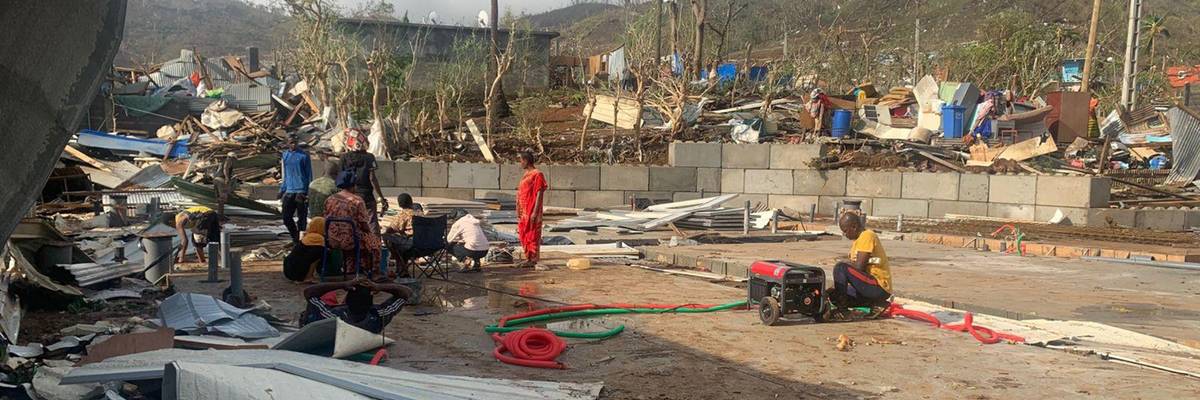
A photo taken on December 15, 2024 shows residents sitting among piles of debris of metal sheets and wood after homes were destroyed by the cyclone Chido that hit France's Indian Ocean territory of Mayotte.
"You feel like you are in the aftermath of a nuclear war," said one resident. "I saw an entire neighborhood disappear."
Undocumented migrants living in informal settlements in the French territory of Mayotte were among those whose lives and livelihoods were most devastated by Cyclone Chido, a tropical cyclone that slammed into the impoverished group of islands in the Indian Ocean over the weekend.
Authorities reported a death toll of at least 20 on Monday, but the territory's prefect, François-Xavier Bieuville, told a local news station that the widespread devastation indicated there were likely "some several hundred dead."
"Maybe we'll get close to a thousand," said Bieuville. "Even thousands... given the violence of this event."
Mayotte, which includes two densely populated main islands, Grande-Terre and Petite-Terre, as well as smaller islands with few residents, is home to about 300,000 people.
The territory is one of the European Union's poorest, with three-quarters of residents living below the poverty line, but roughly 100,000 people have come to Mayotte from the nearby African island nations of Madagascar and Comoros in recent decades, seeking better economic conditions.
Many of those people live in informal neighborhoods and shacks across the islands that were hardest hit by Chido, with aerial footage showing collections of houses "reduced to rubble," according to CNN.
"What we are experiencing is a tragedy, you feel like you are in the aftermath of a nuclear war," Mohamed Ishmael, a resident of the capital city, Mamoudzou, told Reuters. "I saw an entire neighborhood disappear."
Bruno Garcia, owner of a hotel in Mamoudzou, echoed Ishmael's comments, telling French CNN affiliate BFMTV: "It's as if an atomic bomb fell on Mayotte."
"The situation is catastrophic, apocalyptic," said Garcia. "We lost everything. The entire hotel is completely destroyed."
Residents of the migrant settlements in recent years have faced crackdowns from French police who have been tasked with rounding up people for deportation and dismantling shacks.
The aggressive response to migration reportedly led some families to stay in their homes rather than evacuate, for fear of being apprehended by police.
Now, some of those families' homes have been razed entirely or stripped of their roofs and "engulfed by mud and sheet metal," according to Estelle Youssouffa, who represents Mayotte in France's National Assembly.
People in Mayotte's most vulnerable neighborhoods are now without food or safe drinking water as hundreds of rescuers from France and the nearby French territory of Reunion struggle to reach victims amid widespread power outages.
"It's the hunger that worries me most. There are people who have had nothing to eat or drink" since Saturday, French Sen. Salama Ramia, who represents Mayotte, told the BBC.
The Washington Post reported that Cyclone Chido became increasingly powerful and intense—falling just short of becoming a Category 5 hurricane with winds over 155 miles per hour—because of unusually warm water in the Indian Ocean. The ocean temperature ranged from 81-86°F along Chido's path. Tropical cyclones typically form when ocean temperatures rise above 80°F.
"The intensity of tropical cyclones in the Southwest Indian Ocean has been increasing, [and] this is consistent with what scientists expect in a changing climate—warmer oceans fuel more powerful storms," Liz Stephens, a professor of climate risks and resilience at the University of Reading in the United Kingdom, told the Post.
People living on islands like Mayotte are especially vulnerable to climate disasters both because there's little shielding them from powerful storms and because their economic conditions leave them with few options to flee to safety as a cyclone approaches.
"Even though the path of Cyclone Chido was well forecast several days ahead, communities on small islands like Mayotte don't have the option to evacuate," Stephens said. "There's nowhere to go."
Dear Common Dreams reader, It’s been nearly 30 years since I co-founded Common Dreams with my late wife, Lina Newhouser. We had the radical notion that journalism should serve the public good, not corporate profits. It was clear to us from the outset what it would take to build such a project. No paid advertisements. No corporate sponsors. No millionaire publisher telling us what to think or do. Many people said we wouldn't last a year, but we proved those doubters wrong. Together with a tremendous team of journalists and dedicated staff, we built an independent media outlet free from the constraints of profits and corporate control. Our mission has always been simple: To inform. To inspire. To ignite change for the common good. Building Common Dreams was not easy. Our survival was never guaranteed. When you take on the most powerful forces—Wall Street greed, fossil fuel industry destruction, Big Tech lobbyists, and uber-rich oligarchs who have spent billions upon billions rigging the economy and democracy in their favor—the only bulwark you have is supporters who believe in your work. But here’s the urgent message from me today. It's never been this bad out there. And it's never been this hard to keep us going. At the very moment Common Dreams is most needed, the threats we face are intensifying. We need your support now more than ever. We don't accept corporate advertising and never will. We don't have a paywall because we don't think people should be blocked from critical news based on their ability to pay. Everything we do is funded by the donations of readers like you. When everyone does the little they can afford, we are strong. But if that support retreats or dries up, so do we. Will you donate now to make sure Common Dreams not only survives but thrives? —Craig Brown, Co-founder |
Undocumented migrants living in informal settlements in the French territory of Mayotte were among those whose lives and livelihoods were most devastated by Cyclone Chido, a tropical cyclone that slammed into the impoverished group of islands in the Indian Ocean over the weekend.
Authorities reported a death toll of at least 20 on Monday, but the territory's prefect, François-Xavier Bieuville, told a local news station that the widespread devastation indicated there were likely "some several hundred dead."
"Maybe we'll get close to a thousand," said Bieuville. "Even thousands... given the violence of this event."
Mayotte, which includes two densely populated main islands, Grande-Terre and Petite-Terre, as well as smaller islands with few residents, is home to about 300,000 people.
The territory is one of the European Union's poorest, with three-quarters of residents living below the poverty line, but roughly 100,000 people have come to Mayotte from the nearby African island nations of Madagascar and Comoros in recent decades, seeking better economic conditions.
Many of those people live in informal neighborhoods and shacks across the islands that were hardest hit by Chido, with aerial footage showing collections of houses "reduced to rubble," according to CNN.
"What we are experiencing is a tragedy, you feel like you are in the aftermath of a nuclear war," Mohamed Ishmael, a resident of the capital city, Mamoudzou, told Reuters. "I saw an entire neighborhood disappear."
Bruno Garcia, owner of a hotel in Mamoudzou, echoed Ishmael's comments, telling French CNN affiliate BFMTV: "It's as if an atomic bomb fell on Mayotte."
"The situation is catastrophic, apocalyptic," said Garcia. "We lost everything. The entire hotel is completely destroyed."
Residents of the migrant settlements in recent years have faced crackdowns from French police who have been tasked with rounding up people for deportation and dismantling shacks.
The aggressive response to migration reportedly led some families to stay in their homes rather than evacuate, for fear of being apprehended by police.
Now, some of those families' homes have been razed entirely or stripped of their roofs and "engulfed by mud and sheet metal," according to Estelle Youssouffa, who represents Mayotte in France's National Assembly.
People in Mayotte's most vulnerable neighborhoods are now without food or safe drinking water as hundreds of rescuers from France and the nearby French territory of Reunion struggle to reach victims amid widespread power outages.
"It's the hunger that worries me most. There are people who have had nothing to eat or drink" since Saturday, French Sen. Salama Ramia, who represents Mayotte, told the BBC.
The Washington Post reported that Cyclone Chido became increasingly powerful and intense—falling just short of becoming a Category 5 hurricane with winds over 155 miles per hour—because of unusually warm water in the Indian Ocean. The ocean temperature ranged from 81-86°F along Chido's path. Tropical cyclones typically form when ocean temperatures rise above 80°F.
"The intensity of tropical cyclones in the Southwest Indian Ocean has been increasing, [and] this is consistent with what scientists expect in a changing climate—warmer oceans fuel more powerful storms," Liz Stephens, a professor of climate risks and resilience at the University of Reading in the United Kingdom, told the Post.
People living on islands like Mayotte are especially vulnerable to climate disasters both because there's little shielding them from powerful storms and because their economic conditions leave them with few options to flee to safety as a cyclone approaches.
"Even though the path of Cyclone Chido was well forecast several days ahead, communities on small islands like Mayotte don't have the option to evacuate," Stephens said. "There's nowhere to go."
Undocumented migrants living in informal settlements in the French territory of Mayotte were among those whose lives and livelihoods were most devastated by Cyclone Chido, a tropical cyclone that slammed into the impoverished group of islands in the Indian Ocean over the weekend.
Authorities reported a death toll of at least 20 on Monday, but the territory's prefect, François-Xavier Bieuville, told a local news station that the widespread devastation indicated there were likely "some several hundred dead."
"Maybe we'll get close to a thousand," said Bieuville. "Even thousands... given the violence of this event."
Mayotte, which includes two densely populated main islands, Grande-Terre and Petite-Terre, as well as smaller islands with few residents, is home to about 300,000 people.
The territory is one of the European Union's poorest, with three-quarters of residents living below the poverty line, but roughly 100,000 people have come to Mayotte from the nearby African island nations of Madagascar and Comoros in recent decades, seeking better economic conditions.
Many of those people live in informal neighborhoods and shacks across the islands that were hardest hit by Chido, with aerial footage showing collections of houses "reduced to rubble," according to CNN.
"What we are experiencing is a tragedy, you feel like you are in the aftermath of a nuclear war," Mohamed Ishmael, a resident of the capital city, Mamoudzou, told Reuters. "I saw an entire neighborhood disappear."
Bruno Garcia, owner of a hotel in Mamoudzou, echoed Ishmael's comments, telling French CNN affiliate BFMTV: "It's as if an atomic bomb fell on Mayotte."
"The situation is catastrophic, apocalyptic," said Garcia. "We lost everything. The entire hotel is completely destroyed."
Residents of the migrant settlements in recent years have faced crackdowns from French police who have been tasked with rounding up people for deportation and dismantling shacks.
The aggressive response to migration reportedly led some families to stay in their homes rather than evacuate, for fear of being apprehended by police.
Now, some of those families' homes have been razed entirely or stripped of their roofs and "engulfed by mud and sheet metal," according to Estelle Youssouffa, who represents Mayotte in France's National Assembly.
People in Mayotte's most vulnerable neighborhoods are now without food or safe drinking water as hundreds of rescuers from France and the nearby French territory of Reunion struggle to reach victims amid widespread power outages.
"It's the hunger that worries me most. There are people who have had nothing to eat or drink" since Saturday, French Sen. Salama Ramia, who represents Mayotte, told the BBC.
The Washington Post reported that Cyclone Chido became increasingly powerful and intense—falling just short of becoming a Category 5 hurricane with winds over 155 miles per hour—because of unusually warm water in the Indian Ocean. The ocean temperature ranged from 81-86°F along Chido's path. Tropical cyclones typically form when ocean temperatures rise above 80°F.
"The intensity of tropical cyclones in the Southwest Indian Ocean has been increasing, [and] this is consistent with what scientists expect in a changing climate—warmer oceans fuel more powerful storms," Liz Stephens, a professor of climate risks and resilience at the University of Reading in the United Kingdom, told the Post.
People living on islands like Mayotte are especially vulnerable to climate disasters both because there's little shielding them from powerful storms and because their economic conditions leave them with few options to flee to safety as a cyclone approaches.
"Even though the path of Cyclone Chido was well forecast several days ahead, communities on small islands like Mayotte don't have the option to evacuate," Stephens said. "There's nowhere to go."