SUBSCRIBE TO OUR FREE NEWSLETTER
Daily news & progressive opinion—funded by the people, not the corporations—delivered straight to your inbox.
5
#000000
#FFFFFF
To donate by check, phone, or other method, see our More Ways to Give page.
Daily news & progressive opinion—funded by the people, not the corporations—delivered straight to your inbox.
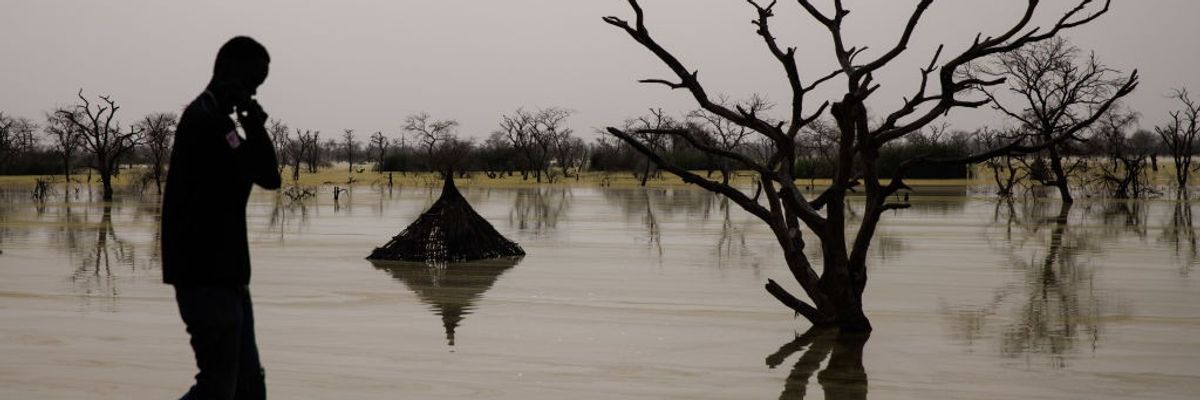
Traditional tukul houses are partly submerged in floodwaters on land that was previously a residential community on November 29, 2023 in Bentiu, South Sudan.
"ICAAD's report incorporates lived-experience testimony and in-depth cross-disciplinary research to propose an innovative and, most importantly, practicable legal standard for the right to life with dignity," an advocate said.
A human rights group on Wednesday released what it called "a gift to the international legal and climate action communities" to support their efforts to protect people around the world displaced by the fossil fuel-driven planetary emergency.
The "groundbreaking" policy brief from the International Center for Advocates Against Discrimination (ICAAD) was crafted to fill a "void in international human rights law" using the insights of Indigenous and climate frontline communities, attorneys, climate modeling experts, social scientists, researchers, and data analysts.
Already, the climate emergency is displacing people within and beyond their home countries. According to the Office of the United Nations High Commissioner for Refugees, over 117.3 million people were forcibly displaced at the end of 2023 for a range of reasons. The report comes as Hurricane Beryl is leaving a trail of destruction through the Caribbean.
The Institute for Economics & Peace has estimated that by 2050, ecological disasters and armed conflict could forcibly displace about 1.2 billion people, about 10% of the global population. Given such warnings, ICAAD's report urges countries to "adopt inclusive, evidence-based legal frameworks" for climate refugees that center on "the right to life with dignity" (RTLWD).
The brief builds on a January 7, 2020 decision from the United Nations Human Rights Committee. As the document details:
Ioane Teitiota and his family sought to remain in New Zealand after migrating from Kiribati. Though the claimant identified how environmental degradation and its downstream impacts would violate his family's right to life with dignity, the majority of the committee did not find that returning the claimant to Kiribati would violate the International Covenant on Civil and Political Rights (ICCPR), citing a lack of individualized and imminent harm. Nevertheless, the committee did provide a significant opening by recognizing that environmental degradation could be so severe as to violate Article 6, right to life (with dignity), and Article 7, cruel, inhuman, and degrading treatment (CIDT). This policy brief's analysis centers on Article 6, right to life with dignity, by first looking at the origin of the term "dignity" in legal contexts and how it should be applied today when considering climate-induced displacement.
After examining the etymology of "dignity," its use in international human rights law, and meanings in non-European philosophies and cultures, ICAAD proposed a legal standard for determining whether a climate-displaced person's RTLWD has been violated.
Under the group's standard, the right has been violated if they are deprived of, or are at risk of being deprived of:
ICAAD also offered an evidentiary standard for tribunals charged with considering a displaced person's application: "An applicant is entitled to protection and nonrefoulement if there is a reasonable chance that the applicant will suffer, in the applicant's lifetime, a violation of their right to life with dignity."
"In cases where multiple similarly situated applicants with familial or community ties apply for protection, some of whom satisfy this reasonable chance standard and some of whom do not, complementary protection should be extended to a nonqualifying applicant if denying protection to the nonqualifying applicant would violate any applicant's RTLWD," the group emphasized.
The new brief points out that "the proposed legal standard could also be adopted in national immigration policies, bilateral immigration policies, and internal relocation policies," highlighting that "in May 2019, a group of eight Torres Strait Islander people submitted a complaint against the Australian Government to the U.N. Human Rights Committee, alleging that Australia's failure to protect them from climate impacts was a violation of their rights under the ICCPR."
In a Wednesday statement, Yumna Kamel, co-founder and executive director of Earth Refuge, welcomed that "ICAAD's report incorporates lived-experience testimony and in-depth cross-disciplinary research to propose an innovative and, most importantly, practicable legal standard for the right to life with dignity for climate-displaced persons."
In addition to recommending legal and evidentiary standards, she noted, the brief "goes so far as to provide a guide to incorporating scientific modeling into future cases."
"The legal standard and overall thesis proposed is one that Earth Refuge would readily support and indeed seek to apply in pursuance of the rights of climate-displaced people," Kamel said. "It provides the practical, conscientious answers to the questions that those working in this field, and those experiencing these travesties, have been asking for years."
Dear Common Dreams reader, It’s been nearly 30 years since I co-founded Common Dreams with my late wife, Lina Newhouser. We had the radical notion that journalism should serve the public good, not corporate profits. It was clear to us from the outset what it would take to build such a project. No paid advertisements. No corporate sponsors. No millionaire publisher telling us what to think or do. Many people said we wouldn't last a year, but we proved those doubters wrong. Together with a tremendous team of journalists and dedicated staff, we built an independent media outlet free from the constraints of profits and corporate control. Our mission has always been simple: To inform. To inspire. To ignite change for the common good. Building Common Dreams was not easy. Our survival was never guaranteed. When you take on the most powerful forces—Wall Street greed, fossil fuel industry destruction, Big Tech lobbyists, and uber-rich oligarchs who have spent billions upon billions rigging the economy and democracy in their favor—the only bulwark you have is supporters who believe in your work. But here’s the urgent message from me today. It's never been this bad out there. And it's never been this hard to keep us going. At the very moment Common Dreams is most needed, the threats we face are intensifying. We need your support now more than ever. We don't accept corporate advertising and never will. We don't have a paywall because we don't think people should be blocked from critical news based on their ability to pay. Everything we do is funded by the donations of readers like you. When everyone does the little they can afford, we are strong. But if that support retreats or dries up, so do we. Will you donate now to make sure Common Dreams not only survives but thrives? —Craig Brown, Co-founder |
A human rights group on Wednesday released what it called "a gift to the international legal and climate action communities" to support their efforts to protect people around the world displaced by the fossil fuel-driven planetary emergency.
The "groundbreaking" policy brief from the International Center for Advocates Against Discrimination (ICAAD) was crafted to fill a "void in international human rights law" using the insights of Indigenous and climate frontline communities, attorneys, climate modeling experts, social scientists, researchers, and data analysts.
Already, the climate emergency is displacing people within and beyond their home countries. According to the Office of the United Nations High Commissioner for Refugees, over 117.3 million people were forcibly displaced at the end of 2023 for a range of reasons. The report comes as Hurricane Beryl is leaving a trail of destruction through the Caribbean.
The Institute for Economics & Peace has estimated that by 2050, ecological disasters and armed conflict could forcibly displace about 1.2 billion people, about 10% of the global population. Given such warnings, ICAAD's report urges countries to "adopt inclusive, evidence-based legal frameworks" for climate refugees that center on "the right to life with dignity" (RTLWD).
The brief builds on a January 7, 2020 decision from the United Nations Human Rights Committee. As the document details:
Ioane Teitiota and his family sought to remain in New Zealand after migrating from Kiribati. Though the claimant identified how environmental degradation and its downstream impacts would violate his family's right to life with dignity, the majority of the committee did not find that returning the claimant to Kiribati would violate the International Covenant on Civil and Political Rights (ICCPR), citing a lack of individualized and imminent harm. Nevertheless, the committee did provide a significant opening by recognizing that environmental degradation could be so severe as to violate Article 6, right to life (with dignity), and Article 7, cruel, inhuman, and degrading treatment (CIDT). This policy brief's analysis centers on Article 6, right to life with dignity, by first looking at the origin of the term "dignity" in legal contexts and how it should be applied today when considering climate-induced displacement.
After examining the etymology of "dignity," its use in international human rights law, and meanings in non-European philosophies and cultures, ICAAD proposed a legal standard for determining whether a climate-displaced person's RTLWD has been violated.
Under the group's standard, the right has been violated if they are deprived of, or are at risk of being deprived of:
ICAAD also offered an evidentiary standard for tribunals charged with considering a displaced person's application: "An applicant is entitled to protection and nonrefoulement if there is a reasonable chance that the applicant will suffer, in the applicant's lifetime, a violation of their right to life with dignity."
"In cases where multiple similarly situated applicants with familial or community ties apply for protection, some of whom satisfy this reasonable chance standard and some of whom do not, complementary protection should be extended to a nonqualifying applicant if denying protection to the nonqualifying applicant would violate any applicant's RTLWD," the group emphasized.
The new brief points out that "the proposed legal standard could also be adopted in national immigration policies, bilateral immigration policies, and internal relocation policies," highlighting that "in May 2019, a group of eight Torres Strait Islander people submitted a complaint against the Australian Government to the U.N. Human Rights Committee, alleging that Australia's failure to protect them from climate impacts was a violation of their rights under the ICCPR."
In a Wednesday statement, Yumna Kamel, co-founder and executive director of Earth Refuge, welcomed that "ICAAD's report incorporates lived-experience testimony and in-depth cross-disciplinary research to propose an innovative and, most importantly, practicable legal standard for the right to life with dignity for climate-displaced persons."
In addition to recommending legal and evidentiary standards, she noted, the brief "goes so far as to provide a guide to incorporating scientific modeling into future cases."
"The legal standard and overall thesis proposed is one that Earth Refuge would readily support and indeed seek to apply in pursuance of the rights of climate-displaced people," Kamel said. "It provides the practical, conscientious answers to the questions that those working in this field, and those experiencing these travesties, have been asking for years."
A human rights group on Wednesday released what it called "a gift to the international legal and climate action communities" to support their efforts to protect people around the world displaced by the fossil fuel-driven planetary emergency.
The "groundbreaking" policy brief from the International Center for Advocates Against Discrimination (ICAAD) was crafted to fill a "void in international human rights law" using the insights of Indigenous and climate frontline communities, attorneys, climate modeling experts, social scientists, researchers, and data analysts.
Already, the climate emergency is displacing people within and beyond their home countries. According to the Office of the United Nations High Commissioner for Refugees, over 117.3 million people were forcibly displaced at the end of 2023 for a range of reasons. The report comes as Hurricane Beryl is leaving a trail of destruction through the Caribbean.
The Institute for Economics & Peace has estimated that by 2050, ecological disasters and armed conflict could forcibly displace about 1.2 billion people, about 10% of the global population. Given such warnings, ICAAD's report urges countries to "adopt inclusive, evidence-based legal frameworks" for climate refugees that center on "the right to life with dignity" (RTLWD).
The brief builds on a January 7, 2020 decision from the United Nations Human Rights Committee. As the document details:
Ioane Teitiota and his family sought to remain in New Zealand after migrating from Kiribati. Though the claimant identified how environmental degradation and its downstream impacts would violate his family's right to life with dignity, the majority of the committee did not find that returning the claimant to Kiribati would violate the International Covenant on Civil and Political Rights (ICCPR), citing a lack of individualized and imminent harm. Nevertheless, the committee did provide a significant opening by recognizing that environmental degradation could be so severe as to violate Article 6, right to life (with dignity), and Article 7, cruel, inhuman, and degrading treatment (CIDT). This policy brief's analysis centers on Article 6, right to life with dignity, by first looking at the origin of the term "dignity" in legal contexts and how it should be applied today when considering climate-induced displacement.
After examining the etymology of "dignity," its use in international human rights law, and meanings in non-European philosophies and cultures, ICAAD proposed a legal standard for determining whether a climate-displaced person's RTLWD has been violated.
Under the group's standard, the right has been violated if they are deprived of, or are at risk of being deprived of:
ICAAD also offered an evidentiary standard for tribunals charged with considering a displaced person's application: "An applicant is entitled to protection and nonrefoulement if there is a reasonable chance that the applicant will suffer, in the applicant's lifetime, a violation of their right to life with dignity."
"In cases where multiple similarly situated applicants with familial or community ties apply for protection, some of whom satisfy this reasonable chance standard and some of whom do not, complementary protection should be extended to a nonqualifying applicant if denying protection to the nonqualifying applicant would violate any applicant's RTLWD," the group emphasized.
The new brief points out that "the proposed legal standard could also be adopted in national immigration policies, bilateral immigration policies, and internal relocation policies," highlighting that "in May 2019, a group of eight Torres Strait Islander people submitted a complaint against the Australian Government to the U.N. Human Rights Committee, alleging that Australia's failure to protect them from climate impacts was a violation of their rights under the ICCPR."
In a Wednesday statement, Yumna Kamel, co-founder and executive director of Earth Refuge, welcomed that "ICAAD's report incorporates lived-experience testimony and in-depth cross-disciplinary research to propose an innovative and, most importantly, practicable legal standard for the right to life with dignity for climate-displaced persons."
In addition to recommending legal and evidentiary standards, she noted, the brief "goes so far as to provide a guide to incorporating scientific modeling into future cases."
"The legal standard and overall thesis proposed is one that Earth Refuge would readily support and indeed seek to apply in pursuance of the rights of climate-displaced people," Kamel said. "It provides the practical, conscientious answers to the questions that those working in this field, and those experiencing these travesties, have been asking for years."