SUBSCRIBE TO OUR FREE NEWSLETTER
Daily news & progressive opinion—funded by the people, not the corporations—delivered straight to your inbox.
5
#000000
#FFFFFF
To donate by check, phone, or other method, see our More Ways to Give page.
Daily news & progressive opinion—funded by the people, not the corporations—delivered straight to your inbox.
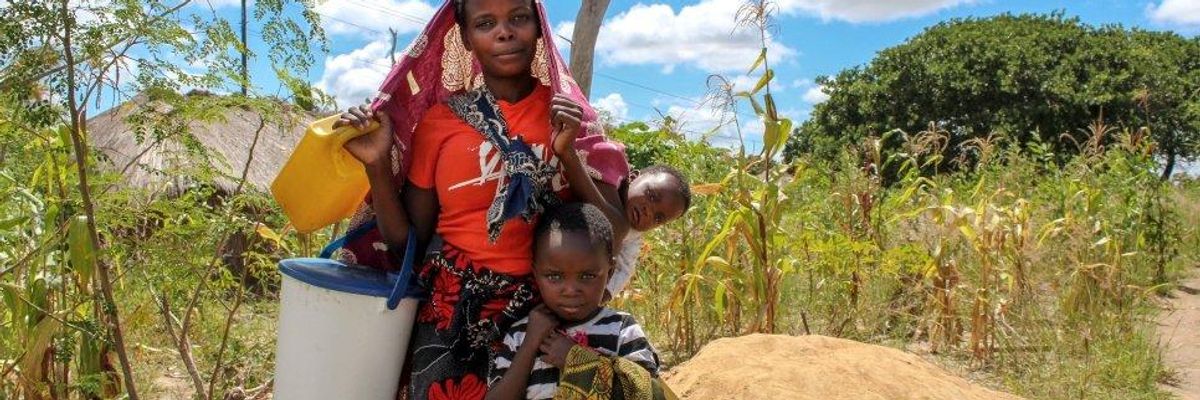
A mother and her children fetch water at a site for internally displaced people in Montepuez District, Cabo Delgado, Mozambique.
"Ongoing climate change is keeping many people in the Global South in poverty, making it more difficult for them to migrate," said the co-author of a new study. "Thus climate change deprives people of an important way to adapt to its impacts and increases the gap between rich and poor."
As the worsening climate emergency creates an increasing number of migrants around the world, the economic effects of the planetary crisis are paradoxically making millions of people throughout the Global South too poor to escape its ravages.
That's according to a study published recently in the journal Environmental Research Letters by researchers from the Potsdam Institute for Climate Impact Research (PIK) in Germany.
" Climate change reduces economic growth in almost all countries of the world. But it has very divergent effects in poorer and richer countries," study co-author Jacob Schewe said Monday. "Overall, migration related to climate change has increased—but it has done so to a lesser extent than might have been expected. The reason is bitter: In poor countries, many people in need are lacking the means to migrate. They have no choice but to stay where they are."
Co-author Christian Otto noted that "economic growth affects national income levels, which in turn affect migration. Relatively few people migrate from high-income and from very low-income countries. In the case of poor countries, this is partly because many people simply cannot afford to leave. So very poor people often stay in their home country, even if they are in need or would like to migrate for other reasons."
Another study co-author, Anders Levermann, said that "ongoing climate change is keeping many people in the Global South in poverty, making it more difficult for them to migrate. Thus climate change deprives people of an important way to adapt to its impacts and increases the gap between rich and poor."
According to a 2017 study published by the British medical journal The Lancet, climate change could create a billion refugees by 2050. Other studies conclude the number could be even higher. Additionally, the World Bank says the planetary emergency could displace more than 200 million people within their home countries by mid-century.
Dear Common Dreams reader, It’s been nearly 30 years since I co-founded Common Dreams with my late wife, Lina Newhouser. We had the radical notion that journalism should serve the public good, not corporate profits. It was clear to us from the outset what it would take to build such a project. No paid advertisements. No corporate sponsors. No millionaire publisher telling us what to think or do. Many people said we wouldn't last a year, but we proved those doubters wrong. Together with a tremendous team of journalists and dedicated staff, we built an independent media outlet free from the constraints of profits and corporate control. Our mission has always been simple: To inform. To inspire. To ignite change for the common good. Building Common Dreams was not easy. Our survival was never guaranteed. When you take on the most powerful forces—Wall Street greed, fossil fuel industry destruction, Big Tech lobbyists, and uber-rich oligarchs who have spent billions upon billions rigging the economy and democracy in their favor—the only bulwark you have is supporters who believe in your work. But here’s the urgent message from me today. It's never been this bad out there. And it's never been this hard to keep us going. At the very moment Common Dreams is most needed, the threats we face are intensifying. We need your support now more than ever. We don't accept corporate advertising and never will. We don't have a paywall because we don't think people should be blocked from critical news based on their ability to pay. Everything we do is funded by the donations of readers like you. When everyone does the little they can afford, we are strong. But if that support retreats or dries up, so do we. Will you donate now to make sure Common Dreams not only survives but thrives? —Craig Brown, Co-founder |
As the worsening climate emergency creates an increasing number of migrants around the world, the economic effects of the planetary crisis are paradoxically making millions of people throughout the Global South too poor to escape its ravages.
That's according to a study published recently in the journal Environmental Research Letters by researchers from the Potsdam Institute for Climate Impact Research (PIK) in Germany.
" Climate change reduces economic growth in almost all countries of the world. But it has very divergent effects in poorer and richer countries," study co-author Jacob Schewe said Monday. "Overall, migration related to climate change has increased—but it has done so to a lesser extent than might have been expected. The reason is bitter: In poor countries, many people in need are lacking the means to migrate. They have no choice but to stay where they are."
Co-author Christian Otto noted that "economic growth affects national income levels, which in turn affect migration. Relatively few people migrate from high-income and from very low-income countries. In the case of poor countries, this is partly because many people simply cannot afford to leave. So very poor people often stay in their home country, even if they are in need or would like to migrate for other reasons."
Another study co-author, Anders Levermann, said that "ongoing climate change is keeping many people in the Global South in poverty, making it more difficult for them to migrate. Thus climate change deprives people of an important way to adapt to its impacts and increases the gap between rich and poor."
According to a 2017 study published by the British medical journal The Lancet, climate change could create a billion refugees by 2050. Other studies conclude the number could be even higher. Additionally, the World Bank says the planetary emergency could displace more than 200 million people within their home countries by mid-century.
As the worsening climate emergency creates an increasing number of migrants around the world, the economic effects of the planetary crisis are paradoxically making millions of people throughout the Global South too poor to escape its ravages.
That's according to a study published recently in the journal Environmental Research Letters by researchers from the Potsdam Institute for Climate Impact Research (PIK) in Germany.
" Climate change reduces economic growth in almost all countries of the world. But it has very divergent effects in poorer and richer countries," study co-author Jacob Schewe said Monday. "Overall, migration related to climate change has increased—but it has done so to a lesser extent than might have been expected. The reason is bitter: In poor countries, many people in need are lacking the means to migrate. They have no choice but to stay where they are."
Co-author Christian Otto noted that "economic growth affects national income levels, which in turn affect migration. Relatively few people migrate from high-income and from very low-income countries. In the case of poor countries, this is partly because many people simply cannot afford to leave. So very poor people often stay in their home country, even if they are in need or would like to migrate for other reasons."
Another study co-author, Anders Levermann, said that "ongoing climate change is keeping many people in the Global South in poverty, making it more difficult for them to migrate. Thus climate change deprives people of an important way to adapt to its impacts and increases the gap between rich and poor."
According to a 2017 study published by the British medical journal The Lancet, climate change could create a billion refugees by 2050. Other studies conclude the number could be even higher. Additionally, the World Bank says the planetary emergency could displace more than 200 million people within their home countries by mid-century.