SUBSCRIBE TO OUR FREE NEWSLETTER
Daily news & progressive opinion—funded by the people, not the corporations—delivered straight to your inbox.
5
#000000
#FFFFFF
To donate by check, phone, or other method, see our More Ways to Give page.
Daily news & progressive opinion—funded by the people, not the corporations—delivered straight to your inbox.
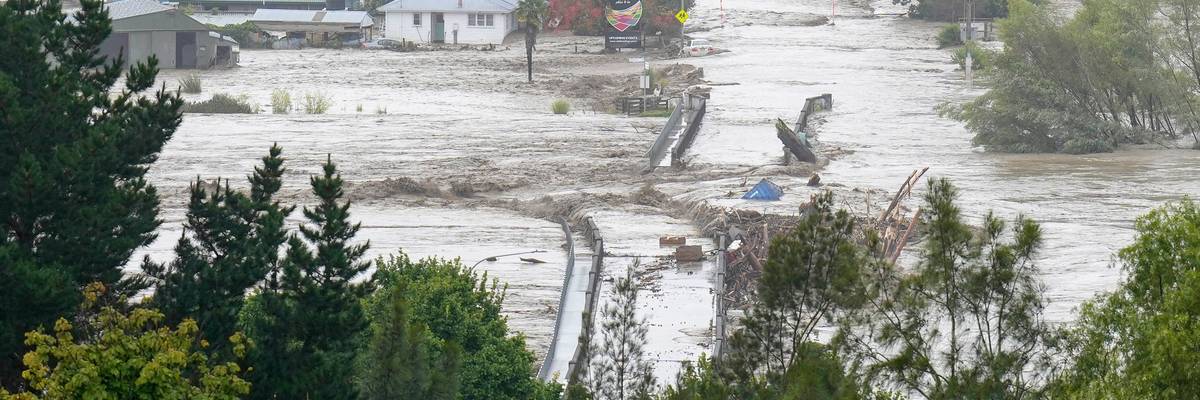
An aerial photo taken on February 14, 2023 shows the Waiohiki bridge and surrounds inundated by the Tutaekuri River after Cyclone Gabrielle made landfall near the city of Napier. New Zealand declared a national state of emergency on February 14 as Cyclone Gabrielle swept away roads, inundated homes, and left more than 225,000 people without power.
"We need to stop making excuses for inaction," said the nation's climate minister in a fiery speech. "We cannot put our heads in the sand when the beach is flooding. We must act now."
New Zealand is under a declared national emergency Tuesday as flood waters and heavy winds from Cyclone Gabrielle battered the island with all the hallmarks of a storm made more intense by the climate crisis by causing severe flooding, mudslides, and cut off power for at least a quarter of a million people.
The North Island took the brunt of the storm, with massive flooding in Hawke's Bay on the east coast and areas north-west of Auckland reporting major power outages and residents scrambling to escape with their lives.
Prime Minister Chris Hipkins said the cyclone was "the most significant weather event New Zealand has seen in this century," as he explained the need for the emergency declaration, only the third time in the nation's history one has been issued.
"The severity and the damage that we are seeing has not been experienced in a generation,” Hipkins said. "We are still building a picture of the effects of the cyclone as it continues to unfold. But what we do know is the impact is significant and it is widespread."
According to the BBC:
About a third of the country's population of five million people live in affected areas.
Many people are displaced and some were forced to swim from their homes to safety after rivers burst their banks.
Others have been rescued from rooftops.
About a quarter of a million people are without power. Falling trees have smashed houses, and landslides have carried others away and blocked roads.
Hawke's Bay, including the city of Napier, was hit especially hard with reports of people trapped on rooftops, surrounded by raging water, for hours while they awaited rescue.
Adrianne Mason, of Esk Valley, told The Guardian that her 22-year-old daughter had to climb out of her bedroom window in the middle of the night and swim to safety as flood waters rose. Mason described other neighbors in the area trapped on their roofs amid flooding she described as "catastrophic."
Footage on social media showed swollen rivers overwhelmed bridges:
On the floor of New Zealand's parliament, climate minister James Shaw, leader of the nation's Green Party, unleashed a fiery oratory against the decades lost in the fight to curb emissions and curb the onset of global warming.
He said it was not "too soon" to make it clear that the devastation being witnessed was directly related to soaring global temperatures. "This is climate change," he declared.
"As I stand here today, I struggle to find words to express what I am thinking and feeling about this particular crisis," Shaw said.
"I don't think I've ever felt as sad or as angry about the lost decades that we spent bickering and arguing about whether climate change was real or not, whether it was caused by humans or not, whether it was bad or not, whether we should do something about it or not," he continued, "because it is clearly here now, and if we do not act, it will get worse."
"We need to stop making excuses for inaction," Shaw added. "We cannot put our heads in the sand when the beach is flooding. We must act now."
Dear Common Dreams reader, It’s been nearly 30 years since I co-founded Common Dreams with my late wife, Lina Newhouser. We had the radical notion that journalism should serve the public good, not corporate profits. It was clear to us from the outset what it would take to build such a project. No paid advertisements. No corporate sponsors. No millionaire publisher telling us what to think or do. Many people said we wouldn't last a year, but we proved those doubters wrong. Together with a tremendous team of journalists and dedicated staff, we built an independent media outlet free from the constraints of profits and corporate control. Our mission has always been simple: To inform. To inspire. To ignite change for the common good. Building Common Dreams was not easy. Our survival was never guaranteed. When you take on the most powerful forces—Wall Street greed, fossil fuel industry destruction, Big Tech lobbyists, and uber-rich oligarchs who have spent billions upon billions rigging the economy and democracy in their favor—the only bulwark you have is supporters who believe in your work. But here’s the urgent message from me today. It's never been this bad out there. And it's never been this hard to keep us going. At the very moment Common Dreams is most needed, the threats we face are intensifying. We need your support now more than ever. We don't accept corporate advertising and never will. We don't have a paywall because we don't think people should be blocked from critical news based on their ability to pay. Everything we do is funded by the donations of readers like you. When everyone does the little they can afford, we are strong. But if that support retreats or dries up, so do we. Will you donate now to make sure Common Dreams not only survives but thrives? —Craig Brown, Co-founder |
New Zealand is under a declared national emergency Tuesday as flood waters and heavy winds from Cyclone Gabrielle battered the island with all the hallmarks of a storm made more intense by the climate crisis by causing severe flooding, mudslides, and cut off power for at least a quarter of a million people.
The North Island took the brunt of the storm, with massive flooding in Hawke's Bay on the east coast and areas north-west of Auckland reporting major power outages and residents scrambling to escape with their lives.
Prime Minister Chris Hipkins said the cyclone was "the most significant weather event New Zealand has seen in this century," as he explained the need for the emergency declaration, only the third time in the nation's history one has been issued.
"The severity and the damage that we are seeing has not been experienced in a generation,” Hipkins said. "We are still building a picture of the effects of the cyclone as it continues to unfold. But what we do know is the impact is significant and it is widespread."
According to the BBC:
About a third of the country's population of five million people live in affected areas.
Many people are displaced and some were forced to swim from their homes to safety after rivers burst their banks.
Others have been rescued from rooftops.
About a quarter of a million people are without power. Falling trees have smashed houses, and landslides have carried others away and blocked roads.
Hawke's Bay, including the city of Napier, was hit especially hard with reports of people trapped on rooftops, surrounded by raging water, for hours while they awaited rescue.
Adrianne Mason, of Esk Valley, told The Guardian that her 22-year-old daughter had to climb out of her bedroom window in the middle of the night and swim to safety as flood waters rose. Mason described other neighbors in the area trapped on their roofs amid flooding she described as "catastrophic."
Footage on social media showed swollen rivers overwhelmed bridges:
On the floor of New Zealand's parliament, climate minister James Shaw, leader of the nation's Green Party, unleashed a fiery oratory against the decades lost in the fight to curb emissions and curb the onset of global warming.
He said it was not "too soon" to make it clear that the devastation being witnessed was directly related to soaring global temperatures. "This is climate change," he declared.
"As I stand here today, I struggle to find words to express what I am thinking and feeling about this particular crisis," Shaw said.
"I don't think I've ever felt as sad or as angry about the lost decades that we spent bickering and arguing about whether climate change was real or not, whether it was caused by humans or not, whether it was bad or not, whether we should do something about it or not," he continued, "because it is clearly here now, and if we do not act, it will get worse."
"We need to stop making excuses for inaction," Shaw added. "We cannot put our heads in the sand when the beach is flooding. We must act now."
New Zealand is under a declared national emergency Tuesday as flood waters and heavy winds from Cyclone Gabrielle battered the island with all the hallmarks of a storm made more intense by the climate crisis by causing severe flooding, mudslides, and cut off power for at least a quarter of a million people.
The North Island took the brunt of the storm, with massive flooding in Hawke's Bay on the east coast and areas north-west of Auckland reporting major power outages and residents scrambling to escape with their lives.
Prime Minister Chris Hipkins said the cyclone was "the most significant weather event New Zealand has seen in this century," as he explained the need for the emergency declaration, only the third time in the nation's history one has been issued.
"The severity and the damage that we are seeing has not been experienced in a generation,” Hipkins said. "We are still building a picture of the effects of the cyclone as it continues to unfold. But what we do know is the impact is significant and it is widespread."
According to the BBC:
About a third of the country's population of five million people live in affected areas.
Many people are displaced and some were forced to swim from their homes to safety after rivers burst their banks.
Others have been rescued from rooftops.
About a quarter of a million people are without power. Falling trees have smashed houses, and landslides have carried others away and blocked roads.
Hawke's Bay, including the city of Napier, was hit especially hard with reports of people trapped on rooftops, surrounded by raging water, for hours while they awaited rescue.
Adrianne Mason, of Esk Valley, told The Guardian that her 22-year-old daughter had to climb out of her bedroom window in the middle of the night and swim to safety as flood waters rose. Mason described other neighbors in the area trapped on their roofs amid flooding she described as "catastrophic."
Footage on social media showed swollen rivers overwhelmed bridges:
On the floor of New Zealand's parliament, climate minister James Shaw, leader of the nation's Green Party, unleashed a fiery oratory against the decades lost in the fight to curb emissions and curb the onset of global warming.
He said it was not "too soon" to make it clear that the devastation being witnessed was directly related to soaring global temperatures. "This is climate change," he declared.
"As I stand here today, I struggle to find words to express what I am thinking and feeling about this particular crisis," Shaw said.
"I don't think I've ever felt as sad or as angry about the lost decades that we spent bickering and arguing about whether climate change was real or not, whether it was caused by humans or not, whether it was bad or not, whether we should do something about it or not," he continued, "because it is clearly here now, and if we do not act, it will get worse."
"We need to stop making excuses for inaction," Shaw added. "We cannot put our heads in the sand when the beach is flooding. We must act now."