SUBSCRIBE TO OUR FREE NEWSLETTER
Daily news & progressive opinion—funded by the people, not the corporations—delivered straight to your inbox.
5
#000000
#FFFFFF
To donate by check, phone, or other method, see our More Ways to Give page.
Daily news & progressive opinion—funded by the people, not the corporations—delivered straight to your inbox.
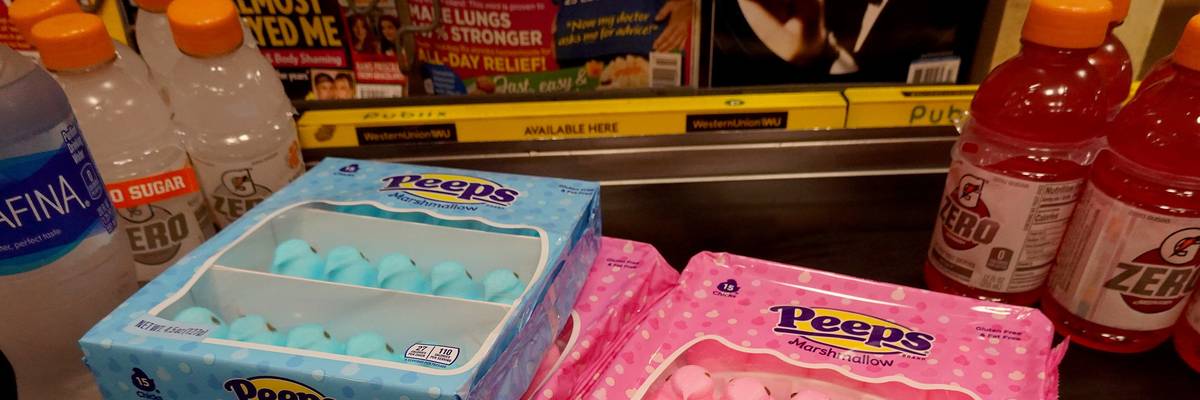
The Easter candy Peeps, made by Just Born Quality Confections, are displayed for sale on a store shelf on April 6, 2023 in Miami, Florida. The company has faced criticism from consumer advocates regarding its up of red dye 3, which California lawmakers aim to ban.
"In the absence of federal leadership, it's up to states like California to keep us safe from dangerous chemicals in candy, cookies, and other foods our families enjoy."
Food safety advocates applauded Monday as California took a major step towards becoming the first U.S. state to ban five chemicals—already prohibited in the European Union—that have been linked to cancer and childhood developmental issues.
The state Assembly passed A.B. 418 three months after it was introduced by Democratic Assemblymembers Buffy Wicks and Jesse Gabriel, who said the passage of the bill "is a major step forward in our effort to protect children and families in California from dangerous and toxic chemicals in our food supply."
"We don't love our children any less than they do in Europe, and it's not too much to ask food and beverage manufacturers to switch to the safer alternative ingredients that they already use in Europe and so many other nations around the globe," said Gabriel, who chairs the state Assembly Committee on Privacy and Consumer Protection.
The legislation would ban the manufacture, sale, delivery, and distribution of food products that contain:
In the U.S., according to EWG, nearly 99% of chemicals introduced to the market since 2000 "were approved by the food and chemical industry, not the Food and Drug Administration, the agency tasked with ensuring our food supply is safe."
Since then, companies have exploited a loophole allowing them to classify the chemicals and the foods that contain them as "generally recognized as safe," or GRAS.
"A food additive petition triggers rigorous pre-market safety review of a chemical, which can only be used after FDA approval. The 1958 Food Additives Amendment intended this review to be the primary way new food chemicals are approved," said EWG in an analysis published last year. "This GRAS loophole was created in the 1958 law and intended to apply narrowly, to common ingredients like sugar, vinegar and baking soda. But as EWG's analysis shows, the loophole—not FDA safety review—has become the main way new chemicals are allowed into food."
New York lawmakers have also proposed a ban on the five chemicals that would close the loophole.
"For decades, the FDA has failed to keep us safe from toxic food chemicals," said Scott Faber, senior vice president for government affairs at EWG. "In the absence of federal leadership, it's up to states like California to keep us safe from dangerous chemicals in candy, cookies, and other foods our families enjoy."
Dear Common Dreams reader, It’s been nearly 30 years since I co-founded Common Dreams with my late wife, Lina Newhouser. We had the radical notion that journalism should serve the public good, not corporate profits. It was clear to us from the outset what it would take to build such a project. No paid advertisements. No corporate sponsors. No millionaire publisher telling us what to think or do. Many people said we wouldn't last a year, but we proved those doubters wrong. Together with a tremendous team of journalists and dedicated staff, we built an independent media outlet free from the constraints of profits and corporate control. Our mission has always been simple: To inform. To inspire. To ignite change for the common good. Building Common Dreams was not easy. Our survival was never guaranteed. When you take on the most powerful forces—Wall Street greed, fossil fuel industry destruction, Big Tech lobbyists, and uber-rich oligarchs who have spent billions upon billions rigging the economy and democracy in their favor—the only bulwark you have is supporters who believe in your work. But here’s the urgent message from me today. It's never been this bad out there. And it's never been this hard to keep us going. At the very moment Common Dreams is most needed, the threats we face are intensifying. We need your support now more than ever. We don't accept corporate advertising and never will. We don't have a paywall because we don't think people should be blocked from critical news based on their ability to pay. Everything we do is funded by the donations of readers like you. When everyone does the little they can afford, we are strong. But if that support retreats or dries up, so do we. Will you donate now to make sure Common Dreams not only survives but thrives? —Craig Brown, Co-founder |
Food safety advocates applauded Monday as California took a major step towards becoming the first U.S. state to ban five chemicals—already prohibited in the European Union—that have been linked to cancer and childhood developmental issues.
The state Assembly passed A.B. 418 three months after it was introduced by Democratic Assemblymembers Buffy Wicks and Jesse Gabriel, who said the passage of the bill "is a major step forward in our effort to protect children and families in California from dangerous and toxic chemicals in our food supply."
"We don't love our children any less than they do in Europe, and it's not too much to ask food and beverage manufacturers to switch to the safer alternative ingredients that they already use in Europe and so many other nations around the globe," said Gabriel, who chairs the state Assembly Committee on Privacy and Consumer Protection.
The legislation would ban the manufacture, sale, delivery, and distribution of food products that contain:
In the U.S., according to EWG, nearly 99% of chemicals introduced to the market since 2000 "were approved by the food and chemical industry, not the Food and Drug Administration, the agency tasked with ensuring our food supply is safe."
Since then, companies have exploited a loophole allowing them to classify the chemicals and the foods that contain them as "generally recognized as safe," or GRAS.
"A food additive petition triggers rigorous pre-market safety review of a chemical, which can only be used after FDA approval. The 1958 Food Additives Amendment intended this review to be the primary way new food chemicals are approved," said EWG in an analysis published last year. "This GRAS loophole was created in the 1958 law and intended to apply narrowly, to common ingredients like sugar, vinegar and baking soda. But as EWG's analysis shows, the loophole—not FDA safety review—has become the main way new chemicals are allowed into food."
New York lawmakers have also proposed a ban on the five chemicals that would close the loophole.
"For decades, the FDA has failed to keep us safe from toxic food chemicals," said Scott Faber, senior vice president for government affairs at EWG. "In the absence of federal leadership, it's up to states like California to keep us safe from dangerous chemicals in candy, cookies, and other foods our families enjoy."
Food safety advocates applauded Monday as California took a major step towards becoming the first U.S. state to ban five chemicals—already prohibited in the European Union—that have been linked to cancer and childhood developmental issues.
The state Assembly passed A.B. 418 three months after it was introduced by Democratic Assemblymembers Buffy Wicks and Jesse Gabriel, who said the passage of the bill "is a major step forward in our effort to protect children and families in California from dangerous and toxic chemicals in our food supply."
"We don't love our children any less than they do in Europe, and it's not too much to ask food and beverage manufacturers to switch to the safer alternative ingredients that they already use in Europe and so many other nations around the globe," said Gabriel, who chairs the state Assembly Committee on Privacy and Consumer Protection.
The legislation would ban the manufacture, sale, delivery, and distribution of food products that contain:
In the U.S., according to EWG, nearly 99% of chemicals introduced to the market since 2000 "were approved by the food and chemical industry, not the Food and Drug Administration, the agency tasked with ensuring our food supply is safe."
Since then, companies have exploited a loophole allowing them to classify the chemicals and the foods that contain them as "generally recognized as safe," or GRAS.
"A food additive petition triggers rigorous pre-market safety review of a chemical, which can only be used after FDA approval. The 1958 Food Additives Amendment intended this review to be the primary way new food chemicals are approved," said EWG in an analysis published last year. "This GRAS loophole was created in the 1958 law and intended to apply narrowly, to common ingredients like sugar, vinegar and baking soda. But as EWG's analysis shows, the loophole—not FDA safety review—has become the main way new chemicals are allowed into food."
New York lawmakers have also proposed a ban on the five chemicals that would close the loophole.
"For decades, the FDA has failed to keep us safe from toxic food chemicals," said Scott Faber, senior vice president for government affairs at EWG. "In the absence of federal leadership, it's up to states like California to keep us safe from dangerous chemicals in candy, cookies, and other foods our families enjoy."