

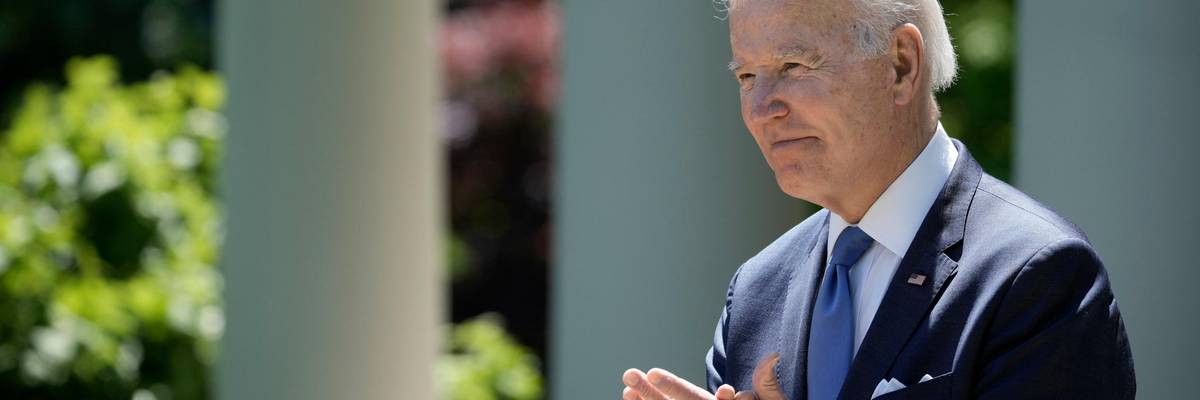
U.S. President Joe Biden listens to speakers during an event in the Rose Garden of the White House May 9, 2022 in Washington, D.C.
Climate Group Vows to Make Sure Biden Environmental Justice Office Isn't 'Just Performative'
"As we celebrate today's victory, we must also recognize that Biden has come to be known worldwide as the fossil fuel president, having approved more drilling projects on federal land than Trump during their first two years."
Climate advocates who have centered environmental justice for decades on Friday said they will continue to fight "false solutions" to the climate crisis—and expressed hope that the newly announced White House Office of Environmental Justice will usher in a new era in which President Joe Biden ends his support for fossil fuel projects.
Biden announced the creation of the Office of Environmental Justice (OEJ) at the White House Friday as he signed an executive order titled "Revitalizing Our Nation's Commitment to Environmental Justice for All."
The office, said the White House, will be tasked with "coordinating the implementation of environmental justice policy across the federal government, ensuring that federal efforts can evolve alongside our understanding of environmental justice"—a concept which recognizes the disproportionate impacts that pollution and the climate emergency have on low-income communities, Indigenous tribes, and people of color, and strives for the "meaningful involvement of all people... with respect to the development, implementation, and enforcement of environmental laws, regulations, and policies."
The president also said the executive order will make environmental justice a focus of every federal agency and will require them to "consider measures to address and prevent disproportionate and adverse environmental and health impacts on communities, including the cumulative impacts of pollution and other burdens like climate change," and to notify communities of the release of toxic substances from federal facilities nearby.
"We're investing in air quality centers in communities near factories so people who live near them know what the risk is and how safe the air is," said Biden. "Because we know historically redlined communities are literally hotter because there's more pavement and fewer trees, we're planting millions of new trees to cool down our city streets."
"Environmental justice will be the mission of the entire government, woven directly into how we work with state, local, tribal, and territorial governments," he added.
The Wilderness Society was among the groups that applauded the announcement as a "huge win" for the environmental justice movement.
Ozawa Bineshi Albert, co-executive director at the Climate Justice Alliance (CJA)—a coalition of 89 rural and urban climate organizations—credited "frontline organizing power" with pushing the White House to adopt a policy aimed at centering support for communities that are disproportionately impacted by pollution, the public health issues resulting from it, and effects of the climate emergency such as catastrophic flooding and extreme heat.
"Today's executive order is the result of nearly two decades of organizing by the environmental justice movement," said Bineshi Albert. "This win belongs to our communities who have been on the frontlines of the climate crisis, creating solutions, building local power, and engaging lawmakers for decades."
But Bineshi Albert pointed out that the executive order also follows a number of actions by the Biden administration that completely disregarded outcry from and dangers posed to frontline communities.
Biden has been condemned this year for approving the Willow project, an oil drilling operation on federal land in Alaska that could support the production of more than 600 million barrels of crude oil over 30 years—leading to about 280 million metric tons of carbon emissions, even as energy and climate experts warn that continuing to extract fossil fuels instead of beginning a rapid drawdown will ensure the Earth warms by more than 1.5°C, locking in the loss of ice sheets, sea-level rise, and more extreme weather.
The president has also angered climate action groups as he has backed new offshore drilling.
"As we celebrate today's victory, we must also recognize that Biden has come to be known worldwide as the fossil fuel president, having approved more drilling projects on federal land than [former President Donald] Trump during their first two years in office," said Bineshi Albert. "The recent approval of harmful, extractive drilling leases such as the Willow project in Alaska, in the Gulf, and the LNG pipeline demonstrate the need for coherent and aligned policies that move us toward a truly just transition, not an expansion of fossil fuel infrastructure."
Jean Su, director of the Center for Biological Diversity's Energy Justice program, expressed wariness of the White House's new "Environmental Justice Scorecard," which will assess federal agencies' efforts to further environmental justice.
No agency should be scored highly if it approves fossil fuel infrastructure like the Willow project, as the Department of the Interior did, suggested Su.
"A White House Office of Environmental Justice is a hard-fought victory that's long overdue, but it needs to be empowered," she said in a statement. "A fundamental part of the president's first-ever Environmental Justice Scorecard needs to be saying no to the fossil fuel projects that pollute communities of color and sow climate chaos. If the president wants to distinguish himself from oily Republicans, let's see him reverse the Willow project, stop approving massive Gulf drilling and gas exports, and phase down public lands drilling."
"It's high time Biden showed up for environmental justice communities and the planet instead of fossil fuel companies," she added.
Bineshi Albert warned that the White House risks creating an office that is "just performative," and said CJA will double down on ensuring it is not.
"The new office of environmental justice must ensure strong, consistent procedures are implemented across agencies moving forward," she said. "Our communities will continue to organize to stop false solutions, support regenerative economic solutions, and ensure that justice and equity are codified and implemented at the rate and speed needed to meet the moment."
We are at a crossroads
This country and this world are at a monumental crossroads. In a few short weeks, US voters will have an opportunity to beat back the forces of fascism and confront the billionaires who are rigging the economy, our media system, and our democracy, making it increasingly impossible for ordinary people to get by. We’re not just talking about the election. We’re talking about what must be done once these fascist elements are vanquished from power. We need a bolder set of solutions than what either major party has so far been willing to offer and a working-class movement ready to fight like hell for it. Trump didn't emerge from nowhere. The conditions that fueled MAGA authoritarianism were created by decades of radical neoliberal economic policies and a corrupt political system dominated by corporate interests. They slashed taxes on the super-rich, promising that the benefits would trickle down. They said giveaways to the corporate titans would make life more affordable for the rest of us. It was all bullshit. And when a bitter, betrayed populace searches for someone to blame, right-wing demagogues have little trouble finding scapegoats. People know when they're being lied to, but you won't hear any of this from the corporate media. Only independent journalism—powered and funded by people who believe in building a better world—can deliver truly trustworthy daily news. Our Fall Campaign is underway, and we need your help. To power our newsroom through the rest of the year, we need to raise $125,000 by midnight on October 31. So if you share our vision, please contribute whatever you can to sustain our work. |
Climate advocates who have centered environmental justice for decades on Friday said they will continue to fight "false solutions" to the climate crisis—and expressed hope that the newly announced White House Office of Environmental Justice will usher in a new era in which President Joe Biden ends his support for fossil fuel projects.
Biden announced the creation of the Office of Environmental Justice (OEJ) at the White House Friday as he signed an executive order titled "Revitalizing Our Nation's Commitment to Environmental Justice for All."
The office, said the White House, will be tasked with "coordinating the implementation of environmental justice policy across the federal government, ensuring that federal efforts can evolve alongside our understanding of environmental justice"—a concept which recognizes the disproportionate impacts that pollution and the climate emergency have on low-income communities, Indigenous tribes, and people of color, and strives for the "meaningful involvement of all people... with respect to the development, implementation, and enforcement of environmental laws, regulations, and policies."
The president also said the executive order will make environmental justice a focus of every federal agency and will require them to "consider measures to address and prevent disproportionate and adverse environmental and health impacts on communities, including the cumulative impacts of pollution and other burdens like climate change," and to notify communities of the release of toxic substances from federal facilities nearby.
"We're investing in air quality centers in communities near factories so people who live near them know what the risk is and how safe the air is," said Biden. "Because we know historically redlined communities are literally hotter because there's more pavement and fewer trees, we're planting millions of new trees to cool down our city streets."
"Environmental justice will be the mission of the entire government, woven directly into how we work with state, local, tribal, and territorial governments," he added.
The Wilderness Society was among the groups that applauded the announcement as a "huge win" for the environmental justice movement.
Ozawa Bineshi Albert, co-executive director at the Climate Justice Alliance (CJA)—a coalition of 89 rural and urban climate organizations—credited "frontline organizing power" with pushing the White House to adopt a policy aimed at centering support for communities that are disproportionately impacted by pollution, the public health issues resulting from it, and effects of the climate emergency such as catastrophic flooding and extreme heat.
"Today's executive order is the result of nearly two decades of organizing by the environmental justice movement," said Bineshi Albert. "This win belongs to our communities who have been on the frontlines of the climate crisis, creating solutions, building local power, and engaging lawmakers for decades."
But Bineshi Albert pointed out that the executive order also follows a number of actions by the Biden administration that completely disregarded outcry from and dangers posed to frontline communities.
Biden has been condemned this year for approving the Willow project, an oil drilling operation on federal land in Alaska that could support the production of more than 600 million barrels of crude oil over 30 years—leading to about 280 million metric tons of carbon emissions, even as energy and climate experts warn that continuing to extract fossil fuels instead of beginning a rapid drawdown will ensure the Earth warms by more than 1.5°C, locking in the loss of ice sheets, sea-level rise, and more extreme weather.
The president has also angered climate action groups as he has backed new offshore drilling.
"As we celebrate today's victory, we must also recognize that Biden has come to be known worldwide as the fossil fuel president, having approved more drilling projects on federal land than [former President Donald] Trump during their first two years in office," said Bineshi Albert. "The recent approval of harmful, extractive drilling leases such as the Willow project in Alaska, in the Gulf, and the LNG pipeline demonstrate the need for coherent and aligned policies that move us toward a truly just transition, not an expansion of fossil fuel infrastructure."
Jean Su, director of the Center for Biological Diversity's Energy Justice program, expressed wariness of the White House's new "Environmental Justice Scorecard," which will assess federal agencies' efforts to further environmental justice.
No agency should be scored highly if it approves fossil fuel infrastructure like the Willow project, as the Department of the Interior did, suggested Su.
"A White House Office of Environmental Justice is a hard-fought victory that's long overdue, but it needs to be empowered," she said in a statement. "A fundamental part of the president's first-ever Environmental Justice Scorecard needs to be saying no to the fossil fuel projects that pollute communities of color and sow climate chaos. If the president wants to distinguish himself from oily Republicans, let's see him reverse the Willow project, stop approving massive Gulf drilling and gas exports, and phase down public lands drilling."
"It's high time Biden showed up for environmental justice communities and the planet instead of fossil fuel companies," she added.
Bineshi Albert warned that the White House risks creating an office that is "just performative," and said CJA will double down on ensuring it is not.
"The new office of environmental justice must ensure strong, consistent procedures are implemented across agencies moving forward," she said. "Our communities will continue to organize to stop false solutions, support regenerative economic solutions, and ensure that justice and equity are codified and implemented at the rate and speed needed to meet the moment."
- Groups Give Biden 10 Executive Actions to Put 'People Over Fossil Fuels' ›
- Sierra Club Applauds Biden Administration Environmental Justice Announcement ›
- Climate Justice Leaders Applaud President Biden’s Executive Order Expanding Focus on Environmental Justice in Federal Agency Planning ›
Climate advocates who have centered environmental justice for decades on Friday said they will continue to fight "false solutions" to the climate crisis—and expressed hope that the newly announced White House Office of Environmental Justice will usher in a new era in which President Joe Biden ends his support for fossil fuel projects.
Biden announced the creation of the Office of Environmental Justice (OEJ) at the White House Friday as he signed an executive order titled "Revitalizing Our Nation's Commitment to Environmental Justice for All."
The office, said the White House, will be tasked with "coordinating the implementation of environmental justice policy across the federal government, ensuring that federal efforts can evolve alongside our understanding of environmental justice"—a concept which recognizes the disproportionate impacts that pollution and the climate emergency have on low-income communities, Indigenous tribes, and people of color, and strives for the "meaningful involvement of all people... with respect to the development, implementation, and enforcement of environmental laws, regulations, and policies."
The president also said the executive order will make environmental justice a focus of every federal agency and will require them to "consider measures to address and prevent disproportionate and adverse environmental and health impacts on communities, including the cumulative impacts of pollution and other burdens like climate change," and to notify communities of the release of toxic substances from federal facilities nearby.
"We're investing in air quality centers in communities near factories so people who live near them know what the risk is and how safe the air is," said Biden. "Because we know historically redlined communities are literally hotter because there's more pavement and fewer trees, we're planting millions of new trees to cool down our city streets."
"Environmental justice will be the mission of the entire government, woven directly into how we work with state, local, tribal, and territorial governments," he added.
The Wilderness Society was among the groups that applauded the announcement as a "huge win" for the environmental justice movement.
Ozawa Bineshi Albert, co-executive director at the Climate Justice Alliance (CJA)—a coalition of 89 rural and urban climate organizations—credited "frontline organizing power" with pushing the White House to adopt a policy aimed at centering support for communities that are disproportionately impacted by pollution, the public health issues resulting from it, and effects of the climate emergency such as catastrophic flooding and extreme heat.
"Today's executive order is the result of nearly two decades of organizing by the environmental justice movement," said Bineshi Albert. "This win belongs to our communities who have been on the frontlines of the climate crisis, creating solutions, building local power, and engaging lawmakers for decades."
But Bineshi Albert pointed out that the executive order also follows a number of actions by the Biden administration that completely disregarded outcry from and dangers posed to frontline communities.
Biden has been condemned this year for approving the Willow project, an oil drilling operation on federal land in Alaska that could support the production of more than 600 million barrels of crude oil over 30 years—leading to about 280 million metric tons of carbon emissions, even as energy and climate experts warn that continuing to extract fossil fuels instead of beginning a rapid drawdown will ensure the Earth warms by more than 1.5°C, locking in the loss of ice sheets, sea-level rise, and more extreme weather.
The president has also angered climate action groups as he has backed new offshore drilling.
"As we celebrate today's victory, we must also recognize that Biden has come to be known worldwide as the fossil fuel president, having approved more drilling projects on federal land than [former President Donald] Trump during their first two years in office," said Bineshi Albert. "The recent approval of harmful, extractive drilling leases such as the Willow project in Alaska, in the Gulf, and the LNG pipeline demonstrate the need for coherent and aligned policies that move us toward a truly just transition, not an expansion of fossil fuel infrastructure."
Jean Su, director of the Center for Biological Diversity's Energy Justice program, expressed wariness of the White House's new "Environmental Justice Scorecard," which will assess federal agencies' efforts to further environmental justice.
No agency should be scored highly if it approves fossil fuel infrastructure like the Willow project, as the Department of the Interior did, suggested Su.
"A White House Office of Environmental Justice is a hard-fought victory that's long overdue, but it needs to be empowered," she said in a statement. "A fundamental part of the president's first-ever Environmental Justice Scorecard needs to be saying no to the fossil fuel projects that pollute communities of color and sow climate chaos. If the president wants to distinguish himself from oily Republicans, let's see him reverse the Willow project, stop approving massive Gulf drilling and gas exports, and phase down public lands drilling."
"It's high time Biden showed up for environmental justice communities and the planet instead of fossil fuel companies," she added.
Bineshi Albert warned that the White House risks creating an office that is "just performative," and said CJA will double down on ensuring it is not.
"The new office of environmental justice must ensure strong, consistent procedures are implemented across agencies moving forward," she said. "Our communities will continue to organize to stop false solutions, support regenerative economic solutions, and ensure that justice and equity are codified and implemented at the rate and speed needed to meet the moment."
- Groups Give Biden 10 Executive Actions to Put 'People Over Fossil Fuels' ›
- Sierra Club Applauds Biden Administration Environmental Justice Announcement ›
- Climate Justice Leaders Applaud President Biden’s Executive Order Expanding Focus on Environmental Justice in Federal Agency Planning ›