SUBSCRIBE TO OUR FREE NEWSLETTER
Daily news & progressive opinion—funded by the people, not the corporations—delivered straight to your inbox.
5
#000000
#FFFFFF
To donate by check, phone, or other method, see our More Ways to Give page.
Daily news & progressive opinion—funded by the people, not the corporations—delivered straight to your inbox.
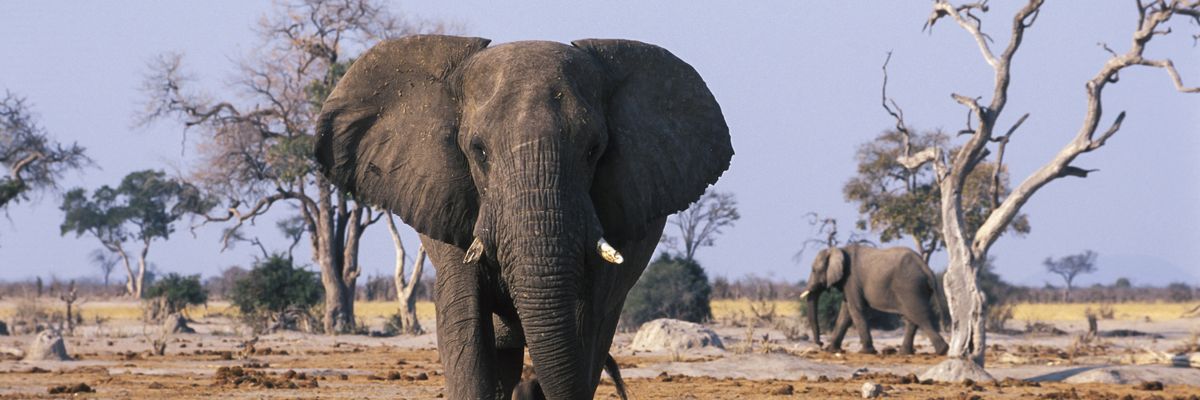
An elephant is seen in the wild.
The new restrictions will do nothing to solve "a devastating biodiversity crisis that requires an elephant-sized response," said one campaigner.
Biodiversity advocates said Friday that the Biden administration had taken "a major step back from true conservation accountability" as it announced new restrictions on imports of elephant hunting trophies—restrictions that did not go as far as banning them outright.
The U.S. Fish and Wildlife Service (FWS) said it was strengthening the African elephant rule under Section 4(d) of the Endangered Species Act, requiring countries to annually certify that their elephant populations are "biologically sustainable" and that habitats for the animals are stable. The U.S. will continue importing trophies and live elephants from countries that prove sustainability.
The restrictions also require countries to have domestic wildlife laws that meet the requirements of the Convention on International Trade in Endangered Species (CITES), but that provision doesn't go into effect until 2026.
The restrictions could eliminate trophy imports from Botswana, Mozambique, and Zambia, which currently have national legislation that may not meet CITES requirements.
A previous proposal from the administration in 2022 required that elephant populations were "stable or increasing" in countries in order for imports to continue.
Tanya Sanerib, international legal director for the Center for Biological Diversity (CBD), said the new rules will do nothing to solve "a devastating biodiversity crisis that requires an elephant-sized response."
"These are mouse-sized rule changes that continue to treat elephants like commodities," said Sanerib. "We need global change that prioritizes biodiversity over profits."
CBD pledged to "do everything we can to fight threats to imperiled elephants from trophy hunting."
The new restrictions were announced almost exactly three years after the International Union for Conservation of Nature (IUCN) reassessed protections for elephants, and found that poaching for ivory and habitat loss over several decades had pushed two elephant species closer to extinction.
The African forest elephant is now "critically endangered" and the African savanna elephant is now listed as "endangered." Before 2021, the two kinds of African elephants were treated as a single species and were listed only as "vulnerable."
The Obama administration in 2016 imposed a near-ban on the elephant ivory trade.
The following year, then-President Donald Trump infuriated conservation groups by reversing the ban on imported elephant trophies from Zimbabwe and Zambia, a decision he quickly reverse due to the uproar it caused. In 2018, the Republican president said the FWS would begin issuing permits "to import a sport-hunted trophy on a case-by-case basis."
Sanerib on Friday said she and her organization were "crushed this rule doesn't ban trade in elephant hunting trophies to the United States, and it doesn't even require stable elephant populations to allow trophy imports."
"These magnificent animals are globally cherished but under threat," said Sanerib, "and it's high time we stop letting wealthy trophy hunters turn them into décor."
Dear Common Dreams reader, It’s been nearly 30 years since I co-founded Common Dreams with my late wife, Lina Newhouser. We had the radical notion that journalism should serve the public good, not corporate profits. It was clear to us from the outset what it would take to build such a project. No paid advertisements. No corporate sponsors. No millionaire publisher telling us what to think or do. Many people said we wouldn't last a year, but we proved those doubters wrong. Together with a tremendous team of journalists and dedicated staff, we built an independent media outlet free from the constraints of profits and corporate control. Our mission has always been simple: To inform. To inspire. To ignite change for the common good. Building Common Dreams was not easy. Our survival was never guaranteed. When you take on the most powerful forces—Wall Street greed, fossil fuel industry destruction, Big Tech lobbyists, and uber-rich oligarchs who have spent billions upon billions rigging the economy and democracy in their favor—the only bulwark you have is supporters who believe in your work. But here’s the urgent message from me today. It's never been this bad out there. And it's never been this hard to keep us going. At the very moment Common Dreams is most needed, the threats we face are intensifying. We need your support now more than ever. We don't accept corporate advertising and never will. We don't have a paywall because we don't think people should be blocked from critical news based on their ability to pay. Everything we do is funded by the donations of readers like you. When everyone does the little they can afford, we are strong. But if that support retreats or dries up, so do we. Will you donate now to make sure Common Dreams not only survives but thrives? —Craig Brown, Co-founder |
Biodiversity advocates said Friday that the Biden administration had taken "a major step back from true conservation accountability" as it announced new restrictions on imports of elephant hunting trophies—restrictions that did not go as far as banning them outright.
The U.S. Fish and Wildlife Service (FWS) said it was strengthening the African elephant rule under Section 4(d) of the Endangered Species Act, requiring countries to annually certify that their elephant populations are "biologically sustainable" and that habitats for the animals are stable. The U.S. will continue importing trophies and live elephants from countries that prove sustainability.
The restrictions also require countries to have domestic wildlife laws that meet the requirements of the Convention on International Trade in Endangered Species (CITES), but that provision doesn't go into effect until 2026.
The restrictions could eliminate trophy imports from Botswana, Mozambique, and Zambia, which currently have national legislation that may not meet CITES requirements.
A previous proposal from the administration in 2022 required that elephant populations were "stable or increasing" in countries in order for imports to continue.
Tanya Sanerib, international legal director for the Center for Biological Diversity (CBD), said the new rules will do nothing to solve "a devastating biodiversity crisis that requires an elephant-sized response."
"These are mouse-sized rule changes that continue to treat elephants like commodities," said Sanerib. "We need global change that prioritizes biodiversity over profits."
CBD pledged to "do everything we can to fight threats to imperiled elephants from trophy hunting."
The new restrictions were announced almost exactly three years after the International Union for Conservation of Nature (IUCN) reassessed protections for elephants, and found that poaching for ivory and habitat loss over several decades had pushed two elephant species closer to extinction.
The African forest elephant is now "critically endangered" and the African savanna elephant is now listed as "endangered." Before 2021, the two kinds of African elephants were treated as a single species and were listed only as "vulnerable."
The Obama administration in 2016 imposed a near-ban on the elephant ivory trade.
The following year, then-President Donald Trump infuriated conservation groups by reversing the ban on imported elephant trophies from Zimbabwe and Zambia, a decision he quickly reverse due to the uproar it caused. In 2018, the Republican president said the FWS would begin issuing permits "to import a sport-hunted trophy on a case-by-case basis."
Sanerib on Friday said she and her organization were "crushed this rule doesn't ban trade in elephant hunting trophies to the United States, and it doesn't even require stable elephant populations to allow trophy imports."
"These magnificent animals are globally cherished but under threat," said Sanerib, "and it's high time we stop letting wealthy trophy hunters turn them into décor."
Biodiversity advocates said Friday that the Biden administration had taken "a major step back from true conservation accountability" as it announced new restrictions on imports of elephant hunting trophies—restrictions that did not go as far as banning them outright.
The U.S. Fish and Wildlife Service (FWS) said it was strengthening the African elephant rule under Section 4(d) of the Endangered Species Act, requiring countries to annually certify that their elephant populations are "biologically sustainable" and that habitats for the animals are stable. The U.S. will continue importing trophies and live elephants from countries that prove sustainability.
The restrictions also require countries to have domestic wildlife laws that meet the requirements of the Convention on International Trade in Endangered Species (CITES), but that provision doesn't go into effect until 2026.
The restrictions could eliminate trophy imports from Botswana, Mozambique, and Zambia, which currently have national legislation that may not meet CITES requirements.
A previous proposal from the administration in 2022 required that elephant populations were "stable or increasing" in countries in order for imports to continue.
Tanya Sanerib, international legal director for the Center for Biological Diversity (CBD), said the new rules will do nothing to solve "a devastating biodiversity crisis that requires an elephant-sized response."
"These are mouse-sized rule changes that continue to treat elephants like commodities," said Sanerib. "We need global change that prioritizes biodiversity over profits."
CBD pledged to "do everything we can to fight threats to imperiled elephants from trophy hunting."
The new restrictions were announced almost exactly three years after the International Union for Conservation of Nature (IUCN) reassessed protections for elephants, and found that poaching for ivory and habitat loss over several decades had pushed two elephant species closer to extinction.
The African forest elephant is now "critically endangered" and the African savanna elephant is now listed as "endangered." Before 2021, the two kinds of African elephants were treated as a single species and were listed only as "vulnerable."
The Obama administration in 2016 imposed a near-ban on the elephant ivory trade.
The following year, then-President Donald Trump infuriated conservation groups by reversing the ban on imported elephant trophies from Zimbabwe and Zambia, a decision he quickly reverse due to the uproar it caused. In 2018, the Republican president said the FWS would begin issuing permits "to import a sport-hunted trophy on a case-by-case basis."
Sanerib on Friday said she and her organization were "crushed this rule doesn't ban trade in elephant hunting trophies to the United States, and it doesn't even require stable elephant populations to allow trophy imports."
"These magnificent animals are globally cherished but under threat," said Sanerib, "and it's high time we stop letting wealthy trophy hunters turn them into décor."