SUBSCRIBE TO OUR FREE NEWSLETTER
Daily news & progressive opinion—funded by the people, not the corporations—delivered straight to your inbox.
5
#000000
#FFFFFF
To donate by check, phone, or other method, see our More Ways to Give page.
Daily news & progressive opinion—funded by the people, not the corporations—delivered straight to your inbox.
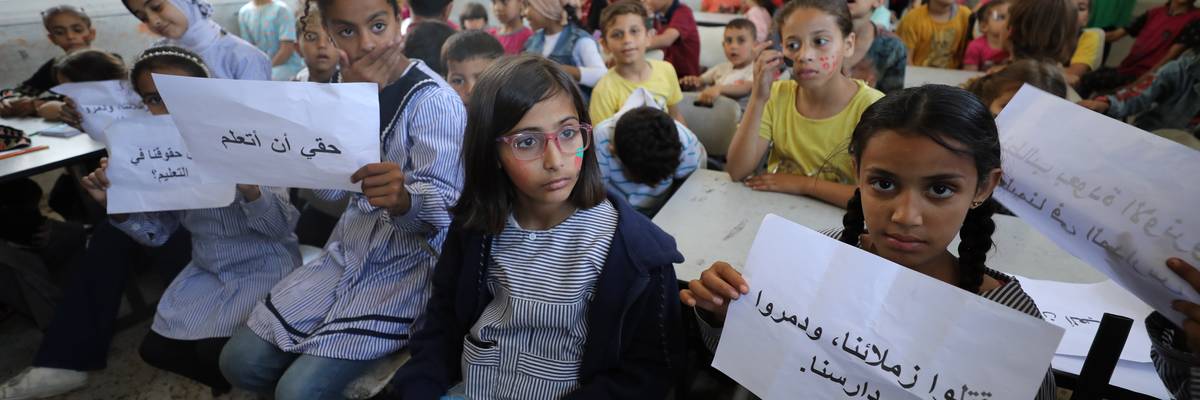
Palestinian students take part in a demonstration demanding the reopening of a United Nations school after the facility was damaged by Israeli attacks in Gaza City, Gaza on May 7, 2024.
"In places like Gaza, in addition to the horrific loss of life, education itself is under attack," said the executive director of the Global Coalition to Protect Education From Attack.
More than 10,000 students, teachers, and academics were killed or harmed in thousands of attacks on education in 2022 and 2023, according to research published Thursday amid Israel's ongoing assault on the Gaza Strip, which has seen its schools and universities decimated by the U.S.-backed Israeli bombing campaign.
The Global Coalition to Protect Education From Attack (GCPEA) identified roughly 6,000 attacks on education in 2022 and 2023, a 10% increase compared to the two preceding years. The highest number of attacks took place in occupied Palestine, Ukraine, the Democratic Republic of the Congo, and Myanmar, and explosive weapons—including rockets and landmines—were involved in about a third of the attacks.
"In places like Gaza, in addition to the horrific loss of life, education itself is under attack," Lisa Chung Bender, GCPEA's executive director, said in a statement. "School and university systems have been shut down, and in some cases completely destroyed. This will have long-term consequences on social and economic recovery, as the very infrastructure needed for peace and stability have been targeted."
GCPEA researchers estimate that more than 475 attacks on schools took place in Palestine last year, surging after Israel launched its large-scale assault on Gaza following the deadly Hamas-led attack on October 7. Israeli forces have damaged or destroyed every university in the Gaza Strip as part of what United Nations experts have described as a "systemic obliteration of education."
"On average, eight attacks on education were recorded daily over the past two years, meaning a startling number of students were unable to follow their dreams."
In addition to attacks on education infrastructure, the new report shows that targeted attacks on students, teachers, and prominent academics have become more frequent worldwide in recent years.
"More than 10,000 students and educators were reportedly killed, injured, abducted, arrested, or otherwise harmed by attacks on education in 2022 and 2023," GCPEA's new report notes. "The number of students, teachers, professors, and education staff killed or injured increased by over 10% compared to 2020 and 2021, the period covered in the last Education Under Attack report."
Jerome Marston, a senior researcher at GCPEA, said that "on average, eight attacks on education were recorded daily over the past two years, meaning a startling number of students were unable to follow their dreams of learning, or develop the skills that an education promises."
"Schools should be safe havens, not targets," said Marston.
The new report stresses that growing attacks on education have taken place "against a backdrop of increasing conflict" and a worsening climate emergency, which GCPEA said "may be linked to attacks on education" such as the "lootings of school canteens" in areas impacted by severe hunger.
"In late March 2022, a suspected armed group allegedly looted a school canteen in Komangou village, Gourma province, Est Region, Burkina Faso, on two consecutive days, as reported by a local media outlet," the report observes. "On November 16, 2022, a suspected armed group allegedly attacked a school and looted its canteen in Fatakara village, Timbuktu region, Mali."
Additionally, the report makes a preliminary connection between climate-fueled extreme weather events and attacks on education.
"For instance, in the Philippines, climate change has contributed to more intense typhoons, affecting in particular the Bangsamoro Autonomous Region in Muslim Mindanao that has faced decades of protracted armed conflict," the report notes. "The U.N. reported that an armed group in the region attacked a school being used as shelter by people displaced by emergencies while state security forces were nearby for disaster-relief efforts."
GCPEA calls on all parties to armed conflicts across the globe to "immediately cease attacks on education" and urges governments to endorse the Safe Schools Declaration, an international effort to protect education during war.
Neither the U.S. nor Israel have backed the declaration.
Dear Common Dreams reader, It’s been nearly 30 years since I co-founded Common Dreams with my late wife, Lina Newhouser. We had the radical notion that journalism should serve the public good, not corporate profits. It was clear to us from the outset what it would take to build such a project. No paid advertisements. No corporate sponsors. No millionaire publisher telling us what to think or do. Many people said we wouldn't last a year, but we proved those doubters wrong. Together with a tremendous team of journalists and dedicated staff, we built an independent media outlet free from the constraints of profits and corporate control. Our mission has always been simple: To inform. To inspire. To ignite change for the common good. Building Common Dreams was not easy. Our survival was never guaranteed. When you take on the most powerful forces—Wall Street greed, fossil fuel industry destruction, Big Tech lobbyists, and uber-rich oligarchs who have spent billions upon billions rigging the economy and democracy in their favor—the only bulwark you have is supporters who believe in your work. But here’s the urgent message from me today. It's never been this bad out there. And it's never been this hard to keep us going. At the very moment Common Dreams is most needed, the threats we face are intensifying. We need your support now more than ever. We don't accept corporate advertising and never will. We don't have a paywall because we don't think people should be blocked from critical news based on their ability to pay. Everything we do is funded by the donations of readers like you. When everyone does the little they can afford, we are strong. But if that support retreats or dries up, so do we. Will you donate now to make sure Common Dreams not only survives but thrives? —Craig Brown, Co-founder |
More than 10,000 students, teachers, and academics were killed or harmed in thousands of attacks on education in 2022 and 2023, according to research published Thursday amid Israel's ongoing assault on the Gaza Strip, which has seen its schools and universities decimated by the U.S.-backed Israeli bombing campaign.
The Global Coalition to Protect Education From Attack (GCPEA) identified roughly 6,000 attacks on education in 2022 and 2023, a 10% increase compared to the two preceding years. The highest number of attacks took place in occupied Palestine, Ukraine, the Democratic Republic of the Congo, and Myanmar, and explosive weapons—including rockets and landmines—were involved in about a third of the attacks.
"In places like Gaza, in addition to the horrific loss of life, education itself is under attack," Lisa Chung Bender, GCPEA's executive director, said in a statement. "School and university systems have been shut down, and in some cases completely destroyed. This will have long-term consequences on social and economic recovery, as the very infrastructure needed for peace and stability have been targeted."
GCPEA researchers estimate that more than 475 attacks on schools took place in Palestine last year, surging after Israel launched its large-scale assault on Gaza following the deadly Hamas-led attack on October 7. Israeli forces have damaged or destroyed every university in the Gaza Strip as part of what United Nations experts have described as a "systemic obliteration of education."
"On average, eight attacks on education were recorded daily over the past two years, meaning a startling number of students were unable to follow their dreams."
In addition to attacks on education infrastructure, the new report shows that targeted attacks on students, teachers, and prominent academics have become more frequent worldwide in recent years.
"More than 10,000 students and educators were reportedly killed, injured, abducted, arrested, or otherwise harmed by attacks on education in 2022 and 2023," GCPEA's new report notes. "The number of students, teachers, professors, and education staff killed or injured increased by over 10% compared to 2020 and 2021, the period covered in the last Education Under Attack report."
Jerome Marston, a senior researcher at GCPEA, said that "on average, eight attacks on education were recorded daily over the past two years, meaning a startling number of students were unable to follow their dreams of learning, or develop the skills that an education promises."
"Schools should be safe havens, not targets," said Marston.
The new report stresses that growing attacks on education have taken place "against a backdrop of increasing conflict" and a worsening climate emergency, which GCPEA said "may be linked to attacks on education" such as the "lootings of school canteens" in areas impacted by severe hunger.
"In late March 2022, a suspected armed group allegedly looted a school canteen in Komangou village, Gourma province, Est Region, Burkina Faso, on two consecutive days, as reported by a local media outlet," the report observes. "On November 16, 2022, a suspected armed group allegedly attacked a school and looted its canteen in Fatakara village, Timbuktu region, Mali."
Additionally, the report makes a preliminary connection between climate-fueled extreme weather events and attacks on education.
"For instance, in the Philippines, climate change has contributed to more intense typhoons, affecting in particular the Bangsamoro Autonomous Region in Muslim Mindanao that has faced decades of protracted armed conflict," the report notes. "The U.N. reported that an armed group in the region attacked a school being used as shelter by people displaced by emergencies while state security forces were nearby for disaster-relief efforts."
GCPEA calls on all parties to armed conflicts across the globe to "immediately cease attacks on education" and urges governments to endorse the Safe Schools Declaration, an international effort to protect education during war.
Neither the U.S. nor Israel have backed the declaration.
More than 10,000 students, teachers, and academics were killed or harmed in thousands of attacks on education in 2022 and 2023, according to research published Thursday amid Israel's ongoing assault on the Gaza Strip, which has seen its schools and universities decimated by the U.S.-backed Israeli bombing campaign.
The Global Coalition to Protect Education From Attack (GCPEA) identified roughly 6,000 attacks on education in 2022 and 2023, a 10% increase compared to the two preceding years. The highest number of attacks took place in occupied Palestine, Ukraine, the Democratic Republic of the Congo, and Myanmar, and explosive weapons—including rockets and landmines—were involved in about a third of the attacks.
"In places like Gaza, in addition to the horrific loss of life, education itself is under attack," Lisa Chung Bender, GCPEA's executive director, said in a statement. "School and university systems have been shut down, and in some cases completely destroyed. This will have long-term consequences on social and economic recovery, as the very infrastructure needed for peace and stability have been targeted."
GCPEA researchers estimate that more than 475 attacks on schools took place in Palestine last year, surging after Israel launched its large-scale assault on Gaza following the deadly Hamas-led attack on October 7. Israeli forces have damaged or destroyed every university in the Gaza Strip as part of what United Nations experts have described as a "systemic obliteration of education."
"On average, eight attacks on education were recorded daily over the past two years, meaning a startling number of students were unable to follow their dreams."
In addition to attacks on education infrastructure, the new report shows that targeted attacks on students, teachers, and prominent academics have become more frequent worldwide in recent years.
"More than 10,000 students and educators were reportedly killed, injured, abducted, arrested, or otherwise harmed by attacks on education in 2022 and 2023," GCPEA's new report notes. "The number of students, teachers, professors, and education staff killed or injured increased by over 10% compared to 2020 and 2021, the period covered in the last Education Under Attack report."
Jerome Marston, a senior researcher at GCPEA, said that "on average, eight attacks on education were recorded daily over the past two years, meaning a startling number of students were unable to follow their dreams of learning, or develop the skills that an education promises."
"Schools should be safe havens, not targets," said Marston.
The new report stresses that growing attacks on education have taken place "against a backdrop of increasing conflict" and a worsening climate emergency, which GCPEA said "may be linked to attacks on education" such as the "lootings of school canteens" in areas impacted by severe hunger.
"In late March 2022, a suspected armed group allegedly looted a school canteen in Komangou village, Gourma province, Est Region, Burkina Faso, on two consecutive days, as reported by a local media outlet," the report observes. "On November 16, 2022, a suspected armed group allegedly attacked a school and looted its canteen in Fatakara village, Timbuktu region, Mali."
Additionally, the report makes a preliminary connection between climate-fueled extreme weather events and attacks on education.
"For instance, in the Philippines, climate change has contributed to more intense typhoons, affecting in particular the Bangsamoro Autonomous Region in Muslim Mindanao that has faced decades of protracted armed conflict," the report notes. "The U.N. reported that an armed group in the region attacked a school being used as shelter by people displaced by emergencies while state security forces were nearby for disaster-relief efforts."
GCPEA calls on all parties to armed conflicts across the globe to "immediately cease attacks on education" and urges governments to endorse the Safe Schools Declaration, an international effort to protect education during war.
Neither the U.S. nor Israel have backed the declaration.