

SUBSCRIBE TO OUR FREE NEWSLETTER
Daily news & progressive opinion—funded by the people, not the corporations—delivered straight to your inbox.
5
#000000
#FFFFFF
To donate by check, phone, or other method, see our More Ways to Give page.

An analysis released Tuesday by a coalition of environmental organizations shows that 30 of the top asset managers in the United States and Europe collectively hold close to $600 billion in bonds and shares in the world's largest fossil fuel developers, making the investment firms key contributors to the global climate emergency.
Titled Who's Managing Your Future? An Assessment of Asset Managers' Climate Action, the new report from Reclaim Finance, ReCommon, Sierra Club, the Sunrise Project, and Urgewald finds that BlackRock and Vanguard had the largest total bond and equity holdings in fossil fuel developers as of the beginning of 2023, respectively controlling $179.5 billion and $170.3 billion.
But BlackRock and Vanguard are far from alone. The report also shows that JPMorgan Asset Management (AM), UBS AM, Fidelity International, and Credit Suisse AM have substantial bond and stock exposure to major fossil fuel producers.
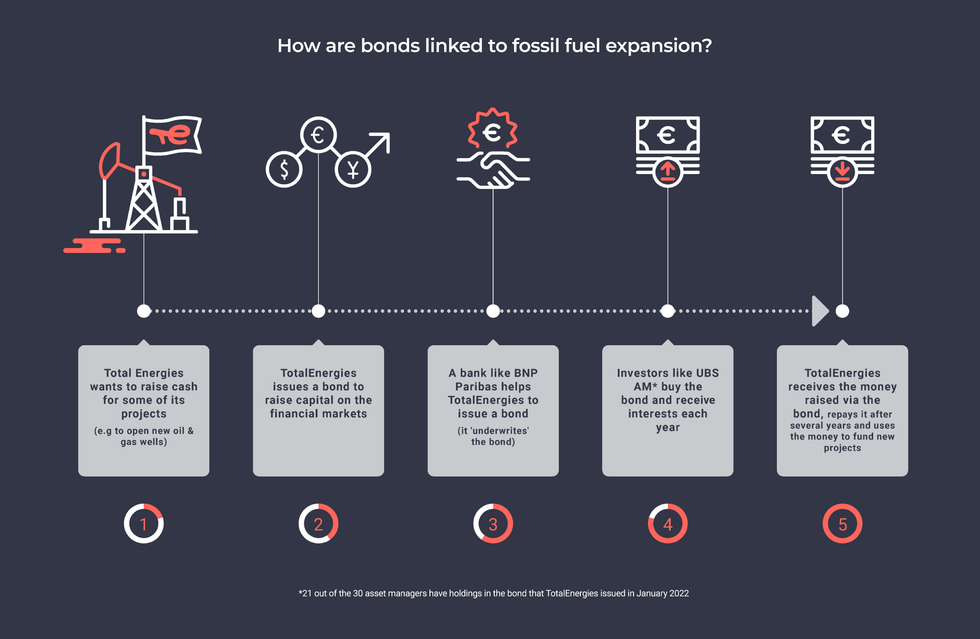
Such investments, the report notes, make it possible for oil and gas companies to finance fossil fuel expansion projects that are sabotaging hopes of reining in catastrophic planetary warming.
Over just the past 18 months, according to data laid out in the new analysis, leading U.S. and European asset managers invested at least $3.5 billion in new bonds from nearly 40 companies involved in expanding fossil fuel production.
"For fossil fuel expansion to stop and production to start decreasing, the financing behind it must stop," the report states. "And as a significant proportion of this financing comes from bonds, asset managers' role in this financing is clear."
While many of the asset managers examined in the new report have in place policies ostensibly aimed at pressuring companies in their portfolios to curb polluting activities, the analysis finds that "there are major loopholes and weaknesses that still allow most of the asset managers to provide financial services that are essential to the development of new coal, oil, and gas projects."
"Asset managers continue to add fuel to the fire by buying the bonds from the worst fossil fuel polluters," Lara Cuvelier, sustainable investment campaigner at Reclaim Finance, said in a statement. "Their policies are an inadequate response to the climate emergency."
"They should listen to the science and sanction companies that refuse to stop their devastating fossil fuel expansion plans," Cuvelier argued. "It is time for asset managers' clients to challenge them on this issue and ask them to put in place robust policies to stop this scourge."
The report specifically urges top asset managers to:
"This report clearly demonstrates a collective failure from the investment sector to manage climate risk responsibly," said Jessye Waxman of the Sierra Club's Fossil-Free Finance campaign.
"BlackRock and Vanguard are by far the worst offenders, together providing 58% of the recent investments in fossil fuel expansion, while setting very few expectations of fossil fuel companies to pivot away from business as usual," Waxman added. "As the world's largest asset managers, BlackRock and Vanguard have a responsibility to mitigate the growing systemic risk posed by climate change."
An analysis released Tuesday by a coalition of environmental organizations shows that 30 of the top asset managers in the United States and Europe collectively hold close to $600 billion in bonds and shares in the world's largest fossil fuel developers, making the investment firms key contributors to the global climate emergency.
Titled Who's Managing Your Future? An Assessment of Asset Managers' Climate Action, the new report from Reclaim Finance, ReCommon, Sierra Club, the Sunrise Project, and Urgewald finds that BlackRock and Vanguard had the largest total bond and equity holdings in fossil fuel developers as of the beginning of 2023, respectively controlling $179.5 billion and $170.3 billion.
But BlackRock and Vanguard are far from alone. The report also shows that JPMorgan Asset Management (AM), UBS AM, Fidelity International, and Credit Suisse AM have substantial bond and stock exposure to major fossil fuel producers.
Such investments, the report notes, make it possible for oil and gas companies to finance fossil fuel expansion projects that are sabotaging hopes of reining in catastrophic planetary warming.
Over just the past 18 months, according to data laid out in the new analysis, leading U.S. and European asset managers invested at least $3.5 billion in new bonds from nearly 40 companies involved in expanding fossil fuel production.
"For fossil fuel expansion to stop and production to start decreasing, the financing behind it must stop," the report states. "And as a significant proportion of this financing comes from bonds, asset managers' role in this financing is clear."
While many of the asset managers examined in the new report have in place policies ostensibly aimed at pressuring companies in their portfolios to curb polluting activities, the analysis finds that "there are major loopholes and weaknesses that still allow most of the asset managers to provide financial services that are essential to the development of new coal, oil, and gas projects."
"Asset managers continue to add fuel to the fire by buying the bonds from the worst fossil fuel polluters," Lara Cuvelier, sustainable investment campaigner at Reclaim Finance, said in a statement. "Their policies are an inadequate response to the climate emergency."
"They should listen to the science and sanction companies that refuse to stop their devastating fossil fuel expansion plans," Cuvelier argued. "It is time for asset managers' clients to challenge them on this issue and ask them to put in place robust policies to stop this scourge."
The report specifically urges top asset managers to:
"This report clearly demonstrates a collective failure from the investment sector to manage climate risk responsibly," said Jessye Waxman of the Sierra Club's Fossil-Free Finance campaign.
"BlackRock and Vanguard are by far the worst offenders, together providing 58% of the recent investments in fossil fuel expansion, while setting very few expectations of fossil fuel companies to pivot away from business as usual," Waxman added. "As the world's largest asset managers, BlackRock and Vanguard have a responsibility to mitigate the growing systemic risk posed by climate change."
An analysis released Tuesday by a coalition of environmental organizations shows that 30 of the top asset managers in the United States and Europe collectively hold close to $600 billion in bonds and shares in the world's largest fossil fuel developers, making the investment firms key contributors to the global climate emergency.
Titled Who's Managing Your Future? An Assessment of Asset Managers' Climate Action, the new report from Reclaim Finance, ReCommon, Sierra Club, the Sunrise Project, and Urgewald finds that BlackRock and Vanguard had the largest total bond and equity holdings in fossil fuel developers as of the beginning of 2023, respectively controlling $179.5 billion and $170.3 billion.
But BlackRock and Vanguard are far from alone. The report also shows that JPMorgan Asset Management (AM), UBS AM, Fidelity International, and Credit Suisse AM have substantial bond and stock exposure to major fossil fuel producers.
Such investments, the report notes, make it possible for oil and gas companies to finance fossil fuel expansion projects that are sabotaging hopes of reining in catastrophic planetary warming.
Over just the past 18 months, according to data laid out in the new analysis, leading U.S. and European asset managers invested at least $3.5 billion in new bonds from nearly 40 companies involved in expanding fossil fuel production.
"For fossil fuel expansion to stop and production to start decreasing, the financing behind it must stop," the report states. "And as a significant proportion of this financing comes from bonds, asset managers' role in this financing is clear."
While many of the asset managers examined in the new report have in place policies ostensibly aimed at pressuring companies in their portfolios to curb polluting activities, the analysis finds that "there are major loopholes and weaknesses that still allow most of the asset managers to provide financial services that are essential to the development of new coal, oil, and gas projects."
"Asset managers continue to add fuel to the fire by buying the bonds from the worst fossil fuel polluters," Lara Cuvelier, sustainable investment campaigner at Reclaim Finance, said in a statement. "Their policies are an inadequate response to the climate emergency."
"They should listen to the science and sanction companies that refuse to stop their devastating fossil fuel expansion plans," Cuvelier argued. "It is time for asset managers' clients to challenge them on this issue and ask them to put in place robust policies to stop this scourge."
The report specifically urges top asset managers to:
"This report clearly demonstrates a collective failure from the investment sector to manage climate risk responsibly," said Jessye Waxman of the Sierra Club's Fossil-Free Finance campaign.
"BlackRock and Vanguard are by far the worst offenders, together providing 58% of the recent investments in fossil fuel expansion, while setting very few expectations of fossil fuel companies to pivot away from business as usual," Waxman added. "As the world's largest asset managers, BlackRock and Vanguard have a responsibility to mitigate the growing systemic risk posed by climate change."

