SUBSCRIBE TO OUR FREE NEWSLETTER
Daily news & progressive opinion—funded by the people, not the corporations—delivered straight to your inbox.
5
#000000
#FFFFFF
To donate by check, phone, or other method, see our More Ways to Give page.
Daily news & progressive opinion—funded by the people, not the corporations—delivered straight to your inbox.
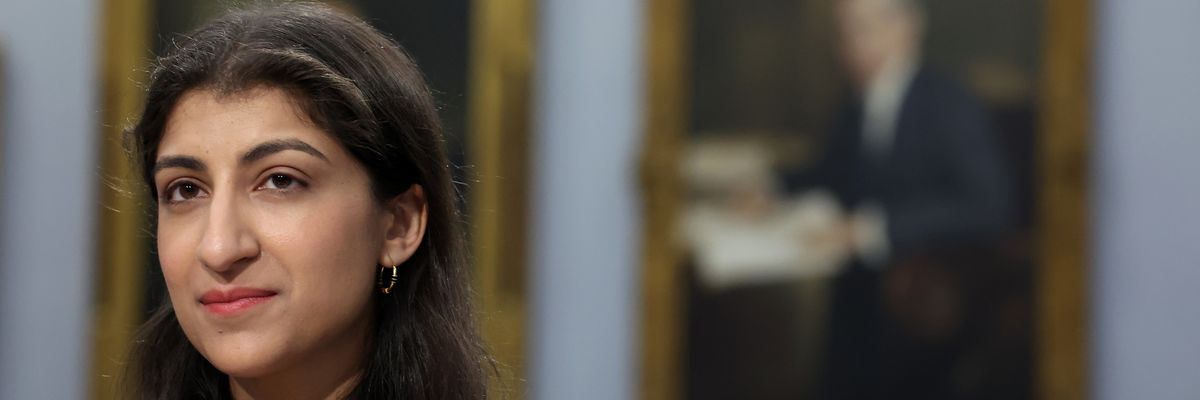
Lina Khan, former chair of the Federal Trade Commission (FTC), testifies before the House Appropriations Subcommittee on May 15, 2024 in Washington, DC.
The Federal Trade Commission's decision to settle with Amazon would be "a big relief for the executives who knowingly harmed their customers," added Khan.
The Federal Trade Commission announced on Thursday it had reached a settlement with Amazon over allegations that the online retailer had tricked consumers into subscribing to its Prime service—but the woman who led the FTC under former President Joe Biden was not impressed.
According to the FTC, Amazon has agreed to pay $2.5 billion to settle claims that it deceived customers into subscribing to Prime and then deliberately made it difficult for them to cancel. In all, Amazon will pay a $1 billion civil penalty, as well as $1.5 billion in refunds to consumers who unwittingly subscribed to Prime.
FTC Chairman Andrew Ferguson framed the settlement as a victory for the Trump administration and touted the deal as "a record-breaking, monumental win for the millions of Americans who are tired of deceptive subscriptions that feel impossible to cancel." Ferguson also said the settlement would ensure "Amazon never does this again."
Amazon, for its part, said in a statement that it didn't break any laws despite agreeing to pay out billions.
"Amazon and our executives have always followed the law and this settlement allows us to move forward and focus on innovating for customers," the company said. "We work incredibly hard to make it clear and simple for customers to both sign up or cancel their Prime membership, and to offer substantial value for our many millions of loyal Prime members around the world."
However, former FTC Chairwoman Lina Khan accused the agency of letting Amazon off easy, while describing the $2.5 billion settlement as a "drop in the bucket" for the tech giant.
"In 2023, we sued Amazon and several top executives for tricking people into Prime subscriptions and then making it absurdly difficult to cancel," she explained in a post on X. "This week marked the start of a historic jury trial, where American citizens would hear details of Amazon’s business practices and determine if it had broken the law. A couple of days into trial, FTC announces it has settled all charges, rescuing Amazon from likely being found liable for having violated the law and allowing it to pay its way out."
Khan added that the settlement was "no doubt, a big relief for the executives who knowingly harmed their customers."
Amazon currently has a market cap of over $2.3 trillion, meaning the $2.5 billion settlement represents a little more than one-tenth of 1% of its total worth. Its billionaire founder, Jeff Bezos, is among the richest people on Earth, with an estimated net worth of nearly $240 billion.
Matthew Stoller, an antitrust advocate and researcher at the American Economic Liberties Project, faulted the FTC for letting Amazon settle without any admission of wrongdoing.
"A judge already ruled in summary judgment they violated the law," Stoller observed.
Amazon may not be completely out of the woods legally, however.
As NPR noted on Thursday, Amazon "still faces another, bigger federal lawsuit, in which the FTC has accused the company of functioning as a monopoly." That trial is currently projected to begin in early 2027, NPR added.
Dear Common Dreams reader, It’s been nearly 30 years since I co-founded Common Dreams with my late wife, Lina Newhouser. We had the radical notion that journalism should serve the public good, not corporate profits. It was clear to us from the outset what it would take to build such a project. No paid advertisements. No corporate sponsors. No millionaire publisher telling us what to think or do. Many people said we wouldn't last a year, but we proved those doubters wrong. Together with a tremendous team of journalists and dedicated staff, we built an independent media outlet free from the constraints of profits and corporate control. Our mission has always been simple: To inform. To inspire. To ignite change for the common good. Building Common Dreams was not easy. Our survival was never guaranteed. When you take on the most powerful forces—Wall Street greed, fossil fuel industry destruction, Big Tech lobbyists, and uber-rich oligarchs who have spent billions upon billions rigging the economy and democracy in their favor—the only bulwark you have is supporters who believe in your work. But here’s the urgent message from me today. It's never been this bad out there. And it's never been this hard to keep us going. At the very moment Common Dreams is most needed, the threats we face are intensifying. We need your support now more than ever. We don't accept corporate advertising and never will. We don't have a paywall because we don't think people should be blocked from critical news based on their ability to pay. Everything we do is funded by the donations of readers like you. When everyone does the little they can afford, we are strong. But if that support retreats or dries up, so do we. Will you donate now to make sure Common Dreams not only survives but thrives? —Craig Brown, Co-founder |
The Federal Trade Commission announced on Thursday it had reached a settlement with Amazon over allegations that the online retailer had tricked consumers into subscribing to its Prime service—but the woman who led the FTC under former President Joe Biden was not impressed.
According to the FTC, Amazon has agreed to pay $2.5 billion to settle claims that it deceived customers into subscribing to Prime and then deliberately made it difficult for them to cancel. In all, Amazon will pay a $1 billion civil penalty, as well as $1.5 billion in refunds to consumers who unwittingly subscribed to Prime.
FTC Chairman Andrew Ferguson framed the settlement as a victory for the Trump administration and touted the deal as "a record-breaking, monumental win for the millions of Americans who are tired of deceptive subscriptions that feel impossible to cancel." Ferguson also said the settlement would ensure "Amazon never does this again."
Amazon, for its part, said in a statement that it didn't break any laws despite agreeing to pay out billions.
"Amazon and our executives have always followed the law and this settlement allows us to move forward and focus on innovating for customers," the company said. "We work incredibly hard to make it clear and simple for customers to both sign up or cancel their Prime membership, and to offer substantial value for our many millions of loyal Prime members around the world."
However, former FTC Chairwoman Lina Khan accused the agency of letting Amazon off easy, while describing the $2.5 billion settlement as a "drop in the bucket" for the tech giant.
"In 2023, we sued Amazon and several top executives for tricking people into Prime subscriptions and then making it absurdly difficult to cancel," she explained in a post on X. "This week marked the start of a historic jury trial, where American citizens would hear details of Amazon’s business practices and determine if it had broken the law. A couple of days into trial, FTC announces it has settled all charges, rescuing Amazon from likely being found liable for having violated the law and allowing it to pay its way out."
Khan added that the settlement was "no doubt, a big relief for the executives who knowingly harmed their customers."
Amazon currently has a market cap of over $2.3 trillion, meaning the $2.5 billion settlement represents a little more than one-tenth of 1% of its total worth. Its billionaire founder, Jeff Bezos, is among the richest people on Earth, with an estimated net worth of nearly $240 billion.
Matthew Stoller, an antitrust advocate and researcher at the American Economic Liberties Project, faulted the FTC for letting Amazon settle without any admission of wrongdoing.
"A judge already ruled in summary judgment they violated the law," Stoller observed.
Amazon may not be completely out of the woods legally, however.
As NPR noted on Thursday, Amazon "still faces another, bigger federal lawsuit, in which the FTC has accused the company of functioning as a monopoly." That trial is currently projected to begin in early 2027, NPR added.
The Federal Trade Commission announced on Thursday it had reached a settlement with Amazon over allegations that the online retailer had tricked consumers into subscribing to its Prime service—but the woman who led the FTC under former President Joe Biden was not impressed.
According to the FTC, Amazon has agreed to pay $2.5 billion to settle claims that it deceived customers into subscribing to Prime and then deliberately made it difficult for them to cancel. In all, Amazon will pay a $1 billion civil penalty, as well as $1.5 billion in refunds to consumers who unwittingly subscribed to Prime.
FTC Chairman Andrew Ferguson framed the settlement as a victory for the Trump administration and touted the deal as "a record-breaking, monumental win for the millions of Americans who are tired of deceptive subscriptions that feel impossible to cancel." Ferguson also said the settlement would ensure "Amazon never does this again."
Amazon, for its part, said in a statement that it didn't break any laws despite agreeing to pay out billions.
"Amazon and our executives have always followed the law and this settlement allows us to move forward and focus on innovating for customers," the company said. "We work incredibly hard to make it clear and simple for customers to both sign up or cancel their Prime membership, and to offer substantial value for our many millions of loyal Prime members around the world."
However, former FTC Chairwoman Lina Khan accused the agency of letting Amazon off easy, while describing the $2.5 billion settlement as a "drop in the bucket" for the tech giant.
"In 2023, we sued Amazon and several top executives for tricking people into Prime subscriptions and then making it absurdly difficult to cancel," she explained in a post on X. "This week marked the start of a historic jury trial, where American citizens would hear details of Amazon’s business practices and determine if it had broken the law. A couple of days into trial, FTC announces it has settled all charges, rescuing Amazon from likely being found liable for having violated the law and allowing it to pay its way out."
Khan added that the settlement was "no doubt, a big relief for the executives who knowingly harmed their customers."
Amazon currently has a market cap of over $2.3 trillion, meaning the $2.5 billion settlement represents a little more than one-tenth of 1% of its total worth. Its billionaire founder, Jeff Bezos, is among the richest people on Earth, with an estimated net worth of nearly $240 billion.
Matthew Stoller, an antitrust advocate and researcher at the American Economic Liberties Project, faulted the FTC for letting Amazon settle without any admission of wrongdoing.
"A judge already ruled in summary judgment they violated the law," Stoller observed.
Amazon may not be completely out of the woods legally, however.
As NPR noted on Thursday, Amazon "still faces another, bigger federal lawsuit, in which the FTC has accused the company of functioning as a monopoly." That trial is currently projected to begin in early 2027, NPR added.