

SUBSCRIBE TO OUR FREE NEWSLETTER
Daily news & progressive opinion—funded by the people, not the corporations—delivered straight to your inbox.
5
#000000
#FFFFFF
To donate by check, phone, or other method, see our More Ways to Give page.
Daily news & progressive opinion—funded by the people, not the corporations—delivered straight to your inbox.
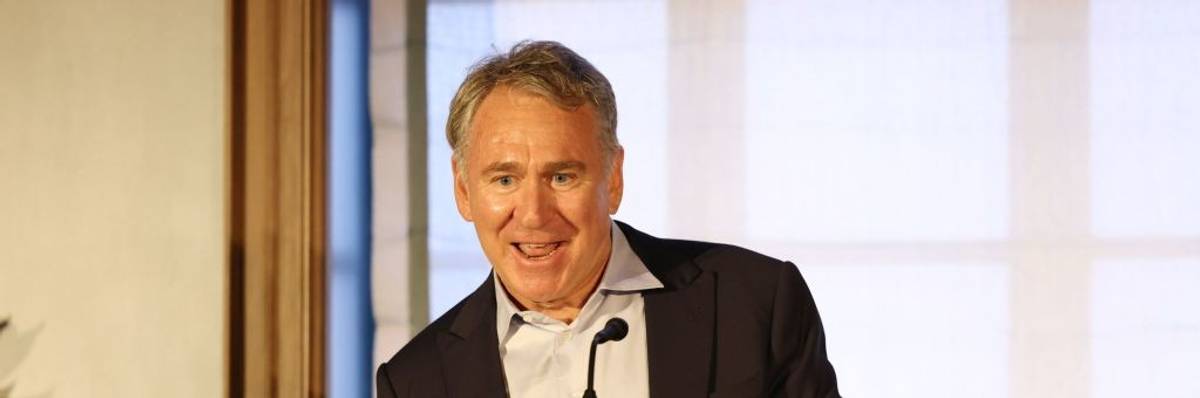
Billionaire hedge fund manager Kenneth Griffin speaks at an event in Miami in April 2024.
The top 50 contributors "skew Republican" but the list includes donors to both major parties, an analysis from The Washington Post showed.
Just 50 donors have contributed more than $1.5 billion in total to the 2024 federal elections, The Washington Post reported Monday, based on an analysis of Federal Election Commission data.
The Post's top 50 list, which includes contributions reported by August 20, is comprised mainly of individual megadonors but also includes some organizations. Most of the contributions accounted for in the list have gone to super political action committees (PACs), which can accept unlimited funds from individuals and corporations, thanks to the 2010 Citizens United ruling by the U.S. Supreme Court that loosened campaign finance law.
Monday's list led critics of the political system to lash out on social media, with one X user arguing that billionaire influence is undemocratic and leads to policies that hurt the working class, and another positing that it showed "capitalists bankrolling both capitalist parties."
Thanks to Citizens United and the Supreme Court.
Meet the megadonors pumping millions into the 2024 election https://t.co/PJHj74bm2U
— Jeff (Gutenberg Parenthesis) Jarvis (@jeffjarvis) August 26, 2024
The Post reported that those on the list "skew Republican" and the top several individual donors on the list are in fact Republicans.
The top donor is Timothy Mellon, an 82-year-old billionaire who was heir to a banking fortune and has given $165 million in total this cycle. He contributed $125 million to the Make America Great Again (MAGA) Inc. super PAC, which supports Republican nominee Donald Trump, and $25 million to Robert F. Kennedy Jr.'s now defunct campaign.
Kennedy withdrew from the presidential race Friday and endorsed Trump. Former U.S. Labor Secretary Robert Reich, who's now a a professor and progressive commentator, said the Trump-Kennedy union was no surprise, given that they shared the same "billionaire nepo baby" donor.
Number two on the Post's individual list is Kenneth Griffin, a billionaire hedge fund manager who's given $75.7 million this cycle, largely to congressional races. The top individual Democratic donor is Michael Bloomberg at $41 million.
The list's top organizational donor is Coinbase, a corporation that hosts a cryptocurrency exchange platform and pushes for deregulation of the industry. Coinbase made an $86 million contribution to the pro-crypto super PAC Fairshake, which spent heavily to influence primaries in both parties. For example, Fairshake spent $2 million to help defeat Rep. Jamaal Bowman (D-N.Y.), a progressive who was also the target of pro-Israel super PACs.
Coinbase is one of several cryptocurrency organizations on the list, as the industry moves to expand its influence in Washington. Sen. JD Vance (R-Ohio), Trump's running mate, reportedly has ties to cryptocurrency interests.
Super PACs aren't legally allowed to coordinate their electioneering efforts with campaigns but regularly do so, according to media reports, and in any case can wield great influence by, for example, buying advertising to support—or attack—a candidate. The FEC has also eased coordination rules for canvassing and paid materials.
Progressives have recently amplified their calls for campaign finance reform. Last week, OpenSecrets, a nonprofit campaign finance watchdog, released an analysis showing that super PACs had spent over $1.1 billion on federal elections through August 15, more than half of it on the presidential election.
OpenSecrets said this was roughly double what super PAC spending had been up until the same point in the 2020 cycle. The group found that MAGA Inc. was by far the largest super PAC spender so far this cycle, with about $125 million in outflows.
Sen. Bernie Sanders (I-Vt.) spoke forcefully about the need for a better campaign finance system in a speech at the Democratic National Convention last week.
"Billionaires in both parties should not be able to buy elections, including primary elections," he said. "For the sake of our democracy, we must overturn the disastrous Citizens United Supreme Court decision and move toward public funding of elections."
Dear Common Dreams reader, It’s been nearly 30 years since I co-founded Common Dreams with my late wife, Lina Newhouser. We had the radical notion that journalism should serve the public good, not corporate profits. It was clear to us from the outset what it would take to build such a project. No paid advertisements. No corporate sponsors. No millionaire publisher telling us what to think or do. Many people said we wouldn't last a year, but we proved those doubters wrong. Together with a tremendous team of journalists and dedicated staff, we built an independent media outlet free from the constraints of profits and corporate control. Our mission has always been simple: To inform. To inspire. To ignite change for the common good. Building Common Dreams was not easy. Our survival was never guaranteed. When you take on the most powerful forces—Wall Street greed, fossil fuel industry destruction, Big Tech lobbyists, and uber-rich oligarchs who have spent billions upon billions rigging the economy and democracy in their favor—the only bulwark you have is supporters who believe in your work. But here’s the urgent message from me today. It's never been this bad out there. And it's never been this hard to keep us going. At the very moment Common Dreams is most needed, the threats we face are intensifying. We need your support now more than ever. We don't accept corporate advertising and never will. We don't have a paywall because we don't think people should be blocked from critical news based on their ability to pay. Everything we do is funded by the donations of readers like you. When everyone does the little they can afford, we are strong. But if that support retreats or dries up, so do we. Will you donate now to make sure Common Dreams not only survives but thrives? —Craig Brown, Co-founder |
Just 50 donors have contributed more than $1.5 billion in total to the 2024 federal elections, The Washington Post reported Monday, based on an analysis of Federal Election Commission data.
The Post's top 50 list, which includes contributions reported by August 20, is comprised mainly of individual megadonors but also includes some organizations. Most of the contributions accounted for in the list have gone to super political action committees (PACs), which can accept unlimited funds from individuals and corporations, thanks to the 2010 Citizens United ruling by the U.S. Supreme Court that loosened campaign finance law.
Monday's list led critics of the political system to lash out on social media, with one X user arguing that billionaire influence is undemocratic and leads to policies that hurt the working class, and another positing that it showed "capitalists bankrolling both capitalist parties."
Thanks to Citizens United and the Supreme Court.
Meet the megadonors pumping millions into the 2024 election https://t.co/PJHj74bm2U
— Jeff (Gutenberg Parenthesis) Jarvis (@jeffjarvis) August 26, 2024
The Post reported that those on the list "skew Republican" and the top several individual donors on the list are in fact Republicans.
The top donor is Timothy Mellon, an 82-year-old billionaire who was heir to a banking fortune and has given $165 million in total this cycle. He contributed $125 million to the Make America Great Again (MAGA) Inc. super PAC, which supports Republican nominee Donald Trump, and $25 million to Robert F. Kennedy Jr.'s now defunct campaign.
Kennedy withdrew from the presidential race Friday and endorsed Trump. Former U.S. Labor Secretary Robert Reich, who's now a a professor and progressive commentator, said the Trump-Kennedy union was no surprise, given that they shared the same "billionaire nepo baby" donor.
Number two on the Post's individual list is Kenneth Griffin, a billionaire hedge fund manager who's given $75.7 million this cycle, largely to congressional races. The top individual Democratic donor is Michael Bloomberg at $41 million.
The list's top organizational donor is Coinbase, a corporation that hosts a cryptocurrency exchange platform and pushes for deregulation of the industry. Coinbase made an $86 million contribution to the pro-crypto super PAC Fairshake, which spent heavily to influence primaries in both parties. For example, Fairshake spent $2 million to help defeat Rep. Jamaal Bowman (D-N.Y.), a progressive who was also the target of pro-Israel super PACs.
Coinbase is one of several cryptocurrency organizations on the list, as the industry moves to expand its influence in Washington. Sen. JD Vance (R-Ohio), Trump's running mate, reportedly has ties to cryptocurrency interests.
Super PACs aren't legally allowed to coordinate their electioneering efforts with campaigns but regularly do so, according to media reports, and in any case can wield great influence by, for example, buying advertising to support—or attack—a candidate. The FEC has also eased coordination rules for canvassing and paid materials.
Progressives have recently amplified their calls for campaign finance reform. Last week, OpenSecrets, a nonprofit campaign finance watchdog, released an analysis showing that super PACs had spent over $1.1 billion on federal elections through August 15, more than half of it on the presidential election.
OpenSecrets said this was roughly double what super PAC spending had been up until the same point in the 2020 cycle. The group found that MAGA Inc. was by far the largest super PAC spender so far this cycle, with about $125 million in outflows.
Sen. Bernie Sanders (I-Vt.) spoke forcefully about the need for a better campaign finance system in a speech at the Democratic National Convention last week.
"Billionaires in both parties should not be able to buy elections, including primary elections," he said. "For the sake of our democracy, we must overturn the disastrous Citizens United Supreme Court decision and move toward public funding of elections."
Just 50 donors have contributed more than $1.5 billion in total to the 2024 federal elections, The Washington Post reported Monday, based on an analysis of Federal Election Commission data.
The Post's top 50 list, which includes contributions reported by August 20, is comprised mainly of individual megadonors but also includes some organizations. Most of the contributions accounted for in the list have gone to super political action committees (PACs), which can accept unlimited funds from individuals and corporations, thanks to the 2010 Citizens United ruling by the U.S. Supreme Court that loosened campaign finance law.
Monday's list led critics of the political system to lash out on social media, with one X user arguing that billionaire influence is undemocratic and leads to policies that hurt the working class, and another positing that it showed "capitalists bankrolling both capitalist parties."
Thanks to Citizens United and the Supreme Court.
Meet the megadonors pumping millions into the 2024 election https://t.co/PJHj74bm2U
— Jeff (Gutenberg Parenthesis) Jarvis (@jeffjarvis) August 26, 2024
The Post reported that those on the list "skew Republican" and the top several individual donors on the list are in fact Republicans.
The top donor is Timothy Mellon, an 82-year-old billionaire who was heir to a banking fortune and has given $165 million in total this cycle. He contributed $125 million to the Make America Great Again (MAGA) Inc. super PAC, which supports Republican nominee Donald Trump, and $25 million to Robert F. Kennedy Jr.'s now defunct campaign.
Kennedy withdrew from the presidential race Friday and endorsed Trump. Former U.S. Labor Secretary Robert Reich, who's now a a professor and progressive commentator, said the Trump-Kennedy union was no surprise, given that they shared the same "billionaire nepo baby" donor.
Number two on the Post's individual list is Kenneth Griffin, a billionaire hedge fund manager who's given $75.7 million this cycle, largely to congressional races. The top individual Democratic donor is Michael Bloomberg at $41 million.
The list's top organizational donor is Coinbase, a corporation that hosts a cryptocurrency exchange platform and pushes for deregulation of the industry. Coinbase made an $86 million contribution to the pro-crypto super PAC Fairshake, which spent heavily to influence primaries in both parties. For example, Fairshake spent $2 million to help defeat Rep. Jamaal Bowman (D-N.Y.), a progressive who was also the target of pro-Israel super PACs.
Coinbase is one of several cryptocurrency organizations on the list, as the industry moves to expand its influence in Washington. Sen. JD Vance (R-Ohio), Trump's running mate, reportedly has ties to cryptocurrency interests.
Super PACs aren't legally allowed to coordinate their electioneering efforts with campaigns but regularly do so, according to media reports, and in any case can wield great influence by, for example, buying advertising to support—or attack—a candidate. The FEC has also eased coordination rules for canvassing and paid materials.
Progressives have recently amplified their calls for campaign finance reform. Last week, OpenSecrets, a nonprofit campaign finance watchdog, released an analysis showing that super PACs had spent over $1.1 billion on federal elections through August 15, more than half of it on the presidential election.
OpenSecrets said this was roughly double what super PAC spending had been up until the same point in the 2020 cycle. The group found that MAGA Inc. was by far the largest super PAC spender so far this cycle, with about $125 million in outflows.
Sen. Bernie Sanders (I-Vt.) spoke forcefully about the need for a better campaign finance system in a speech at the Democratic National Convention last week.
"Billionaires in both parties should not be able to buy elections, including primary elections," he said. "For the sake of our democracy, we must overturn the disastrous Citizens United Supreme Court decision and move toward public funding of elections."

