

SUBSCRIBE TO OUR FREE NEWSLETTER
Daily news & progressive opinion—funded by the people, not the corporations—delivered straight to your inbox.
5
#000000
#FFFFFF
To donate by check, phone, or other method, see our More Ways to Give page.
Daily news & progressive opinion—funded by the people, not the corporations—delivered straight to your inbox.
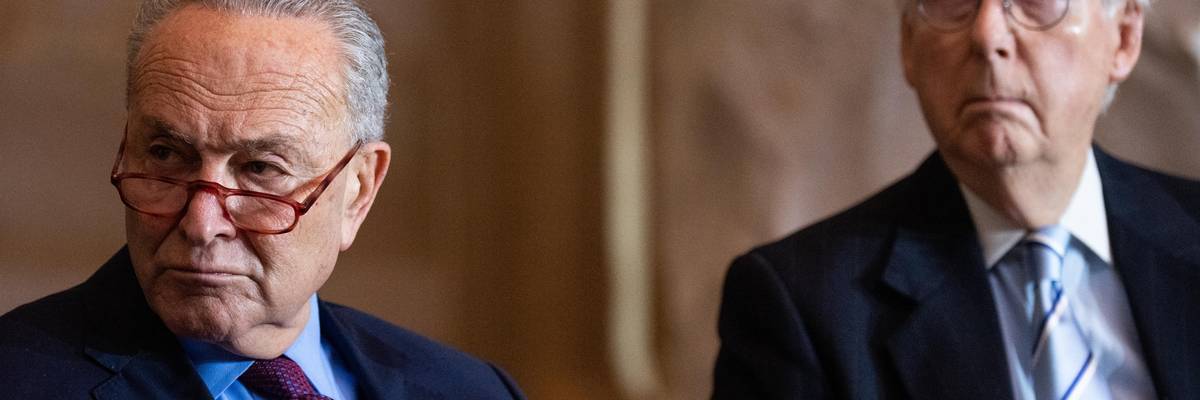
Senate Majority Leader Chuck Schumer (D-N.Y.) and Senate Minority Leader Mitch McConnell (R-Ky.) attend the Congressional Gold Medal Ceremony in the Capitol Rotunda on December 6, 2022.
Progressive advocacy groups and economic analysts on Tuesday denounced retirement savings-related tax changes embedded in Congress' end-of-year $1.7 trillion spending package, characterizing the pending reforms taken directly from the SECURE 2.0 Act as a "giveaway to the rich."
"This bill does not make it easier for workers to save for retirement, it just makes it easier for high-income earners to shelter more of their earnings from taxes."
According to Patriotic Millionaires, a group of wealthy tax fairness champions, the must-pass omnibus bill includes "some minor provisions to help low-income earners save for retirement, but the vast majority are designed to allow high earners to avoid paying more taxes."
Morris Pearl, the group's chair and a former managing director at BlackRock, said: "I'm tired of tax cuts for the rich being sold as help for the poor. The retirement changes in the omnibus package overwhelmingly benefit wealthy people like me while doing almost nothing for the people who truly struggle to save for retirement. This bill does not make it easier for workers to save for retirement, it just makes it easier for high-income earners to shelter more of their earnings from taxes."
"This law will make my heirs hundreds of thousands of dollars wealthier," said Pearl. "It will do virtually nothing for the worker who toasted my bagel this morning. This may be good for the children of some rich people, but in the long run, the increased inequality it creates is bad for everyone, including my own family."
"This legislation is not what America needs to help workers save for retirement," he added. "Congress should scrap SECURE 2.0 and start from scratch with something that would help all Americans, not just the rich, save for a comfortable, well-deserved retirement. A multibillion dollar tax cut for the rich should not be the last act of a Democratic Congress."
Pearl was not alone in criticizing the retirement savings-related tax provisions included in the fiscal year 2023 appropriations bill.
Sharon Parrott, president of the Center on Budget and Policy Priorities, said that some of the changes "are laudatory, such as creating a savings match for low-income savers and allowing certain kinds of savings to be tapped for emergency purposes and not just retirement."
"But others expand existing unnecessary and regressive tax subsidies for people nearing or deep into retirement," she continued. "For example, affluent people will now be able to wait until age 75 before they are required to touch their tax-favored 'retirement' account."
Parrott added that "it is particularly unfortunate that these tax cuts are in the package while a provision to allow very low-income seniors and people with disabilities to have modest savings and still qualify for income assistance through the Supplemental Security Income program was excluded, despite bipartisan efforts to include it."
In an email to Common Dreams, the Institute on Taxation and Economic Policy (ITEP) also lamented the omnibus package's inclusion of bipartisan retirement legislation that "would mainly help the well-off."
The reforms in question "will exacerbate inequality that is already pervasive in tax benefits for retirement savings," ITEP warned. "Currently, the wealthiest 40% of taxpayers receive 87% of those benefits."
Dear Common Dreams reader, It’s been nearly 30 years since I co-founded Common Dreams with my late wife, Lina Newhouser. We had the radical notion that journalism should serve the public good, not corporate profits. It was clear to us from the outset what it would take to build such a project. No paid advertisements. No corporate sponsors. No millionaire publisher telling us what to think or do. Many people said we wouldn't last a year, but we proved those doubters wrong. Together with a tremendous team of journalists and dedicated staff, we built an independent media outlet free from the constraints of profits and corporate control. Our mission has always been simple: To inform. To inspire. To ignite change for the common good. Building Common Dreams was not easy. Our survival was never guaranteed. When you take on the most powerful forces—Wall Street greed, fossil fuel industry destruction, Big Tech lobbyists, and uber-rich oligarchs who have spent billions upon billions rigging the economy and democracy in their favor—the only bulwark you have is supporters who believe in your work. But here’s the urgent message from me today. It's never been this bad out there. And it's never been this hard to keep us going. At the very moment Common Dreams is most needed, the threats we face are intensifying. We need your support now more than ever. We don't accept corporate advertising and never will. We don't have a paywall because we don't think people should be blocked from critical news based on their ability to pay. Everything we do is funded by the donations of readers like you. When everyone does the little they can afford, we are strong. But if that support retreats or dries up, so do we. Will you donate now to make sure Common Dreams not only survives but thrives? —Craig Brown, Co-founder |
Progressive advocacy groups and economic analysts on Tuesday denounced retirement savings-related tax changes embedded in Congress' end-of-year $1.7 trillion spending package, characterizing the pending reforms taken directly from the SECURE 2.0 Act as a "giveaway to the rich."
"This bill does not make it easier for workers to save for retirement, it just makes it easier for high-income earners to shelter more of their earnings from taxes."
According to Patriotic Millionaires, a group of wealthy tax fairness champions, the must-pass omnibus bill includes "some minor provisions to help low-income earners save for retirement, but the vast majority are designed to allow high earners to avoid paying more taxes."
Morris Pearl, the group's chair and a former managing director at BlackRock, said: "I'm tired of tax cuts for the rich being sold as help for the poor. The retirement changes in the omnibus package overwhelmingly benefit wealthy people like me while doing almost nothing for the people who truly struggle to save for retirement. This bill does not make it easier for workers to save for retirement, it just makes it easier for high-income earners to shelter more of their earnings from taxes."
"This law will make my heirs hundreds of thousands of dollars wealthier," said Pearl. "It will do virtually nothing for the worker who toasted my bagel this morning. This may be good for the children of some rich people, but in the long run, the increased inequality it creates is bad for everyone, including my own family."
"This legislation is not what America needs to help workers save for retirement," he added. "Congress should scrap SECURE 2.0 and start from scratch with something that would help all Americans, not just the rich, save for a comfortable, well-deserved retirement. A multibillion dollar tax cut for the rich should not be the last act of a Democratic Congress."
Pearl was not alone in criticizing the retirement savings-related tax provisions included in the fiscal year 2023 appropriations bill.
Sharon Parrott, president of the Center on Budget and Policy Priorities, said that some of the changes "are laudatory, such as creating a savings match for low-income savers and allowing certain kinds of savings to be tapped for emergency purposes and not just retirement."
"But others expand existing unnecessary and regressive tax subsidies for people nearing or deep into retirement," she continued. "For example, affluent people will now be able to wait until age 75 before they are required to touch their tax-favored 'retirement' account."
Parrott added that "it is particularly unfortunate that these tax cuts are in the package while a provision to allow very low-income seniors and people with disabilities to have modest savings and still qualify for income assistance through the Supplemental Security Income program was excluded, despite bipartisan efforts to include it."
In an email to Common Dreams, the Institute on Taxation and Economic Policy (ITEP) also lamented the omnibus package's inclusion of bipartisan retirement legislation that "would mainly help the well-off."
The reforms in question "will exacerbate inequality that is already pervasive in tax benefits for retirement savings," ITEP warned. "Currently, the wealthiest 40% of taxpayers receive 87% of those benefits."
Progressive advocacy groups and economic analysts on Tuesday denounced retirement savings-related tax changes embedded in Congress' end-of-year $1.7 trillion spending package, characterizing the pending reforms taken directly from the SECURE 2.0 Act as a "giveaway to the rich."
"This bill does not make it easier for workers to save for retirement, it just makes it easier for high-income earners to shelter more of their earnings from taxes."
According to Patriotic Millionaires, a group of wealthy tax fairness champions, the must-pass omnibus bill includes "some minor provisions to help low-income earners save for retirement, but the vast majority are designed to allow high earners to avoid paying more taxes."
Morris Pearl, the group's chair and a former managing director at BlackRock, said: "I'm tired of tax cuts for the rich being sold as help for the poor. The retirement changes in the omnibus package overwhelmingly benefit wealthy people like me while doing almost nothing for the people who truly struggle to save for retirement. This bill does not make it easier for workers to save for retirement, it just makes it easier for high-income earners to shelter more of their earnings from taxes."
"This law will make my heirs hundreds of thousands of dollars wealthier," said Pearl. "It will do virtually nothing for the worker who toasted my bagel this morning. This may be good for the children of some rich people, but in the long run, the increased inequality it creates is bad for everyone, including my own family."
"This legislation is not what America needs to help workers save for retirement," he added. "Congress should scrap SECURE 2.0 and start from scratch with something that would help all Americans, not just the rich, save for a comfortable, well-deserved retirement. A multibillion dollar tax cut for the rich should not be the last act of a Democratic Congress."
Pearl was not alone in criticizing the retirement savings-related tax provisions included in the fiscal year 2023 appropriations bill.
Sharon Parrott, president of the Center on Budget and Policy Priorities, said that some of the changes "are laudatory, such as creating a savings match for low-income savers and allowing certain kinds of savings to be tapped for emergency purposes and not just retirement."
"But others expand existing unnecessary and regressive tax subsidies for people nearing or deep into retirement," she continued. "For example, affluent people will now be able to wait until age 75 before they are required to touch their tax-favored 'retirement' account."
Parrott added that "it is particularly unfortunate that these tax cuts are in the package while a provision to allow very low-income seniors and people with disabilities to have modest savings and still qualify for income assistance through the Supplemental Security Income program was excluded, despite bipartisan efforts to include it."
In an email to Common Dreams, the Institute on Taxation and Economic Policy (ITEP) also lamented the omnibus package's inclusion of bipartisan retirement legislation that "would mainly help the well-off."
The reforms in question "will exacerbate inequality that is already pervasive in tax benefits for retirement savings," ITEP warned. "Currently, the wealthiest 40% of taxpayers receive 87% of those benefits."

