SUBSCRIBE TO OUR FREE NEWSLETTER
Daily news & progressive opinion—funded by the people, not the corporations—delivered straight to your inbox.
5
#000000
#FFFFFF
To donate by check, phone, or other method, see our More Ways to Give page.
Daily news & progressive opinion—funded by the people, not the corporations—delivered straight to your inbox.
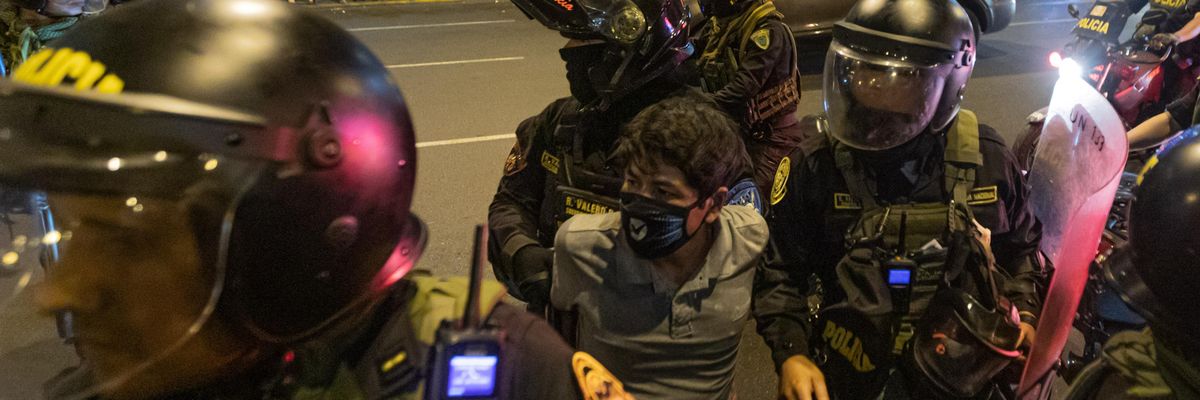
Police detain a young man during December 15, 2022 demonstrations in Lima, the Peruvian capital, against the removal and jailing of erstwhile President Pedro Castillo. (Photo: Lucas Aguayo/Picture Alliance via Getty Images)
Peruvian human rights defenders said Friday that the death toll has risen to 21 in nationwide protests sparked by the ouster and jailing of leftist President Pedro Castillo, whose pretrial imprisonment term was extended to 18 months by the Andean country's high court.
"It's becoming clear that early elections will not be enough to quiet the protests."
For the 10 straight day, Peruvians took to the streets of cities and towns across the country, denouncing what many are calling a "coup" against Castillo, while demanding his immediate release, the removal of unelected interim President Dina Boluarte, the dissolution of Congress, and new elections.
Protesters defied bullets, batons, gas bombs, curfews, and a 30-day national state of emergency declared on Wednesday, a move that suspended the right to assemble and move freely about the country.
Demonstrators blocked roads, leading to the deaths of six people in traffic accidents, according to The Guardian. Peru's El Commercio reports a 12-day-old baby being rushed to a hospital in Lima died due to roadblocks. Protesters also forced the closure of five airports, leaving travelers and tourists stranded in places including near the popular Machu Picchu complex.
In addition to the deaths, at least 426 people, including 216 security personnel, have been wounded in the capital Lima and other regions, the Ombudsman's Office of Peru said.
Reuters reports eight people were killed Thursday as state security forces moved to suppress protests in the southern Andean city of Ayacucho, where demonstrators torched the local judiciary and prosecutor's office. The city's government blamed Boluarte and her defense and interior ministers for the deaths while demanding "an immediate cessation of the use of firearms... against our people."
Citing a flight risk posed by Castillo, a judicial panel of Peru's Supreme Court of Justice on Thursday ordered the deposed president held for 18 months while prosecutors investigate charges of rebellion and conspiracy. Prior to his removal, Castillo attempted to dissolve Congress and declare an emergency government in which he would rule by decree.
Castillo denies the charges. On Thursday, his Twitter account posted a handwritten note in which Castillo sounded the alarm over a meeting held the day before his removal at the Government Palace in Lima between Boluarte and U.S. Ambassador Lisa Kenna, a former longtime CIA agent appointed by former President Donald Trump.
The note alleges the meeting "was to give the order to take the troops out into the streets and massacre my defenseless people; and, incidentally, leave the way clear for mining exploitation, as in the case of Conga, Tia Maria, and others."
Boluarte's office said that Kenna has "reiterated her country's full support for democratic institutions in Peru and for the actions of the constitutional government to stabilize the social situation."
In addition to the United States, Canada, Chile, Costa Rica, Ecuador, and Uruguay have recognized Boluarte's government. On the other hand, leftist leaders of 10 regional nations met Wednesday in Havana, Cuba to "reject the political framework created by right-wing forces" against Castillo.
Earlier this week the leftist leaders of Argentina, Bolivia, Colombia, and Mexico issued a joint statement expressing their "deep concern" over Castillo's ouster and imprisonment.
Peru's National Coordinator for Human Rights (CNDDHH) called for an immediate end to the use of force against protesters, blaming the country's "highest political authorites" for the deaths.
Speaking at a Friday CNDDHH hearing, Rafael Goto, a pastor and former president of the National Evangelical Council, called for early elections and said that "there can be no ethical democracy based on murders."
CNDDHH executive secretary Jennie Dador Tozzini claimed at least 147 cases of arbitrary detention, telling the hearing that "when our lawyers went to police stations, they were not allowed to pass."
Press freedom advocates also condemned attacks on journalists. Zuliana Laines Otero, who heads Peru's National Association of Journalists, said during the hearing there have been 69 such incidents during the protests.
"The freedom of journalists to report is fundamental in a democracy and even more so in a moment of political crisis like the one Peru is experiencing," Human Rights Watch said in response to the arrests.
Dador emphasized that "the right of defense must be exercised from the moment the police arrest you, the democratic space is closing; we are on the way to authoritarianism."
Dear Common Dreams reader, It’s been nearly 30 years since I co-founded Common Dreams with my late wife, Lina Newhouser. We had the radical notion that journalism should serve the public good, not corporate profits. It was clear to us from the outset what it would take to build such a project. No paid advertisements. No corporate sponsors. No millionaire publisher telling us what to think or do. Many people said we wouldn't last a year, but we proved those doubters wrong. Together with a tremendous team of journalists and dedicated staff, we built an independent media outlet free from the constraints of profits and corporate control. Our mission has always been simple: To inform. To inspire. To ignite change for the common good. Building Common Dreams was not easy. Our survival was never guaranteed. When you take on the most powerful forces—Wall Street greed, fossil fuel industry destruction, Big Tech lobbyists, and uber-rich oligarchs who have spent billions upon billions rigging the economy and democracy in their favor—the only bulwark you have is supporters who believe in your work. But here’s the urgent message from me today. It's never been this bad out there. And it's never been this hard to keep us going. At the very moment Common Dreams is most needed, the threats we face are intensifying. We need your support now more than ever. We don't accept corporate advertising and never will. We don't have a paywall because we don't think people should be blocked from critical news based on their ability to pay. Everything we do is funded by the donations of readers like you. When everyone does the little they can afford, we are strong. But if that support retreats or dries up, so do we. Will you donate now to make sure Common Dreams not only survives but thrives? —Craig Brown, Co-founder |
Peruvian human rights defenders said Friday that the death toll has risen to 21 in nationwide protests sparked by the ouster and jailing of leftist President Pedro Castillo, whose pretrial imprisonment term was extended to 18 months by the Andean country's high court.
"It's becoming clear that early elections will not be enough to quiet the protests."
For the 10 straight day, Peruvians took to the streets of cities and towns across the country, denouncing what many are calling a "coup" against Castillo, while demanding his immediate release, the removal of unelected interim President Dina Boluarte, the dissolution of Congress, and new elections.
Protesters defied bullets, batons, gas bombs, curfews, and a 30-day national state of emergency declared on Wednesday, a move that suspended the right to assemble and move freely about the country.
Demonstrators blocked roads, leading to the deaths of six people in traffic accidents, according to The Guardian. Peru's El Commercio reports a 12-day-old baby being rushed to a hospital in Lima died due to roadblocks. Protesters also forced the closure of five airports, leaving travelers and tourists stranded in places including near the popular Machu Picchu complex.
In addition to the deaths, at least 426 people, including 216 security personnel, have been wounded in the capital Lima and other regions, the Ombudsman's Office of Peru said.
Reuters reports eight people were killed Thursday as state security forces moved to suppress protests in the southern Andean city of Ayacucho, where demonstrators torched the local judiciary and prosecutor's office. The city's government blamed Boluarte and her defense and interior ministers for the deaths while demanding "an immediate cessation of the use of firearms... against our people."
Citing a flight risk posed by Castillo, a judicial panel of Peru's Supreme Court of Justice on Thursday ordered the deposed president held for 18 months while prosecutors investigate charges of rebellion and conspiracy. Prior to his removal, Castillo attempted to dissolve Congress and declare an emergency government in which he would rule by decree.
Castillo denies the charges. On Thursday, his Twitter account posted a handwritten note in which Castillo sounded the alarm over a meeting held the day before his removal at the Government Palace in Lima between Boluarte and U.S. Ambassador Lisa Kenna, a former longtime CIA agent appointed by former President Donald Trump.
The note alleges the meeting "was to give the order to take the troops out into the streets and massacre my defenseless people; and, incidentally, leave the way clear for mining exploitation, as in the case of Conga, Tia Maria, and others."
Boluarte's office said that Kenna has "reiterated her country's full support for democratic institutions in Peru and for the actions of the constitutional government to stabilize the social situation."
In addition to the United States, Canada, Chile, Costa Rica, Ecuador, and Uruguay have recognized Boluarte's government. On the other hand, leftist leaders of 10 regional nations met Wednesday in Havana, Cuba to "reject the political framework created by right-wing forces" against Castillo.
Earlier this week the leftist leaders of Argentina, Bolivia, Colombia, and Mexico issued a joint statement expressing their "deep concern" over Castillo's ouster and imprisonment.
Peru's National Coordinator for Human Rights (CNDDHH) called for an immediate end to the use of force against protesters, blaming the country's "highest political authorites" for the deaths.
Speaking at a Friday CNDDHH hearing, Rafael Goto, a pastor and former president of the National Evangelical Council, called for early elections and said that "there can be no ethical democracy based on murders."
CNDDHH executive secretary Jennie Dador Tozzini claimed at least 147 cases of arbitrary detention, telling the hearing that "when our lawyers went to police stations, they were not allowed to pass."
Press freedom advocates also condemned attacks on journalists. Zuliana Laines Otero, who heads Peru's National Association of Journalists, said during the hearing there have been 69 such incidents during the protests.
"The freedom of journalists to report is fundamental in a democracy and even more so in a moment of political crisis like the one Peru is experiencing," Human Rights Watch said in response to the arrests.
Dador emphasized that "the right of defense must be exercised from the moment the police arrest you, the democratic space is closing; we are on the way to authoritarianism."
Peruvian human rights defenders said Friday that the death toll has risen to 21 in nationwide protests sparked by the ouster and jailing of leftist President Pedro Castillo, whose pretrial imprisonment term was extended to 18 months by the Andean country's high court.
"It's becoming clear that early elections will not be enough to quiet the protests."
For the 10 straight day, Peruvians took to the streets of cities and towns across the country, denouncing what many are calling a "coup" against Castillo, while demanding his immediate release, the removal of unelected interim President Dina Boluarte, the dissolution of Congress, and new elections.
Protesters defied bullets, batons, gas bombs, curfews, and a 30-day national state of emergency declared on Wednesday, a move that suspended the right to assemble and move freely about the country.
Demonstrators blocked roads, leading to the deaths of six people in traffic accidents, according to The Guardian. Peru's El Commercio reports a 12-day-old baby being rushed to a hospital in Lima died due to roadblocks. Protesters also forced the closure of five airports, leaving travelers and tourists stranded in places including near the popular Machu Picchu complex.
In addition to the deaths, at least 426 people, including 216 security personnel, have been wounded in the capital Lima and other regions, the Ombudsman's Office of Peru said.
Reuters reports eight people were killed Thursday as state security forces moved to suppress protests in the southern Andean city of Ayacucho, where demonstrators torched the local judiciary and prosecutor's office. The city's government blamed Boluarte and her defense and interior ministers for the deaths while demanding "an immediate cessation of the use of firearms... against our people."
Citing a flight risk posed by Castillo, a judicial panel of Peru's Supreme Court of Justice on Thursday ordered the deposed president held for 18 months while prosecutors investigate charges of rebellion and conspiracy. Prior to his removal, Castillo attempted to dissolve Congress and declare an emergency government in which he would rule by decree.
Castillo denies the charges. On Thursday, his Twitter account posted a handwritten note in which Castillo sounded the alarm over a meeting held the day before his removal at the Government Palace in Lima between Boluarte and U.S. Ambassador Lisa Kenna, a former longtime CIA agent appointed by former President Donald Trump.
The note alleges the meeting "was to give the order to take the troops out into the streets and massacre my defenseless people; and, incidentally, leave the way clear for mining exploitation, as in the case of Conga, Tia Maria, and others."
Boluarte's office said that Kenna has "reiterated her country's full support for democratic institutions in Peru and for the actions of the constitutional government to stabilize the social situation."
In addition to the United States, Canada, Chile, Costa Rica, Ecuador, and Uruguay have recognized Boluarte's government. On the other hand, leftist leaders of 10 regional nations met Wednesday in Havana, Cuba to "reject the political framework created by right-wing forces" against Castillo.
Earlier this week the leftist leaders of Argentina, Bolivia, Colombia, and Mexico issued a joint statement expressing their "deep concern" over Castillo's ouster and imprisonment.
Peru's National Coordinator for Human Rights (CNDDHH) called for an immediate end to the use of force against protesters, blaming the country's "highest political authorites" for the deaths.
Speaking at a Friday CNDDHH hearing, Rafael Goto, a pastor and former president of the National Evangelical Council, called for early elections and said that "there can be no ethical democracy based on murders."
CNDDHH executive secretary Jennie Dador Tozzini claimed at least 147 cases of arbitrary detention, telling the hearing that "when our lawyers went to police stations, they were not allowed to pass."
Press freedom advocates also condemned attacks on journalists. Zuliana Laines Otero, who heads Peru's National Association of Journalists, said during the hearing there have been 69 such incidents during the protests.
"The freedom of journalists to report is fundamental in a democracy and even more so in a moment of political crisis like the one Peru is experiencing," Human Rights Watch said in response to the arrests.
Dador emphasized that "the right of defense must be exercised from the moment the police arrest you, the democratic space is closing; we are on the way to authoritarianism."