SUBSCRIBE TO OUR FREE NEWSLETTER
Daily news & progressive opinion—funded by the people, not the corporations—delivered straight to your inbox.
5
#000000
#FFFFFF
To donate by check, phone, or other method, see our More Ways to Give page.
Daily news & progressive opinion—funded by the people, not the corporations—delivered straight to your inbox.
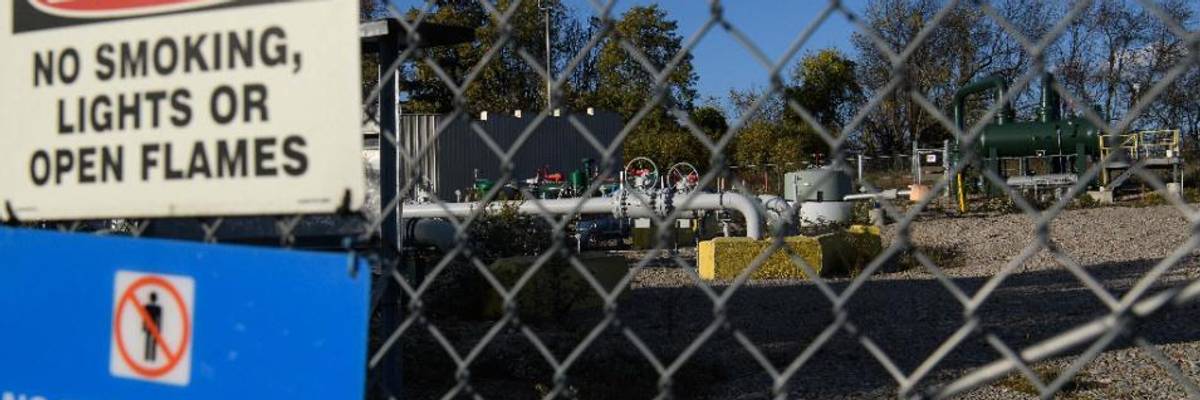
Fracked gas infrastructure is seen in Daisytown, Pennsylvania on October 22, 2020.
A leak that erupted at a methane storage facility in western Pennsylvania on November 6 spewed massive amounts of the highly potent greenhouse gas for a week and a half, reigniting demands on Friday to better regulate and eventually euthanize the fracking industry as part of a crucial transition from fossil fuels to clean energy.
As the Pittsburgh Post-Gazette reported Thursday morning before venting was stopped:
A natural gas storage well in Cambria County has been leaking gas for 10 days, blanketing the mountains in Jackson Township with a roar like a jet engine and its valleys with an odor of hydrocarbons.
Equitrans Midstream Corp., which owns the well, has estimated that the leak may be around 100 million cubic feet a day. The figure is preliminary and has likely fluctuated as the Canonsburg-based company and the specialized well control firm that it brought in have struggled and, so far, failed to kill the well.
At that rate, the well may have already dispensed some 1 billion cubic feet of gas, about 10% of the gas that was recently injected into and held at the Rager Mountain Storage facility in preparation for winter.
By comparison, the Aliso Canyon storage well that leaked for 118 days in California in 2015 and 2016 and is believed to have been the largest methane leak in history, was estimated to have released 4.62 billion cubic feet in total.
Equitrans' contractors finally stopped the flow of methane to the surface on Thursday afternoon, 11 days after the leak began.
"Crews will work 24/7 to monitor the well and prepare the site for plugging activities, which could extend into the weekend," said Equitrans, which plans to investigate what caused the well to start venting methane as soon as it is plugged with cement. At the request of the Pennsylvania Department of Environmental Protection (DEP), Equitrans has set up air monitoring in the area, and regulators have also asked the company to monitor for subsurface leaks as a precaution.
"The only long-term solution is to end fracking in the Keystone State."
In response to the environmental and public health debacle, PennEnvironment executive director David Masur said in a statement that "for Pennsylvania to do its part to tackle climate change, it must act swiftly and aggressively to rein in polluters who emit methane and other global warming pollutants."
So-called "natural" gas is primarily made up of methane. This potent greenhouse gas traps roughly 80 times as much heat as carbon dioxide over the first 20 years after it reaches the atmosphere and is responsible for almost half of the 1.2degC increase in average surface temperatures since the Industrial Revolution.
"Methane is a scourge wherever people drill for oil and gas, and leaks are an inevitable byproduct," said Masur.
As Fossil Free Media director Jamie Henn pointed out, Equitrans is the corporation behind the Mountain Valley Pipeline, a fracked gas project pushed by right-wing Democratic Sen. Joe Manchin and his industry allies in neighboring West Virginia.
Last week, the U.S. Environmental Protection Agency released draft supplemental rules to slash methane pollution from oil and gas producers. Thanks to citizen feedback--including public comments submitted by thousands of Pennsylvanians--the proposed regulations are stronger than those unveiled last year by the agency.
However, as Jean Su of the Center for Biological Diversity points out, "even the best methane reduction plan will be irrelevant if fossil fuels keep expanding."
One of the fastest-growing elements of the fossil fuel industry since the turn of the century has been fracking.
"Pervasive fracking across Pennsylvania means that dangerous leaks, which can come during the fracking process itself, transport, or underground storage--apparently the case in Cambria County--pose constant threats to our health and environment," said Masur.
"Fracking can taint our drinking water, pollute rivers and streams, contaminate public lands, and subject Pennsylvanians to hazardous waste," he noted.
"For now, we need Pennsylvania's DEP and the federal Environmental Protection Agency to crack down on violators of our emissions regulations," Masur continued.
According to PennEnvironment, DEP "issued a combined five violation notices to the facility operator, Equitrans LP, on November 7 and November 8."
The alleged violations include "failure to allow unrestricted access" to the DEP; failure to construct, operate, and maintain the well's integrity; venting "gas to the atmosphere that produced a hazard to the public health and safety"; failing "to operate and maintain the storage reservoir and its facilities as required"; and "conducting a drilling or production activity in a manner that creates a public nuisance or adversely affects public health, safety, welfare, or the environment."
Research published earlier this year found that residential proximity to fracking is correlated with a higher risk of dying early. Another recent study estimated that reducing energy-related air pollution would prevent more than 50,000 premature deaths and save $608 billion per year in the U.S. alone.
Despite the clear case for moving more quickly toward green energy, President Joe Biden has yet to use his executive authority to cancel nearly two dozen fracked gas export projects set to unleash pollution equivalent to roughly 400 new coal-fired power plants.
"Moving forward, the only long-term solution is to end fracking in the Keystone State," Masur stressed. "It's long past time to end our antiquated reliance on fossil fuels and transition our state to power generated by clean, renewable sources such as wind and solar."
Dear Common Dreams reader, It’s been nearly 30 years since I co-founded Common Dreams with my late wife, Lina Newhouser. We had the radical notion that journalism should serve the public good, not corporate profits. It was clear to us from the outset what it would take to build such a project. No paid advertisements. No corporate sponsors. No millionaire publisher telling us what to think or do. Many people said we wouldn't last a year, but we proved those doubters wrong. Together with a tremendous team of journalists and dedicated staff, we built an independent media outlet free from the constraints of profits and corporate control. Our mission has always been simple: To inform. To inspire. To ignite change for the common good. Building Common Dreams was not easy. Our survival was never guaranteed. When you take on the most powerful forces—Wall Street greed, fossil fuel industry destruction, Big Tech lobbyists, and uber-rich oligarchs who have spent billions upon billions rigging the economy and democracy in their favor—the only bulwark you have is supporters who believe in your work. But here’s the urgent message from me today. It's never been this bad out there. And it's never been this hard to keep us going. At the very moment Common Dreams is most needed, the threats we face are intensifying. We need your support now more than ever. We don't accept corporate advertising and never will. We don't have a paywall because we don't think people should be blocked from critical news based on their ability to pay. Everything we do is funded by the donations of readers like you. When everyone does the little they can afford, we are strong. But if that support retreats or dries up, so do we. Will you donate now to make sure Common Dreams not only survives but thrives? —Craig Brown, Co-founder |
A leak that erupted at a methane storage facility in western Pennsylvania on November 6 spewed massive amounts of the highly potent greenhouse gas for a week and a half, reigniting demands on Friday to better regulate and eventually euthanize the fracking industry as part of a crucial transition from fossil fuels to clean energy.
As the Pittsburgh Post-Gazette reported Thursday morning before venting was stopped:
A natural gas storage well in Cambria County has been leaking gas for 10 days, blanketing the mountains in Jackson Township with a roar like a jet engine and its valleys with an odor of hydrocarbons.
Equitrans Midstream Corp., which owns the well, has estimated that the leak may be around 100 million cubic feet a day. The figure is preliminary and has likely fluctuated as the Canonsburg-based company and the specialized well control firm that it brought in have struggled and, so far, failed to kill the well.
At that rate, the well may have already dispensed some 1 billion cubic feet of gas, about 10% of the gas that was recently injected into and held at the Rager Mountain Storage facility in preparation for winter.
By comparison, the Aliso Canyon storage well that leaked for 118 days in California in 2015 and 2016 and is believed to have been the largest methane leak in history, was estimated to have released 4.62 billion cubic feet in total.
Equitrans' contractors finally stopped the flow of methane to the surface on Thursday afternoon, 11 days after the leak began.
"Crews will work 24/7 to monitor the well and prepare the site for plugging activities, which could extend into the weekend," said Equitrans, which plans to investigate what caused the well to start venting methane as soon as it is plugged with cement. At the request of the Pennsylvania Department of Environmental Protection (DEP), Equitrans has set up air monitoring in the area, and regulators have also asked the company to monitor for subsurface leaks as a precaution.
"The only long-term solution is to end fracking in the Keystone State."
In response to the environmental and public health debacle, PennEnvironment executive director David Masur said in a statement that "for Pennsylvania to do its part to tackle climate change, it must act swiftly and aggressively to rein in polluters who emit methane and other global warming pollutants."
So-called "natural" gas is primarily made up of methane. This potent greenhouse gas traps roughly 80 times as much heat as carbon dioxide over the first 20 years after it reaches the atmosphere and is responsible for almost half of the 1.2degC increase in average surface temperatures since the Industrial Revolution.
"Methane is a scourge wherever people drill for oil and gas, and leaks are an inevitable byproduct," said Masur.
As Fossil Free Media director Jamie Henn pointed out, Equitrans is the corporation behind the Mountain Valley Pipeline, a fracked gas project pushed by right-wing Democratic Sen. Joe Manchin and his industry allies in neighboring West Virginia.
Last week, the U.S. Environmental Protection Agency released draft supplemental rules to slash methane pollution from oil and gas producers. Thanks to citizen feedback--including public comments submitted by thousands of Pennsylvanians--the proposed regulations are stronger than those unveiled last year by the agency.
However, as Jean Su of the Center for Biological Diversity points out, "even the best methane reduction plan will be irrelevant if fossil fuels keep expanding."
One of the fastest-growing elements of the fossil fuel industry since the turn of the century has been fracking.
"Pervasive fracking across Pennsylvania means that dangerous leaks, which can come during the fracking process itself, transport, or underground storage--apparently the case in Cambria County--pose constant threats to our health and environment," said Masur.
"Fracking can taint our drinking water, pollute rivers and streams, contaminate public lands, and subject Pennsylvanians to hazardous waste," he noted.
"For now, we need Pennsylvania's DEP and the federal Environmental Protection Agency to crack down on violators of our emissions regulations," Masur continued.
According to PennEnvironment, DEP "issued a combined five violation notices to the facility operator, Equitrans LP, on November 7 and November 8."
The alleged violations include "failure to allow unrestricted access" to the DEP; failure to construct, operate, and maintain the well's integrity; venting "gas to the atmosphere that produced a hazard to the public health and safety"; failing "to operate and maintain the storage reservoir and its facilities as required"; and "conducting a drilling or production activity in a manner that creates a public nuisance or adversely affects public health, safety, welfare, or the environment."
Research published earlier this year found that residential proximity to fracking is correlated with a higher risk of dying early. Another recent study estimated that reducing energy-related air pollution would prevent more than 50,000 premature deaths and save $608 billion per year in the U.S. alone.
Despite the clear case for moving more quickly toward green energy, President Joe Biden has yet to use his executive authority to cancel nearly two dozen fracked gas export projects set to unleash pollution equivalent to roughly 400 new coal-fired power plants.
"Moving forward, the only long-term solution is to end fracking in the Keystone State," Masur stressed. "It's long past time to end our antiquated reliance on fossil fuels and transition our state to power generated by clean, renewable sources such as wind and solar."
A leak that erupted at a methane storage facility in western Pennsylvania on November 6 spewed massive amounts of the highly potent greenhouse gas for a week and a half, reigniting demands on Friday to better regulate and eventually euthanize the fracking industry as part of a crucial transition from fossil fuels to clean energy.
As the Pittsburgh Post-Gazette reported Thursday morning before venting was stopped:
A natural gas storage well in Cambria County has been leaking gas for 10 days, blanketing the mountains in Jackson Township with a roar like a jet engine and its valleys with an odor of hydrocarbons.
Equitrans Midstream Corp., which owns the well, has estimated that the leak may be around 100 million cubic feet a day. The figure is preliminary and has likely fluctuated as the Canonsburg-based company and the specialized well control firm that it brought in have struggled and, so far, failed to kill the well.
At that rate, the well may have already dispensed some 1 billion cubic feet of gas, about 10% of the gas that was recently injected into and held at the Rager Mountain Storage facility in preparation for winter.
By comparison, the Aliso Canyon storage well that leaked for 118 days in California in 2015 and 2016 and is believed to have been the largest methane leak in history, was estimated to have released 4.62 billion cubic feet in total.
Equitrans' contractors finally stopped the flow of methane to the surface on Thursday afternoon, 11 days after the leak began.
"Crews will work 24/7 to monitor the well and prepare the site for plugging activities, which could extend into the weekend," said Equitrans, which plans to investigate what caused the well to start venting methane as soon as it is plugged with cement. At the request of the Pennsylvania Department of Environmental Protection (DEP), Equitrans has set up air monitoring in the area, and regulators have also asked the company to monitor for subsurface leaks as a precaution.
"The only long-term solution is to end fracking in the Keystone State."
In response to the environmental and public health debacle, PennEnvironment executive director David Masur said in a statement that "for Pennsylvania to do its part to tackle climate change, it must act swiftly and aggressively to rein in polluters who emit methane and other global warming pollutants."
So-called "natural" gas is primarily made up of methane. This potent greenhouse gas traps roughly 80 times as much heat as carbon dioxide over the first 20 years after it reaches the atmosphere and is responsible for almost half of the 1.2degC increase in average surface temperatures since the Industrial Revolution.
"Methane is a scourge wherever people drill for oil and gas, and leaks are an inevitable byproduct," said Masur.
As Fossil Free Media director Jamie Henn pointed out, Equitrans is the corporation behind the Mountain Valley Pipeline, a fracked gas project pushed by right-wing Democratic Sen. Joe Manchin and his industry allies in neighboring West Virginia.
Last week, the U.S. Environmental Protection Agency released draft supplemental rules to slash methane pollution from oil and gas producers. Thanks to citizen feedback--including public comments submitted by thousands of Pennsylvanians--the proposed regulations are stronger than those unveiled last year by the agency.
However, as Jean Su of the Center for Biological Diversity points out, "even the best methane reduction plan will be irrelevant if fossil fuels keep expanding."
One of the fastest-growing elements of the fossil fuel industry since the turn of the century has been fracking.
"Pervasive fracking across Pennsylvania means that dangerous leaks, which can come during the fracking process itself, transport, or underground storage--apparently the case in Cambria County--pose constant threats to our health and environment," said Masur.
"Fracking can taint our drinking water, pollute rivers and streams, contaminate public lands, and subject Pennsylvanians to hazardous waste," he noted.
"For now, we need Pennsylvania's DEP and the federal Environmental Protection Agency to crack down on violators of our emissions regulations," Masur continued.
According to PennEnvironment, DEP "issued a combined five violation notices to the facility operator, Equitrans LP, on November 7 and November 8."
The alleged violations include "failure to allow unrestricted access" to the DEP; failure to construct, operate, and maintain the well's integrity; venting "gas to the atmosphere that produced a hazard to the public health and safety"; failing "to operate and maintain the storage reservoir and its facilities as required"; and "conducting a drilling or production activity in a manner that creates a public nuisance or adversely affects public health, safety, welfare, or the environment."
Research published earlier this year found that residential proximity to fracking is correlated with a higher risk of dying early. Another recent study estimated that reducing energy-related air pollution would prevent more than 50,000 premature deaths and save $608 billion per year in the U.S. alone.
Despite the clear case for moving more quickly toward green energy, President Joe Biden has yet to use his executive authority to cancel nearly two dozen fracked gas export projects set to unleash pollution equivalent to roughly 400 new coal-fired power plants.
"Moving forward, the only long-term solution is to end fracking in the Keystone State," Masur stressed. "It's long past time to end our antiquated reliance on fossil fuels and transition our state to power generated by clean, renewable sources such as wind and solar."