SUBSCRIBE TO OUR FREE NEWSLETTER
Daily news & progressive opinion—funded by the people, not the corporations—delivered straight to your inbox.
5
#000000
#FFFFFF
To donate by check, phone, or other method, see our More Ways to Give page.
Daily news & progressive opinion—funded by the people, not the corporations—delivered straight to your inbox.

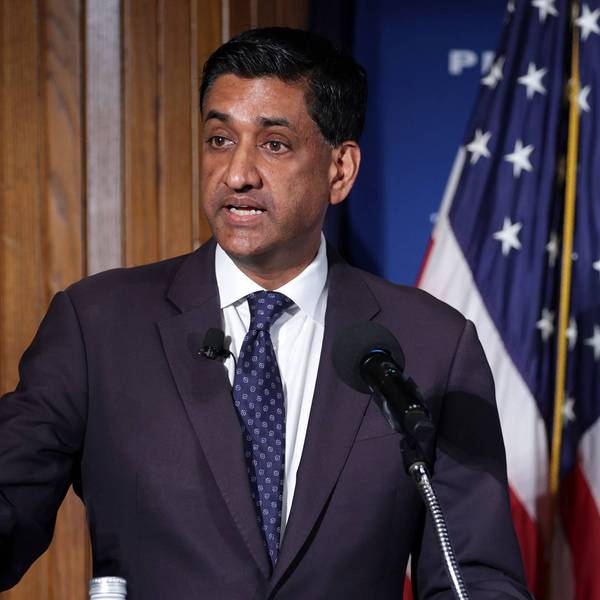
Rep. Ro Khanna (D-Calif.) speaks at a rally on July 20, 2021 in Washington, D.C. (Photo: Shannon Finney/Getty Images for Green New Deal Network)
Rep. Ro Khanna announced Sunday that he is teaming up with Democratic Sen. Richard Blumenthal on a bill to block all U.S. weapons sales to Saudi Arabia in response to Saudi-led OPEC's newly announced decision to slash oil production, driving up gas prices across the globe.
In an op-ed for Politico, Khanna (D-Calif.), Blumenthal (D-Conn.), and Yale School of Management professor Jeffrey Sonnenfeld argued that OPEC and Russia's move to cut oil production by two million barrels per day starting in November will "worsen global inflation, undermine successful efforts in the U.S. to bring down the price of gas, and help fuel Putin's unprovoked invasion of Ukraine."
"The Saudi decision was a pointed blow to the U.S., but the U.S. also has a way to respond: It can promptly pause the massive transfer of American warfare technology into the eager hands of the Saudis," the trio wrote. "That is why we are proposing bicameral legislation in the Senate and House on Tuesday that will immediately halt all U.S. arms sales to Saudi Arabia."
"For several years now, our colleagues have been considering similar proposals, but those measures haven't passed," they added. "Due to intense bipartisan blowback to Saudi's collusion with Russia, we think this time is different. Based on our conversation with colleagues, our legislation is already garnering bipartisan support in both chambers."
According to one estimate, the U.S. agreed to sell roughly $64.1 billion worth of weapons--averaging over $10 billion a year--to Saudi Arabia between 2015 and 2020.
Arms sales to the Saudis, the largest purchaser of U.S. weaponry, have continued under the Biden administration despite its pledges to end the war on Yemen and render the oil kingdom a "pariah" over its assassination of journalist Jamal Khashoggi in 2018.
In the wake of OPEC's announcement of a production cut aimed at propping up oil prices, calls for an end to U.S. arms sales to Saudi Arabia intensified, with Khanna and Sen. Bernie Sanders (I-Vt.) leading the chorus.
"We must end OPEC's illegal price-fixing cartel, eliminate military assistance to Saudi Arabia, and move aggressively to renewable energy," Sanders wrote in a social media post on Wednesday.
The Biden administration and Democratic leaders have said they're exploring a range of responses to OPEC's decision, but it's unclear whether an end to military assistance to the Saudis is actively being discussed at the highest levels.
In their op-ed on Sunday, Khanna, Blumenthal, and Sonnenfeld noted that some members of Congress are proposing "extending domestic antitrust laws to international commerce" while others are calling for the revival of "a GOP initiative to withdraw U.S. troops from Saudi Arabia."
"A simpler, far more urgent move to fortify U.S. national security would be to pause all U.S. military supplies, sales, and other weapons aid to Saudi Arabia," Khanna, Blumenthal, and Sonnenfeld argued. "This includes the controversial, new, and hastily planned Red Sands testing facilities in Saudi Arabia."
"U.S. military collaboration with the Saudi regime is more extensive than many realize, but that also gives the U.S. significant economic and security leverage over Riyadh," they added. "Today, Saudi Arabia is hugely dependent on U.S. defense assistance, purchasing the vast majority of its arms from the United States... Saudi can do little to respond to this proposed legislation other than come back to the table and negotiate with the U.S. in good faith."
Dear Common Dreams reader, It’s been nearly 30 years since I co-founded Common Dreams with my late wife, Lina Newhouser. We had the radical notion that journalism should serve the public good, not corporate profits. It was clear to us from the outset what it would take to build such a project. No paid advertisements. No corporate sponsors. No millionaire publisher telling us what to think or do. Many people said we wouldn't last a year, but we proved those doubters wrong. Together with a tremendous team of journalists and dedicated staff, we built an independent media outlet free from the constraints of profits and corporate control. Our mission has always been simple: To inform. To inspire. To ignite change for the common good. Building Common Dreams was not easy. Our survival was never guaranteed. When you take on the most powerful forces—Wall Street greed, fossil fuel industry destruction, Big Tech lobbyists, and uber-rich oligarchs who have spent billions upon billions rigging the economy and democracy in their favor—the only bulwark you have is supporters who believe in your work. But here’s the urgent message from me today. It's never been this bad out there. And it's never been this hard to keep us going. At the very moment Common Dreams is most needed, the threats we face are intensifying. We need your support now more than ever. We don't accept corporate advertising and never will. We don't have a paywall because we don't think people should be blocked from critical news based on their ability to pay. Everything we do is funded by the donations of readers like you. When everyone does the little they can afford, we are strong. But if that support retreats or dries up, so do we. Will you donate now to make sure Common Dreams not only survives but thrives? —Craig Brown, Co-founder |
Rep. Ro Khanna announced Sunday that he is teaming up with Democratic Sen. Richard Blumenthal on a bill to block all U.S. weapons sales to Saudi Arabia in response to Saudi-led OPEC's newly announced decision to slash oil production, driving up gas prices across the globe.
In an op-ed for Politico, Khanna (D-Calif.), Blumenthal (D-Conn.), and Yale School of Management professor Jeffrey Sonnenfeld argued that OPEC and Russia's move to cut oil production by two million barrels per day starting in November will "worsen global inflation, undermine successful efforts in the U.S. to bring down the price of gas, and help fuel Putin's unprovoked invasion of Ukraine."
"The Saudi decision was a pointed blow to the U.S., but the U.S. also has a way to respond: It can promptly pause the massive transfer of American warfare technology into the eager hands of the Saudis," the trio wrote. "That is why we are proposing bicameral legislation in the Senate and House on Tuesday that will immediately halt all U.S. arms sales to Saudi Arabia."
"For several years now, our colleagues have been considering similar proposals, but those measures haven't passed," they added. "Due to intense bipartisan blowback to Saudi's collusion with Russia, we think this time is different. Based on our conversation with colleagues, our legislation is already garnering bipartisan support in both chambers."
According to one estimate, the U.S. agreed to sell roughly $64.1 billion worth of weapons--averaging over $10 billion a year--to Saudi Arabia between 2015 and 2020.
Arms sales to the Saudis, the largest purchaser of U.S. weaponry, have continued under the Biden administration despite its pledges to end the war on Yemen and render the oil kingdom a "pariah" over its assassination of journalist Jamal Khashoggi in 2018.
In the wake of OPEC's announcement of a production cut aimed at propping up oil prices, calls for an end to U.S. arms sales to Saudi Arabia intensified, with Khanna and Sen. Bernie Sanders (I-Vt.) leading the chorus.
"We must end OPEC's illegal price-fixing cartel, eliminate military assistance to Saudi Arabia, and move aggressively to renewable energy," Sanders wrote in a social media post on Wednesday.
The Biden administration and Democratic leaders have said they're exploring a range of responses to OPEC's decision, but it's unclear whether an end to military assistance to the Saudis is actively being discussed at the highest levels.
In their op-ed on Sunday, Khanna, Blumenthal, and Sonnenfeld noted that some members of Congress are proposing "extending domestic antitrust laws to international commerce" while others are calling for the revival of "a GOP initiative to withdraw U.S. troops from Saudi Arabia."
"A simpler, far more urgent move to fortify U.S. national security would be to pause all U.S. military supplies, sales, and other weapons aid to Saudi Arabia," Khanna, Blumenthal, and Sonnenfeld argued. "This includes the controversial, new, and hastily planned Red Sands testing facilities in Saudi Arabia."
"U.S. military collaboration with the Saudi regime is more extensive than many realize, but that also gives the U.S. significant economic and security leverage over Riyadh," they added. "Today, Saudi Arabia is hugely dependent on U.S. defense assistance, purchasing the vast majority of its arms from the United States... Saudi can do little to respond to this proposed legislation other than come back to the table and negotiate with the U.S. in good faith."
Rep. Ro Khanna announced Sunday that he is teaming up with Democratic Sen. Richard Blumenthal on a bill to block all U.S. weapons sales to Saudi Arabia in response to Saudi-led OPEC's newly announced decision to slash oil production, driving up gas prices across the globe.
In an op-ed for Politico, Khanna (D-Calif.), Blumenthal (D-Conn.), and Yale School of Management professor Jeffrey Sonnenfeld argued that OPEC and Russia's move to cut oil production by two million barrels per day starting in November will "worsen global inflation, undermine successful efforts in the U.S. to bring down the price of gas, and help fuel Putin's unprovoked invasion of Ukraine."
"The Saudi decision was a pointed blow to the U.S., but the U.S. also has a way to respond: It can promptly pause the massive transfer of American warfare technology into the eager hands of the Saudis," the trio wrote. "That is why we are proposing bicameral legislation in the Senate and House on Tuesday that will immediately halt all U.S. arms sales to Saudi Arabia."
"For several years now, our colleagues have been considering similar proposals, but those measures haven't passed," they added. "Due to intense bipartisan blowback to Saudi's collusion with Russia, we think this time is different. Based on our conversation with colleagues, our legislation is already garnering bipartisan support in both chambers."
According to one estimate, the U.S. agreed to sell roughly $64.1 billion worth of weapons--averaging over $10 billion a year--to Saudi Arabia between 2015 and 2020.
Arms sales to the Saudis, the largest purchaser of U.S. weaponry, have continued under the Biden administration despite its pledges to end the war on Yemen and render the oil kingdom a "pariah" over its assassination of journalist Jamal Khashoggi in 2018.
In the wake of OPEC's announcement of a production cut aimed at propping up oil prices, calls for an end to U.S. arms sales to Saudi Arabia intensified, with Khanna and Sen. Bernie Sanders (I-Vt.) leading the chorus.
"We must end OPEC's illegal price-fixing cartel, eliminate military assistance to Saudi Arabia, and move aggressively to renewable energy," Sanders wrote in a social media post on Wednesday.
The Biden administration and Democratic leaders have said they're exploring a range of responses to OPEC's decision, but it's unclear whether an end to military assistance to the Saudis is actively being discussed at the highest levels.
In their op-ed on Sunday, Khanna, Blumenthal, and Sonnenfeld noted that some members of Congress are proposing "extending domestic antitrust laws to international commerce" while others are calling for the revival of "a GOP initiative to withdraw U.S. troops from Saudi Arabia."
"A simpler, far more urgent move to fortify U.S. national security would be to pause all U.S. military supplies, sales, and other weapons aid to Saudi Arabia," Khanna, Blumenthal, and Sonnenfeld argued. "This includes the controversial, new, and hastily planned Red Sands testing facilities in Saudi Arabia."
"U.S. military collaboration with the Saudi regime is more extensive than many realize, but that also gives the U.S. significant economic and security leverage over Riyadh," they added. "Today, Saudi Arabia is hugely dependent on U.S. defense assistance, purchasing the vast majority of its arms from the United States... Saudi can do little to respond to this proposed legislation other than come back to the table and negotiate with the U.S. in good faith."