SUBSCRIBE TO OUR FREE NEWSLETTER
Daily news & progressive opinion—funded by the people, not the corporations—delivered straight to your inbox.
5
#000000
#FFFFFF
To donate by check, phone, or other method, see our More Ways to Give page.
Daily news & progressive opinion—funded by the people, not the corporations—delivered straight to your inbox.
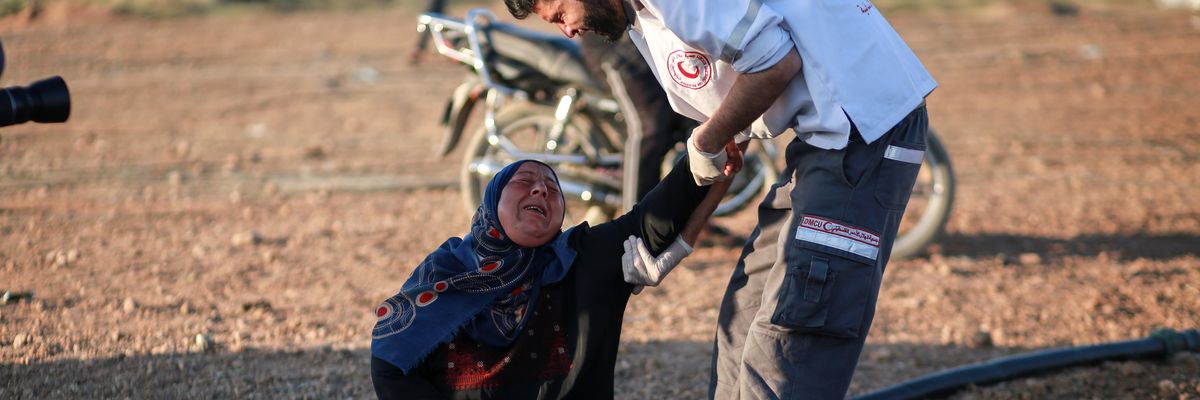
This photograph, taken by a freelancer recently terminated by The New York Times, shows a paramedic attending to a woman injured by Israeli forces during a protest along the border with Israel, east of Gaza City, on April 1, 2018. (Photo: Hosam Salem/NurPhoto via Getty Images)
Hosam Salem, a Palestinian freelance journalist and photographer, said Wednesday that The New York Times terminated his contract over social media posts in which he "expressed support for the Palestinian resistance against the Israeli occupation."
"After years of covering the Gaza Strip as a freelance photojournalist for The New York Times, I was informed via an abrupt phone call from the U.S. outlet that they will no longer work with me in the future," Salem wrote on Twitter. "I began working with the newspaper in 2018, covering critical events in Gaza such as the weekly protests at the border fence with Israel, the investigation into the Israeli killing of field nurse Razan al-Najjar, and more recently, the May 2021 Israeli offensive on the Gaza Strip."
Salem explained that he was eventually informed that "the decision was made based on a report prepared by a Dutch editor--who obtained Israeli citizenship two years ago--for a website called Honest Reporting."
According to Salem:
The article, [on] which The New York Times had based its decision for dismissing me, gives examples of posts I wrote on my social media accounts, namely Facebook, where I had expressed support for the Palestinian resistance against the Israeli occupation.
My aforementioned posts also spoke of the resilience of my people and those who were killed by the Israeli army--my cousin included--which Honest Reporting described as "Palestinian terrorists."
The editor later wrote an article stating that he had succeeded in sacking three Palestinian journalists working for The New York Times in the Gaza Strip, on the basis of us being "anti-Semitic."
"Not only has Honest Reporting succeeded in terminating my contract with The New York Times," said Salem. "It has also actively discouraged other international news agencies from collaborating with me and my two colleagues."
"What is taking place," he added, "is a systematic effort to distort the image of Palestinian journalists as being incapable of trustworthiness and integrity, simply because we cover the human rights violations that the Palestinian people undergo on a daily basis at hands of the Israeli army."
As Philip Weiss noted Wednesday in Mondoweiss, Salem's case "stands in stark contrast to the three Jewish reporters, Ethan Bronner, Isabel Kershner, and David Brooks, who carried on writing about the issue for The New York Times even when their children were enlisted in the Israeli Defense Forces."
"The Times executive editor in 2010 overruled the public editor's recommendation that Bronner be removed from the post of Jerusalem bureau chief," Weiss pointed out, "saying that those who questioned his bias should not 'be allowed to deny the rest of our audience the highest quality of reporting.'"
"This is an important case because it shows the impossibility of even representing the Palestinian voice in the Western media," Weiss continued. "There is widespread support for armed resistance to Israeli occupation among Palestinians. Sorting out journalists who have not expressed such views at some time is something like looking for Palestinian reporters who support Zionism."
News of Salem's termination comes just days after progressive commentator Katie Halper was dismissed by The Hill for defending U.S. Rep. Rashida Tlaib's (D-Mich.) characterization of Israel as an apartheid regime--a label that numerous human rights organizations have used to describe the government's violent oppression of Palestinians.
Dear Common Dreams reader, It’s been nearly 30 years since I co-founded Common Dreams with my late wife, Lina Newhouser. We had the radical notion that journalism should serve the public good, not corporate profits. It was clear to us from the outset what it would take to build such a project. No paid advertisements. No corporate sponsors. No millionaire publisher telling us what to think or do. Many people said we wouldn't last a year, but we proved those doubters wrong. Together with a tremendous team of journalists and dedicated staff, we built an independent media outlet free from the constraints of profits and corporate control. Our mission has always been simple: To inform. To inspire. To ignite change for the common good. Building Common Dreams was not easy. Our survival was never guaranteed. When you take on the most powerful forces—Wall Street greed, fossil fuel industry destruction, Big Tech lobbyists, and uber-rich oligarchs who have spent billions upon billions rigging the economy and democracy in their favor—the only bulwark you have is supporters who believe in your work. But here’s the urgent message from me today. It's never been this bad out there. And it's never been this hard to keep us going. At the very moment Common Dreams is most needed, the threats we face are intensifying. We need your support now more than ever. We don't accept corporate advertising and never will. We don't have a paywall because we don't think people should be blocked from critical news based on their ability to pay. Everything we do is funded by the donations of readers like you. When everyone does the little they can afford, we are strong. But if that support retreats or dries up, so do we. Will you donate now to make sure Common Dreams not only survives but thrives? —Craig Brown, Co-founder |
Hosam Salem, a Palestinian freelance journalist and photographer, said Wednesday that The New York Times terminated his contract over social media posts in which he "expressed support for the Palestinian resistance against the Israeli occupation."
"After years of covering the Gaza Strip as a freelance photojournalist for The New York Times, I was informed via an abrupt phone call from the U.S. outlet that they will no longer work with me in the future," Salem wrote on Twitter. "I began working with the newspaper in 2018, covering critical events in Gaza such as the weekly protests at the border fence with Israel, the investigation into the Israeli killing of field nurse Razan al-Najjar, and more recently, the May 2021 Israeli offensive on the Gaza Strip."
Salem explained that he was eventually informed that "the decision was made based on a report prepared by a Dutch editor--who obtained Israeli citizenship two years ago--for a website called Honest Reporting."
According to Salem:
The article, [on] which The New York Times had based its decision for dismissing me, gives examples of posts I wrote on my social media accounts, namely Facebook, where I had expressed support for the Palestinian resistance against the Israeli occupation.
My aforementioned posts also spoke of the resilience of my people and those who were killed by the Israeli army--my cousin included--which Honest Reporting described as "Palestinian terrorists."
The editor later wrote an article stating that he had succeeded in sacking three Palestinian journalists working for The New York Times in the Gaza Strip, on the basis of us being "anti-Semitic."
"Not only has Honest Reporting succeeded in terminating my contract with The New York Times," said Salem. "It has also actively discouraged other international news agencies from collaborating with me and my two colleagues."
"What is taking place," he added, "is a systematic effort to distort the image of Palestinian journalists as being incapable of trustworthiness and integrity, simply because we cover the human rights violations that the Palestinian people undergo on a daily basis at hands of the Israeli army."
As Philip Weiss noted Wednesday in Mondoweiss, Salem's case "stands in stark contrast to the three Jewish reporters, Ethan Bronner, Isabel Kershner, and David Brooks, who carried on writing about the issue for The New York Times even when their children were enlisted in the Israeli Defense Forces."
"The Times executive editor in 2010 overruled the public editor's recommendation that Bronner be removed from the post of Jerusalem bureau chief," Weiss pointed out, "saying that those who questioned his bias should not 'be allowed to deny the rest of our audience the highest quality of reporting.'"
"This is an important case because it shows the impossibility of even representing the Palestinian voice in the Western media," Weiss continued. "There is widespread support for armed resistance to Israeli occupation among Palestinians. Sorting out journalists who have not expressed such views at some time is something like looking for Palestinian reporters who support Zionism."
News of Salem's termination comes just days after progressive commentator Katie Halper was dismissed by The Hill for defending U.S. Rep. Rashida Tlaib's (D-Mich.) characterization of Israel as an apartheid regime--a label that numerous human rights organizations have used to describe the government's violent oppression of Palestinians.
Hosam Salem, a Palestinian freelance journalist and photographer, said Wednesday that The New York Times terminated his contract over social media posts in which he "expressed support for the Palestinian resistance against the Israeli occupation."
"After years of covering the Gaza Strip as a freelance photojournalist for The New York Times, I was informed via an abrupt phone call from the U.S. outlet that they will no longer work with me in the future," Salem wrote on Twitter. "I began working with the newspaper in 2018, covering critical events in Gaza such as the weekly protests at the border fence with Israel, the investigation into the Israeli killing of field nurse Razan al-Najjar, and more recently, the May 2021 Israeli offensive on the Gaza Strip."
Salem explained that he was eventually informed that "the decision was made based on a report prepared by a Dutch editor--who obtained Israeli citizenship two years ago--for a website called Honest Reporting."
According to Salem:
The article, [on] which The New York Times had based its decision for dismissing me, gives examples of posts I wrote on my social media accounts, namely Facebook, where I had expressed support for the Palestinian resistance against the Israeli occupation.
My aforementioned posts also spoke of the resilience of my people and those who were killed by the Israeli army--my cousin included--which Honest Reporting described as "Palestinian terrorists."
The editor later wrote an article stating that he had succeeded in sacking three Palestinian journalists working for The New York Times in the Gaza Strip, on the basis of us being "anti-Semitic."
"Not only has Honest Reporting succeeded in terminating my contract with The New York Times," said Salem. "It has also actively discouraged other international news agencies from collaborating with me and my two colleagues."
"What is taking place," he added, "is a systematic effort to distort the image of Palestinian journalists as being incapable of trustworthiness and integrity, simply because we cover the human rights violations that the Palestinian people undergo on a daily basis at hands of the Israeli army."
As Philip Weiss noted Wednesday in Mondoweiss, Salem's case "stands in stark contrast to the three Jewish reporters, Ethan Bronner, Isabel Kershner, and David Brooks, who carried on writing about the issue for The New York Times even when their children were enlisted in the Israeli Defense Forces."
"The Times executive editor in 2010 overruled the public editor's recommendation that Bronner be removed from the post of Jerusalem bureau chief," Weiss pointed out, "saying that those who questioned his bias should not 'be allowed to deny the rest of our audience the highest quality of reporting.'"
"This is an important case because it shows the impossibility of even representing the Palestinian voice in the Western media," Weiss continued. "There is widespread support for armed resistance to Israeli occupation among Palestinians. Sorting out journalists who have not expressed such views at some time is something like looking for Palestinian reporters who support Zionism."
News of Salem's termination comes just days after progressive commentator Katie Halper was dismissed by The Hill for defending U.S. Rep. Rashida Tlaib's (D-Mich.) characterization of Israel as an apartheid regime--a label that numerous human rights organizations have used to describe the government's violent oppression of Palestinians.